
Comparing active vs. passive ETFs: Finding the right fit for your portfolio
- Passive ETFs seek to track an index, providing disciplined market exposure that’s typically cost-efficient, transparent, and broadly diversified with minimal ongoing management.
- Active ETFs rely on portfolio managers to make investment decisions, providing flexible exposure that can adapt to changing market conditions and pursue specific investment objectives.
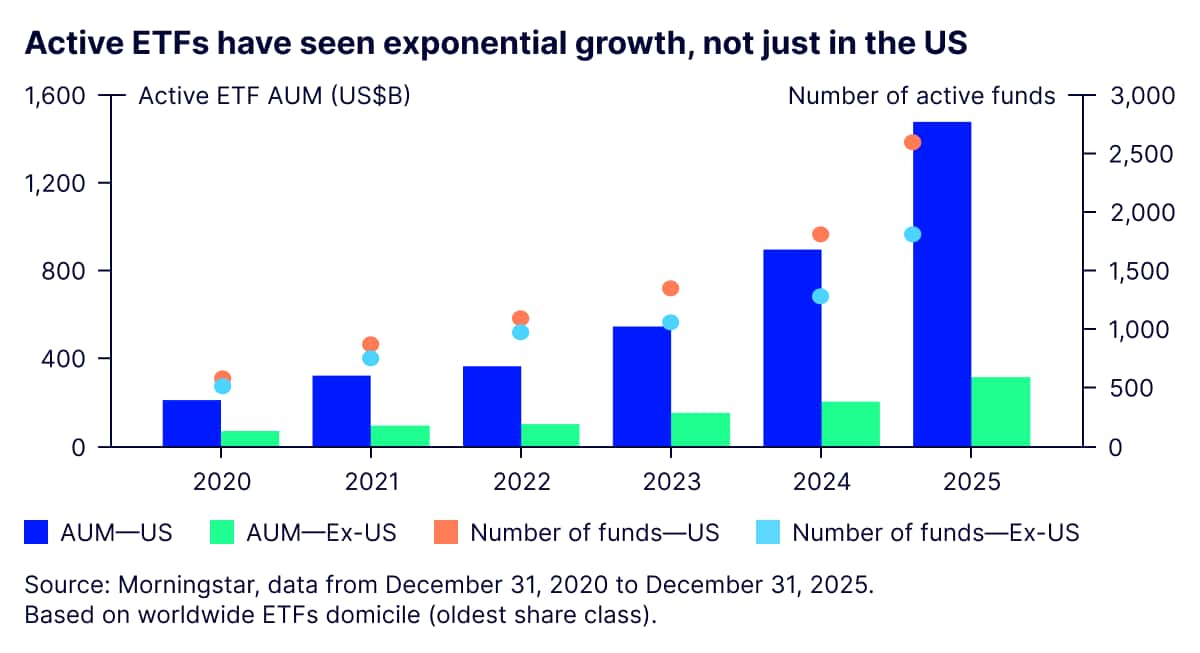
- There’s a growing appetite for active ETFs. US-domiciled active ETF assets have reached approximately $1.9 trillion in 2026, reflecting a 45% compound annual growth rate (CAGR) over the past five years.1
Early ETFs started out with a simple goal: give investors easy, low-cost access to markets by passively tracking an index. And they aced that test with flying colors. Today, not all ETFs are passive—some use active management, where portfolio managers make active investment decisions.
Both approaches have their place in a portfolio—the question is, which one fits your goals?
What are active ETFs?
Many passive ETFs track an index, like the S&P 500®, and typically update their holdings as the index changes. Active ETFs take a different approach. They’re run by portfolio managers who decide what to buy, hold, or sell with a particular objective in mind—like managing risk, outperforming a benchmark index, or targeting specific outcomes.
Think of it like cooking. A passive ETF is like a ready-to-cook meal kit: everything is pre-measured, and you follow the recipe exactly as written. An active ETF is like a professional chef making adjustments along the way: they tinker with the ingredients, season to taste, and add personal touches—all in an effort to elevate the final dish beyond the standard recipe.
It’s safe to say more and more investors want that *chef’s kiss* personal touch. Despite representing only 10% of US-domiciled ETF assets, active ETFs captured approximately 33% of total flows over the past 12 months.2
In addition, active ETFs’ five-year compound annual growth rate (CAGR) of 45% is nearly three times the rate for passive ETFs (Figure 1). And over those last five years, cumulative flows into active ETFs (+$1.3 trillion) totaled nearly 437% of start-of-period assets ($308 billion) versus a modest but still impressive 61% for passive ETFs.3
Benefits of active ETFs
Active ETFs go beyond simply following a recipe. With a professional “chef” managing the portfolio, they can adjust in ways passive ETFs can’t.
What are the benefits of this approach?
- Potential for outperformance: Active involvement opens the door to alpha (above-market returns) by leaning into attractive opportunities or avoiding potential weak spots.
- Risk management: Portfolio managers can dial exposure up or down in response to volatility, interest rate changes, sector-specific headwinds, or other market curveballs.
- Flexibility: Managers aren’t bound to hold every stock in an index. They can swap out positions, tweak weightings, and/or focus on companies that best align with certain themes or goals.
- Liquidity: Like passive ETFs, active ETFs trade throughout the day on exchanges, so investors can enter or exit positions quickly.
- Tax efficiency: Unlike traditional mutual funds, active strategies using the ETF structure can minimize taxable capital gain distributions.
- Expertise access: Active ETFs combine professional research, analysis, and oversight into a transparent wrapper.
What's fueling the growth of active ETFs?
Active ETFs are gaining attention from investors across the globe. Explore the factors driving adoption and how they’re shaping the next chapter of investing.
Risks of active ETFs
Of course, handing the recipe to a chef and letting them improvise doesn’t guarantee the meal will be better. There are trade-offs with active ETFs that investors must consider.
- Higher fees: Active ETFs may charge more than passive ETFs, since you’re paying for professional management and research. Those fees can eat into returns, especially if the fund’s performance falls short of expectations or doesn’t offset the added cost of an alternative.
- Uncertain performance: Unlike index-tracking ETFs, which seek to mirror their benchmark, active ETFs can outperform or underperform their benchmark depending on the skill of the manager and market conditions.
- Less predictability: Portfolio holdings may change more often, which can make it harder to know exactly what you own at any given time.
- Complex strategies: Some active ETFs use derivatives, options, or other advanced strategies that can be more difficult to follow.
- Limited track records: Depending on the ETF, the portfolio manager and fund may not have long performance histories to evaluate compared to passive ETFs.
What are passive ETFs?
Passive ETFs are the original blueprint. They’re designed to track the performance of an index, like the S&P 500, Dow Jones Industrial Average, or Russell 1000. But unlike active ETFs, which typically have unique goals, passive ETFs simply aim to match the returns of their benchmark as closely as possible, typically at the lowest cost possible.
While interest in active management is gaining ground, passive funds still rule the roost. In the US, passive ETFs account for 87% of ETF assets under management (AUM).4
Benefits of passive ETFs
Passive ETFs are popular for good reason: they offer straightforward, low-cost access to broad market exposure. For investors who want simplicity and more predictability, they check a lot of boxes.
- Lower costs: Since passive ETFs follow an index, they don’t need the same level of research or active decision-making as managed funds—often translating into significantly lower fees.
- Broad diversification: A single passive ETF can provide exposure to hundreds or even thousands of securities, spreading risk across sectors, asset classes, or regions.
- Transparency: Most index-tracking ETFs publish their holdings each day, so you can see what you own at any given time.
- Consistency: Passive ETFs mirror their underlying index. While you won’t beat the market, you also don’t run the risk of the market beating you.
- Tax efficiency: The ETF structure is tax-friendly, and the low turnover of passive funds helps minimize costs and capital gains distributions.
Limitations of passive ETFs
Meal kits are convenient and cost-effective. But if you always follow the same recipe, you might miss opportunities to adapt when conditions—or taste buds—change.
- Unlikely to beat the market: Index-tracking funds won’t outperform the underlying index, especially after fees and taxes.
- Limited flexibility: Passive ETFs don’t adapt to market conditions. If a sector in the index is struggling, the ETF still holds those stocks until the index changes.
- Concentration risk: Some indexes are heavily weighted towards a handful of large companies or sectors—and that concentration carries through to the ETF.
How active vs. passive ETFs compare
Active and passive ETFs share the same ETF wrapper. But their approaches differ in important ways.
In short, passive ETFs are built for consistency and cost efficiency, while active ETFs are built for flexibility and the noble pursuit of index outperformance. Which is better depends on your goals, risk tolerance, and how hands-on you want your portfolio to be.
Figure 2: Key characteristics of active vs. passive ETFs
| Active ETFs | Passive ETFs | |
| Fees | Usually higher, since you’re paying for professional management and research. | Usually lower, because they simply track an index. |
| Transparency | High, though holdings may change more often. | Very high, holdings closely mirror a published index. |
| Tax efficiency | Typically tax-efficient thanks to the ETF structure, but trading can create more turnover. | Typically very tax-efficient thanks to ETF structure and low turnover. |
| Alpha potential | Possible, since managers can actively try to outperform. Has the potential to underperform as a result. | No, since they’re designed to match an index. Unlikely to underperform as a result. |
| Best fit | Investors who want professional oversight and targeted strategies. | Investors who want low-cost, broad exposure. |
Using active ETFs in today’s market
Markets aren’t linear. Economic productivity, inflation, interest rates, geopolitics, conflicts, technological advancement—all of these factors brew a potent batch of ongoing uncertainty. Active ETFs can help investors adapt, with professional managers making adjustments as conditions change—like a chef refining a dish in real time.
What might that look like in practice?
Resilience across cycles: An investor wants a portfolio that can weather different market conditions, whether the economy is growing or contracting. There are active ETFs for that. An active strategy can target quality companies with strong balance sheets or defensive sectors that tend to historically outperform during downturns.
Rotating with market leaders: Some investors want to capture upside by prioritizing whichever sectors are anticipated to lead the market at any given point in the economic cycle. There are active ETFs for that. Active managers can rotate exposures, overweighting sectors that are best positioned to outperform and underweighting laggards based on the current environment.
Investing in the future: Many investors have an eye on the horizon and want to position their portfolios for structural change and major opportunities. The digital asset ecosystem is a prime example. Plot twist: There are active ETFs for that, too. An active strategy allows managers to add exposure to new companies or trends as they emerge, without waiting for an index to update periodically.
No matter your approach, give ETFs an apron and put them to work
Chances are, you don’t eat prepackaged meals every night. And you likely don’t shell out for a private chef every night, either. The same goes for ETFs. It’s really not active versus passive—they can coexist.
Whether you lean passive, active, or a mix of both, consider:
- Your goals: Are you looking for broad, low-cost exposure? Or do you want adaptable, targeted strategies?
- Your mix: Many investors use passive ETFs as a “core” holding, then add active ETFs for specific objectives like alpha, risk management, income, and other “satellite” strategies.
- Your timing: While you can buy and sell ETFs anytime the market is open, the decision of what to invest in should match your long-term plans.