
Three reasons to implement a sector strategy
Sector strategies can help strengthen the core of your portfolio by focusing on strong-performing sectors, while reducing company-specific risk to diversify portfolios. They also can help reposition your portfolio in response to shifting business cycles, secular trends, or technological changes.
When people invest in the stock market, they often start in one of two ways.
Some investors choose a broad market approach, such as investing in an S&P 500® fund. This means owning hundreds of the largest US companies at once, spread across many industries. It’s a simple way to get diversified exposure to the overall market.
Other investors take a more hands-on approach and invest in individual stocks, choosing specific companies they believe may perform well over time.
Sector investing sits in between these two approaches.
Rather than owning every stock in the market—or trying to pick just a few companies—sector investing focuses on groups of companies that operate in the same part of the economy, such as Technology, Health Care, Financials, or Energy. These groups are called sectors.
By investing in a sector, you can gain exposure to an entire area of the economy without needing to decide which single company will win.
Sector investing can be a cost-efficient and powerful way to build and manage your portfolio. Since economic conditions and business cycles impact segments of the economy differently, sector-based investment strategies may help you:
- Target potential growth opportunities across different market sectors
- Diversify to reduce concentration or company-specific risk
- Reposition for business cycle changes and secular trends
1. Target potential growth opportunities across different market sectors
As business cycles and secular trends shift, you have the opportunity to enhance potential returns by gaining exposure to sectors that are outperforming the broader market.
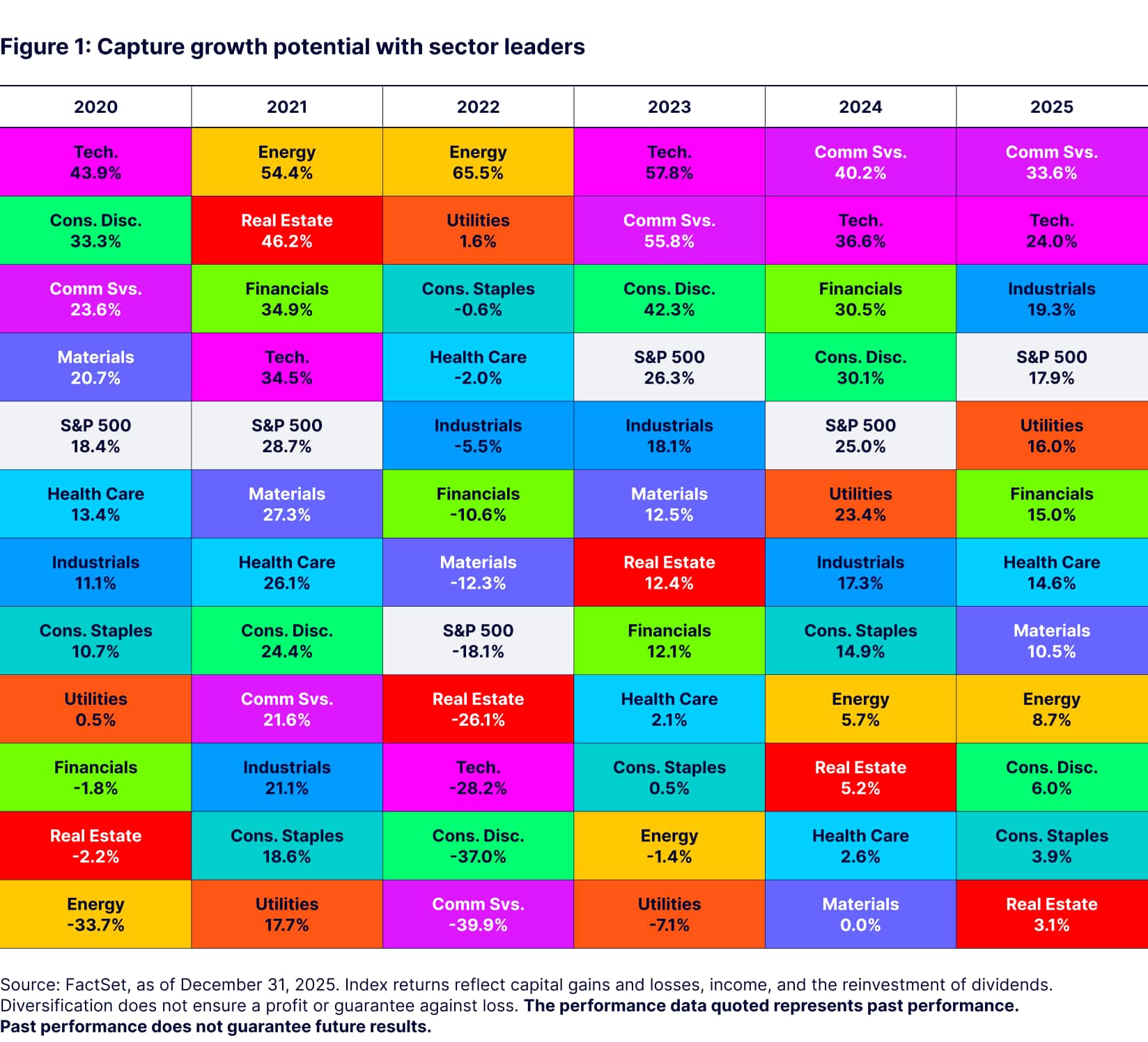
Over the past decade, the difference in returns across sectors—such as Technology, Health Care, or Energy—has been more than twice as wide as traditional investment styles like Growth, Value, or Size.1
While this wider range means more variability in potential returns, it also can create more opportunity (Figure 1). By increasing your exposure to sectors with stronger return potential and reducing exposure to weaker ones, you can use this return variability to your portfolio’s advantage.
2. Diversify to reduce concentration or company-specific risk
Picking individual stocks can be difficult due to the large number of choices and the unpredictable risks tied to each company. Sector investing can help you gain the exposure you want without relying too heavily on a few individual stocks.
For example, instead of choosing one or two utility companies that may benefit from rising energy demand and the rapid build-out of power intensive AI data centers, you can invest in the Utilities sector as a whole. This approach can provide broader exposure to the sector’s growth trends—from electrification and renewable energy producers to companies that represent the “picks and shovels” of the AI-related data center buildout—while also reducing company-specific risk.
And that’s helpful, because identifying which companies will outperform within a sector isn’t easy. Over the past 20 years, more stocks (34%) have underperformed their respective sector average by more than 10% than have outperformed (29%) by more than 10% (Figure 2). This highlights how challenging stock selection can be and why broader sector exposure can be useful.
3. Reposition for business cyclical changes or secular trends
Economic activity is broadly categorized into four different cycles: expansion, slowdown, recession, and recovery. Each phase typically brings about changes—in interest rates, inflation, consumer spending, and business investment—as the economy moves through these cycles. These changes can impact sectors and the underlying companies differently, meaning specific sectors may outperform or underperform during different phases.
With sector-based strategies, you can align your portfolio with business cycles by increasing allocations to sectors that are favored by the current economic conditions and reducing allocations to sectors facing headwinds (Figure 3).
Figure 3: Capture sector opportunities with business cycle shifts
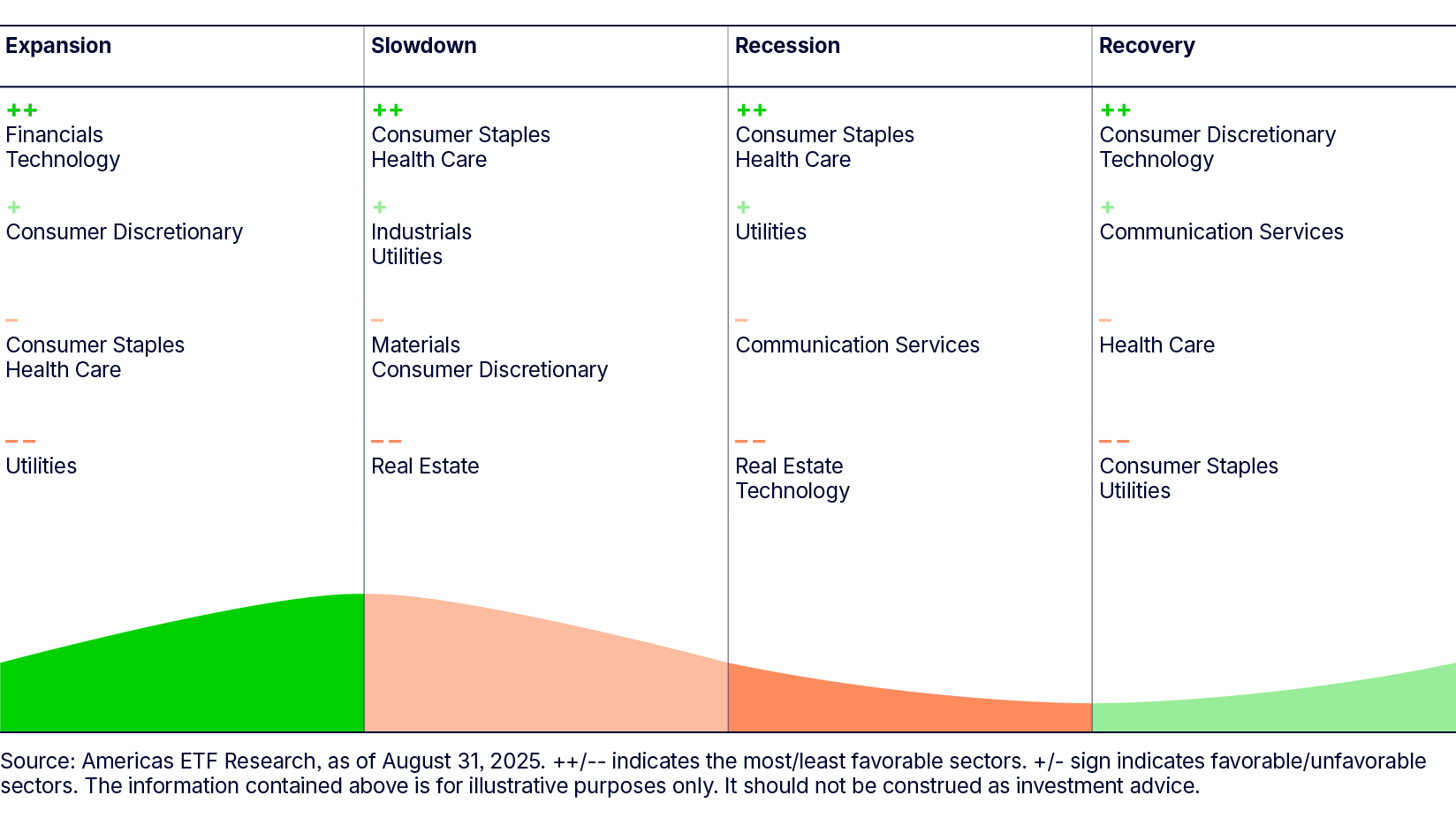
For example, in an economic recovery phase, improvement in the labor market and consumer confidence leads to increases in discretionary spending for restaurants, travel, and durable goods, benefiting Consumer Discretionary sectors. On the other hand, Consumer Staples (which focus more on needs-based items like food) may become less attractive as investors shift toward growth-oriented sectors.
Also, sector-based strategies can help you capture long-term growth opportunities. Since the launch of ChatGPT in November 2022, Generative AI technology has had a significant impact on how users access information and consume and interact with digital content. Leading AI innovation and adoption, large Communication Services companies, such as Alphabet, Meta, and Netflix have benefited from AI-driven operational efficiency gains—from automated content generation and scalable personalization to advertising campaign optimization.
As a result, the sector’s earnings growth ranked in the top two for three consecutive years between 2023 and 2025,2 and it was the best performing sector over the same time period, outperforming the broad market by 20% on an annualized basis (Figure 4).3
Consider ETFs for cost-effective, precise exposure to sectors
Sector ETFs provide a cost-effective and diversified way to strengthen your portfolio by offering broad exposure to potential growth opportunities, while helping reduce the costs and risks associated with picking individual stocks. They allow you to implement both simple and sophisticated sector strategies—whether technical, fundamental, or macro-driven—with precision.
State Street launched the first sector suite in 1998. Today, the State Street® Sector SPDR® ETF suite covers all 11 GICS® sectors and is the largest suite by AUM with assets of $338 billion as of December 31, 2025.4 The suite also boasts the lowest expense ratios, tightest spreads, and highest options volume for those seeking liquidity and option income generating strategies.5

Build your portfolio with sector ETFs
Target sector trends and trade with confidence. Invest where you see opportunity with State Street® Sector SPDR® ETFs.