
USD rebounds to neutral
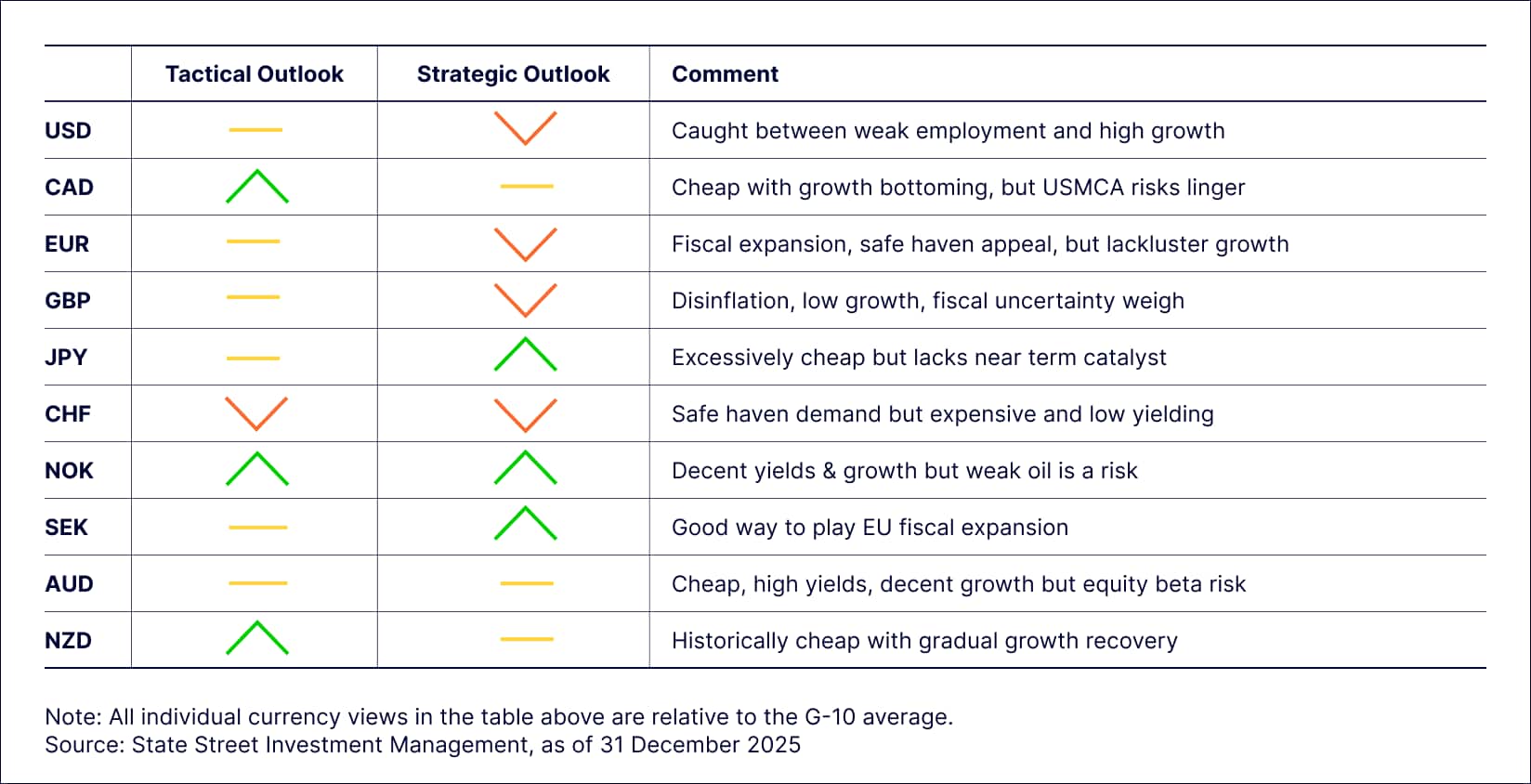
After last month’s weakness on softer data and Fed cuts, the US dollar steadies and returns to a neutral outlook. We also turn tactically neutral on EUR, GBP, and JPY, while shifting to a positive view on NZD, supported by recent improvements in both consumer and business sentiment.

Over the next one to two months, we expect relative economic conditions and monetary policy trajectories to drive currency markets. For the US dollar, this is likely to translate into a neutral to slightly positive bias, supported by expectations of a stabilizing labor market and still‑resilient inflation.
We are stepping back from last month’s bullish view on the yen. While the currency remains fundamentally undervalued on medium‑ to long‑term metrics, both relative to interest‑rate differentials and Purchasing Power Parity (PPP) fair value, there is limited visibility on near‑term catalysts. Recent softness in headline inflation, persistent fiscal concerns, and a notably patient Bank of Japan reduce the likelihood of that value unlocking soon.
The outlook for the Australian dollar has improved meaningfully, supported by the US–China trade truce, firmer inflation, strong home‑price gains, resilient industrial‑metal prices, solid labor‑market conditions, and steady consumer spending.The Norwegian krone also screens well, backed by its G10‑leading 4% yield and a run of positive surprises in both growth and inflation. Our caution for both Australian dollar and Norwegian krone long positions is their vulnerability to equity‑market drawdowns, as well as krone’s additional sensitivity to weaker oil prices.
The Canadian dollar similarly ranks high on our scorecards and has been out of favor for some time, even as labor markets rebound and growth data stabilizes. However, the ongoing United States–Mexico–Canada Agreement (USMCA) (referred to as CUSMA in Canada) is likely to involve tough US negotiating tactics. The associated uncertainty should continue to weigh on both the Canadian economy and the Canadian dollar.
The British pound appears vulnerable as fiscal austerity, soft labor‑market conditions, and renewed disinflation increase the likelihood of more rapid Bank of England policy easing. These dynamics point to additional pound weakness through 2026.
Figure 2: January 2026 directional outlook
The Swiss franc is struggling under the weight of near‑zero inflation, zero interest rates, and elevated tariff levels. The Swiss National Bank is likely to rely on periodic currency intervention to prevent further downside in the franc.
The euro is on relatively firmer footing and should hold up better during an equity‑market correction. However, underlying growth remains sluggish, and there is considerable uncertainty around both the speed and effectiveness of prospective German fiscal stimulus. As a result, we expect the euro to struggle to break meaningfully higher over the next one to two months.
Over the longer term, we favor short US dollar positions against currencies that combine positive net international investment positions, strong fiscal and monetary flexibility, and historically attractive valuations versus the dollar. On these criteria, the Japanese yen, Swedish krona, and Norwegian krone stand out as the most compelling potential outperformers.
The Australian dollar, euro, Canadian dollar, and British pound should also post solid gains against the US dollar over time, broadly in that order.
In contrast, the Swiss franc is most at risk of underperforming the US dollar, particularly on a total‑return basis once the franc’s negative interest‑rate carry is taken into account.
US dollar (USD)
The US dollar has been trending lower since late November, driven by a weaker labor market, softer‑than‑expected inflation, and the resulting Federal Reserve (Fed) rate cuts. However, we see limits to further near‑term weakness. The Fed is likely to pause for a meeting or two—potentially longer—after front‑loading easing.
.Third‑quarter gross domestic product (GDP) surprised to the upside at 4.3%, and while the unemployment rate has risen to a four‑year high of 4.6%, it is expected to stabilize and improve modestly. The first half of 2026 is set to deliver meaningful fiscal stimulus alongside ongoing AI‑related capital expenditures and resilient consumer spending. In that environment, we do not anticipate a steady, directional sell‑off in the dollar.
Instead, unless labor‑market conditions deteriorate materially from here, the broad US dollar index is likely to remain within the trading range that has prevailed since June of last year. With the index currently near the lower end of that range, we should be prepared for upside surprises in the coming months, particularly if the hiring slowdown seen during the second half of 2025 proves partly transitory, reflecting firms’ cost‑right‑sizing in response to higher tariff expenses.
We retain our call for a multi‑year US dollar bear market, one in which the currency loses at least 15% over the next two to four years. The United States will remain a strong destination for capital investment, supported by innovative companies and dynamic, flexible labor and capital markets. However, we expect the degree of US economic outperformance to be materially smaller, and the reliability of the US dollar as a safe‑haven asset to be materially weaker, over the next ten to fifteen years compared with the previous decade and a half.
According to the Bureau of Economic Analysis, the US net international investment position data shows that non‑US investors hold more than USD 33 trillion in US portfolio investments and over USD 62 trillion in total US assets excluding financial derivatives. Even a modest 10% increase in average USD hedge ratios would imply over USD 3 trillion in dollar selling. This alone is sufficient to sustain a prolonged US dollar bear market, even if the United States continues to rank among the stronger‑performing global economies.
Canadian dollar (CAD)
We are constructive on the Canadian dollar, supported by improved commodity prices, strong local equity‑market performance, and a material strengthening in the labor market. It is encouraging to see signs of growth stabilization, particularly the three consecutive strong employment reports.
We also expect that the cumulative impact of easing the policy rate from 5% to 2.25% over the past 18 months will begin to provide more meaningful support to the economy. In addition, we are watching closely for fiscal investment initiatives and targeted support for tariff‑impacted sectors in the upcoming government budget, which could further underpin economic stabilization and a potential recovery.
That said, we see limited near‑term upside now that USD/CAD has fallen toward 1.37, given the upcoming renegotiation of the United States–Mexico–Canada Agreement (USMCA, referred to as CUSMA in Canada). We expect the risk of threats and tough negotiating tactics from the US to keep the Canadian dollar on the back foot, as heightened uncertainty could weaken both consumer and business sentiment, threaten growth, and increase the likelihood of further interest‑rate cuts.
On the positive side, the relatively quiet and orderly start to the renegotiation process over the past couple of months has been somewhat reassuring.
We are more constructive on the Canadian dollar over the medium term. The currency screens as cheap on our long‑run fair‑value measures. We see the North American tariff dispute ultimately culminating in a renegotiated USMCA (referred to as CUSMA in Canada) that largely preserves the region’s favorable relative tariff structure versus the rest of the world.
Canada also has greater scope for rapid monetary and fiscal stimulus than the United States, as well as considerable room for deregulation and deeper trade engagement with markets outside North America. As clarity emerges around tariffs and the USMCA, the Federal Reserve resumes rate cuts, and the Canadian economy begins to feel the full growth impact of both the Bank of Canada’s aggressive easing cycle and renewed fiscal stimulus, we see room for USD/CAD to decline into the low 1.30s in 2026.
Ultimately, reflecting our broader US dollar bear‑market thesis, we see USD/CAD trading back below 1.20 in the coming years. That said, the Canadian dollar performance is still likely to be sluggish versus the G10 ex‑US dollar, as a broadly weaker US dollar would limit its relative upside.
Euro (EUR)
We remain neutral on the euro. The European Central Bank appears to have completed its rate‑cutting cycle, but its 2% policy rate still sits in the lower half of G10 yield levels and is unlikely to attract meaningful capital inflows. Planned fiscal expansion, led by Germany, should be supportive, but much of this is already reflected in currency pricing, and the risks are skewed toward slower and/or less effective implementation than currently envisioned.
The most compelling near‑term support for the euro is its role as a hedge during temporary corrections in risk assets. Beyond that, we prefer the Australian dollar and Norwegian krone, which benefit from higher yields and a stronger near‑term growth backdrop. We expect the euro to remain largely range‑bound against the US dollar, with movements within the range driven mainly by incoming US economic data and Federal Reserve policy expectations.
Over the medium term, however, we are more constructive. Strong household balance sheets, low unemployment, positive real wage growth, increased defense spending, and the proposed 500 billion euro German infrastructure fund all contribute positively to the euro’s outlook. Moreover, the strategic case for European investors to reduce their concentrated exposure to US assets—or at a minimum increase average currency‑hedge ratios—is strengthening as the United States becomes a less reliable trade and security partner. We see scope for EUR/USD to move toward 1.30 or higher over the next three to five years.
The outlook against other G10 currencies is less favorable. The euro screens expensive relative to the Japanese yen, Norwegian krone, Swedish krona, and Australian dollar and is likely to underperform those currencies in the years ahead, once tariff‑related growth risks subside and markets move through a period of elevated equity‑market volatility.
British pound (GBP)
We are moderately negative on the British pound in the near term. Sterling rests on a fragile foundation of high public debt and persistent current‑account deficits. Recent growth has been barely positive, the labor market continues to soften, retail sales remain weak, and inflation is beginning to trend lower. Together, these conditions point toward easier monetary policy and a weaker currency. Ongoing concerns about fiscal stability and the Starmer government’s limited progress in improving long‑run growth prospects are also likely to weigh on UK sentiment and the pound performance.
The Bank of England’s relatively high 3.75% policy rate offers some marginal support for the pound, but that support is constrained by the fact that rates are high for “unhealthy” reasons—namely weak supply‑side dynamics, which limits the Bank’s ability to provide countercyclical support to the economy.
Over the longer term, the outlook is less fragile, at least relative to the US dollar and Swiss franc. While the pound faces structural challenges against most G10 currencies, we expect it to stabilize in the low‑to‑mid‑1.30s against the US dollar this year and to approach 1.45 or higher over the next three to five years. We also expect the pound to outperform the expensive, low‑yielding Swiss franc on a total‑return basis over the coming years.
Beyond US dollar and franc, however, we see the pound struggling over the medium term relative to the broader G10.
Japanese yen (JPY)
The Japanese yen remains extremely cheap relative to our long‑run fair‑value estimates and increasingly favorable interest‑rate differentials. However, it is still stuck in a weak regime with little sign of an imminent catalyst to unlock that value. We expect the yen to remain soft through the start of 2026. The Bank of Japan is likely to proceed cautiously as headline inflation moderates, while market concerns over excessive fiscal spending continue to pressure term premiums higher and weigh on the currency.
Eventually, we expect a sustained period of negotiated wage growth, along with an upturn in growth and inflation supported by strong fiscal spending, to bring the Bank of Japan back to the table and allow for higher policy rates and a stronger yen. A firmer yen also depends on easing investor concerns around Japan’s fiscal trajectory. We believe this will occur: the fiscal plan is unlikely to generate a destabilizing surge in new issuance, and risks associated with the existing debt stock are mitigated by Japan’s persistent current‑account surplus, which supports a high share of domestic ownership and reduces the likelihood of abrupt capital flight.
Taken together, these conditions should be sufficient to pull the yen back toward the 135-140 by end of 2026. Thus, we maintain a medium‑term bullish yen view, while acknowledging that the recent period of weakness may persist into early 2026.
Over the longer term, we see additional upside, with the yen likely to return to 120–130 vs. US dollar range over the next three to five years, consistent with our broader long‑term US dollar bear‑market thesis.
Swiss franc (CHF)
We expect the Swiss franc to materially underperform the G10 currencies going forward. It is the most expensive currency in the group based on our long‑run fair‑value metrics, and it carries the lowest yields and the lowest inflation rate among its peers. Inflation is likely to remain uncomfortably close to zero, and growth is expected to run below trend. In this environment, we anticipate that the Swiss National Bank will remain amenable to direct currency‑market intervention to limit unwanted franc appreciation.
On a total‑return basis, after accounting for the increasingly negative interest‑rate carry embedded in long‑franc positions, it is difficult to see the franc outperforming the broader G10. Even versus the US dollar, the franc would need to appreciate an additional 10–15% over the next three to five years simply to offset its negative carry.
Moreover, we do not expect global portfolio rebalancing away from the US dollar over the next one to three years to benefit the franc as much as it may benefit other G10 currencies. Swiss investors already hedge a relatively high share of their foreign‑currency exposure, leaving limited room for additional increases in US dollar hedge ratios. In simpler terms, we see less scope for incremental US dollar selling and franc buying.
Norwegian krone (NOK)
We retain a positive tactical bias on the Norwegian krone despite potential risks from further oil‑price weakness and/or an equity‑market correction. Norwegian growth continues to hold up well, and Norway maintains the highest policy rate in the G10. Our hesitation stems from krone’s historical vulnerability to swings in both oil and equity markets. Oil prices have been sluggish, with many forecasters projecting a supply glut in 2026 that could weigh on price action. Equity markets appear healthier but are fully valued, and bouts of volatility may become more frequent even if 2026 ultimately proves to be a positive year. For these reasons, we see scope for periods of substantial krone volatility despite our generally constructive outlook.
Over the longer term, the krone is historically cheap relative to our estimates of fair value and is supported by solid long‑run potential growth and a strong national balance sheet. Norway also possesses significant fiscal and monetary flexibility to offset long‑term damage from the current tariff shock. We believe the krone is well‑positioned for meaningful gains once markets move past peak tariffs, reprice risky assets, reprice oil, and begin to focus on tariff reductions and renewed fiscal and monetary stimulus.
Swedish krona (SEK)
We hold a neutral near‑term outlook on the Swedish krona. After leading G10 performance in 2025, the krona appears to be running out of momentum. Interest rates remain low at 1.75%, roughly –0.5% in real terms. While such low rates typically argue for currency weakness, markets have already priced in strong forward‑looking growth. The Riksbank has upgraded its 2026 growth forecast to 2.9%, with the Bloomberg consensus at 2.4%. Over the next one to two months, this optimistic narrative appears well‑discounted, leaving limited room for further appreciation.
Beyond the near term, we are more constructive. The medium‑term trend in Fed policy is toward further easing, while the Riksbank looks set to remain on hold for an extended period. This dynamic should push interest‑rate differentials increasingly in Sweden’s favor. Additionally, Sweden’s notably low public‑debt burden, around 33% of GDP, provides insulation from global fiscal‑risk premiums. The economy also has significant exposure to the defense sector, a major beneficiary of EU‑led fiscal expansion.
Valuation further supports the krona. The krona is historically cheap on a real effective exchange‑rate basis. Over a multi‑year horizon, Sweden should also benefit from gradual portfolio rebalancing under our long‑term US dollar bear‑market thesis. With both Swedish and EU investors holding large foreign asset positions, even modest increases in average USD hedge ratios imply meaningful potential US dollar selling and krona buying. This should provide a material tailwind for the krona in the years ahead.
Australian dollar (AUD)
We retain a modest positive bias on the Australian dollar over the near term. The fourth‑quarter US–China tariff cease‑fire and the recent appreciation of the Chinese yuan have removed a major headwind that weighed on Australian dollar for much of 2025. Elevated CPI, improving consumer spending, and strong home‑price gains support a solid 2026 growth outlook, which should keep the Reserve Bank of Australia on the sidelines. This leaves the Australian dollar positioned as one of the higher‑yielding G10 currencies heading into 2026. Australia also has ample fiscal space and the capacity to deploy more forceful stimulus should the global economy face renewed pressure, an enviable position in a world where government debt levels are excessively high.
We do have concerns that temper our enthusiasm. Australia continues to grapple with weak business investment, high household debt‑service burdens, and structurally low productivity growth. The Australian dollar is also sensitive to equity‑market volatility, which appears more likely after the sharp rally since April.
Over the longer term, however, we are distinctly positive on the currency. Australian investors hold substantial unhedged exposure to US‑dollar‑denominated assets, which we expect to be subject to rising currency‑hedge ratios or even a broader rotation toward more globally diversified portfolios. Once markets adjust to the new global tariff regime, we see scope for a significant long‑term rally in the Australian dollar.
New Zealand dollar (NZD)
We hold a slightly positive near‑term outlook for the New Zealand dollar. Recent improvements in both consumer and business sentiment suggest that the economy is finding a bottom and is positioned for a gradual recovery through 2026. Interest rates remain low for an economy running a moderate fiscal deficit and a current‑account deficit near 6%, but the stable monetary‑policy outlook limits further downside risks, especially relative to the US dollar given expectations for Federal Reserve easing. The US–China trade truce and a modestly improved Chinese growth outlook are also supportive, given China’s role as a key trading partner.
That said, the New Zealand dollar may remain volatile due to its historically high sensitivity to global risk sentiment, which is likely to remain unstable amid elevated global economic and policy uncertainty. However, the key point is that the New Zealand dollar has already fallen significantly; from here, stabilization and incremental improvement in underlying fundamentals argue for a neutral‑to‑positive bias.
Over the longer term, our outlook is mixed. On our long‑run fair‑value estimates, the New Zealand dollar screens cheap versus the US dollar and Swiss franc and therefore has scope to appreciate. Conversely, it appears expensive relative to the Japanese yen and the Scandinavian currencies, limiting its relative upside within the broader G10 complex.