
How fixed income can (still) provide an anchor to windward
Fixed income investors face a backdrop rife with change, as persistent inflationary pressures, shifting volatility in government bonds, and inconsistent stock/bond correlations are raising questions as to bonds’ role in portfolios.
However, with a continually expanding fixed income toolkit, investors can still find ways to use bonds as a stabilizer, exploit their classic role as a reliable source of income, and help produce desired outcomes in a holistic fixed income strategy.
Bonds are being tested, but stabilizing role is still possible
Financial markets have endured a range of shocks so far this year but have shown remarkable resilience. While equities have continued to soar to new highs, government bonds have seen volatility and bear flattening alongside shifting expectations for policy rates, inflation, and fiscal policy. Meanwhile, both high-yield and corporate bond spreads remain near multidecade tights (Figure 1).
Looking ahead, bonds face several trends that could put upward pressure on yields across the curve, including:
- A more hawkish Fed and less frequent forward guidance, leaving markets more prone to react strongly to macro data
- Hyperscalers with large capex plans have turned to the debt markets, and while their fundamentals are strong, investment-grade markets still have significant supply to absorb
- The rise in the term premium is a long-term trend that has been driven by inflationary concerns and rising fiscal deficits in nations across the globe
- In addition, stock/bond correlation has reached its highest level in decades (Figure 2), calling into question the role of bonds as a hedge against equities or other high-beta assets
In such an environment, many investors are trying to determine how, and whether, they can use fixed income to play its traditional role as portfolio ballast. Specifically in the pension space, plan sponsors are searching for ways to improve their funding ratios without meaningfully increasing the risk in their portfolios.
Given the expanding menu of ways to access fixed income, investors can look beyond traditional exposures and consider fixed income strategies with qualities that diversify and build portfolio resilience—even when rates are rising and stock/bond correlation has turned positive.
In this piece, we discuss tactics that may help manage risk, improve diversification, and potentially generate additional return.
Systematic active fixed income
Systematic active fixed income can help provide stability by diversifying investors’ sources of excess return beyond fundamental active management.
Active management can potentially enhance a fixed income allocation’s returns, while preserving the qualities that help fixed income stabilize a broadly diversified portfolio—namely, regular income payments.
However, correlations between fundamental fixed income managers can be high, as they can use similar tilts toward higher-beta credits to generate alpha and may react similarly to macro events (Figure 3).
By contrast, systematic active strategies use a quantitative approach emphasizing specific investment factors that have been shown to add alpha over time. Systematic active fixed income strategies seek to deliver excess return comparable to that of traditional fundamental active strategies. However, because systematic and fundamental strategies derive alpha from different sources, the two approaches’ excess returns may have low correlations with each other, providing the potential to enhance diversification in the overall fixed income allocation (Figure 3).
Adding a systematic approach to an allocation otherwise composed of fundamental active strategies can help enhance diversification while maintaining the incremental return offered by active management.
Figure 3: Systematic active fixed income has produced low correlations to fundamental active strategies
| Systematic US HQ Long Corp | NISA Long Corp | PGIM US Long Corp | MetLife Long Credit | Wellington US IG Long Credit | Insight Long Corp | PIMCO Long Credit | Columbia US IG Corp Long | |
| Systematic US HQ Long Corp | 1 | |||||||
| NISA Long Corp | 0.25 | 1 | ||||||
| PGIM US Long Corp | 0.18 | 0.23 | 1 | |||||
| MetLife Long Credit | 0.04 | 0.41 | 0.24 | 1 | ||||
| Wellington US IG Long Credit | 0.1 | 0.71 | -0.05 | 0.39 | 1 | |||
| Insight Long Corp | 0.14 | 0.31 | 0.16 | 0.33 | 0.37 | 1 | ||
| PIMCO Long Credit | -0.14 | 0.13 | 0.82 | 0.51 | -0.12 | 0.17 | 1 | |
| Columbia US IG Corp Long | 0.04 | 0.14 | 0.55 | -0.03 | 0.31 | -0.17 | 0.1 | 1 |
| Mean | 0 | 0.31 | 0.28 | 0.27 | 0.24 | 0.19 | 0.18 | 0.13 |
Source: State Street Investment Management, eVestment, Bloomberg Finance, L.P. As of December 31, 2025. Analysis is conducted on the seven largest fundamental active long credit managers by AUM as of 12/31/2025 using monthly excess returns versus manager preferred benchmarks from January 2024 to December 2025. Our SystematicUS High Quality Corporate Bond strategies were converted to the SAFI investment process on December 31, 2025. Manager returns are gross of fees. The performance data quoted represents past performance. Past performance does not guarantee future results.
Broad exposure to investment-grade debt—public and private
Many core-plus fixed income strategies are pegged to the bond market’s standard benchmark, the Bloomberg US Aggregate Bond Index, with additional out-of-benchmark exposure to higher-yielding, higher-credit- risk public bonds, such as high-yield bonds. The problem here is that focusing exclusively on public fixed income effectively ignores large swaths of the debt markets. Core-plus strategies that incorporate private credit may provide investors with higher yields—and, therefore, more income to help cushion against capital depreciation—but without meaningfully greater credit or liquidity risk.
Many investors associate private credit with the roughly $2 trillion middle market direct lending market, which has had significant volatility over the past year. In fact, the full scope of private credit is much larger, in the realm of $38 trillion.1 It includes direct lending to large investment-grade companies that are willing to pay somewhat higher interest than they would on publicly issued debt in exchange for greater speed, certainty, and flexibility in the lending process. Private debt markets also encompass a diverse universe of private, investment-grade, asset-backed securities backed by a broad range of collateral, from real estate, aviation equipment, and machinery to music royalties, consumer receivables, and more. Pairing public debt exposure with high-quality private credit from these sources has the potential to generate significantly higher yield than public-only core-plus strategies without a commensurate boost in credit risk.
This investment thesis is at the foundation of the SPDR SSGA IG Public & Private Credit ETF (PRIV), launched in 2025 through a collaboration between State Street Investment Management and Apollo Global Management. PRIV’s combination of actively managed public and private exposures offers access to the full breadth of the investment-grade debt markets, potentially helping public and multiemployer plans balance return potential and stability.
TIPS
TIPS offer a hedge against higher inflation, which can be an important stabilizer in an environment in which both nominal inflation and inflation risk premia loom due to continued geopolitical conflict and resilient growth. Real yields have increased over the course of 2026 while breakevens followed a bumpy path to roughly unchanged year to date (Figure 4), indicating markets are more focused on growth than inflation. These higher real yields make TIPS a more attractive allocation while offering some shelter in an inflationary environment.
International debt exposure
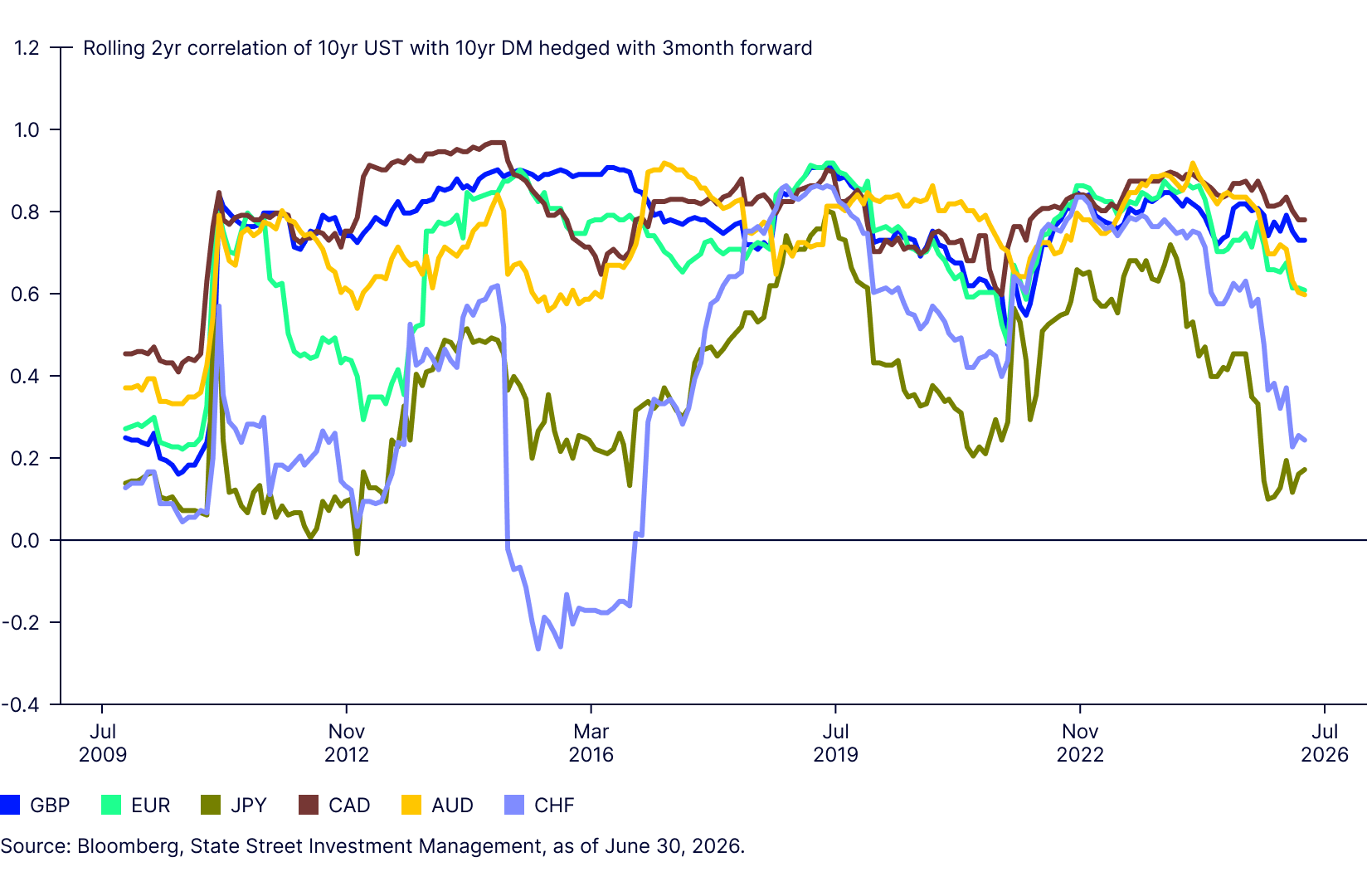
As countries pull back on foreign relationships to varying degrees, we expect economies to experience divergent growth, inflation, and policy trends. Those differences are likely to affect bond markets, creating a wider range of opportunities for return and diversification. For example, US 10-year Treasury rates’ correlations with developed market sovereign rates (hedged to USD) have been declining since the middle of 2024 as developed market economies continue be influenced by country- and region-specific factors (Figure 5).
Figure 5: Correlations between US Treasury rates and other sovereign bond rates are declining
Spotlight on EM Debt
Emerging market debt has held up solidly so far in 2026; YTD, EM corporate and sovereign spreads have tightened 2bp and 11bp, respectively.2 Moving forward, the diversification provided by exposure to bond markets outside the US could help provide stability to fixed income allocations.
Emerging Market Debt (EMD) has evolved from an opportunistic, tactical trade into a core building block of institutional fixed income portfolios. Over the past 25 years, the investable universe has grown to more than USD 30 trillion, and its share of the global bond market has risen from around 2% in 2000 to over 25% today3—a scale that is increasingly difficult for global asset allocators to overlook. Underpinning this is the relatively stronger growth of EM economies and generally lower government debt burdens, alongside continued broadening of index coverage as new issuers meet inclusion criteria. Importantly, the way institutional investors think about EMD has shifted: rather than a tactical or opportunistic allocation, it is now best viewed as a complementary exposure that delivers a potential yield premium over developed market sovereign and corporate debt, backed by robust credit ratings and lower realized default rates than is often perceived.
EMD hard currency
EMD hard currency, benchmarked to the J.P. Morgan EMBI Global Diversified, offers exposure to US dollar-denominated sovereign and quasi-sovereign bonds from close to 70 countries, with an average credit quality of BB+, and roughly half of the index rated investment grade.4 Because the bonds are dollar-denominated, returns are driven primarily by two building blocks: US Treasury rates and the sovereign credit spread over Treasuries. This dual-engine profile is what gives the asset class its stabilizing role. The Treasury leg anchors it to the same rate cycle that governs a US investor’s core fixed income book, while the spread component adds an income cushion, currently around 244 bps.5
Diversification across nearly 70 issuers, spanning oil exporters in the Gulf, Asian manufacturing hubs and Latin American commodity economies, further dilutes single-country risk, meaning idiosyncratic shocks in any one sovereign tend to be absorbed by the broader index rather than derailing overall portfolio outcomes.
EMD local currency
EMD local currency, tracked by the J.P. Morgan GBI-EM Global Diversified, is the larger of the two segments, with an underlying market of around $6 trillion and an average credit rating of BBB+,4 a full notch above the hard currency index and comfortably investment grade. Returns are driven by domestic interest rates and local currency movements rather than US credit spreads, which is precisely why the asset class behaves differently from many other fixed income holdings, potentially smoothing overall portfolio outcomes.
Countries in the local index tend to have independent central banks, developed yield curves and strong balance sheets. The IMF notes that EM economies with a higher share of local currency debt and a diversified investor base have exhibited more stable bond yield and market liquidity. In addition, positive real yields, credible policy frameworks and, in some cases, undervalued currencies, provide a relative valuation cushion and a source of carry that is genuinely hard to replicate elsewhere in fixed income. The trade-off is sensitivity to the US dollar; renewed dollar strength can dampen returns for EM Local strategies.
Indexed leveraged loans
Investors can add another layer of diversification by allocating to assets with lower interest rate risk than the broad fixed income universe. Leveraged loans—also known as senior loans or bank loans—can play this role. Investors need to recognize that these are below-investment grade investments with a commensurate higher level of credit risk. However, loans are higher in the capital stack than traditional high yield bonds and are often secured, which can support higher recovery rates.
Leveraged loans have floating rates, resulting in effective durations close to zero, which can help provide diversification in a rising rate environment. In part because of this, leveraged loans have a historical correlation of just 0.15 to the Bloomberg US Aggregate Bond Index (Figure 6). Furthermore, loans are often both callable (a feature that caps their upside) and secured (which means they are above unsecured high-yield bonds in the capital structure), contributing to a relatively stable return profile over time.
While loans have traditionally been an opaque market in which investors faced liquidity and access challenges, it is now possible to index exposure to leveraged loans, which can help improve the efficiency and liquidity of allocations to this diversifying, yield-oriented asset class.
Putting it all together
We have covered several ways for investors to add diversification, taking advantage of a continually broadening range of fixed income building blocks to anchor their portfolios in what seems to be an increasingly uncertain world. A reasonable question many might ask is, how do I incorporate some of these exposures into my existing portfolio in a way that is consistent with my overarching objectives? We address this problem in our recent Core/Satellite paper.
The bottom line
Balancing growth and stability is a primary focus for public and Taft-Hartley plans. That balancing act becomes especially challenging amid volatile, fast-shifting market environments. Plans can address this challenge by capitalizing on fixed income markets’ breadth and depth, which can provide the diversification and range of opportunities they need to help navigate volatile markets.
Please contact your relationship manager to learn more about making the most of your fixed income allocation.