
Four key trends in the 2025 active-passive debate
2025’s flows and performance trends about active and indexed strategies gives us a glimpse into how investor sentiment may be leaning in 2026.

The active-passive rivalry is an industry staple—asset management’s version of Red Sox versus Yankees, Montagues versus Capulets, Jets versus Sharks, or Kendrick Lamar versus Drake.
Each year brings new data points that reshape the debate—and 2025 was no exception.
Four flow and performance trends across active and indexed strategies—spanning both ETFs and mutual funds—help illustrate how investors’ preferences are shifting and where active management may add value.
1. Investors prefer active ETFs over mutual funds
One of the defining trends of 2025 was the accelerating shift toward active ETFs. With a record $580 billion of inflows, equities, bonds, and alternatives all set new records.
Meanwhile, active mutual funds continued to face significant headwinds. They saw $640 billion in outflows in 2025. Only active bond mutual funds had net inflows.1 This marked the ninth outflow year in the past decade for active mutual funds.2 Alternatively, active ETFs have posted inflows every year over that same period.
The cumulative divergence of that trend is striking; active ETFs have attracted nearly $1.2 trillion in inflows, whereas active mutual funds have seen almost $4 trillion in cumulative outflows. Together, these trends underscore just how decisively investors favor the ETF wrapper (Figure 1).
2. Investor demand for active is strongest in fixed income
Active fixed income ETFs took in $178 billion in 2025, representing 40% of all fixed income ETF flows—a larger share than active equity ETFs, which captured 32% of all equity ETF flows. This contrasts with low-cost core exposures, where equities attracted more than fixed income (Figure 2).
Investors’ preference for bonds extended beyond ETFs. Active fixed income mutual funds bucked the mutual fund industry’s persistent outflows with $120 billion of inflows.3 Yet, unlike the low-cost trend, passive equity mutual funds had $100 billion of outflows.4
3. Active fixed income offered a far more fertile environment for alpha generation than equities
Performance data reinforces why active fixed income strategies drew so much more attention in 2025. Nearly half of active fixed income managers across both ETFs and mutual funds (47%) beat their benchmark, compared to only 32% of active equity managers.5
Looking across key asset classes commonly used in portfolios the difference becomes more striking. Across nine major bond categories, 58% of active managers outperformed, delivering an average excess return of +0.34%.6 In contrast, across 11 major equity categories, only 31% beat their benchmark, with an average excess return of –3.13%.7
The divergence is even sharper in core exposures. In fixed income, 65% of intermediate core-plus managers outperformed their benchmark, with an average excess return of +0.13%.8 Meanwhile, only 31% of active US large blend equity managers beat theirs, posting an average excess return of –2.02%.9
Meanwhile, just 31% of active US equity large blend managers beat theirs.10 More so, the average excess return for intermediate core-plus was +0.13%, while US large blend’s average excess return was a negative at -2.02%.11
4. Active ETFs outperformed active mutual funds in most categories
The final trend is also performance related—and it strengthens the growing case for active management in ETFs. Active fixed income ETFs delivered stronger results than active mutual funds, often by a meaningful margin:
- 60% of active bond ETFs beat their benchmark, with a +0.11% average excess return12
- 43% of active bond mutual funds outperformed, but with a –0.32% average excess return13
In the crucial intermediate core plus category:
- 73% of active ETFs outperformed, with a +0.18% excess return14
- 64% of active mutual funds outperformed, with a +0.12% excess return15
While it’s just one year, across those nine major bond sectors, active ETFs produced a higher percentage of outperforming managers in five of them (Figure 3). This highlights a key shift—active ETFs are increasingly demonstrating meaningful alpha generation within a product wrapper long associated almost exclusively with passive investing.
Will 2026 be another bright spot for active bond ETFs?
Adding active bonds to portfolios may add value once again in 2026 given that:
- Tight credit spreads mean security selection can help identify relative value opportunities
- Evolving monetary policy and fiscal impulses may spur inflation risks, making active duration management along the curve helpful to navigate rate uncertainty
- The evolving macro paradigm and redrawing the flow of capital and global cooperation among nations that began in 2025 increases the importance of having flexibility to rotate across sectors, manage liquidity, and capture income where risk-adjusted opportunities exist
For more information on fixed income dynamics and active management, visit our market trends page.
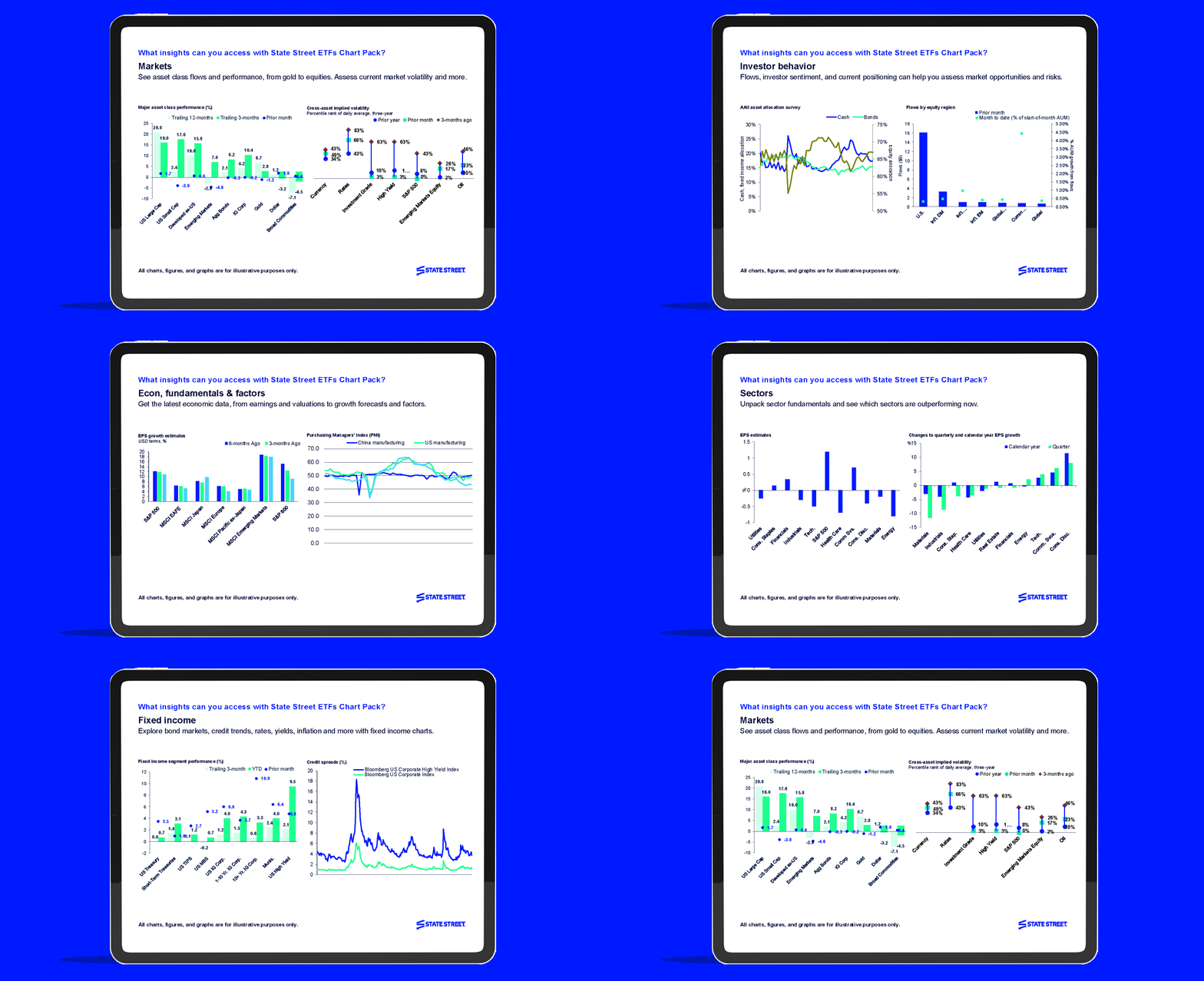
Chart Pack
An easy way to visualize the latest market movements.