
What blue-chip companies can teach us about staying power
- Blue chips are built to last. Their long histories, strong balance sheets, and competitive positions have historically helped these companies hold up through all kinds of markets.
- Resilience goes a long way. Touting a lower maximum drawdown than the S&P 5001 and opportunities to earn higher dividends,2 the Dow’s blue chips can make it easier to stay invested and focused on the long term.
- DIA brings it all together. The State Street® SPDR® Dow Jones Industrial Average ETF Trust (DIA) gives you access to 30 of the world’s most established companies in a single trade—making blue-chip investing easy to plug into a portfolio.
You know that friend who’s never late, remembers every birthday, and drops off a casserole when times are tough? Someone who is always there for you. Some companies have that same energy. They’ve been through market booms and recessions. They’ve watched entire industries reinvent themselves. And yet, they keep showing up. Steady. Reliable. Time-tested.
There’s a name for companies like these: blue chips. They’re known for their resilience and their ability to perform for decades (yes, the average age of Dow companies is 99 years old3). If you’ve ever wondered, “Are blue-chip stocks safe?” or “Why do blue chips seem to weather downturns better than others?,” you’re in the right place.
Here’s a closer look at what defines a blue-chip company, why they’ve historically stayed strong, and how investors can use them to support long-term goals.
What are blue-chip stocks?
Fun fact: the term comes from poker, where blue chips carry the highest value. Investors began using the phrase in the late 1920s to describe companies with strong earnings, stable operations, and reputations for quality. Essentially, the biggest players in the corporate world.
Today, “blue chip” is shorthand for large, well-established businesses with long histories and recognizable brands. Microsoft. Home Depot. Goldman Sachs. Visa. These are just a few examples of firms that have spent decades proving they can adapt, compete, and endure.
Thirty blue chips make up the Dow Jones Industrial Average—a group of 30 market leaders and a common benchmark for the overall health of the US economy. And the State Street® SPDR® Dow Jones Industrial Average ETF Trust (DIA) makes it easy for investors to own them all in a single trade.

Invest in America’s corporate giants
With DIA, you can get exposure to 30 US blue-chip stocks in a single trade.
Traits that make blue chips resilient
There’s more to blue chips than sheer size. These companies have sterling reputations, proving they can not only operate but have the potential to lead through all kinds of market environments.
What are the common traits of blue-chip resiliency that have made them less volatile than smaller or younger companies?
Key trait #1: Built to last
Blue chips typically sell products or services that people rely on, year after year, decade after decade. The things households, hospitals, factories, or businesses simply can’t stop using. Instead of chasing trends, they build business models around that constant demand.
Think of them as the “infrastructure companies” of everyday life: payments still need to be processed, medicine still needs to be made, flights still need to take off, and groceries still need to be stocked—whether markets are calm or chaotic.
Steady demand usually translates into steadier earnings. And while no company is immune to turmoil, the Dow’s earnings have grown at a compounded annual growth rate (CAGR) of 8% per year.4 This consistency is a big reason why blue-chip stocks may be less risky.
Figure 1: Blue chips have the financial strength and global reach to endure
| Coca-Cola | 2.2 billion servings sold per day worldwide⁵ |
| Microsoft | More than 1.4 billion active monthly Windows users⁶ |
| Johnson&Johnson | Created the first adhesive bandage in 1921⁷ |
| McDonald’s | Over 43,000 restaurants in 100+ countries⁸ |
Why it matters: A durable business model can help reduce volatility. When revenue and earnings are steady, stock prices tend to be less volatile than the broader market.9 That consistency could be a differentiator.
Key trait #2: Strength in downturns
For investors wondering, “Are blue-chip stocks safe during recessions?” history shows they often experience smaller declines and faster recoveries compared with more speculative areas of the market.10
Of course, no company is truly “recession-proof.” When a recession hits, almost everyone feels it. That said, many blue-chip companies have weathered those downturns slightly better than the broader market for a few reasons:
- Strong balance sheets
- Steady customer bases
- The flexibility to cut costs or adjust operations
Why it matters: Downturns can stir up fears and push investors to panic-sell their holdings. Blue-chip companies help soften the bumps, which can make it easier to stay invested and benefit from market recoveries.
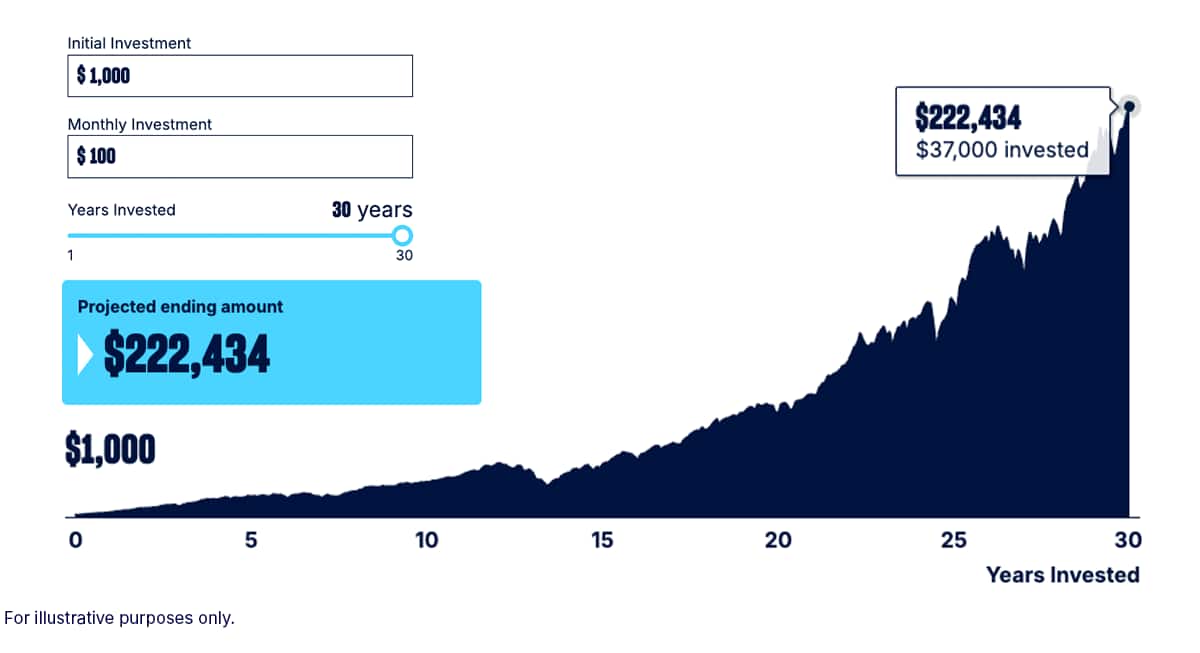
How much would your money be worth?
Discover the long-term growth potential of investing in the Dow’s blue-chip companies.
Key trait #3: Industry dominance
13% of Dow companies are the single largest firm (by market cap) in their respective sector across the entire S&P 500; 40% rank in the top 3.12
As industry leaders, these blue-chip companies often benefit from global scale, operational efficiency, brand loyalty, and research capabilities that smaller competitors can’t match. That dominance helps them defend market share and stay profitable when competition heats up or the economy slows.
Why it matters: Competitive advantages translate into long-term growth potential. Think slow and steady, not flashy and unpredictable. That typically leads to fewer surprises and more consistency.
Key trait #4: Consistent dividends
Many blue-chip companies return a portion of their profits to shareholders through regular dividends (usually quarterly)—and several have been doing so for longer than many investors have been alive. These payments are not only an added benefit of ownership but also a strong indication of a company’s ability to generate steady cash flow.
Figure 4: Dividend longevity across major indexes
Average number of years companies have paid dividends
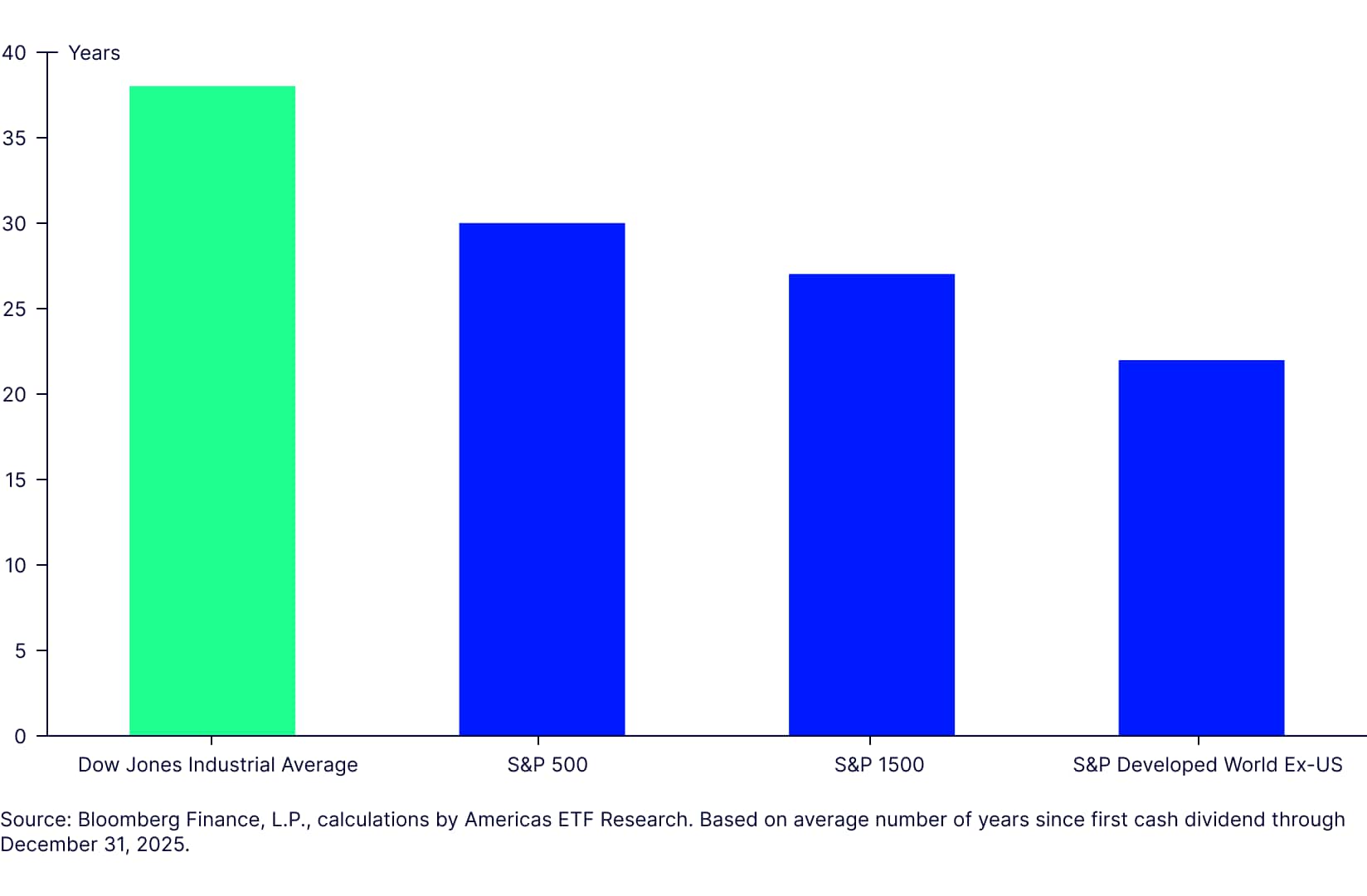
Why it matters: Dividends can provide an income stream that may help cushion returns during market downturns13 and encourage disciplined capital allocation. While not guaranteed, consistent dividend policies can signal management’s focus on returning capital to shareholders. And for investors who reinvest their dividends, those payouts can support compounding potential over time.
Key trait #5: Global reach and diversification
Most blue-chip companies operate globally. That means they don’t depend on just one country or region’s economy. The Dow, for example, offers investors access to 30 blue-chip stocks in a single trade. Sure, that may not seem like enough diversification on the surface. But the mega-caps that comprise the Dow Jones Industrial Average offer revenue exposure to 177 countries and 152 different industries.14
Figure 5: The Dow’s blue-chip companies offer vast revenue exposure
countries
industries
Source: Factset, as of December 31, 2025 based on revenue streams from portfolio holdings.
Why it matters: When one region slows, another may be growing. For instance, following the COVID-19 pandemic, the US economy bounced back much faster than parts of Europe. A global footprint helps diversify earnings exposure and makes these companies less dependent on any single country’s economy.
Why blue-chip stocks may be ideal for patient investors
It’s tough to be patient. That’s especially true when markets decline sharply and investors’ instincts tell them to sell.
But blue-chip companies tend to share several important characteristics that can make it easier to take a long-term view: Market leadership. Operational efficiencies through scale. Brand recognition. And intangible assets. And on top of all this, the companies that make up the Dow are likely to help patient investors tap into:
- The power of compounding: Earnings, dividends, and reinvested returns can grow meaningfully over long periods.
- Lower volatility and faster recovery: Blue-chip stocks tend to experience smaller drawdowns than more speculative companies,15 which makes it easier to avoid emotional (and potentially regrettable) decisions. And history shows that high-quality companies with strong balance sheets tend to bounce back faster as conditions improve.16
- Lasting business models: Companies with dominant brands and global footprints can survive tough periods without reinventing themselves every six months.
How to include blue-chip companies in your portfolio
Blue-chip stocks can play multiple roles in a portfolio because they blend durability and long-term growth potential. You can use them as:
- A foundation: Blue-chip stocks are a common core equity allocation—a base you can build around. From there, you could round out your portfolio with small caps, mid caps, or international stocks for additional diversification.
- An income source: Many blue-chips pay dividends, which has the potential to generate income. And reinvesting the proceeds can bolster value.
- A balance: Blue chips can offset the frequent ups and downs of more volatile investments—a resilient core for your portfolio.
Buying individual blue-chip stocks requires research, monitoring, and rebalancing—in other words, time and effort. But an ETF can help simplify the entire process.
The State Street® SPDR® Dow Jones Industrial Average ETF Trust (DIA) is the only ETF that tracks the Dow Jones Industrial Average, giving investors exposure to 30 of the country’s most established blue-chip names in a single trade. It’s a straightforward, cost-effective approach to blue-chip investing.
Quick Quiz
Which company has been part of the Dow Jones Industrial Average for the longest continuous stretch?
Correct!
Procter & Gamble has been part of the Dow Jones Industrial Average since 1932—94 years and counting, making it the longest continuous run of any company.17
Sorry, wrong answer
Procter & Gamble has been part of the Dow Jones Industrial Average since 1932—94 years and counting, making it the longest continuous run of any company.17
Are blue chips the right fit for your portfolio?
Chasing trends can be exciting, like tearing open the latest Labubu. But building wealth comes down to something far less flashy: staying invested in companies built to last. That’s why blue chips fit the bill. They’ve spent decades proving their resilience through recessions, recoveries, inflation cycles, and technological change.
And with an ETF like DIA, you get 30 of those established companies in a single trade.
Want 30 blue-chip stocks in a single trade?
Gain exposure to well-established blue chips with DIA, the only ETF to track the Dow.