
Return expectations from the Global Market Portfolio
Broad and diversified, the Global Market Portfolio (GMP) can help investors make risk and return comparisons among asset classes. With today’s market volatility keeping diversification in focus, the GMP reinforces the importance of a carefully planned asset mix.


Using proprietary capital market assumptions, the GMP is expected to deliver a nominal return of 6.3% in USD terms over the medium term, and 6.1% over the long term, gross of fees and transaction costs. This return comfortably exceeds current and anticipated inflation levels in most advanced economies, with equities and risky debt emerging as the primary contributors (Figure 12).
For investors operating in other base currencies, returns may vary depending on hedging strategies. As of March 2026, the portfolio’s estimated volatility stands at 9.9%, and with an expected USD cash return of 3.3%, the ex-ante Sharpe ratio is calculated at 0.3, indicating a reasonable compensation for the risks borne by investors.
Figure 1: Risk–return forecasts (USD basis) for the GMP are attractive
| USD (billions) | Weights (%) | 3-5 years (%) | 10+ years (%) | Estimated risk (Sd) | |
| Equity | 99,290 | 45.0% | 7.5% | 7.1% | 16.0% |
| Government Bonds | 43,646 | 19.8% | 5.3% | 4.9% | 7.4% |
| IG Credit | 18,871 | 8.5% | 4.9% | 4.9% | 8.5% |
| Inflation Linked Bonds | 3,090 | 1.4% | 3.6% | 3.7% | 6.8% |
| HY Bonds | 1,829 | 0.8% | 5.2% | 5.4% | 11.0% |
| EM Debt | 10,487 | 4.8% | 6.5% | 6.6% | 9.9% |
| Securitized | 10,040 | 4.5% | 4.9% | 4.7% | 4.9% |
| Convertibles | 537 | 0.2% | 5.4% | 5.4% | 11.2% |
| Real Estate | 7,050 | 3.2% | 6.8% | 6.6% | 20.4% |
| Private Equity | 10,661 | 4.8% | 9.2% | 8.8% | 10.6% |
| Private Debt | 1,770 | 0.8% | 6.7% | 6.7% | 7.9% |
| Gold | 13,454 | 6.1% | 2.6% | 2.6% | 18.3% |
| Total GMP | 220,722 | 100.0% | 6.3% | 6.1% | 9.9% |
Note: The above forecasts are estimates based on certain assumptions made and analyses run by State Street Investment Management. There is no guarantee that the estimates will be achieved. We have used returns over 10 years as a proxy for 3–5-year returns for convertibles, private credit and gold. Source: Bloomberg, Thomson Reuters, Preqin, J.P. Morgan, MSCI, World Gold Council, FactSet, State Street Investment Management, as of March 31, 2026
Yet, not all investors will find these expected returns sufficient. Those with higher return expectations or unique constraints may need to pursue more aggressive allocations or consider private assets, active security selection, or tactical strategies. Conversely, institutional investors such as banks or endowments may tailor their portfolios based on liquidity needs and investment horizons, often incorporating short-term bonds or illiquid assets like private equity and private credit.
Sources of diversification and risk
In today’s volatile and uncertain investment landscape, diversification has re-emerged as a foundational principle for managing risk and enhancing long-term returns. The strength of the GMP lies not only in its return potential, but also in its inherent diversification.
Diversification is achieved when the combined risk of a portfolio is less than the sum of the risks of its individual components. This is typically measured by comparing the sum of the risk contributions from each asset class with the overall portfolio volatility:
Diversification Benefit = ∑ (wi × σi) − σp
Where:
- wi = weight of asset i in the portfolio
- σi = volatility of asset i
- σp = overall portfolio volatility
A higher diversification benefit indicates a more diversified portfolio. This metric complements traditional measures like the Sharpe Ratio, expected risk, and expected return. Assessing the degree of portfolio diversification is vital, but recognizing its origins is equally significant. In uncertain times like these, it is beneficial to examine the individual contributors to diversification within our portfolio and determine if these elements are undergoing any changes. This entails comparing the difference between standalone risk and total risk contribution for each asset. As of March 2026, the GMP demonstrates a significant diversification benefit of 2.77%. If all assets were perfectly correlated, the total portfolio risk would be 12.6%, compared to the actual estimated 9.9% for the GMP—a material and meaningful difference (Figure 2).
Figure 2: The diversification of the GMP reduces total portfolio risk by 277 bps
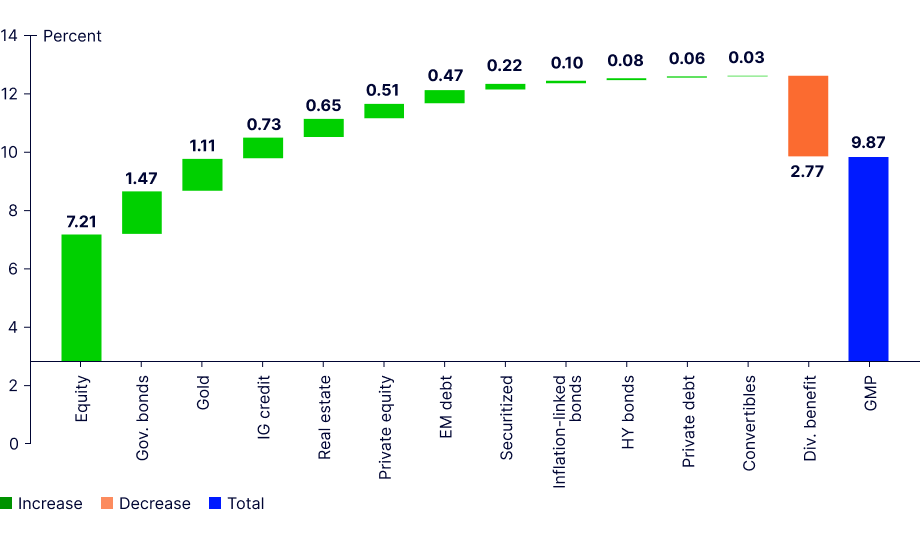
Understanding the sources of diversification is just as important as measuring it. Notably, government bonds, gold, and private equity are among the top contributors.
Government bonds, which make up 19.8% of the GMP, contribute 25% to this diversification benefit. Meanwhile, alternative investments such as gold, real estate, private equity, and private debt—despite their smaller allocations—collectively contribute over 47% to the benefit (Figure 3). This underscores the strategic value of including less correlated assets in a portfolio.
On the flip side, public equities, while comprising 44% of the capital allocation, account for nearly 70% of the total portfolio risk, highlighting the importance of balancing growth potential with risk exposure (Figure 4).
Managing higher equity risk
To manage this risk, investors might consider strategies such as managed-volatility equities, target volatility triggers, or option overlays. Dynamic asset allocation—guided by market regime analysis and tactical outlooks—can also play a key role in both enhancing returns and mitigating risk.
In conclusion, the GMP offers a compelling case for diversified investing. It not only provides a robust return profile, but also exemplifies how thoughtful asset allocation can reduce risk and improve resilience. In an environment where uncertainty is the only constant, diversification remains one of the most effective tools for navigating complexity and achieving long-term investment success.