
Identifying sustainable innovation through patent data
Patent data can provide a forward-looking view of innovation activity that may support products and services contributing to sustainable outcomes.
Introduction: Using patents to identify assets contributing to sustainable outcomes
Sustainable Outcome Investing (SOI) is an approach used to identify assets that are assessed as contributing to measurable environmental or social outcomes. As we explained in our previous paper, Identifying Sustainable Outcome Investments, central to this approach is the concept of asset contribution, which refers to identifying assets whose products and services are intended to contribute to sustainable outcomes.
This identification process relies on a set of key performance indicators (KPIs) linked to companies’ products and services. Revenue from products and services intended to contribute to a sustainable outcome is a prevalent KPI used to identify and measure potential outcomes. In addition, patents can be used as a complementary KPI, offering a documented indication of a company’s innovation activity because patents involve formal registration and technology disclosures. We can use these disclosures to link the patents to products and services that may contribute to environmental or social outcomes within a defined theory of change.
Patents can provide a forward-looking view of innovation by indicating technologies under development that may not yet be commercialized. As a result, patent data may help identify issuers whose innovation activity could support products and services contributing to sustainable outcomes, even when current revenue-based KPIs are relatively low. In this sense, patents can complement other KPIs by providing granular insights into R&D activity and potential future products and services, including detail that may not be visible in revenue data segments.
While patent data provides a proxy measure for innovation and a forward-looking method for assessing how innovations may contribute to sustainable outcomes, it is important to recognize that not all patents translate into marketable products. Patent-based indicators, in our view, should therefore be interpreted alongside other product- and service-related KPIs and outcome evidence.
Designing a patents KPI within the SOI framework
The use of patent data within our SOI framework is designed to distinguish patents linked to products and services from those related primarily to innovations supporting internal operations, and to assess their alignment with potential sustainable outcomes. It leverages structured patent datasets, standard classification systems, and filtering mechanisms.
Our definition of patents extends beyond traditional “green” patents that focus solely on environmental technologies. It also includes patents mapped to social themes that are classified as aligned with relevant UN Sustainable Development Goals (SDGs), such as healthcare and education, based on defined criteria.
To define scope, we rely primarily on an in-house thematic mapping built on a code-based classification approach. We use World Intellectual Property Organization (WIPO) and European Patent Office (EPO) patent classification schemes across both environmental and social themes, mapping the relevant classifications into our SOI themes and SDG-alignment categories. For environmental themes, this leverages the WIPO “IPC Green Inventory” and the EPO “Y02/Y04S” tagging scheme. For social themes, including health, zero hunger, and education, we use broader WIPO and EPO patent classifications. Because the WIPO and EPO classifications are complementary, using both can improve coverage versus either source alone and supports a more comprehensive thematic mapping design.
We begin with patent records and integrate reference data to enable aggregation at the issuer level, including handling of mapped or merged entities. We then compute thematic patent metrics—such as granted patent counts, newly published counts, and patent ratios—based on the mapped schemes. We use all classified codes, and we avoid double counting even if codes appear in multiple sub-categories or themes.
Finally, we refine the SOI patents set using quantitative thresholds and a products-and-services classifier, a filter used to distinguish patents that are more likely to support revenue-generating activities aiming to contribute to sustainable outcomes from patents that may relate primarily to innovations supporting internal operations. The classifier further narrows the dataset to keep it evidence-based and outcome-relevant. In other words, the framework goes beyond asking whether a company has patents. It assesses whether those patents are classified as aiming to contribute to a sustainable outcome in a way that aligns with our SOI framework and approach to asset contribution.
Thematic Example: Water
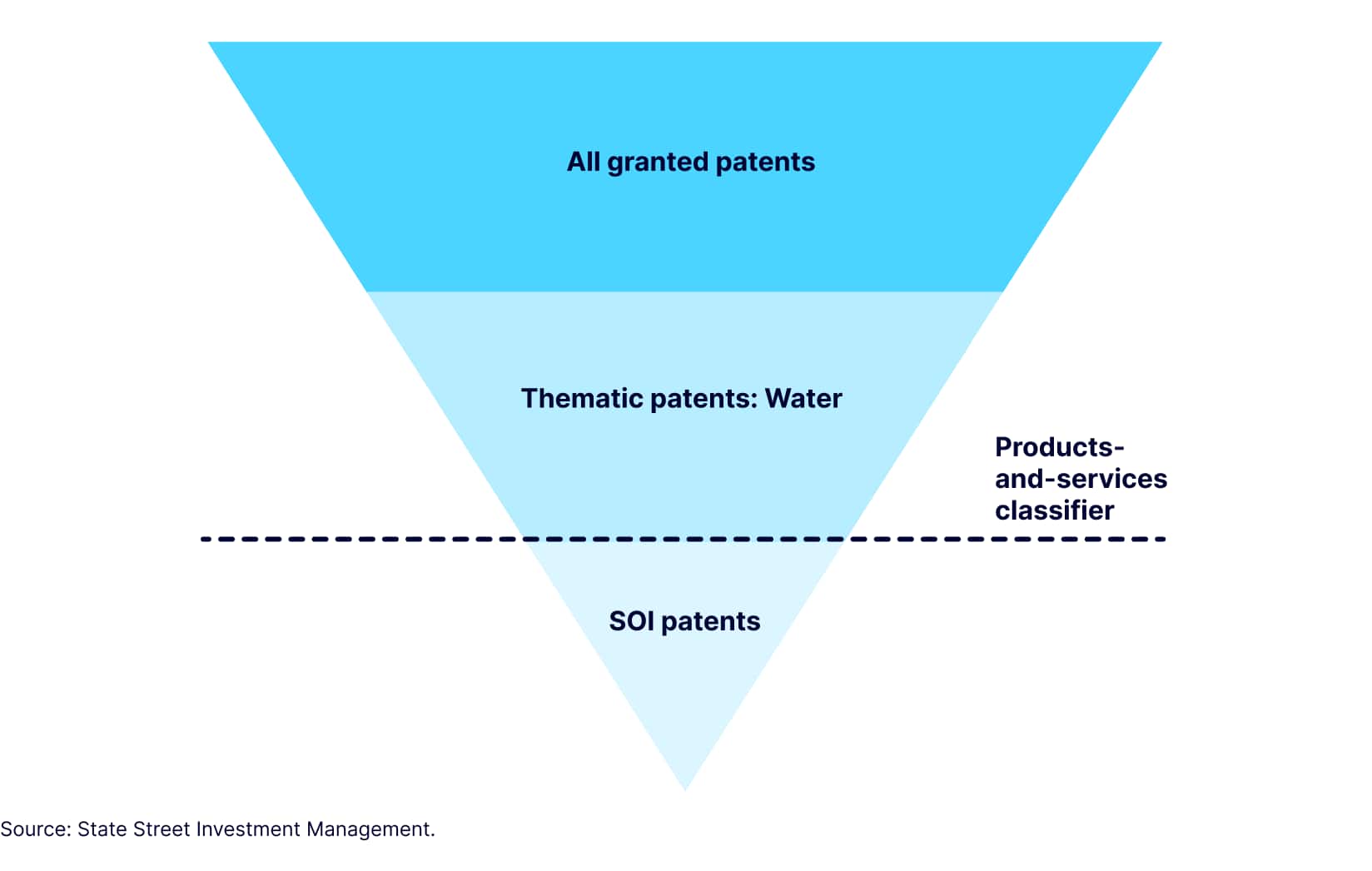
The water theme provides a practical example of how the framework is applied (see Figure 1).
For classification, the “Y02/Y04S” tagging scheme includes patent classifications for technologies related to wastewater treatment, water conservation, and efficient water supply and use. Under the “IPC Green Inventory,” these map to categories such as control of water pollution. The two classification systems are complementary and together broaden coverage of the theme.Within the SOI framework, we then apply the products-and-services classifier. Water-related patents are classified as “products and services-related” when the issuer has evidence of water-related products and services activity (for example, positive revenue mapped to the water theme, or reported outcome KPIs like water treated or water saved). If there is no evidence of water-related products and services activity, they are categorized as operational patents. This distinction helps reduce the risk that operational patents are interpreted as identifying a potential sustainable outcome investment, which would not be aligned with our SOI framework.
Figure 1: Water theme patents
Thematic trends in sustainable innovation
Figure 2 illustrates the number of issuers with at least one thematic patent mapped to the sustainability themes over time. For this analysis, thematic patents include both products-and-services-related and operational patents. Each line represents a theme aligned with SDG-related categories.
Overall, the data indicates growth in the number of issuers with patents mapped to sustainability themes, with differences across themes in both scale and trajectory. For example, transportation and energy conservation show a higher number of issuers with mapped patents and stronger growth in issuer count, which may be consistent with broader innovation activity in areas such as electric vehicles and energy efficiency. Other themes, such as water and waste, show more gradual growth patterns.
Conclusion
The patents KPI combines transparent mapping based on established patent-classification systems with a practical filter for product-and-service relevance. This produces a theme-level view that can be used as one input within the SOI framework. For investors seeking to do so, it may help identify assets whose products and services are assessed as aiming to contribute to sustainable outcomes and, where relevant, support portfolio construction and reporting. By incorporating patents alongside other KPIs, the framework offers a practical approach to identifying companies whose current activities and potential innovation pipeline may be linked to certain sustainable outcomes.