
What is strategic asset allocation?
It is recognised that asset allocation is a key driver of long-term investment results, meaning it may be the most important decision an investor can make.
Asset allocation is the process that determines the different asset class distribution within an investor’s portfolio. This process balances risk and return across a combination of asset classes within a portfolio. Assets can be categorised as growth or defensive. Growth assets are investments that tends to carry high levels of risk, but also offer potential for higher returns over time. Whereas, defensive assets carry lower levels of risk, and typically lower returns. Equities are an example of a growth asset, whereas fixed income and cash are examples of defensive assets.
Asset classes perform differently in different market cycles and, as a result, maintaining a diversified approach in asset allocation is generally considered prudent. By combining asset classes whose performance is relatively uncorrelated, when one asset class underperforms, this may be offset by the performance of another asset class.
There are three common approaches to asset allocation:
- Strategic asset allocation (SAA) is constructed on the basis of long-term asset class forecasts and seeks to maintain a set combination/mix of asset classes.
- Dynamic asset allocation (DAA) is an active strategy that continually adjusts the allocation of assets based on medium-term views and market trends and themes.
- Tactical asset allocation (TAA) is an active asset allocation strategy whereby allocations are adjusted to take advantage of shorter-term market opportunities.
Investors should be aware that the more active asset allocation strategies typically incur active fees or higher management costs.
Given SAA is constructed on the basis of long-term asset class forecasts, this approach is considered appropriate for investors with longer investment time horizons (for example, five years or more). The investor’s time horizon, risk tolerance and investment objective are taken into consideration when selecting the appropriate SAA strategy. From an industry perspective, SAA strategies are commonly labelled to reflect the investor’s risk tolerance. Labels include moderate, balanced, growth and high growth. Below are examples of hypothetical model portfolio allocations for the State Street ETF Model Portfolios.
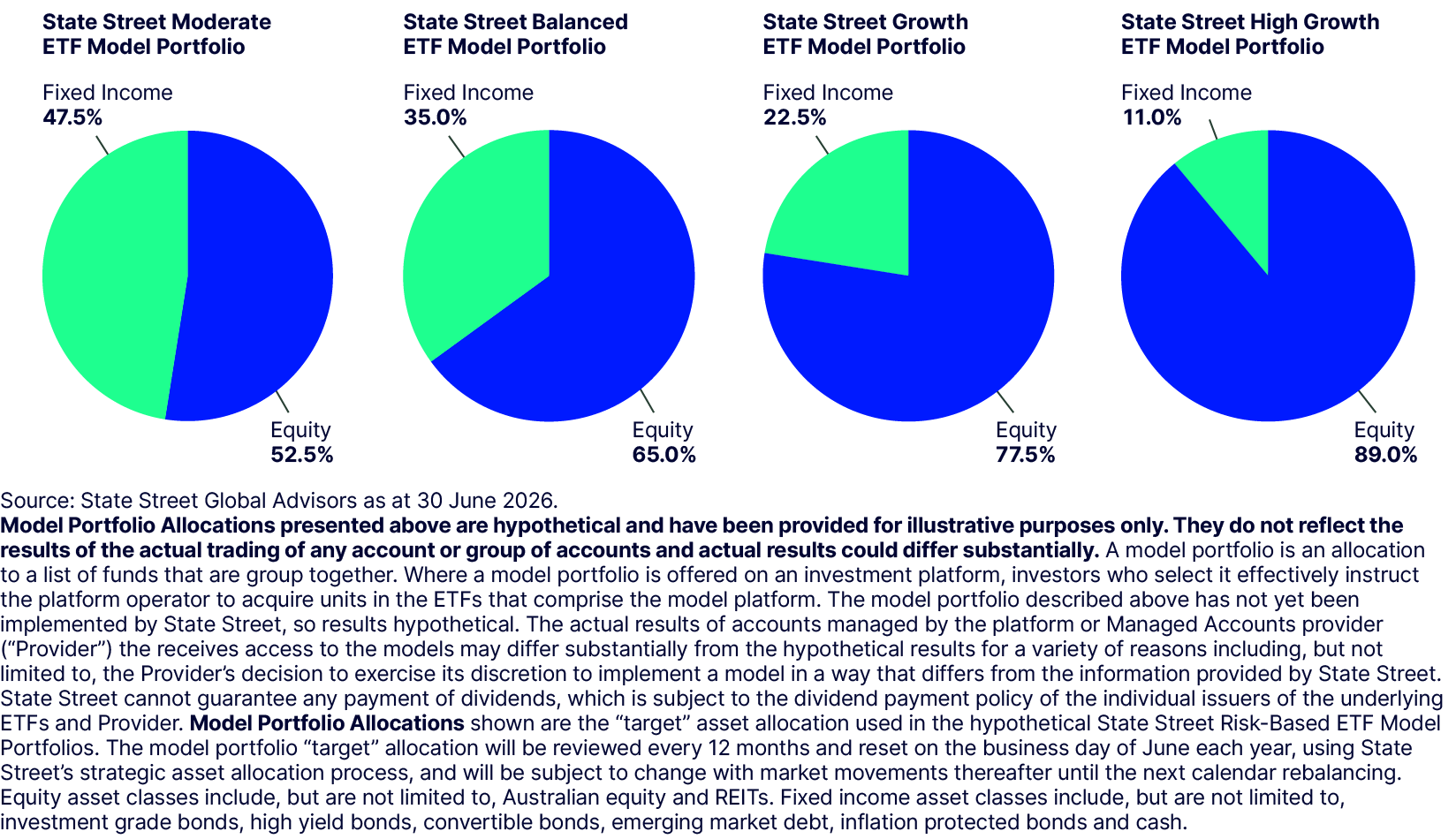
The forecasts driving a portfolio’s asset allocation will evolve over time to align with the fundamental, structural and market changes. Therefore, it’s important to continually review and monitor asset allocation forecasts to ensure they remain aligned with the risk and return objectives of the SAA strategy. The State Street ETF Model Portfolios are founded on an SAA framework. The portfolios’ asset allocation is reviewed and updated annually and reflects the long-term capital market assumptions and qualitative insights of the State Street multi asset investment team.
Reflective of asset class forecasts, portfolio allocations will naturally fluctuate over time. All else being equal, assets that have performed strongly will make up a larger share of the portfolio, while assets that have underperformed will represent a smaller allocation. To maintain alignment with long-term strategic objectives, the multi asset investment team recommends rebalancing portfolios back to their annual reconstitution weights on a quarterly basis.
SAA provides investors with a long-term investment framework, a disciplined and diversified asset allocation approach, and is therefore utilised as the foundation of the State Street ETF Model Portfolios. It is no surprise that many investors have chosen to incorporate these strategies either as a standalone core portfolio solution or as part of a core-satellite investment approach.