
Fed shift hits USD

The yen appears well positioned to outperform, as it remains the most undervalued relative to declining US yields over the next year. The hawkish remarks by Bank of Japan (BoJ) Governor Ueda strengthen the case for at least two rate hikes by the BoJ within the next 9–12 months, with the first potentially as early as December.
While concerns persist about excessive fiscal spending, the proposed budget is relatively moderate. It is unlikely to trigger a surge in new bond issuance, yet it supports growth and inflation, further reinforcing the argument for additional monetary tightening.
The outlook for the Australian dollar has notably improved, supported by the US-China trade truce, higher inflation, strong home price gains, solid employment data, and resilient consumer spending.
The Norwegian krone also appears attractive, underpinned by its G10-leading 4% yield and positive surprises in both growth and inflation. However, we remain cautious on long positions in Australian dollar and Norwegian krone, as both currencies are highly sensitive to equity market drawdowns and weaker oil prices.
The Canadian dollar has been out of favor for some time, but growth data has stabilized, and the Bank of Canada is likely nearing the end of its easing cycle. This makes the Canadian dollar appealing in our scorecards. Nevertheless, the upcoming renegotiation of the United States-Mexico-Canada Agreement (USMCA) trade agreement (or Canada-United States-Mexico Agreement [CUSMA] in Canada) is expected to involve tough US negotiating tactics, creating uncertainty that could weigh on the Canadian economy and keep the currency under pressure.
The British pound, Swiss franc, and euro rank lowest on our scorecards. The pound appears vulnerable as fiscal austerity, weak labor markets, and renewed disinflation pave the way for faster Bank of England policy easing and further pound softness through 2026. The franc faces headwinds from near-zero inflation, zero interest rates, and elevated tariff levels. The Swiss National Bank has also stepped up currency interventions to curb franc strength this year, primarily against the euro. The euro looks relatively better and should hold up during an equity market correction. However, growth remains sluggish, uncertainty surrounds the speed and quality of German fiscal stimulus, and French political gridlock continues to weigh. We expect the euro to struggle to break higher over the next one to two months.
Figure 2: December 2025 directional outlook
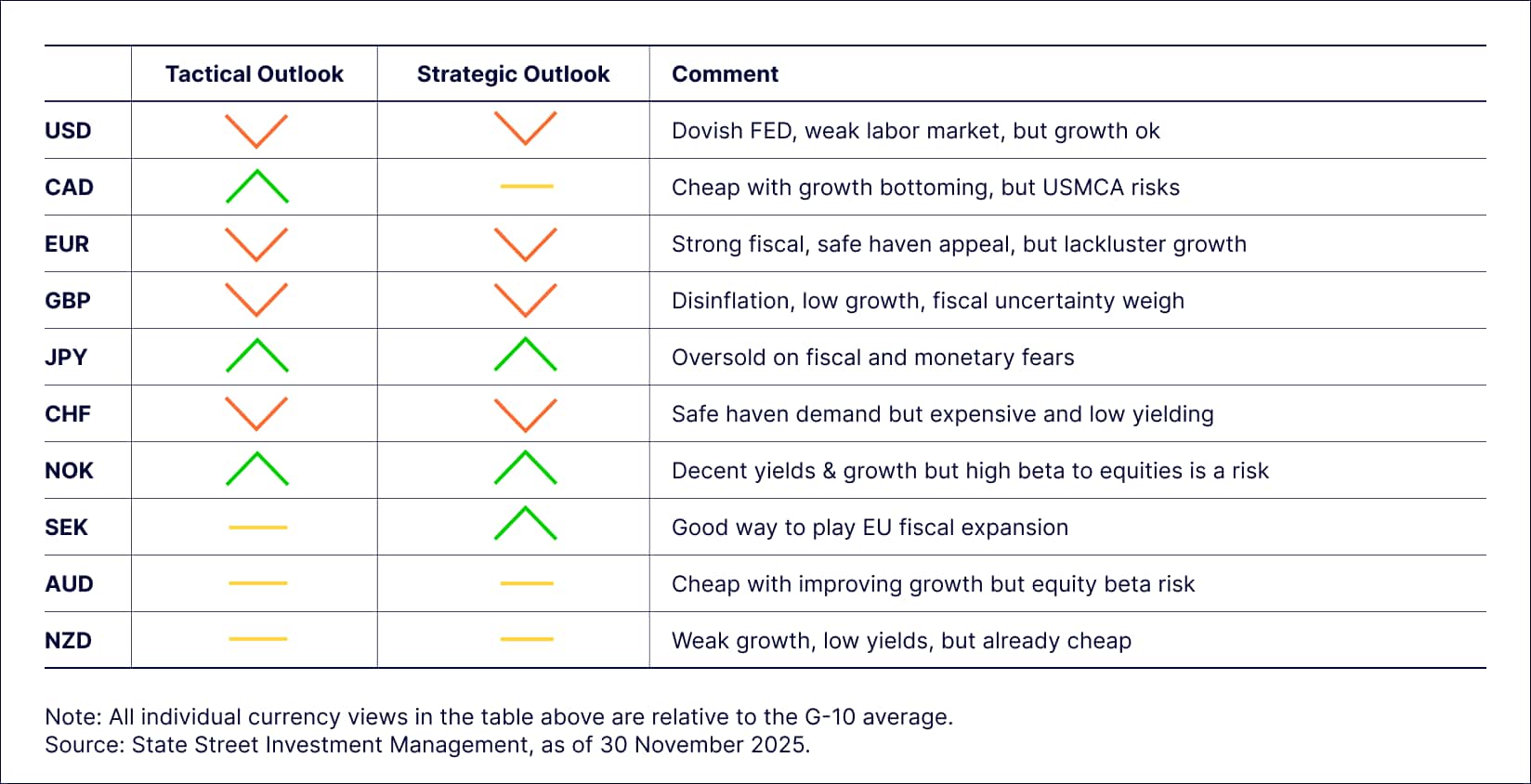
In the long term, we favor being short the US dollar against currencies with strong net international investment positions, solid fiscal and monetary flexibility, and valuations that remain historically cheap versus the US dollar. On these metrics, the Japanese yen, Swedish krona, and Norwegian krone stand out as likely top performers. The Australian dollar, euro, Canadian dollar, and British pound should also see meaningful appreciation against the US dollar, in that order. In contrast, the Swiss franc is most at risk of underperforming the US dollar, particularly on a total‑return basis given its negative interest‑rate carry.
US dollar (USD)
We came into November expecting some further upside but saw it as limited. That worked out. Now, the shift in the Federal Reserve toward a December rate cut, backed by ongoing softness in labor markets, has likely halted the mid-September to mid-November US Dollar recovery. This opens the door to further dollar strength in December, though we do not see potential for a material selloff as growth remains solid, impressive equity earnings encourage investor capital to remain in the US, and supportive fiscal and monetary policy help offset near-term growth risks from lackluster labor markets.
Importantly, even though we enter December with a negative dollar bias, it may receive a positive jolt from the upcoming December Federal Reserve meeting. The rate cut is negative, but there is a material risk that we see multiple dissents in favor of a hold, along with a warning from Fed Chair Powell that the Fed may pause the cutting cycle to evaluate data and the impacts of past cuts.
In the long term, we retain our call for a multi-year US Dollar bear market that will see the currency lose at least 15% over the next 2–4 years. Innovative companies and the dynamic, flexible US labor and capital markets underpin the US as a strong home for capital investment. However, we expect the degree of US economic outperformance to be materially smaller and the reliability of the US Dollar as a safe haven to be materially weaker over the next 10–15 years than it has been for the last 10–15 years.
The Bureau of Economic Analysis (BEA) net international investment position report indicates that non-US investors hold over USD 33 trillion of US portfolio investments and more than USD 62 trillion in total US investments excluding financial derivatives. Even a modest 10–15% reallocation from US assets or a 10% increase in the average US Dollar hedge ratio implies USD 3 trillion US Dollars or more in US Dollar sales. That’s admittedly a very simple estimate, but even half of that is enough to power a prolonged US Dollar bear market, even if the US remains among the top-performing countries.
Canadian dollar (CAD)
Our models favor the Canadian Dollar on improved commodity prices and strong local equity returns, partly thanks to robust earnings from commodity-related companies. Our economic indicator remains on the weak side but is improving slightly. It is encouraging to see signs of growth stabilization, particularly the second consecutive strong employment report. We further expect that the cumulative impact of easing the monetary policy rate from 5% to 2.25% over the past 18 months should begin to lend support to the economy.
Contrary to the Canadian Dollar’s decent ranking in our model scorecard, we struggle to see material appreciation as we head into 2026, given the upcoming renegotiation of the USMCA trade agreement (also known as CUSMA in Canada). We expect threats and tough negotiating tactics on the part of the US to keep the Canadian Dollar on the back foot as it destabilizes consumer and business sentiment, threatening growth and increasing the potential for lower interest rates.
We are more constructive in the medium term. The Canadian Dollar is cheap by our long-run fair value measure. We see the North American tariff dispute as ultimately leading to a renegotiated USMCA that largely preserves favorable relative tariffs for North America compared to the rest of the world. Canada also has more room for quick monetary and fiscal stimulus than the US, as well as ample scope for deregulation and greater trade with countries outside North America.
We see scope for USD/CAD to fall into the low 1.30s versus the US Dollar in 2026 as clarity emerges on tariffs and the USMCA, the Fed resumes rate cuts, and we begin to see greater growth benefits from both the Bank of Canada’s aggressive rate cuts and Canadian fiscal stimulus. Ultimately, given our US Dollar bear market thesis, we see USD/CAD trading back below 1.20 in coming years, though the Canadian Dollar likely remains sluggish versus the G10 ex-US as the weak US Dollar serves as a headwind.
Euro (EUR)
We maintain a negative stance on the euro over the near term. EU fundamentals are okay but lackluster compared to other opportunities in G10. Our economic score for the EU is in the top half of the G10, though we expect absolute growth levels to be low. The ECB is likely done with its rate-cutting cycle, but with the policy rate at 2%, there are more interesting opportunities to pick up carry. Recent equity market underperformance on a relative basis and the uptrend in commodity prices also weigh on the outlook relative to other G10 currencies.
The most positive factor supporting the euro is that it provides a nice hedge against temporary corrections in risk assets. Aside from that risk asset hedge, we prefer the Australian dollar and Norwegian krone, which are backed by higher yields and a better near-term growth story. We also prefer the yen on valuation and an expected reduction in Japanese fiscal risk premium despite its ultra-low yield. We expect the euro to be largely rangebound versus the US Dollar, with oscillations in the range mostly driven by US economic and monetary policy data.
In the medium term, we remain constructive on the currency while recognizing that it is quite expensive on a trade-weighted basis. Strong household balance sheets, low unemployment, positive real wage growth, increased defense spending, and the proposed 500 billion Euro German infrastructure fund are all positive for the euro.
The case for EU investors to pull back from their concentrated exposure to US assets—or at least implement higher average currency hedge ratios over the next few years—is strong as the US becomes a less reliable trade and security partner.
We see scope for a move up toward 1.30+ in EUR/USD in the next 3–5 years, driven by broad US Dollar weakness rather than euro strength. The medium- to long-term outlook against other G10 currencies is notably less optimistic. It is expensive versus the Japanese yen, Norwegian krone, Swedish krona, and Australian dollar and is likely to underperform those currencies over coming years once we work through tariff-related growth risks and the heightened potential for equity market volatility.
British pound (GBP)
We are modestly negative on the pound over the near term. Sterling rests on a shaky foundation of high debt, persistent current account deficits, and near-stagflation. The autumn budget was initially received well. The most severe austerity measures were backloaded into future years, limiting the near-term hit to growth, but enough fiscal room was established—at least on paper—to limit any negative reaction in the bond market.
We see problems, though. The budget does not invest to break free of the low-productivity growth rut, and the social spending is insufficient to appease the left wing of the Labour Party. That threatens the stability of Prime Minister Starmer’s government and ultimately may lead to a more progressive prime minister, which, in turn, threatens a level of spending likely to destabilize the bond market and the British Pound. At the same time, near-term growth remains stagnant, with unemployment rising to 5%, a four-year high, and the budget will not help. Relatively high 4% yields are marginally supportive of the British Pound, but that support is limited by the fact that rates are high for unhealthy reasons.
In the long term, the story is not as shaky—at least not against the US Dollar and the Swiss franc. While the pound looks challenged versus most of the G10, against the US Dollar we see it stabilizing in the low 1.30s this year and approaching 1.40+ over the 3–5 year horizon. We also see the British Pound outpacing the expensive, low-yielding Swiss franc over coming years on a total return basis. Beyond the US Dollar and Swiss franc, we see the pound struggling over the medium term.
Japanese yen (JPY)
We expected November to be difficult as investors worried about higher fiscal spending and the potential for a new government to pressure the BoJ to delay rate hikes, but we have a more optimistic outlook. We think the November low is likely the near-term bottom for the yen, and our view has shifted positive. Going into December, BoJ Governor Ueda made hawkish comments hinting at a rate hike as early as this month.
Growth is likely to remain positive and stable, further supported by the fiscal stimulus that will also help embed above-target inflation. Ultimately, we see 2–3 rate hikes from the BoJ over the next 12–15 months, while the Federal Reserve eases policy by 75–100 basis points over that same period for a total carry compression of 1.25–1.5% in favor of the yen. That should be sufficient to get the yen back toward 135 by end-2026. Thus, we have a medium-term bullish yen view despite acknowledging the recent rocky period may persist for a short time.
In the long term, we see even more upside, with the yen likely to fall back into the 120–130 versus the US Dollar range over the next 3–5 years, consistent with our long-term US Dollar bear market thesis.
Swiss franc (CHF)
We expect the Swiss franc to materially underperform G10 currencies going forward. It is the most expensive G10 currency per our estimates of long-run fair value and has the lowest yields and inflation in the G10. The lower US tariffs are helpful to the growth outlook, but inflation is likely to remain uncomfortably close to zero and growth below trend. In response, we expect the Swiss National Bank (SNB) to prove more amenable to direct currency market intervention to limit Swiss franc appreciation.
The SNB may also be forced to move to negative policy rates, though we believe a move to negative rates would require a return to outright deflation. On a total return basis, accounting for the increasingly negative interest rate carry in long Swiss franc positions, it is difficult to see the franc outperforming the G10. Even versus the US Dollar, the franc would have to gain at least another 10–15% over the next 3–5 years just to overcome the negative interest rate carry.
In addition, we do not expect portfolio rebalancing away from the US Dollar over the next 1–3 years to be as beneficial for the franc as it is for other currencies. Swiss investors already tend to hedge a large percentage of their foreign exchange risk. That means there is not as much room for US Dollar hedge ratio increases. In simpler terms, we see less scope for US Dollar selling and franc buying.
Norwegian krone (NOK)
We retain a positive tactical bias on the krone despite potential risks from additional oil weakness and/or an equity market correction. Norwegian growth is holding up well, and following the Fed rate cut, Norway is now the highest-yielding G10 currency. Technically, it is tied with the UK as the highest-yielding G10 currency with a 4% overnight policy rate. But we expect the Norges Bank to ease policy at a slower rate than the Bank of England over 2026, so that yields in Norway should exceed those of the UK.
The krone is historically quite vulnerable to oil and equity market volatility. Oil markets have been sluggish, with many projecting a supply glut next year threatening weak price action. Equity markets look better, but as we saw in November, periods of volatility appear increasingly likely following the stellar gains since April. For these reasons, we see the potential for periods of substantial volatility in the krone despite our model’s positive outlook.
In the long term, the krone is historically cheap relative to our estimates of fair value and is supported by steady long-run potential growth and a strong balance sheet. Norway also has significant fiscal and monetary flexibility to prevent long-term damage from the current tariff shock. We believe the krone is setting up for solid gains once we reach peak tariffs, reprice risky assets, reprice oil, and begin to focus on tariff reductions and fiscal/monetary stimulus.
Swedish krona (SEK)
Our krona outlook is neutral over the near term. After leading the G10 in 2025 (+9.5% vs. the G10 average), we see the krona running out of steam. As a small, open economy with a less liquid currency, we expect the krona to see greater downside volatility in sympathy with higher euro volatility as France sorts out its government, regional growth continues to experience a tariff drag, and risks of a healthy pullback in equity markets appear elevated. This is not to say we see risks of a notable depreciation in the krona, just less upside for now.
Beyond our near-term concerns, we are more constructive. The medium-term trend in Federal Reserve policy favors easing, and the Riksbank appears on hold for an extended period. Thus, interest rate differentials are likely to continue to shift in Sweden’s favor. In addition, growth is improving, and Sweden is an attractive way to play potential EU fiscal stimulus considering French debt and political worries. Sweden has a very comfortable 33% debt-to-GDP ratio, partly immunizing the krona from global fiscal risk premium, and it has material exposure to the defense sector—a primary recipient of EU fiscal expansion. Valuation also favors the krona, which is historically cheap on a real effective basis. Finally, over a multi-year horizon, Sweden should benefit from gradual portfolio rebalancing under our long-term US Dollar bear market thesis. The scope for a shift in the large foreign asset holdings in both Sweden and the EU away from the US, even if just in the form of higher US Dollar currency hedges, should provide a material tailwind for the krona.
Australian dollar (AUD)
Our tactical models retain a modest positive bias on the Australian Dollar over the near term. The US–China tariff ceasefire suggests a prolonged period of relative stability, opening the door for a further reduction in tariff risk premium. Higher-than-expected CPI, improving consumer spending, and strong home price gains underpin a decent 2026 growth outlook, which should keep the RBA on the sidelines.
This solidifies the Australian Dollar as one of the higher-yielding G10 currencies heading into 2026. On top of that, there is ample room for fiscal support and the ability for more pronounced fiscal spending should we experience a negative global growth shock, an enviable position in a world of excessively high government debt.
We have some concerns that limit the degree of our enthusiasm. Australia faces lackluster business investment, high household debt service burdens, and a seemingly structural downshift in productivity growth. The Australian Dollar is also sensitive to equity market volatility, which appears more likely following the dramatic rally since April. These factors temper our tactical outlook.
In the long term, we are quite positive on the currency. The Australian Dollar is significantly cheap relative to our estimates of fair value. As mentioned above, growth has been more resilient and inflation higher than expected. Australia also has ample room for fiscal and monetary stimulus to limit long-run damage from high tariffs.
Australian investors appear to have high levels of currency-unhedged US Dollar asset exposure that we believe will be subject to higher currency hedge ratios or an outright rotation into a more diversified global portfolio. Once the world adjusts to the new tariff regime, the Australian Dollar has room for a material long-term rally.
New Zealand dollar (NZD)
Our tactical model improved to a small positive outlook for the New Zealand Dollar over the near term. The pickup in consumer and business sentiment indicates that the economy is finding a bottom and is positioned to recover into next year. Interest rates are low for a country with a moderate fiscal deficit and a near 6% current account deficit, but the stable monetary policy outlook reduces further downside risk—especially relative to the US, given the increased expectation for Federal Reserve policy easing. The US–China trade deal and slightly improved Chinese growth outlook are also positive, as China is a key trading partner.
The New Zealand Dollar may be volatile due to its historically high sensitivity to global risk sentiment, which is likely to be unstable in this period of heightened global economic and policy uncertainty. The key is that the New Zealand Dollar has already fallen significantly, pricing in its low rates, higher cyclical beta, and below-trend growth. From here, stabilization and eventual improvement in fundamentals suggest a neutral-to-positive bias for the currency.
In the long term, our outlook is mixed. Our estimates of long-run fair value suggest that it is cheap versus the US Dollar and Swiss franc and has ample room to appreciate, but it is expensive against the yen and the Scandinavian currencies.