
US labor market sends mixed policy signals
August US employment surprised to the upside, higher gilt yields pressured UK housing activity, and Australia’s GDP data reinforced expectations for a possible RBA rate hike.
Weekly highlights
Much better than expected
Steady, wage inflation eased
Intensifying price pressures
Held steady
Weakening
Below expectations
Third highest in the world
Signal?
Mixed data
US: Employment data see-saw
The employment update for August was the mirror image of July’s and a reminder that no single data point should be relied on too heavily when constructing the macro narrative. Unlike July, which brought a huge miss to the downside and an equally large downward revision, August came with a headline beat on the headline and an upward revision to the prior two months. Best to take these two reports and average them rather than look at each individually.
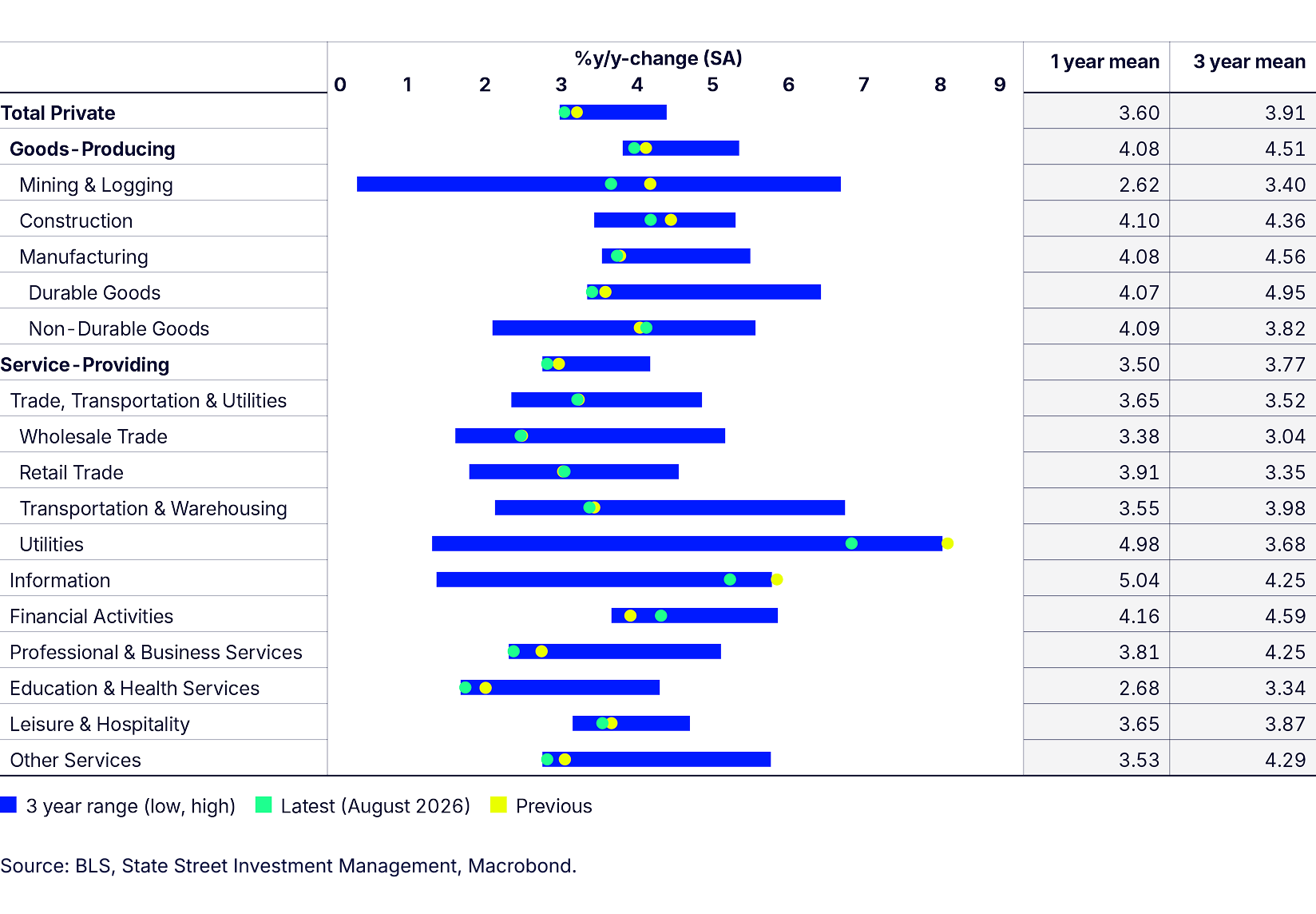
This is what the August numbers showed: the economy added 162k jobs (Bloomberg consensus anticipated 55k) and the prior two months were revised upward by a cumulative 55k. Goods producing sectors added 41k jobs, while private service industries added 86k. The pickup in goods services employment is notable, as is its growing relative contribution to overall employment gains. It seems unlikely to us that the pace of this improvement can be sustained, but time will tell. Within services, performance was mixed. There were job losses in financial services (-11k) and information (-23k) that partly offset an unexpectedly large gain in leisure and hospitality (+62k). Government employment rose by 35k, mostly in the state and local space.
The participation rate picked up two tenths, but the unemployment rate held steady at 4.1%, which is simultaneously good news and a bit puzzling insofar as this combo hints at potential data issues. On one hand, we had been looking for an increase in the participation rate given how rapid and severe the recent downshift has been. On the other, the fact that this increase in the labor force overwhelmingly reflected a rise in people in employment raises questions about its sustainability.
Figure 1: US nominal average hourly earnings
Importantly, despite the pickup in employment, wage inflation remains very well contained. In fact, overall average hourly earnings (AHE) inflation eased to 3.1% YoY in August, down from 3.7% YoY in January. AHE inflation for production and nonsupervisory employees held steady at 3.3% YoY. The message is clear: the labor market is not a source of inflationary pressures. Typically, this should be very reassuring for the Fed…except Chair Warsh downplayed the importance of wages as inflation drivers in his Jackson Hole speech.
In conjunction with a strong read on non-manufacturing ISM index, the balance of this week’s data nets out on the positive side and would likely boost the odds of a September hike. But data was partly offset by more neutral comments from Fed Vice Chair Williams and from Governor Waller that seemed to imply a preference for a September hold. Admittedly, both those comments were made prior to the employment report. All this puts enormous weight on the August CPI inflation data to be released next week. We align with consensus on expectations for a 0.4% MoM increase in the headline (largely energy driven) and a 0.2% MoM rise in the core.
UK: Gilt shock
A renewed energy shock is tightening UK financial conditions. US strikes on Iran drove oil and natural gas prices sharply higher, fueling inflation concerns and expectations of further rate increases. By midweek, gilt yields had climbed to a multi-year high before easing on Thursday.
The timing is difficult for new chancellor John Healey. Ahead of his first Budget on October 28, higher borrowing costs have further constrained his already limited room for maneuver. Since March’s Spring Statement, the conflict has pushed market expectations from rate cuts towards further increases, driving gilt yields materially higher.
The squeeze is now reaching households, with quoted mortgage rates rising sharply since the conflict began. Housing activity has weakened: mortgage approvals fell to 56k in July, while net lending dropped to £4.3bn, below the previous six-month average.
Higher yields are impacting housing affordability and stalling the recovery in the housing market. With mortgage rates unlikely to ease materially before later next year, demand should remain subdued. Restricted supply will cushion prices, but the near-term outlook is stagnation rather than renewed growth
Australia: A hike this month?
Q2 GDP growth came in a tenth stronger than our forecast at 0.4% QoQ, presenting a mixed picture of an economy that is slowing, but not yet slowing decisively enough. On a two-quarter annualized basis, growth has lost momentum, easing to 1.4%, while annual growth remained relatively firm at 2.1% YoY. Although this was four tenths lower than in Q1, it was still two tenths above the Reserve Bank of Australia's (RBA) latest Statement on Monetary Policy forecast.
Nominal GDP growth also remained solid at 5.3%, while real household disposable income improved to 2.3% YoY from 1.9%. Domestic demand, our key focus, grew 0.3% QoQ and household consumption rose 0.4% QoQ. However, annual household consumption growth slowed to 1.8% YoY, falling below 2.0% for the first time in five quarters. Taken together, the data suggest demand is moderating, but not at a pace likely to provide the RBA with complete comfort. The composition of consumption further complicates the policy assessment. A large part of the increase in household spending reflected a sharp 10.3% QoQ jump in vehicle purchases, largely electric vehicles according to the ABS. At the same time, the household saving ratio edged up to 6.5%, indicating that consumers remain relatively cautious despite continued spending growth.
Business investment was weaker beneath the surface. Machinery and equipment investment fell 5.6% QoQ following Q1's data center-driven surge. However, this was largely offset by a 4.1% increase in non-residential construction, which likely also reflects ongoing data center activity. As a result, total new business investment subtracted only 0.5 percentage points from growth.
Residential construction remained a notable bright spot, rising 1.6% QoQ and lifting annual housing investment growth to a three-year high of 6.3% YoY. A substantial pipeline of work should keep the sector an important growth anchor over coming quarters, although it is also likely to sustain pressure on new dwelling cost inflation.
Trade made a modest positive contribution. Strong growth in imports of electric and hybrid vehicles (37.6%) and fuel imports (5.7%) was more than offset by a surprisingly firm 1.4% rise in goods exports, resulting in net exports contributing 0.1 percentage points to GDP growth.
Overall, the report contains enough signs of resilience to leave the RBA uncomfortable with the pace of economic cooling. If August employment data surprise on the upside, the case for a September rate hike strengthens materially, a scenario we view as a genuine possibility. Such a move would lift the cash rate to 4.60%, a new post-pandemic peak. While we do not yet see a compelling case for further tightening beyond that, it remains difficult to rule out given the limited evidence of disinflation and the still-gradual moderation in economic activity.
Spotlight on next week
- ECB set to hike again.
- US inflation data to decide Fed’s next move.
- Japan’s Q2 GDP to be revised up marginally.

Catch the whole story...
There's more to the Weekly Economic Perspectives in PDF. Take a look at our Week in Review table – a short and sweet summary of the major data releases and the key developments to look out for next week.