
Three shifts reshaping Technology—and portfolios
Three shifts: rotation from Tech to old economy sectors; AI driven dispersion in Tech; and higher risk from Tech concentration are underscoring the value of diversification.

Markets move quickly, and that can blur investor’s vision. So, let’s zoom out a bit and try to see the bigger picture.
There’s no shortage of commentary on the Technology sector, particularly around what artificial intelligence (AI) means for the largest hyperscaler names. But today’s market dynamics extend well beyond a handful of glamour stocks or forecasts of AI’s productivity promise.
Below are three big picture takeaways from recent market trends—insights that extend beyond hyperscalers, valuation multiples, and AI growth forecasts to help inform more resilient portfolio positioning.
1. Technology no longer leads the market
The old economy is cool again. In recent months, old economy and manufacturing and asset heavy sectors have rebounded relative to new economy sectors like Technology.
Since the end of October 2025, Industrials, Materials, and Energy have outperformed the Tech sector by more than 20%, 31%, and 32%, respectively (Figure 1).1 On a trailing three-month basis, Energy’s 24% outperformance versus Tech sector ranks in the 93rd percentile over the past 35 years.2
Importantly, this rotation is not purely cyclical. It reflects a combination of fundamental and macroeconomic forces—some of which are increasingly structural.
On the fundamental side, concerns around exuberant capital spending and rising debt issuance have weighed on headline Tech sentiment, despite strong earnings results. At the same time, many old economy sectors have delivered solid earnings so far this season. Industrials and Materials companies are posting double-digit bottom line growth, while Energy’s earnings have come in better than expected at the start of the year.3
From a macro perspective, easy monetary policy has supported growth and, in turn, cyclical market segments, with Industrials being a prime beneficiary. Fiscal spending initiative, especially in defense, have provided additional tailwinds, There is also a more structural shift: the rewiring of global trade and supply chains. These changes have put upward pressure on commodity prices, benefiting natural resource sensitive sectors like Energy and Materials.
Key takeaway: This shift in market leadership may have seemed unfathomable to many investors in 2024 and 2025, when the prevailing narrative was “tech or bust.” It’s a reminder of how difficult it is to predict the future, how quickly winners and losers can change, and how challenging it is for any sector to remain on top indefinitely. It also reflects growing investor impatience with the timeline for returns on the massive wave of AI related spending.
2. AI is amplifying volatility in Technology
Identifying the ultimate winners and losers of AI remains extraordinarily difficult—not just among AI leaders themselves, but across the broader economy.
The recent bear market drawdown in the software industry—down roughly 20% in 2026 following the release of Anthropic’s Claude Code and Claude Cowork—underscores this uncertainty.4 Notably, this disruption occurred in an industry in the Technology sector, highlighting how AI can have the potential to disrupt even peer-like firms.
Ambiguity over eventual AI leadership and software’s drawdown have produced a market dynamic rarely seen outside of major inflection points. Return dispersion across the 11 Technology sub industries has surged to extreme levels, reaching the 92nd percentile historically (Figure 2).
This level of dispersion has occurred only during the COVID-19 pandemic, the Great Financial Crisis, and the dot-com bubble. Three major memorable market events that have historically coincided with broad market meltdowns. But, today, the market is up, making this level of dispersion extremely noteworthy.
In hindsight, this period will be viewed as the point at which a structural divide emerged within the Technology sector—driven not by external forces, but by innovation originating in the sector itself. As AI reshapes competitive dynamics, Technology appears to be fragmenting into firms that are successfully translating AI investment into sustainable growth and those that are not.
Key takeaway: Elevated dispersion serves as a reminder that sector membership alone does not guarantee uniform performance. Even if sectors share similar macroeconomic and fundamental exposures, outcomes can vary meaningfully. For investors, this creates opportunities to harness dispersion through targeted industry selection within sectors.
3. Portfolio vulnerability exposed
The challenge with a self inflicted setback within the Technology sector is that, due to its outsized weight in broad equity benchmarks, many investors may be more exposed to this risk than they realize. Technology’s share of both US and global equity markets sits at generational highs—at a time when US households also hold record levels of corporate equity exposure. This concentration stands in contrast to the notion of a broadly diversified investor base (Figure 3).
This level of ownership hasn’t proved problematic; US equity markets have had double-digit annual returns in six out of the last seven years.5 Yet household wealth remains more sensitive to market fluctuations than any other point in recent history.
This Goldilocks-like positioning extends beyond household wealth. Seventy percent of all ETF and mutual fund assets are invested in equities—namely US equities.6 Our State Street Institutional investor holdings indicator for equity allocations is at its highest point since 20077 and levered investors have rebuilt positions from mid-2026 and are currently extended as well.8
With all this wealth invested in the market, any drawdown—particularly Technology led weakness, given the sector’s disproportionate contribution to overall returns—has the potential to create cascading effects. These may include pressures on consumer spending, labor formation, and aggregate economic growth. The resulting policy response is also uncertain: low interest rates or fiscal stimulus could provide short term relief, but at the cost of worsening fiscal imbalances. In that context, weakness in Technology may represent not an isolated event, but the first domino.
Key takeaway: What may appear to be isolated weakness within Technology could translate into broader portfolio pressures, given the sector’s outsized role in market returns. That risk can be mitigated by reassessing asset allocations and seeking greater diversification and balance across assets, geographies, and economic environments. As with sectors, no single asset class remains dominant indefinitely.
Making the big picture clearer
The throughline of these takeaways is that we are investing during a period of profound transition and transformation—marked by seismic changes in macroeconomic frameworks, a move from international cooperation toward greater isolation, and technological innovations with still unknown social and economic impacts.
With this level of uncertainty on the horizon, forecasting future winners feels like looking into a car’s side-view mirror and seeing things as all clear—without recognizing the blind spots just outside the frame. In that context, balanced diversification remains the most reliable safeguard: a way to broaden perspective, manage uncertainty, and navigate what lies ahead with greater confidence.
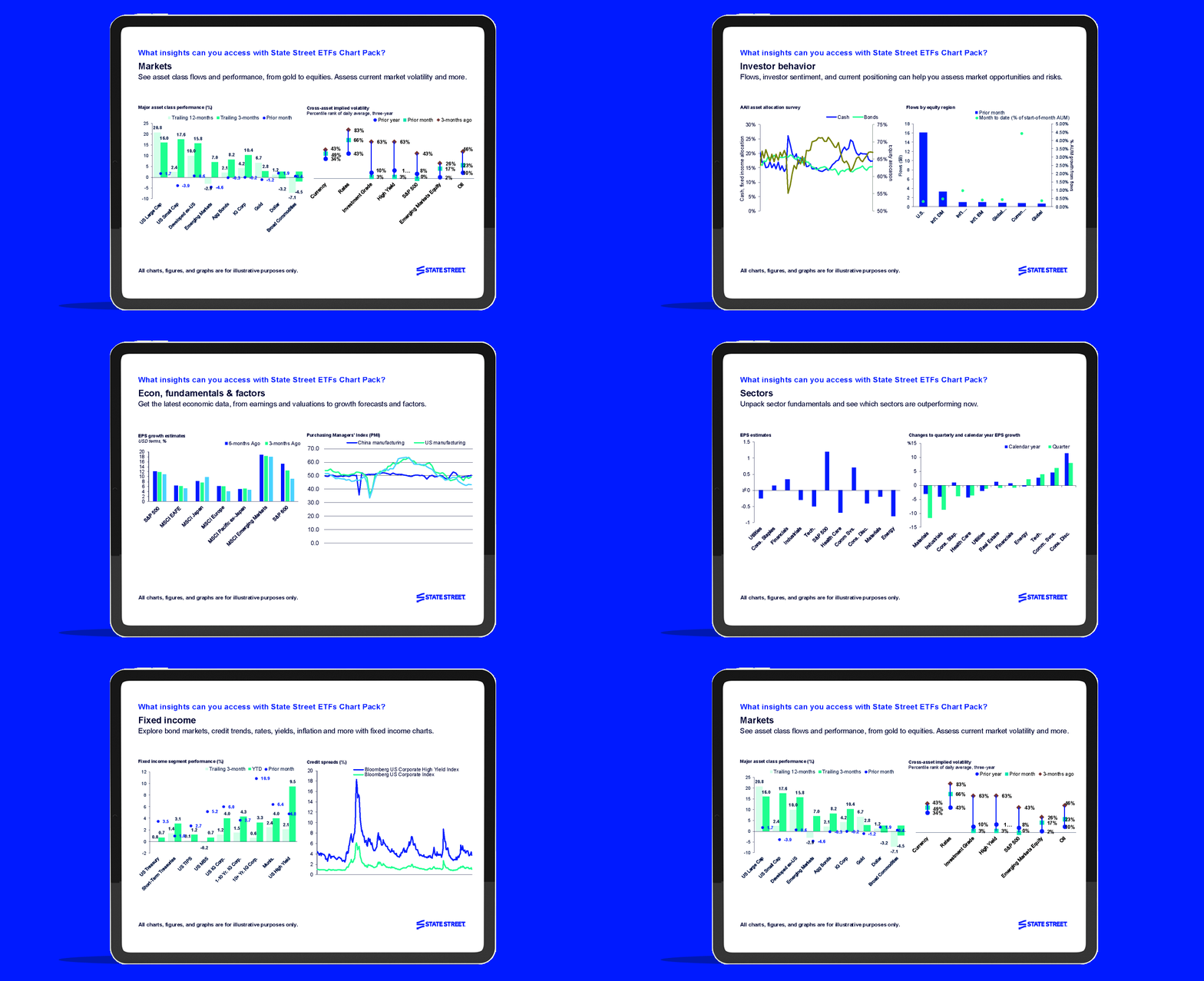
Chart Pack
An easy way to visualize the latest market movements.