
Three market trends to watch beyond war-driven headlines
Look beyond conflict-driven market moves. Explore three structural trends shaping returns: non-US equities, US corporate re-leveraging, and sticky inflation.

The war in Iran has dominated headlines, market narratives, and asset repricing over the past six weeks—fueling both peace-driven rallies and conflict-related pullbacks. Given the uncertainty created around rates, inflation, growth, and sentiment, that focus is understandable.
But when markets fall into a monoculture mindset, longer-term structural trends can fade into the background. Beyond Iran, here are three bigger picture trends I continue to monitor:
1. Non-US markets are still in the driver’s seat
Non-US equity markets are outperforming the US by roughly 6% to start 2026,1 a sharp break from the recent past. Prior to June 2025, the S&P 500 Index outperformed the MSCI ACWI ex-US Index in 80 of the last 85 rolling 12-month return periods,2 extending a run of consistent US leadership that began in 2018.
Since then, as a rapidly shifting macro paradigm has replaced global cooperation with more state-driven capitalism and competition, that leadership has begun to change. Non-US stocks have now outperformed the US in seven consecutive rolling 12-month periods—the longest stretch since 2008.3
This trend has endured the volatility, dispersion, and growth/inflation/policy uncertainty amplified by the war in Iran. And it has breadth. Of the 46 non-US countries in the MSCI ACWI Index, 72% are beating the US so far in 2026.4 That hit rate is slightly below the 76% of non-US nations that beat the US in 2025.5
More broadly, the average return across those 46 countries is 10% versus 3% for the US.6 This deep reversal began in 2025 after years of a US return advantage (Figure 1).
Big picture: Over the past 18 months, independent of the war, the larger macro backdrop has materially shifted. A narrow, US-led, low-volatility environment has evolved to a more complex setting shaped by intersecting growth and inflation risks, evolving trade and supply-chain dynamics, renewed monetary policy uncertainty, more frequent geopolitical risk events, and rapid technological change (artificial intelligence).
The current regime looks profoundly different from the recent past, and equity leadership has shifted accordingly. Yet, many investors were not positioned for this, particularly given how concentrated portfolios had become in US equities. Today, geographical diversification has taken on greater importance for balance and resilience in a more complex world.
2. US firms are quietly re-leveraging
Despite fragile market conditions, US corporate debt issuance rose 16% year-over-year through the first quarter of 2026.7 Q1 2026’s issuance of $775 billion was the largest quarterly total since Q2 2020.8
Rising M&A pipelines (US M&A activity is up 25% year-over-year) and hyperscalers tapping debt markets to fund AI and cloud capital expenditures are supporting this trend.9
For example, S&P 500 information technology firms have seen total debt rise 18% over the last eight quarters, versus 13% for the average non-financial firm.10 Taken together, these debt-issuing dynamics may persist if expectations for an AI-driven productivity miracle continue to fuel a resource race for AI leadership and the need for capital.
Debt issuance is only one side of the ledger, and many of the firms driving issuance are also generating robust earnings growth. To frame issuance relative to earnings, net-debt-to-EBITDA can be a useful gauge, as it approximates how quickly a company could pay down net debt using operating cash flow.
Even with strong profitability over the past six quarters (S&P 500 firms are poised to post six consecutive quarters of double-digit earnings growth),11 a quiet re-leveraging trend has emerged after post-pandemic deleveraging.
While leverage is nowhere near extremes, net-debt-to-EBITDA is approaching pre-pandemic levels, with the pickup more prominent in large caps than small caps amid AI- and M&A-driven financing (Figure 2).
Big picture: Years of elevated government borrowing to stimulate economies, fund ongoing spending needs, and support self-sufficiency in the new macro backdrop have steepened yield curves and lifted term premiums. That public issuance trend is unlikely to change: the IMF projects global debt will go above 100% of global GDP within three years. US debt is already around 125% of GDP and projected to exceed 140% over the same horizon.12
Until recently, private-sector borrowers (e.g., corporations) had not participated meaningfully in this debt wave. That is slowly changing, partly driven by a win-at-all-costs push for AI leadership. If this mentality persists, corporate issuance and re-leveraging could continue while Treasury curves shift higher due to public indebtedness.
The key risk is that debt is being taken on to fund future growth at the expense of current cash flow and debt servicing costs may rise. If that future growth fails to materialize at the high level that is expected—as the AI endgame is very uncertain—higher debt-service costs could ultimately weigh on the US growth engine or have asymmetric effects on the presumed “AI-leaders” of today. This supports the case for a diversified AI exposure.
3. Inflation may be “sticking” around
US inflation surged in March by the most in nearly four years, as energy prices spiked following the start of the war in Iran. Near-term breakeven inflation rates rose to the highest level since the 2022 post-pandemic highs, then receded on the back of peace talks.13
That reversal may suggest the inflation pop is more temporary than structural. But it risks underestimating the non-war forces that can keep inflation elevated—including the rewiring of supply chains and trade, as well as heavy spending on critical AI inputs that are pushing up prices across multiple categories.
Those pressures show up in the latest PPI details: sub-categories such as “components for manufacturing,” “manufacturing supplies,” and “processed materials ex-food and energy” registered their largest monthly increases since the immediate post-pandemic period.
Structural forces that may keep inflation above the Federal Reserve’s 2% target also appear in slower-moving measures. The Atlanta Fed’s Sticky CPI series just rose after falling in prior months due to base effects and the lagged pass-through of higher rates post 2022. More importantly, Sticky CPI ex-shelter has resumed an upward trajectory since its trough on Liberation Day in April 2025 (Figure 3).
Big picture: With energy prices driving near-term inflation, other forces may keep inflation more stubborn and closer to 3% than 2%. An additional complication is measurement: the share of CPI values imputed from a different cell is 39%, versus roughly 10% before shutdowns and department cuts impaired survey collection.14
Taken together, you have an upward bias, geopolitical uncertainty around a critical input (energy), and more estimation embedded in a vital macro indicator. This underscores the need for portfolios to have sufficient inflation resilience to handle moves in either direction across a wide range of inflation-driven outcomes.
Reading beyond the headlines
Fast-moving headlines can distract from slower-moving trends. Looking beyond the dominant market narrative can help surface other portfolio-relevant dynamics and clarify which trends may prove enduring, or even be accelerated by today’s monoculture moment.
For more examples of these beneath-the-surface trends, see the Monthly Chart Pack.
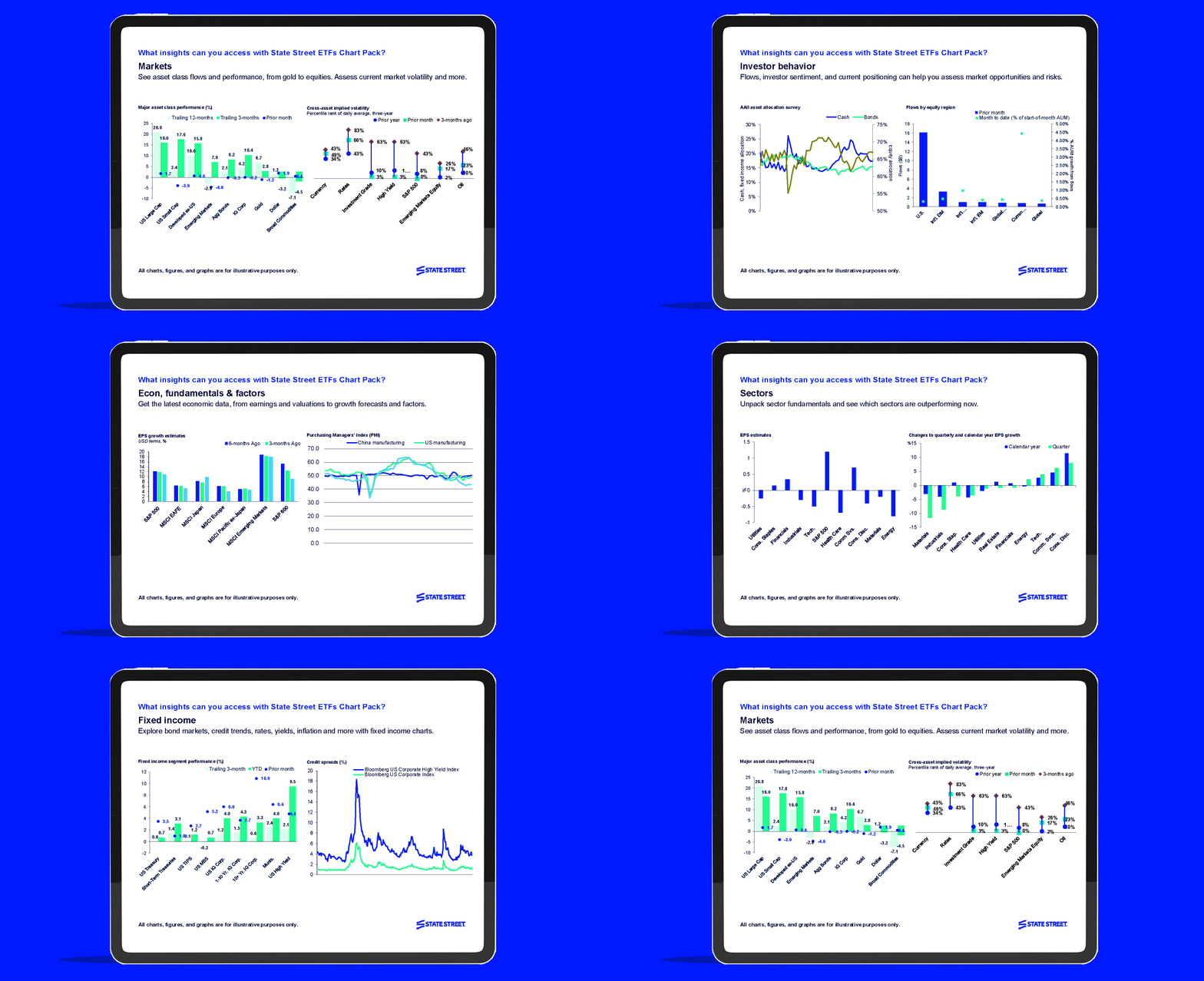
Chart Pack
An easy way to visualize the latest market movements.