
ETFs on the rise: The investment choice revolutionizing portfolios
Exchange traded funds (ETFs) have emerged as a transformative investment vehicle, gaining substantial traction in recent years. While early ETFs provided broad, index-based exposures that quickly became core portfolio building blocks, the vehicle has evolved to include more specialized and targeted strategies. Today, ETFs attract attention from retail and institutional investors in the US and around the world.
Driving evolution within financial markets
The ETF has come a long way since its humble beginnings more than 30 years ago as an innovative tool for tracking market indexes. In fact, today, ETFs are a cornerstone of finance within the United States and around the globe—with global assets reaching more than $18 trillion and continuing to grow at a record pace.1
Innovation across the board
Over their short history, ETFs have garnered substantial attention and assets worldwide as they support a growing number of investment strategies—including active management, factor-based strategies, and thematics—covering everything from traditional asset classes to specialty markets and innovative sectors like technology and alternatives.
Behind their robust, decades-long evolution lies growing investor demand for transparency, liquidity, and cost efficiency, coupled with the desire for more specialized investment solutions.
The rapid expansion of ETFs across various asset classes and the introduction of novel ETF structures—from derivative-based strategies to outcome-focused products and spot exposures to commodities and currencies—highlights the industry’s ability to adapt and meet a wide range of investor needs.
As a result, ETFs have become instrumental in democratizing access to investments, enabling retail and institutional investors alike to tailor their portfolios with once-unimaginable precision and flexibility.
“ETFs aren’t just growing, they are absorbing the broader asset management industry. And the next frontiers—new geographies, new investor segments, new structures, new delivery mechanisms—are only beginning to come into view.”
- Michael Arone, Chief Investment Strategist
US retail investors are driving ETF adoption
ETFs have seen remarkable growth in popularity over the past decade, increasingly fueled by a new generation of investors.
In the US, retail investors are emerging as a primary force behind ETF adoption, supported by easier access to markets, digital-first investing platforms, and lower barriers to entry. At the same time, ETFs have been around long enough that many newer investors have grown up with them already embedded in their portfolios—making them a familiar and intuitive starting point for building long-term wealth.
This generational shift is already visible in adoption data. The number of US households owning ETFs has grown from just 0.9 million in 2005 to 16.9 million in 2024,2 underscoring the role ETFs now play in everyday investing.
Figure 1: ETF adoption has surged among US households
Number of US households owning ETFs (millions)
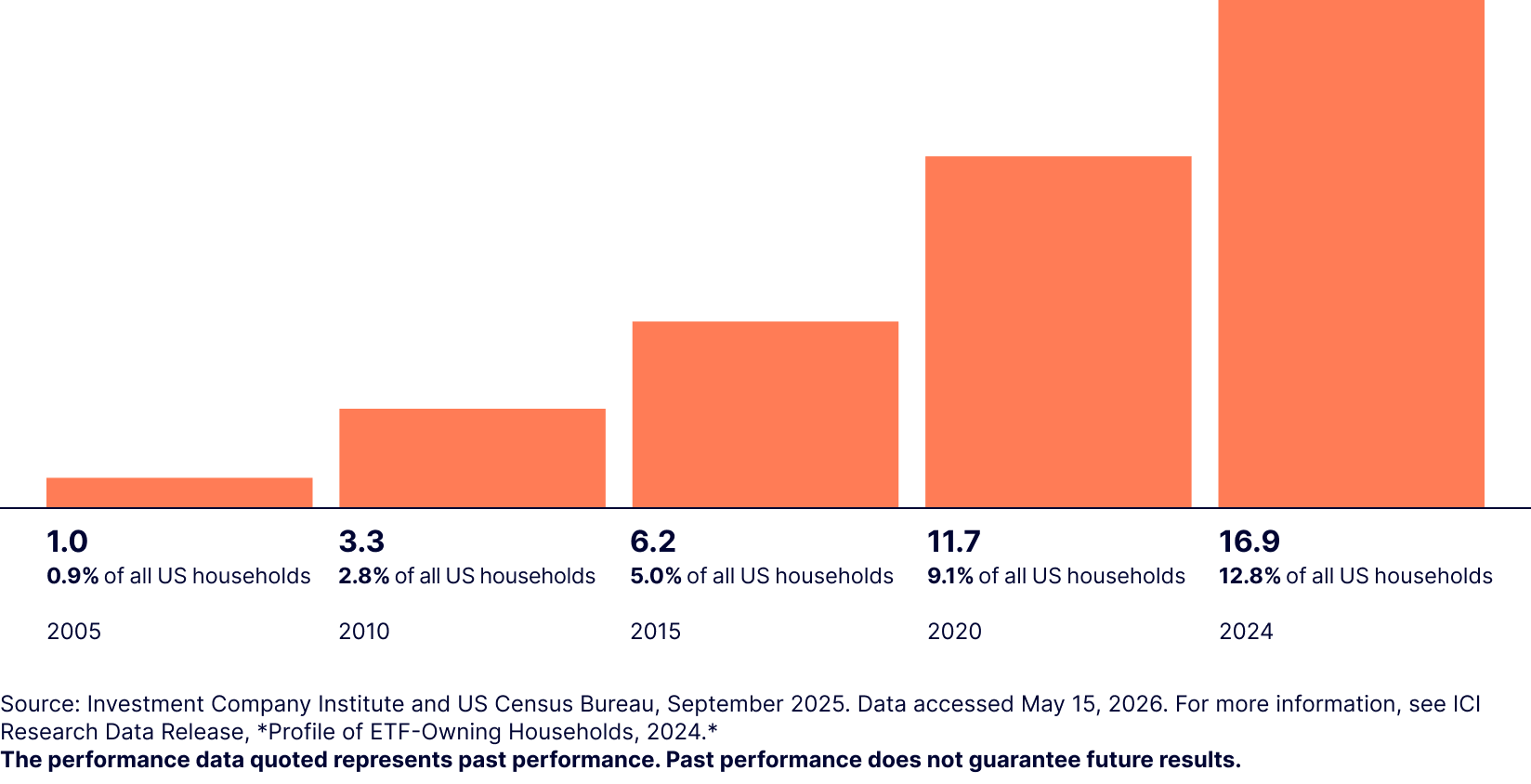
As wealth continues to transfer across generations and younger investors enter the market earlier through vehicles like custodial accounts, Trump Accounts, and education savings plans, ETFs are becoming the default investment vehicle for a growing number of investors.
“The next chapter of this industry’s growth is being written by everyday investors opening brokerage accounts on their phones to help build long-term wealth. It’s all fueled by an ETF structure that’s simple enough to be intuitive, yet robust enough to scale across generations.
And with Trump Accounts, long-term, tax-advantaged vehicles designed to jump-start investing for children, ETFs could shape how an entire generation experiences investing from the very beginning.”
- Matthew Bartolini, Global Head of Research Strategists
Why are ETFs a preferred choice among investors?
Several compelling factors are driving broader adoption of ETFs, making them a favored investment vehicle for institutional and retail investors alike.
ETFs offer inherent diversification by pooling various assets into a single fund, which can track a specific index, sector, commodity, or even a country’s economy. This feature allows investors to spread their risk across multiple assets without needing to buy each one individually. For example, an ETF that tracks the S&P 500® gives exposure to 500 different companies, providing instant diversification.
Compared to mutual funds, ETFs typically have lower expense ratios due to their passive management style. This means investors can enjoy broader market exposure without the high fees associated with actively managed funds. The cost savings on management fees and reduced transaction costs make ETFs an attractive choice for cost-conscious investors.
ETFs are traded on major stock exchanges, just like individual stocks. This trading flexibility allows investors to buy and sell ETF shares throughout the trading day at market prices—offering investors more control over investment decisions and enabling strategies such as tactical asset allocation and liquidity management.
ETFs are known for their high liquidity, or their ability to be easily bought and sold in large quantities without significantly affecting their market price. This liquidity is particularly appealing to institutional investors who need to manage large volumes of assets efficiently. The ability to get in and out of markets quickly ensures that ETFs remain a flexible and responsive tool in portfolio management.
Beyond core portfolio construction, ETFs are utilized to access innovative and specialized investment strategies. Today, investors can use ETFs to pursue specific outcomes—such as generating income, managing downside risk, hedging inflation, or gaining exposure to alternative asset classes all within a single, transparent structure. This expansion of use cases reflects a broader shift: investors are no longer just selecting market exposures. They’re using ETFs as tools to build portfolios aligned with specific goals and outcomes.
Signs of continued ETF growth ahead
The exponential growth of ETFs reflects their versatility and robust appeal across different types of investors. Financial advisors and institutions have long embraced ETFs—and now, individual investors are following suit.
As access expands and awareness grows, ETFs’ role in portfolios is expected to deepen across generations and investor segments.
Plenty of room for ETF growth and adoption
Even given their explosive growth over the past three decades, ETFs still have a long runway for adoption—ETFs currently represent roughly 14% of global investable assets, underscoring significant room for further expansion.3
Now with more than $18 trillion in global assets,4 more than 14,000 ETFs available worldwide,5 and growth tracking approximately 18% ahead of the 10-year forecast we made last year (Figure 2),6 ETFs continue to scale across both markets and investor segments.
Figure 2: Global ETF AUM growth is outpacing our original expectations by 18% ($, trillions)
Last year’s 10-year projection versus this year’s updated forecast
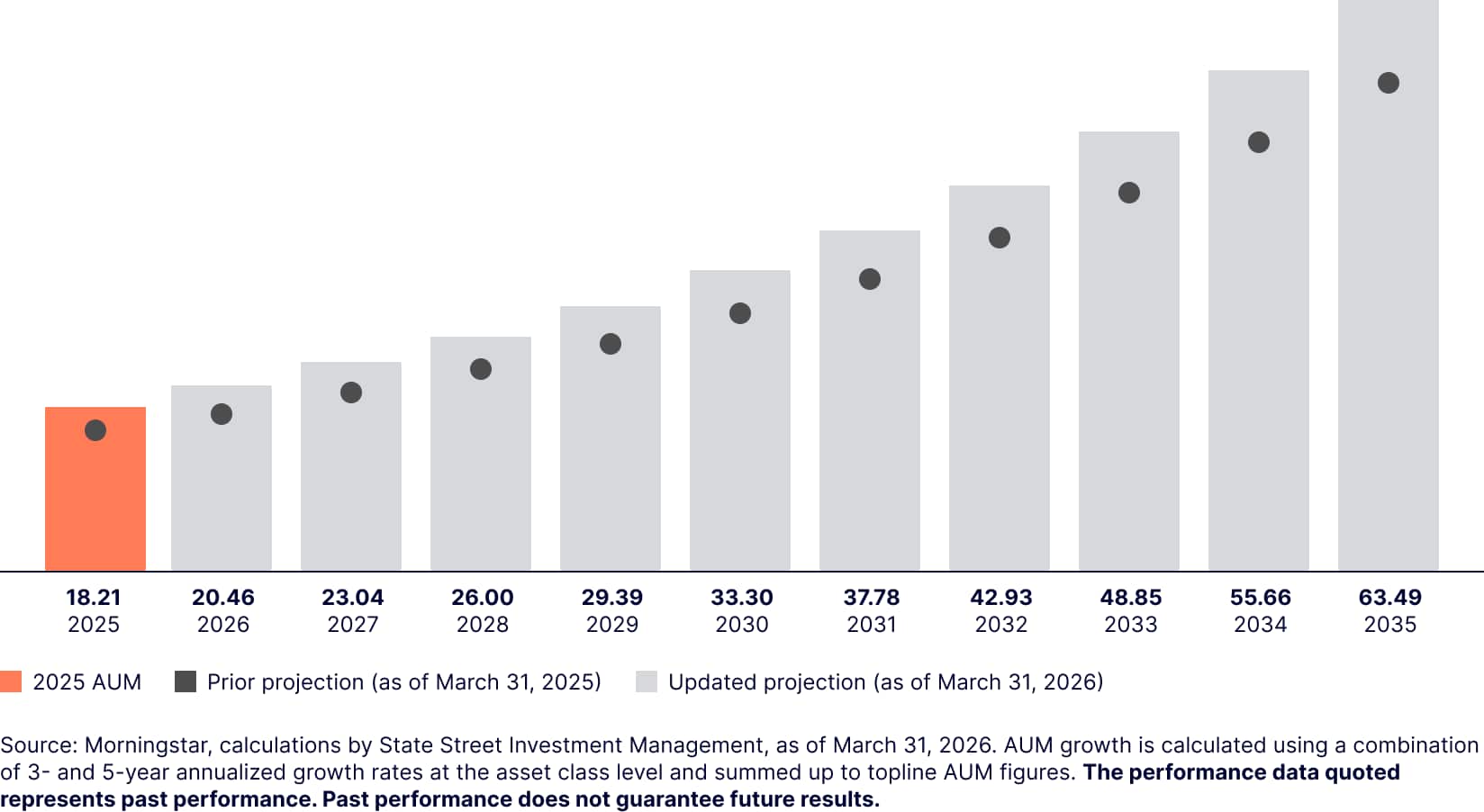
As we look to the future, we predict that ETF assets will reach nearly $64 trillion by 2035.7 And as product innovation accelerates and access expands, investors can gain exposure to a wide range of markets, strategies, and outcomes through these highly liquid, cost-effective, and highly transparent portfolio building blocks.

What’s next for ETFs?
Get top ETF trends and our bold predictions for the future of ETF growth inside our ETF Impact Report 2026-2027.