
Why ETF growth is booming
From their ability to help democratize investing access to their liquidity and unique in-kind structure, ETFs offer investors a diverse set of benefits. And having demonstrated their resilience over the past three decades, ETFs continue to attract a growing number of investors. Read on to discover why.
The original ETF innovation sparked remarkable industry growth
State Street Investment Management is proud to have launched the State Street® SPDR® S&P 500® ETF Trust (SPY)—the first US-listed ETF—in 1993 in response to the 1987 market crash known as “Black Monday.” At that time, the industry consisted of a single product tracking a single index. What distinguished SPY wasn’t the exposure it delivered, but the structure behind it.
Over the three decades that followed, that structure has supported a growing global ecosystem of more than 14,000 ETFs, representing $18.49 trillion in assets worldwide1—with product offerings stretching across geographies, demographics, investment strategies, asset classes, and everything in between.
Figure 1: ETFs by the numbers
in assets under management
ETFs worldwide
major Morningstar asset classes
Source: Bloomberg Finance, L.P., Morningstar, as of March 31, 2026.
ETFs offer investors several key advantages
The global ETF market has come a long way since the launch of the first index-linked fund. Today, ETFs play a central role in portfolio construction—used by investors to gain efficient exposure, implement strategies, and manage portfolios with precision.
A best-of-both-worlds structure
ETFs are a hybrid investment: trading like stocks while offering the diversification benefits of mutual funds.
But unlike mutual funds, ETFs can be bought and sold throughout the trading day on an exchange. Many track indexes and typically have lower fees than mutual funds, offering diversified, transparent, and tax-efficient exposure in a single trade.
Figure 2: ETFs can offer the best of both worlds
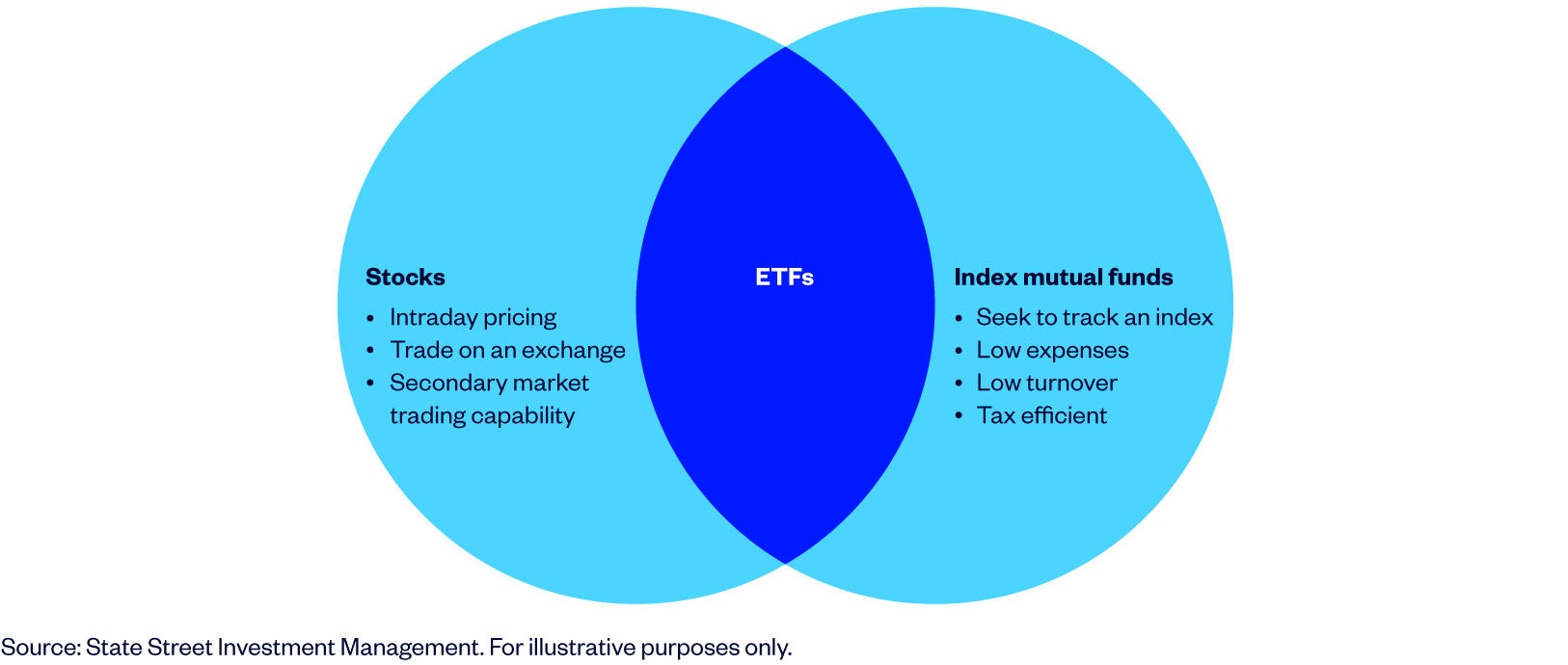
Figure 3: How ETFs compare to mutual funds and individual stocks
| ETFs | Index mutual funds | Individual stocks | |
|---|---|---|---|
| Track an index | Yes | Yes | No |
| Provide diversification | Yes | Yes | No |
| Median net expense ratio | 0.58% | 0.90% | N/A |
| Pricing | Market price | Closing net asset value (NAV) | Market price |
| Intraday trading | Yes | No | Yes |
| Minimum investment | No minimum required* | Some require minimum investments | No minimum required* |
| Tax treatment | Low impact on shareholder’s level | High impact on shareholder’s level | Impact on individual level only |
Source: Morningstar, as of March 31, 2026. The median US-listed ETF expense ratio is 0.58% compared to the median US-listed mutual fund expense ratio (oldest share class) of 0.90%.
*The brokerage through which you purchase ETFs or individual stocks may have a minimum account requirement.
Equal access to markets
ETFs can provide access to financial markets, enabling investors—from individuals to institutions—to build diversified outcome-oriented portfolios using a wide range of exposures.
With ETFs, investors can gain exposure to a full spectrum of investment strategies—including active management, factor-based strategies, and thematics—and everything from traditional asset classes to specialty markets, including innovative segments like sectors at the forefront of AI innovation, digital assets, and private markets.
The proliferation of ETFs across various asset classes and the more recent introduction of novel ETF structures, from strategies that use derivatives to spot-based commodity and currency exposures, highlight the industry’s adaptability and ability to meet diverse investor needs.
Use cases that meet investors’ diverse needs
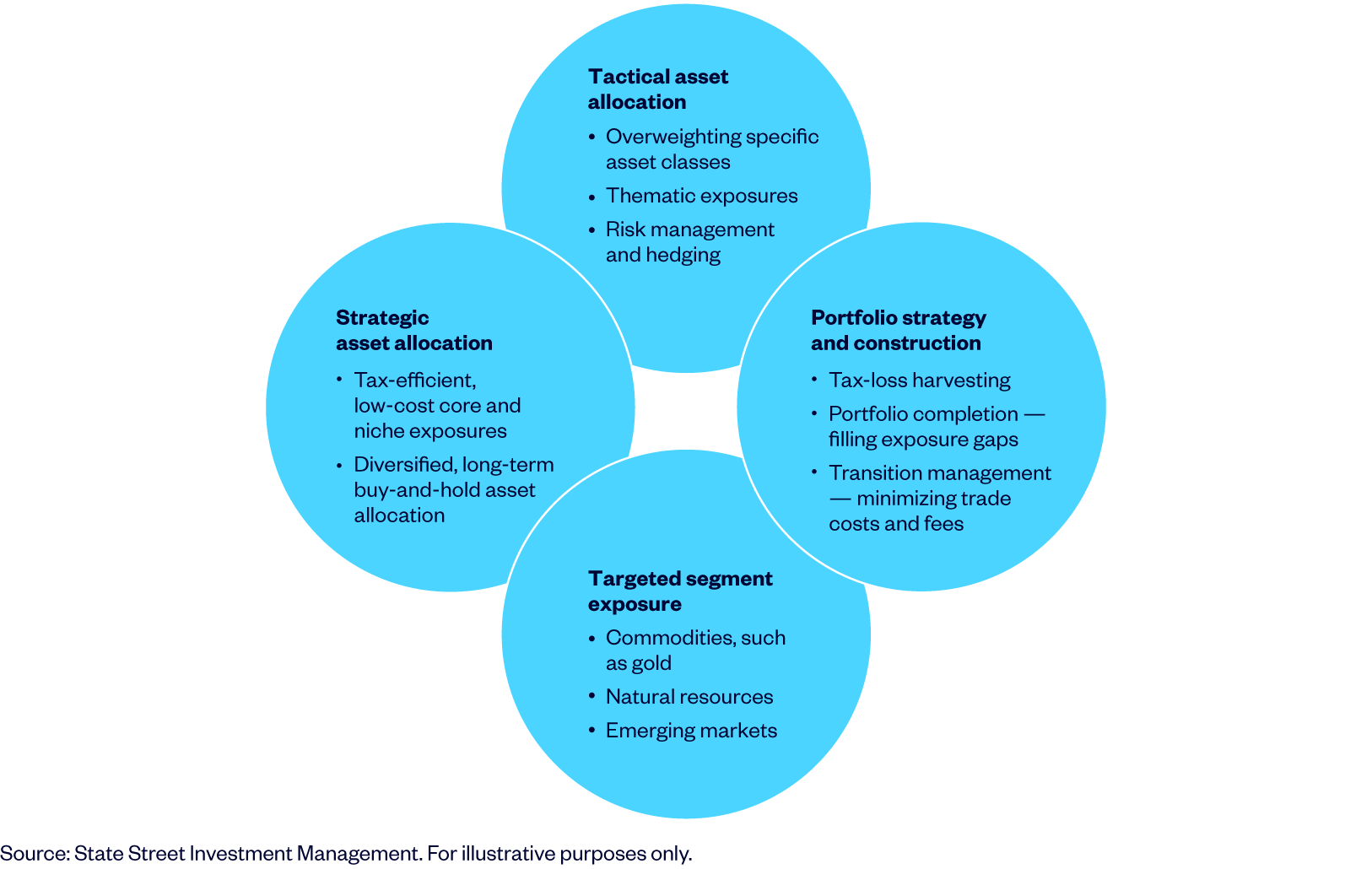
Today, ETFs have become key building blocks for asset allocation decisions. They allow investors to pursue a wide range of portfolio outcomes with greater efficiency. Increasingly, investors are using ETFs as flexible tools to respond to market conditions—leaning in, leaning out, hedging, or holding steady depending on their objectives.
From strategic asset allocation to risk management, ETFs offer a myriad of use cases that can help investors pursue their investment objectives, showcasing the versatility and effectiveness of these investment vehicles (Figure 4).
Figure 4: ETF use cases for traditional investors
ETFs’ surging popularity has also given rise to remarkable liquidity—making them powerful trading tools, especially amid periods of market volatility.
Record growth reinforces investors’ confidence in ETFs
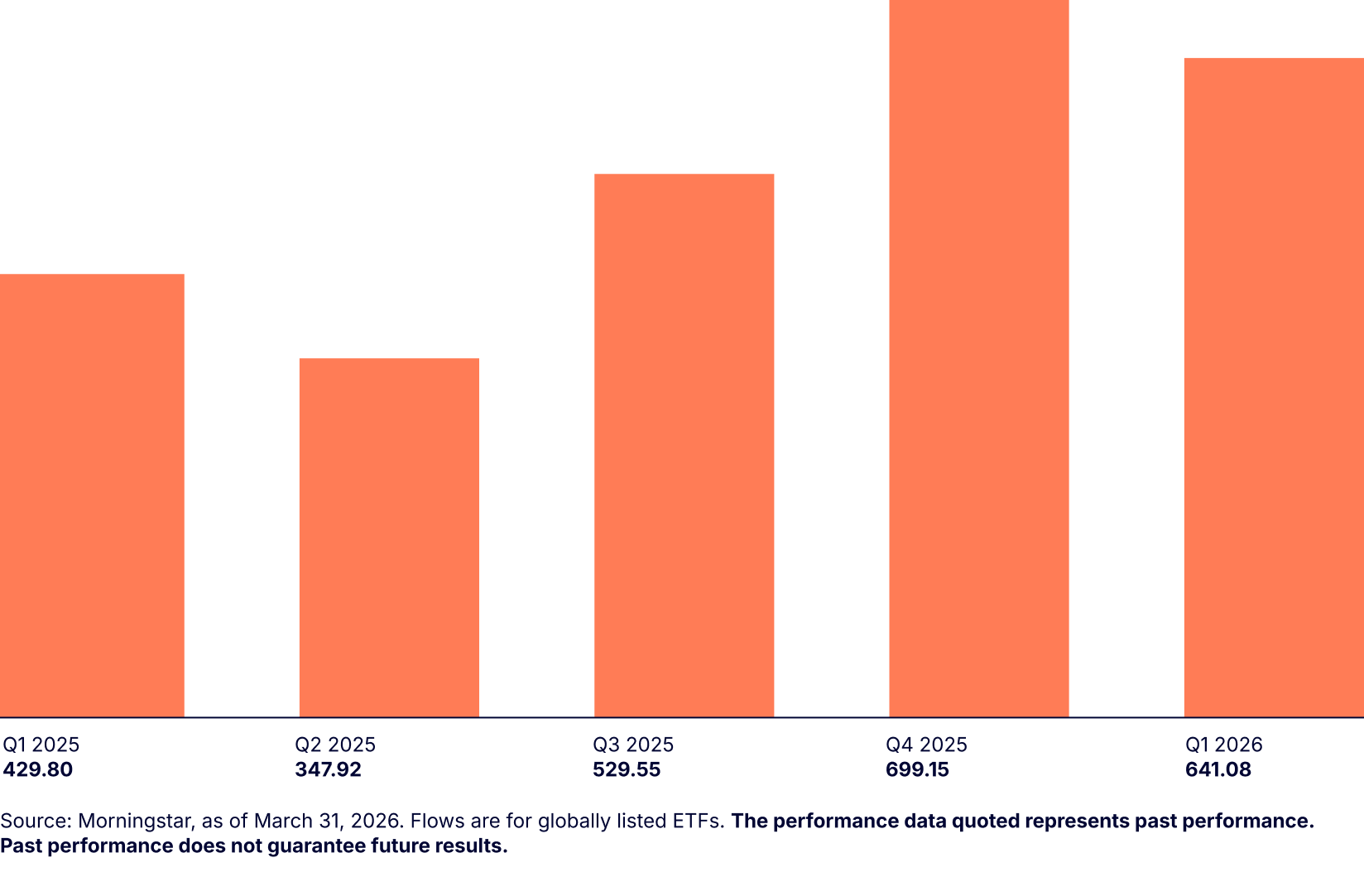
ETFs wouldn’t be attracting record levels of inflows and attention if investors weren’t finding real value in them. In 2025, ETFs gathered a record $2 trillion in inflows globally,2 far exceeding prior highs and underscoring strong demand across market environments.
Momentum has continued into 2026, with $641 billion flowing into ETFs in the first quarter alone,3 even amid heightened volatility and geopolitical uncertainty. When inflows remain strong during uncertain periods, it highlights the structural role ETFs now play in portfolios.
Figure 5: Global ETF flows by quarter ($, billions)
This surge in adoption reflects a broader shift in how ETFs are used. What began as a way to access broad market exposure has become a way to engineer outcomes—whether that’s generating income, improving diversification, or managing downside risk.
Together, these trends point to a clear conclusion: ETFs are no longer just growing in popularity—they have become relied-upon building blocks for modern portfolio construction.
ETF growth is accelerating—with more to come
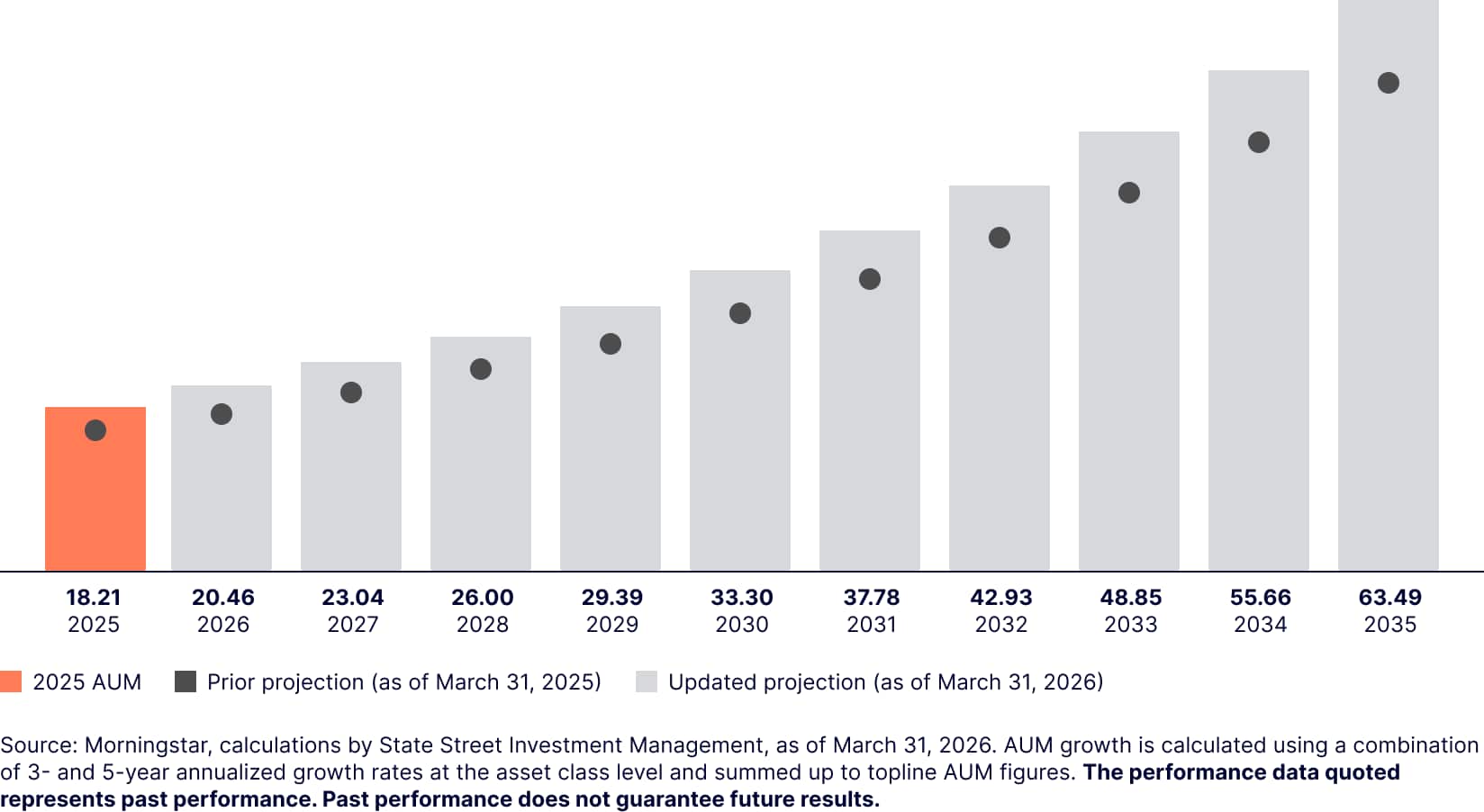
Even after decades of expansion, ETF adoption continues to accelerate. We’re predicting that global ETF assets will reach $63.49 trillion by 2035, suggesting the pace of growth may even exceed the 10-year forecast we made last year (Figure 6).
Figure 6: Global ETF AUM growth is outpacing our original expectations by nearly 18% ($, trillions)
Last year’s 10-year projection versus this year’s updated forecast
As new structures emerge and access expands, ETFs are positioned to play an even greater role in how investors build portfolios and pursue long-term outcomes.

What’s next for ETFs?
Get top ETF trends and our bold predictions for the future of ETF growth inside our ETF Impact Report 2026-2027.