
A case study: The advantages of precision in an LDI portfolio
How State Street Investment Management created and managed a dynamic de-risking allocation that enabled a corporate DB plan to maintain its surplus funded status over time.
The dramatic improvement in corporate pension plan funded status over the past decade has opened up new opportunities for de-risking. Companies need to monitor the impact of equity returns and interest rate fluctuations on their plan’s funded status to identify the best de-risking approach for their plans—and the right time to implement those strategies.
In 2015, a US-based technology firm with a partially active plan came to State Street Investment Management for help developing a de-risking strategy, after realizing it had just missed a good window to make important changes to its portfolio. The plan had achieved approximately 95% funded status, but still held a 62% allocation to return-seeking assets and was relying on an internal team to manage funded status oversight and asset allocation changes.
Company objectives
The company wanted us to:
- Identify a future state strategic asset allocation roadmap that would incrementally de-risk the plan while continuing to improve its funded status.
- Redesign, oversee, and implement a new return-seeking allocation and dynamic LDI portfolio to minimize funded status volatility.
- Offer an excess return buffer over liability growth rates.
State Street Investment Management recommended a liquid, low-cost portfolio that would generate return but still manage risks.
Managing an LDI portfolio with precise and efficient hedging
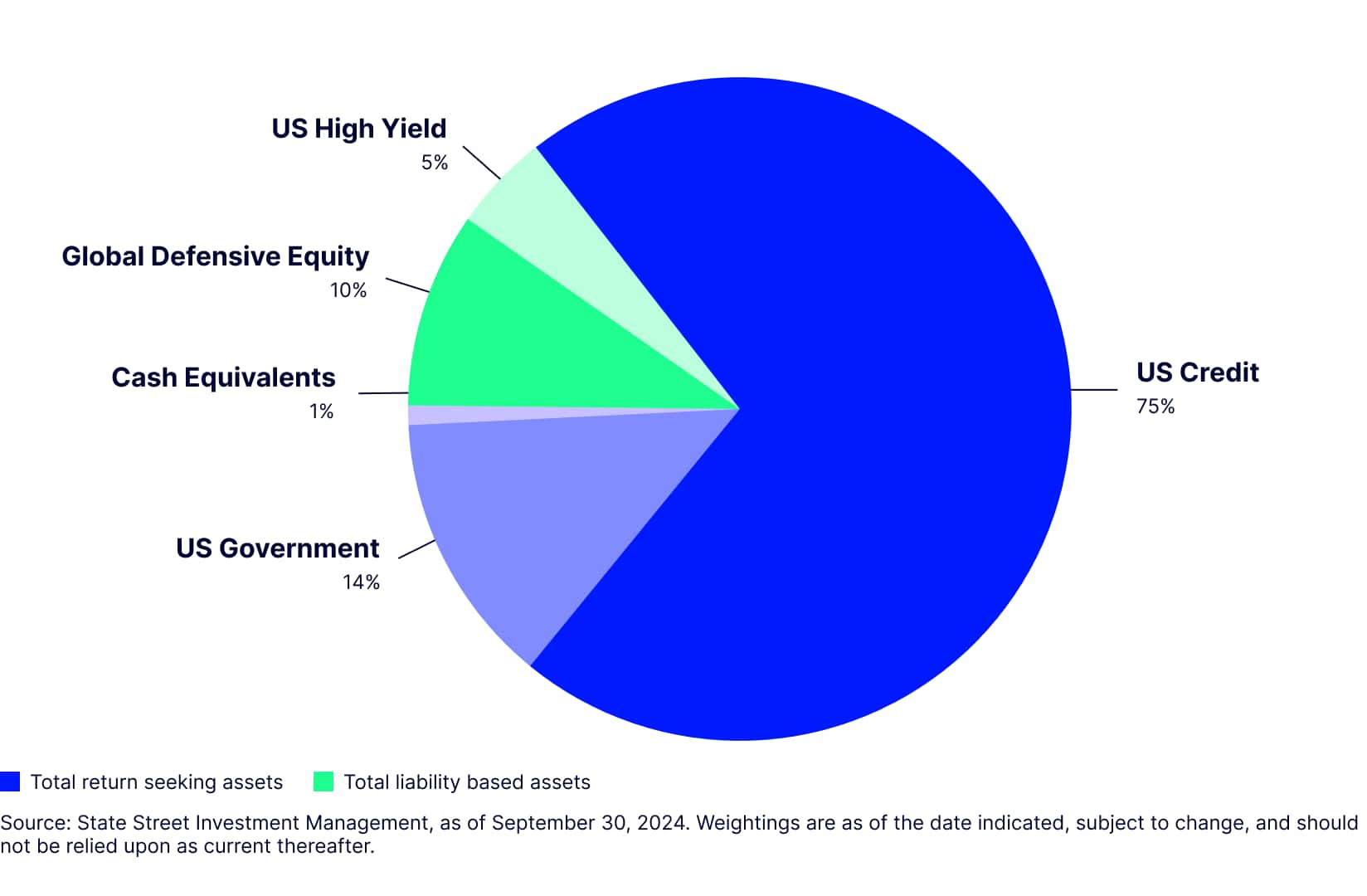
After analyzing the plan’s liabilities, State Street Investment Management recommended a new asset allocation of 85% liability-based assets and 15% return-seeking assets. An allocation to defensive growth assets, such as global defensive low volatility equity and U.S. high yield, would help provide the additional return that the company sought, with lower total risk and limited drawdown exposure compared to typical cap-weighted equities. High yield exposure would also provide additional spread income to offset yield give-up from the plan’s long-duration US Treasury exposure. A new custom and dynamic LDI allocation, developed by SSGA, would target an 85%-90% hedge ratio to plan liabilities at the early stage of the glide path.
Customization with building blocks
To implement the custom LDI portfolio against the strategic LDI benchmark, we used a selection from our LDI Building Blocks, a collection of 17 highly liquid, co-mingled fixed income strategies that cover a range of duration, credit, and curve exposures to provide a more efficient and precise asset-liability hedge ratio. The LDI portfolio included index fund exposure to intermediate and long-term US Treasuries, as well as Treasury STRIPS. But for credit exposure, we used actively managed, intermediate and long-duration high quality corporate strategies measured against a benchmark representing securities with credit ratings of A- or better. The systematic, actively managed strategies offered an additional source of potential return above and beyond the plan’s liabilities and credit risk management, further supporting the company’s goal to continue boosting its funded status.
Figure 1: Target asset allocation Q4 2015
Outcome
State Street Investment Management’s oversight of the plan’s funded status and discretionary authority to make allocation changes upon reaching a de-risking trigger allowed the company to more quickly take advantage of de-risking opportunities. Further, in 2016, the company undertook a partial annuitization of the plan’s retired population, which boosted the plan’s funded status above 110% thanks to favorable annuity pricing.
The liquid State Street Investment Management LDI building blocks made it easy for them to reallocate the portfolio after hitting a de-risking trigger and adjust for liability risk profile changes post-annuitization. With the increase in funded status, State Street Investment Management shifted to a 90% liability-based allocation/10% return-seeking allocation, targeting a 97.5%-100% hedge ratio for the plan’s new liability profile.
Through continual monitoring of funded status and market conditions, the company was able to move down its de-risking glidepath over the next several years, finding additional pension risk transfer opportunities and making the necessary adjustments to its LDI portfolio assets and growth assets to maintain the plan’s surplus.
Improved funded status, despite market volatility
Engaging us to develop and oversee its de-risking glidepath and favorable annuitization activity helped the company improve its funded status considerably. The combination of dynamic hedge ratio monitoring, LDI building block allocations, and lower-risk return-seeking assets has maintained pension surplus within a very narrow corridor—even through extreme swings in equity market performance and interest rates, particularly post-2019. In the last five years, for example, the plan’s funded status volatility has averaged 1.6% even as markets have experienced extreme peak-to-trough moves in equities, an aggressive Fed tightening cycle, and sharp changes in the shape of the yield curve.
Figure 2: Estimated pension benefit obligation funded status
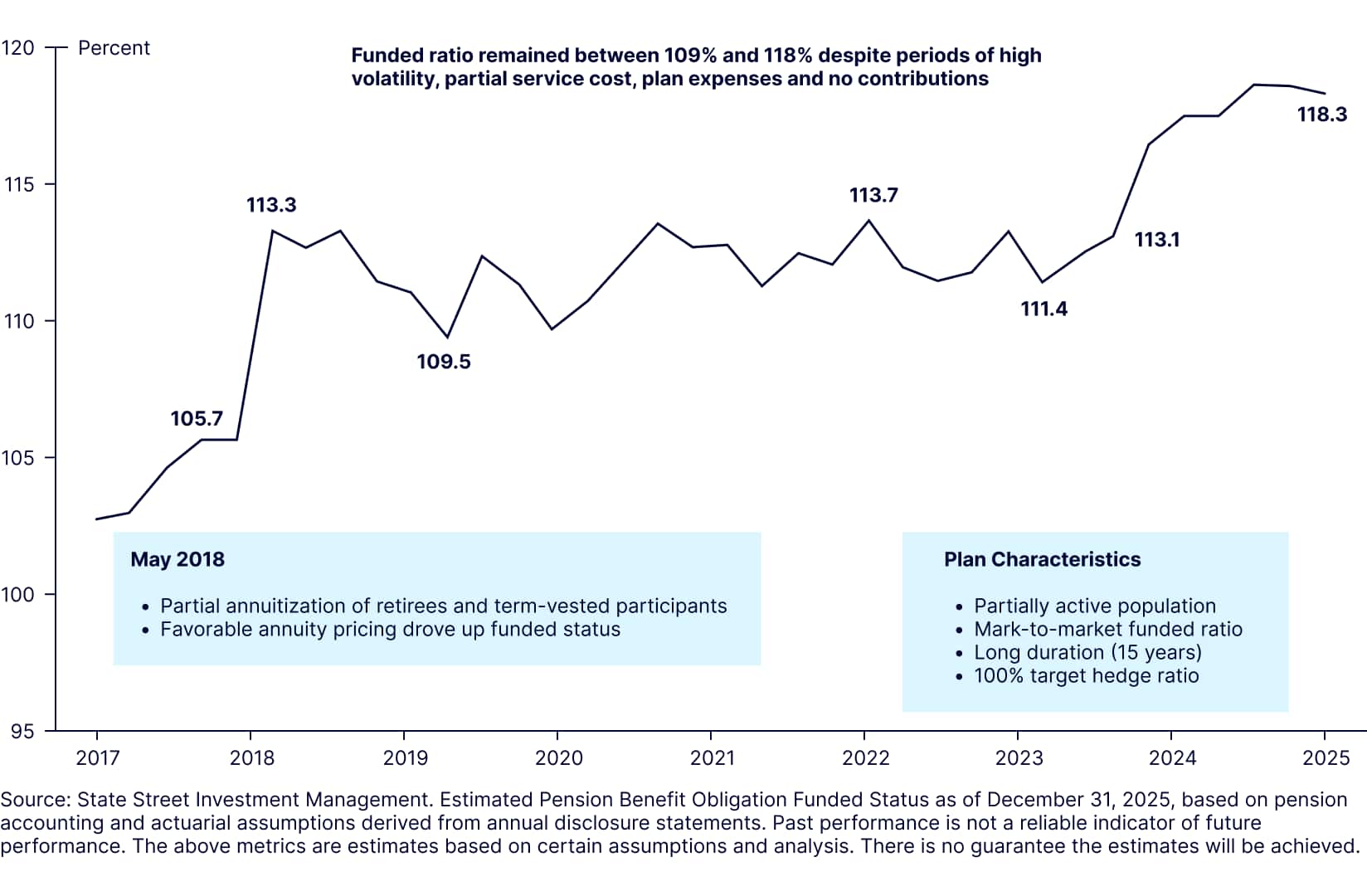
For five years ending in 2025, the plan has been in hibernation, maintaining a funded status surplus hovering around 113% with no contributions. The increased certainty around funding volatility management through a cost-effective and transparent solution has allowed the company to continue on its planned path of liability downsizing via partial annuitizations.
The bottom line
This successful and collaborative transition reflects the benefits of a multi-pronged de-risking approach: Developing a custom LDI benchmark based on the plan’s actual liabilities; implementing a highly liquid LDI portfolio that allows for dynamic management of the asset-liability hedge ratio; surplus volatility management that keeps pace with liability growth of remaining active participants; seizing pension risk transfer opportunities based on favorable annuity pricing; and active oversight of both growth-seeking and liability-based assets that includes thoughtful rebalancing all helped ensure the plan remained on track through changes in its liability risk profile.
Please contact us if you would like to discuss how we might help develop and manage your own de-risking glidepath.