
SAFI Intermediate: A modern hedging tool for DB plans
The systematic active fixed income (SAFI) intermediate fixed income strategy can help sponsors improve funded-ratio risk management, diversify alpha sources, and better align hedging assets with maturing liabilities.
Precise hedging and greater control
Our Systematic US High Quality Intermediate strategy combines intermediate-duration liability relevance with a systematic, benchmark-aware process designed to complement traditional fundamental active credit managers. It can play several roles for DB hedging, as follows:
- More precise hedging, which will help ensure funding stability for plans that are maturing and better funded
- Diversification to actively-managed portfolios, because traditional active credit lineups can be exposed to correlated fundamental alpha
- Expanded options for intermediate solutions, which matters amid an LDI ecosystem that is more developed around long-duration mandates
SAFI Intermediate addresses investor goals to maintain funded status with increased customization flexibility, lower tracking risk, low cost, and strong performance potential.
From deficit repair to surplus protection
Corporate defined benefit plan sponsors are entering a new phase of pension risk management. Funded ratios are still meaningfully elevated at 109.5%,1 as plans have benefited from stronger asset returns, higher discount rates relative to the post-financial crisis period, and disciplined de-risking programs. Meanwhile, many plans are frozen or closed. As benefit accruals decline, liability cash flows mature and plan duration often shortens. Sponsors therefore need a more balanced mix of long, intermediate, and cash-flow-aware hedging assets.
Against this backdrop, objectives have shifted from earning out of deficits and growing, to preserving surplus, reducing funded-ratio volatility, and maintaining end-state optionality. This has raised the importance of hedge quality. Sponsors need fixed income portfolios that are more precisely aligned with their liability duration, spread exposure, cash flows, liquidity needs, and governance objectives.
SAFI’s role in improving hedge quality
Corporate bonds remain DB plans’ primary liability-hedging asset because they provide exposure to the interest-rate and credit-spread risks embedded in pension liabilities. SAFI may improve hedge quality in several ways:
Diversification against actively-managed fixed income assets
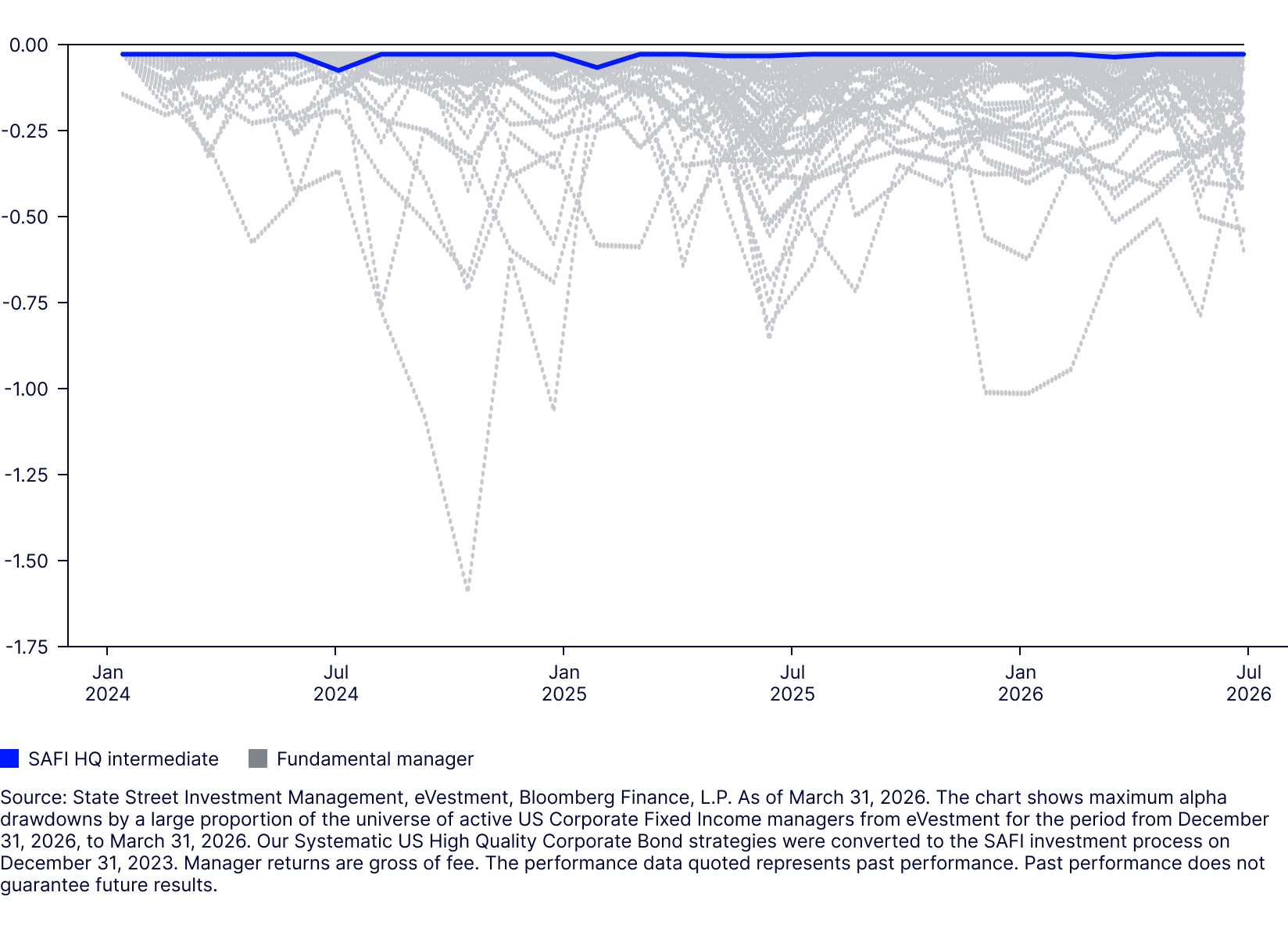
As plans have de-risked, active credit managers have become central to hedge portfolios. Many active credit managers rely on similar fundamental research processes and may express comparable issuer, sector, quality, liquidity, and spread-risk preferences. Their excess returns can become correlated, especially during stress periods (Figure 1).
For a DB sponsor, correlated alpha is a funded-ratio risk:if multiple managers underperform at the same time, the hedge portfolio can experience alpha drawdowns precisely when funded-status protection is most valuable.
Figure 1: SAFI high-quality Intermediate can offer protection against drawdowns precisely when its most needed: When fundamental managers may be struggling in concert
Plan closures mean shorter-duration liability streams
At the same time, liability duration is changing. As plans freeze, close, and mature, cash flows shift closer to the present and duration declines. This makes intermediate fixed income a more central element of the hedging portfolio. Intermediate mandates can serve as a lower-duration hedge for mature liabilities, a liquidity sleeve for benefit payments, a middle ground between core bond assets and long-duration LDI, or a completion tool alongside long credit and Treasuries.
The opportunity gap is not due to a lack of securities; intermediate credit offers a broad issuer set. The gap is that the institutional LDI ecosystem has historically been more developed around long-duration mandates than differentiated intermediate active solutions. SAFI Intermediate can support hibernation, retention, partial risk transfer, or broader LDI customization.
Hedge quality also requires balancing excess return, risk, and cost
If the strategy can deliver competitive excess return with low tracking error, lower fees, and lower alpha correlation, it can improve the trade-off between expected return, drawdown risk, and cost.
SAFI Case study: The power of diversification
In this illustrative analysis, adding SAFI Intermediate improved hedge quality by reducing tracking error from 66 basis points (bps) to 55bps, and lowering the 95th percentile drawdown from $17 million to $12 million. It also reduced the probability of falling below a 99% funded ratio over both one and three years, while maintaining the same expected funded ratio.
| Illustrative Pension Plan | |
| Funded Status ($M) | |
| Assets | $1,000 |
| Liability | $1,000 |
| Surplus/Deficit | $0 |
| Funded Ratio | 100% |
| Asset Allocation (%) | |
| Custom Corporate LDI | 100% |
| LDI Managers | |
| Expected α | 50 bps |
| Expected Tracking Error | 100 bps |
| Correlation | |
| —Fundamental | 0.25 |
| —Systematic | – 0.05 |
| Other Assumptions | |
| Liability Hurdle Rate | 50 bps |
Impact of Adding SAFI Intermediate
| Expected Outcomes | W/O Systematic | W/ Systematic |
| Portfolio Tracking Error | 66 bps | 55 bps |
| 95th Percentile Drawdown | $17M | $12M |
| Funded Ratio (FR) (1-yr) | 100% | 100% |
| Probability of FR < 99% (1-yr) | ~7% | ~3% |
| Probability of FR < 99% (3-yr) | ~10% | ~6% |
Source: State Street Investment Management, as of July 31, 2026.
SAFI US High Quality Intermediate: A systematic complement
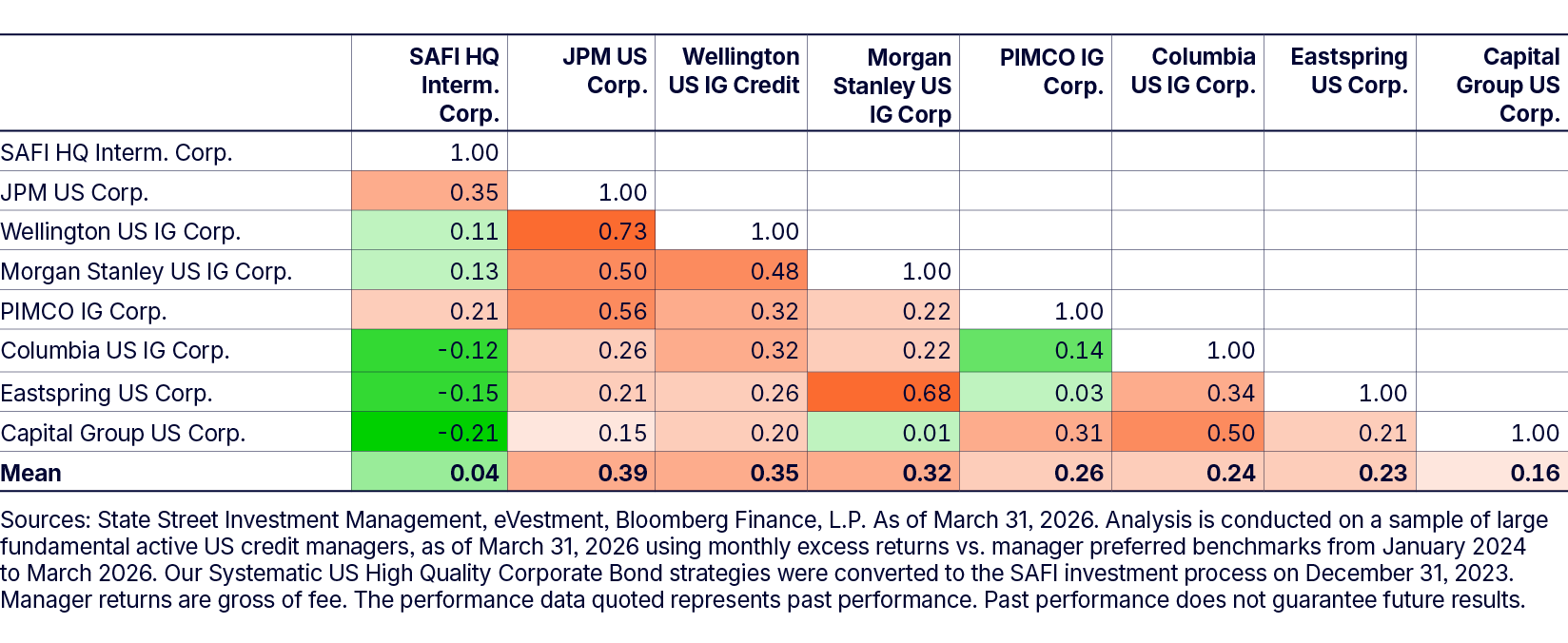
SAFI Intermediate should be evaluated as part of the total hedge portfolio rather than as an isolated manager search. Sponsors can model it as a partial replacement for fundamental active credit or as a new allocation funded from passive intermediate credit, with the comparison focused on funded-ratio volatility, expected excess return, alpha drawdown, managerstyle concentration, liquidity, and net cost. Rather than adding another credit allocation driven by discretionary issuer research, SAFI Intermediate brings a systematic implementation approach to high-quality corporate bonds, one that uses the potential return benefits of factor signals such as value, momentum, and sentiment.
This creates a differentiated alpha source. SAFI Intermediate can evaluate a broad universe consistently, apply disciplined risk controls, and target active risk where compensation appears most attractive, making it complementary—not redundant—to traditional fundamental managers (Figure 2). Intermediate-duration exposure can better match maturing liabilities and reduce reliance on long credit where it is less appropriate.
Figure 2: SAFI high-quality intermediate can offer diversifying alpha, while fundamental managers tend to exhibit higher excess return correlations with each other
SAFI performance results
As of June 30, 2026, the strategy generated positive gross excess return versus the Bloomberg Intermediate Corporate ex-Baa Index: 54 basis points over one year and 72 basis points annualized since inception of the SAFI process. These results were achieved with low realized tracking error of 0.13% over one year and 0.26% since inception.
| Intermediate (1-10Yr) Portfolio | ||||
| QTR (%) | YTD (%) | 1 Year (%) | Since SAFI Inception (%)* | |
| Systematic US High Quality Corporate Bond (Gross) | 0.90 | 0.90 | 4.35 | 5.08 |
| Benchmark | 0.78 | 0.59 | 3.81 | 4.35 |
| Excess Return (Gross) | 0.12 | 0.32 | 0.54 | 0.72 |
| Systematic US High Quality Corporate Bond (Net) | 0.85 | 0.81 | 4.16 | 4.89 |
| Benchmark | 0.78 | 0.59 | 3.81 | 4.35 |
| Excess Return (Net) | 0.08 | 0.22 | 0.35 | 0.54 |
| Tracking Error Volatility | 0.13 | 0.26 | ||
| Information Ratio | 4.20 | 2.82 | ||
Source: State Street Investment Management. As of June 30, 2026.
* Since-inception performance reflects conversion to our Systematic Active Fixed Income (SAFI) investment process effective December 31, 2023. The performance data quoted represents past performance. Past performance does not guarantee future results. Index returns are unmanaged and do not reflect the deduction of any fees or expenses. Index returns reflect all items of income, gain and loss and the reinvestment of dividends and other income as applicable. Performance returns for periods of less than one year are not annualized. The performance figures contained herein are provided on a gross and net of fees basis. Gross of fees do not reflect and net of fees reflect the deduction of advisory or other fees which could reduce the return. The performance includes the reinvestment of dividends and other corporate earnings and is calculated in US dollars.