
Four investment takeaways from the One Big Beautiful Bill Act
The One Big Beautiful Bill Act is expected to boost the US economy in the short term but what are the long-term impacts and investment opportunities?

President Trump signed the One Big Beautfiul Bill Act (OBBBA) into law after a dizzying array of Congressional negotiations. Although the market’s immediate non-reaction may have been a function of trade deal/tariff noise, here are four charts that illustrate key longer-term ramifications—and investment opportunities—of the OBBBA:
#1: Generationally large deficits remain
Projections from the Congressional Budget Office (CBO) show the deficit both worsening and getting better, depending on what baseline assumption is used.1
If the current policy baseline is used, which excludes the extension of current Tax Cuts and Jobs Act (TCJA) measures, the deficit is forecast to decline by $0.4 trillion by 2035. If the more expansive view is used, which includes the TCJA measures, the deficit is likely to increase by $3.4 trillion over the next decade.
The mixed picture over the next 10 years illustrates that the OBBBA in isolation doesn’t address the ballooning US deficit. The assumptions in those forecasts also have a wide variance. Pay-fors of the tax cuts are heavily backloaded. Also, these pay-fors might not be fully realized if future administrations make adjustments or repeal them as part of their own fiscal reforms, making the impact worse.
The OBBBA’s tax cuts/extensions mean a loss of revenue, but could tariffs offset that?
Our base-case assumption about where final trade policy lands implies a marginal worsening of the deficit starting in 2026, with a 0.1% increase that gradually grows to 0.4% of GDP by 2030. So, trade won’t completely offset the widening of the deficit, it’ll only slow its widening.
And while pay-fors/tariffs later down the line may help reduce the severity of the growing deficit, the 10-year forecast under the more comprehensive baselines is for the deficit to increase to between 6.5% and 7% of GDP, up from the 6.2% CBO baseline at the start of the year.2
Big picture? High deficits are here to stay. And a wider deficit has the potential to keep long-end rates high, put pressure on the dollar, and foster demand for alternative sources of resiliency (e.g., gold) from investors (i.e., central banks) to further diversify away from US Treasurys.
Higher rates will also keep debt financing costs high (Figure 1), and they are already at generational highs and moving higher. Not to mention above defense spending. More and more dollars used to pay down debt issued at high rates is a negative for growth, unless that high-cost debt can be rolled over.
#2: Defense industries benefit
The OBBBA supports earnings growth and potential returns for the Aerospace & Defense industry with a significant $150 billion investment in defense spending that pushes the total planned defense spending requests and appropriations to over $1 trillion for the fiscal year 2026. And the increased spending is widespread with support for advancements in innovation and funding for early-stage research.
The OBBBA also includes specific callouts for Artificial intelligence (AI), next generation 5G/ 6G technologies, and quantum computing measures totaling $1 billion combined. These large-scale projects require a lot of research and development (R&D). And a provision for immediate business expensing of capital investments for domestic R&D lowers its after-tax cost, making it more attractive for businesses to invest in new technologies and processes.
Immediate expensing allows companies to deduct R&D expenses in the year they are incurred. This directly lowers taxable income and leads to improved cash flow and earnings.
Notably, R&D expenses for the Aerospace & Defense industry represent 3.3% of trailing 12-month sales, compared to the broader industrial sector’s 2.1% and the market ex-Tech’s rate of 2.7%.3
More funding toward traditional and innovative defense initiatives combined with better tax treatment for investing in R&D—as well as heightened conflicts around the world—mean defense firms may continue outperforming the market as they have since the election (Figure 2).
The R&D change will have the greatest impact in high R&D sectors. The sectors with the highest R&D expense as a percentage of sales over the past 12 months are: Communication Services (15%), Health Care (13%), Tech (12%), and Consumer Discretionary (7%).4 Depending on the magnitude of domestic R&D by the firms in those sectors, there could be a boost to the bottom-line growth numbers.
#3: Growth forecasts reduce recession fears
While the R&D measure offers some benefits for fundamental growth, the broader tax cut measures may benefit consumption. As a result, regardless of deficit forecasts, the OBBBA will be stimulative in the short term.
The more consumer-oriented tax cuts (no taxes on tips/overtime, a deduction for seniors, and a higher cap for the state and local tax [SALT] deduction) may also help offset any drag from tariffs. Either their first order (higher prices paid, weakening purchasing power) or second order effects (consumers forgoing discretionary consumption, like housing) on growth.
Thus, forecasts have growth being revised higher this year and in 2026 per consensus estimates. At the same time, the market’s expectation for a recession in 2026 has declined modestly over the past month.5
On balance, this suggests that economic calamity from tariffs is unlikely. But US economic growth is not forecast to be above trend by the consensus. Instead, 2025 and 2026 GDP growth forecasts are projected to be below pre-liberation day forecasts. There is a lag to these estimates, as not all reflect the OBBBA impacts just yet. So, there is room for these estimates to see upward revisions, as we see growth for 2026 modestly stronger than the consensus today.
This means that while risk assets (e.g., equities) may be supported from a positive growth environment, focusing on durable growth or quality growth may be advisable. That’s because there is little margin for error given the conflicting dynamics of growth (tariff reductive, OBBBA stimulative) in a market already dealing with a weakening labor market, restrictive Federal Reserve policy, and still-above trend inflation.
The desire for quality growth combined with the new treatment for R&D expenses may lead to increased opportunities in AI-related market sectors.
#4: Small caps find a friend
Small-cap stocks have lagged large caps by 10% and 37% over the past year and three years.6 Their growth profiles explain why. Small caps have seen earnings-per-share growth (EPS) decline over the past three years (-28%), while large caps have enjoyed strong EPS growth (+9%).7
But small caps’ bottom line could get a boost from the OBBBA changing the maximum amount of deductible business interest expense from 30% of EBIT, to 30% of EBITDA. The inclusion of depreciation and amortization expenses in calculating interest expense deductibility means larger deductions that should flow through as a positive for earnings. Companies that incur both high depreciation and amortization, along with high interest expenses, will receive the largest benefit.
From a market cap perspective, this would favor small caps over large caps. Small caps’ depreciation and amortization factors are nearly double that of large caps, illustrated by the gaps between EBIT and EBITDA where small caps’ EBIT-to-EBITDA ratio is 2.7 compared to large caps’ 1.4.8
Small caps also carry a higher debt load and financing costs than large caps, reflected by small caps’ net-debt-to-EBITDA being greater than large caps’ and an interest cover ratio four times less than for large caps.9
To be clear, this change is unlikely to suddenly close the gap between large- and small-cap stocks from a return and growth perspective. Large caps have multiple tailwinds, including big Tech. But the change does help provide fundamental support for small caps at a time where the percentage of companies with negative earnings remains near record highs (34% of all Russell 2000).10
Will today’s impacts be outdated tomorrow?
The OBBBA has the potential to provide a stimulative impulse for the US economy. But because it’s just part of the Trump administration’s policy-making, some of the specific impacts outlined here could be altered or offset by other portions of his agenda.
But the deficit problem will remain constant; it will be here today and tomorrow for the economy and investors to contend with.
For more insights check out our market trends page.
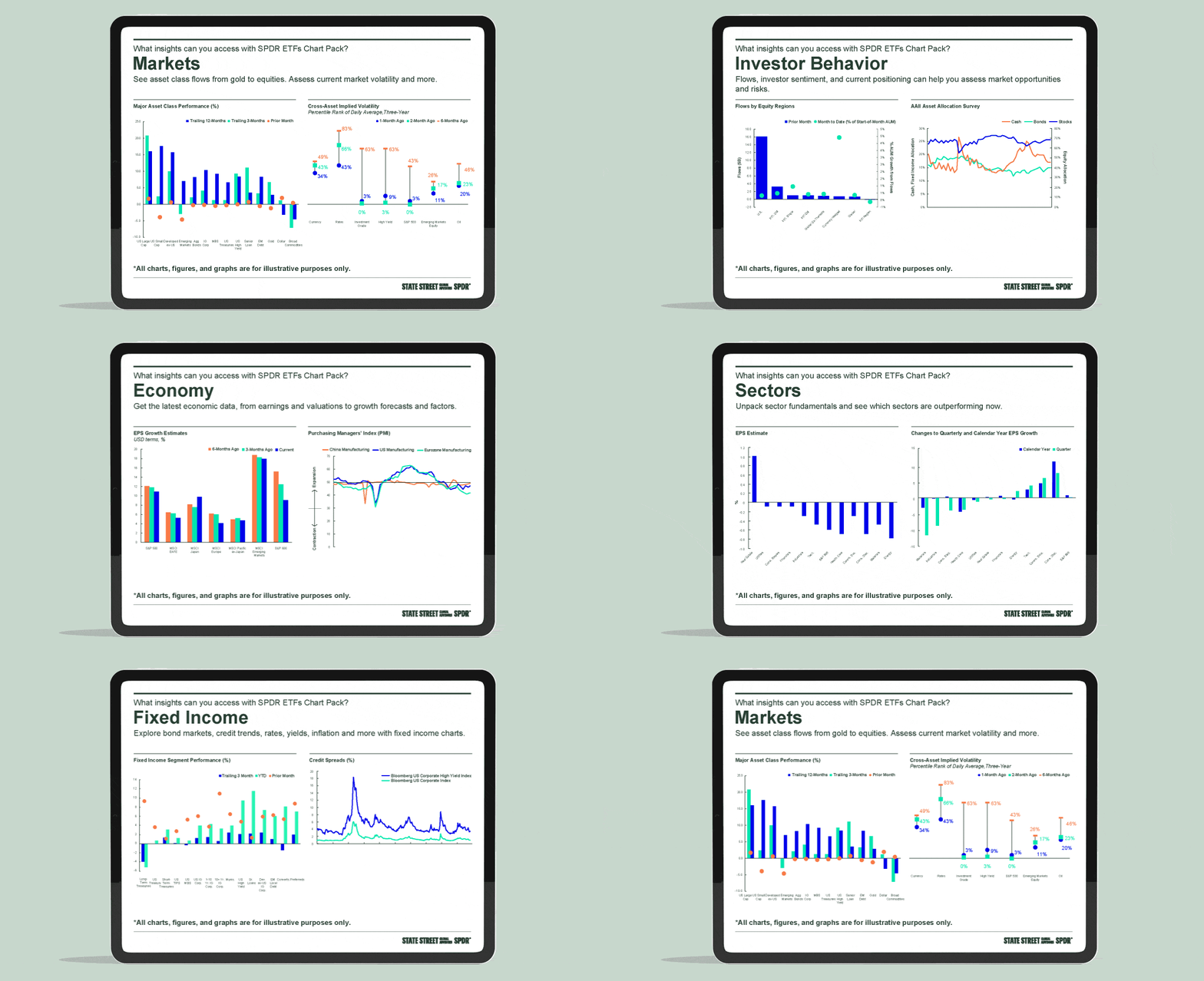
Chart Pack
An easy way to visualize the latest market movements.