
Why consider exposure to the S&P 500® Index A proven track record of excellence
- The S&P 500 tracks the biggest companies that shape our daily lives and reflects the market’s strength in real time.
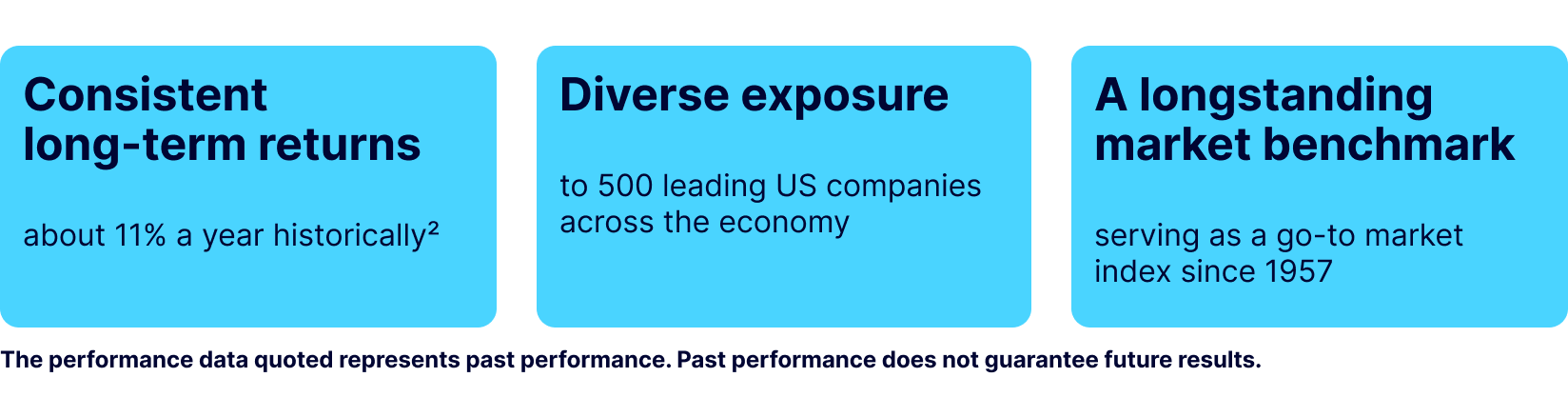
- The index has stood the test of time, returning roughly 11% annualized since inception1—even after market downturns.
- Exposure to the S&P 500 means instant diversification across 11 sectors and hundreds of industry leaders, making it a resilient foundation for today’s portfolios.
Since 1958, music fans check the Billboard Hot 100 weekly to see which songs are trending, dominating, or falling off the charts. More than just a ranking, it’s a dynamic glimpse into the music industry in real time—measuring not only past performance, but relevance and staying power. These charts evolve constantly, capturing the energy of each moment in pop culture by highlighting the artists making the biggest impact.
The S&P 500 works the same way for the US stock market, and by extension, the greater global economy. It reflects the current top 500 publicly traded US companies by market size and overall financial health. But it’s not a static list of legacy names: it’s dynamic, rebalanced four times a year to represent the strongest performers in the market. And so, the index acts as a real-time snapshot of the strength, innovation, and leadership of the world’s largest economy.
Whether you’re just starting out or building your portfolio’s core, gaining exposure to the S&P 500 is a go-to way for many investors to stay invested for the long haul.
Figure 1: Key reasons you may consider S&P 500 exposure for your portfolio
What makes the S&P 500 a foundational index?
Every investor needs a launch pad. For generations, the S&P 500 has been just that—the index where countless investor journeys take off.
But is an investment tracking the S&P 500 still a good idea today? History says yes. Sure, it’s had its share of ups and downs. But through every bear market, crash, and rebound, the index has come back strong—delivering impressive long-term returns and helping generations of investors work toward building wealth over time.
The S&P 500 Index is comprised of 503 holdings,3 consisting of the biggest large- and mega-cap companies traded on American stock exchanges and businesses that impact our daily lives. The list includes:
- Innovation tech giants like Apple and NVIDIA
- Healthcare pioneers like Pfizer
- Consumer icons like Coca-Cola and Costco Wholesale
- Financial leaders like S&P Global and Nasdaq
- And so many more that keep the economy humming
Due to its sheer size, immense scale, and the inclusion of so many household name brands, many investors turn to the index.
How has the S&P 500 performed over time?
Like any chart-topping list, the S&P 500 has had its share of hits, flops, and comebacks since its debut on March 4, 1957. It’s shown a remarkable ability to bounce back from volatility and keep moving forward. Through each decade of economic turbulence, the index has endured.
Figure 2: Every decade has seen market and economic downturns
| 1970s | - 1973 Arab Oil Embargo |
| 1980s | - Energy Crisis Recession - Black Monday Crash of 1987 |
| 1990s | - Dot-com Bubble Burst |
| 2000s | - 9/11 Terrorist Attacks - 2008 Great Financial Crisis (GFC) |
| 2010s | - The Flash Crash of 2010 - The US Sovereign Downgrade in 2011 - Volmageddon in 2018 - The December 2018 Drawdown |
| 2020s | - COVID-19 Pandemic - 2023 Regional Banking Crisis - Liberation Day 2025 |
Source: Global ETF Research, as of June 15, 2026.
Is the S&P 500 a safe place to put your money?
The S&P 500 Index isn’t immune to volatility, but history has shown that after every market disruption, the index not only recovered—it thrived, surpassing an index level of 1,000 in 1998, 3,000 in 2019, and breaking 5,000 for the first time in early 2024.4 And over the long term, the S&P 500 has delivered average annual returns of around 11%,5 proving its staying power.
Those results won’t hit every year, but they reflect the strength that comes from diversification, scale, and innovation of the US market.
The benefits of S&P 500 Index exposure
For many investors, the S&P 500 offers a rare combination of advantages, especially if you’re focused on long-term growth:
1. Diversification, delivered
With 500 companies spanning every major sector—from Industrials to Information Technology—the S&P 500 provides instant diversification, so your investment portfolio isn’t overly concentrated in any single company, industry, or investment.
Why it matters: Instead of trying to handpick winners or betting on single stocks, you’re gaining exposure to a portfolio of holdings, each contributing to performance in their own way.
2. Consistency over complexity
The S&P 500 takes the guesswork out of investing. Instead of trying to time the market or identify the next breakout stock, you're investing in a strategy that’s already stood the test of time and continues to evolve.
Why it matters: Investing in an S&P 500 index fund or ETF can be especially appealing if you’re an investor who prefers a set-it-and-forget-it approach.

Two State Street S&P 500 ETFs strategies to help you reach your goals
You have the choice and power to invest your way with SPY and SPYM.
3. Powerful long-term potential
Over decades, the index has provided long-term growth potential to patient and steady investors. Swift and sizable recoveries historically follow steep declines,6 and it’s almost impossible to see them coming. The reality is this: some of the market’s best days have occurred after their worst. Out of the worst 20 days between 1979 and 2026, the market was up on 17 of the following days—four of which were in the top 20 performing days of all time.7
Why it matters: While short-term swings can be unsettling, history has shown that time in the S&P 500—not timing the S&P 500—tends to lead to more successful outcomes over the long term.
What are the risks of the S&P 500?
Even the strongest performers hit a few off notes. No investment or index is risk-free and the S&P 500 is no exception. That’s why it’s important to know what the risks are before investing:
- Market risk: Like any equity investment, the index is subject to market fluctuations. Periods of volatility—due to economic uncertainty, interest rates, or geopolitical tension—can affect the performance of the underlying stocks within the index.
- Concentration risk: Because the index is market-cap weighted, a handful of mega-cap stocks—often in tech—can have an outsized influence. When they stumble, they can pull down the entire index’s returns.
- Short-term declines: Markets rise and fall. Periodic setbacks are part of the long-term growth story.
Despite these risks, the S&P 500 has shown remarkable resilience, proving that long-term investors often benefit when they stay the course.
Two ways to get the performance of the S&P 500 in a single trade
While you can’t invest in the S&P 500 directly, there are several ways to access the index. Two of the most efficient, transparent, and widely used are State Street ETFs:
Both SPY and SPYM are designed to track the S&P 500 Index, giving you exposure to 500 of the largest US companies in a single trade. The difference comes down to how you plan to invest—whether you prioritize trading flexibility or keeping costs low over time.
SPY: A proven track record of liquidity and flexibility
Launched in 1993 as the first US-listed ETF, SPY helped transform how investors access the market. More than 30 years later, it remains one of the most recognized and widely traded ETFs in the world.8
With SPY, you don’t have to build your own US large-cap stock portfolio. One trade gives you diversified exposure to the S&P 500—backed by decades of performance that has closely tracked the index through bull markets, bear markets, and everything in between.
What sets SPY apart is how easily it can be traded.
- Unmatched liquidity: As the world’s most traded ETF,9 SPY offers unmatched liquidity and portfolio flexibility for even the most sophisticated trading strategies
- Tight trading spreads: High trading volume helps keep transaction costs low, especially for investors who trade frequently
- Consistency over time: SPY has closely tracked the S&P 500 for more than three decades, offering a reliable way to capture broad market performance
And, SPY’s impact goes beyond performance—it helped shape the ETF industry itself.
Figure 5: SPY milestones that moved the market
| 1993 | SPY launches as the first US ETF, revolutionizing market access for all types of investors. |
| 2004 | SPY becomes the first ETF to trade over $1 trillion in a single year.10 |
| 2008–2009 | SPY weathers the financial crisis, proving the resilience of ETFs. |
| 2013 | SPY surpasses $100 billion in assets under management.11 |
| 2020 | SPY hits record trading volume during COVID-19—$100 billion in a single day—solidifying SPY’s role as a liquidity leader.12 |
| 2025 | SPY trades more than $127 billion in a single day on April 7, 2025, an all-time record for SPY and any ETF.13 |
From launching an entire industry to setting trading volume records, these milestones reflect SPY’s scale, resilience, and enduring role in modern investing.
For investors who trade more actively—or want the flexibility to adjust positions quickly—SPY remains a go-to investment tool.
SPYM: A low-cost way to stay invested for the long term
While SPY is known for its liquidity, SPYM is designed with a different goal in mind: keeping costs as low as possible over time.
SPYM also tracks the S&P 500 Index, providing the same broad exposure to 500 US large-cap companies—but at just 2 basis points, it’s the lowest-cost S&P 500 ETF in the US.14
That difference in cost may seem small, but over years—or even decades—it can add up.
With SPYM, investors can:
- Reduce investment costs: A lower expense ratio means more of your return stays invested and compounds over time
- Build a core portfolio holding: SPYM is designed for long-term investors who plan to stay invested through market cycles
- Access the same index exposure: Like SPY, SPYM tracks the S&P 500—delivering diversified exposure across sectors and industry leaders
As the default investment option for Trump Accounts, SPYM can be used by families to help jumpstart their children’s investment journeys with a simple, long-term approach designed to encourage lifelong investing habits.

TRUMP ACCOUNTS + SPYM
A new way to invest in your child’s future
Discover how the lowest-cost US-listed S&P 500® ETF15 is helping the next generation invest—even from day one.
Which one may be right for you?
Because both ETFs track the same index, the decision often comes down to how you plan to use them.
For some investors, it’s not an either/or decision.
You might hold SPYM as a long-term foundation—while using SPY for shorter-term trades or portfolio adjustments when opportunities arise.
| SPY may be a better fit if you: | SPYM may be a better fit if you: |
|---|---|
| Trade frequently or adjust your portfolio regularly | Plan to invest for the long term |
| Need deep liquidity and tight spreads | Want to minimize fees over time |
| Want flexibility for tactical positioning | Are building a core, buy-and-hold allocation |
Want to reach your financial goals? Lay the foundation with SPY or SPYM
Just as the Billboard charts highlight the songs you can’t escape, the S&P 500 showcases the companies actively shaping the economy. For decades, it’s let investors tap into the market’s top performers—leaders in innovation, strength, and growth.
In a world full of complexity and market noise, the S&P 500 brings clarity. It’s where the journey begins—and, for many, where progress happens.
With SPY and SPYM, you gain diversified, transparent, and highly liquid exposure in a single trade. It’s your shortcut to the market’s greatest hits, and investing in either ETF can help you get there.