
What industry ETFs add to your sector and industry strategy
Maximize your portfolio strategy by understanding the distinct roles of sector and industry ETFs, targeting industry trends and niche opportunities for alpha.
Many investors view sectors and industry ETFs as if they’re a pair—like salt and pepper on a dinner table. In fact, they’re mentioned together so frequently that it’s easy to forget they play different roles in your portfolio.
Yes, investors use both sector and industry ETFs to express their market views, position for macroeconomic changes and industry trends, and manage portfolio risks.
But sector funds target broad industry categories with shared economic characteristics. And industry funds focus on a narrower group of companies that offer similar products or services.
That is, sectors, like salt, provide the most foundational seasoning for a portfolio. And industries, like pepper, add nuance, complexity, and variation, influencing a portfolio’s flavor in more targeted ways.
Distinguishing between the roles of sector and industry funds
While grouping sector and industry funds together might feel natural, it can lead to oversimplified strategies and missed opportunities. How can you improve? Use sector funds for exposure to broad economic trends and to position different phases of the business cycle, and industry funds to target more specific market themes or groups of companies in a narrow niche.
Importantly, the precision of industry ETFs can amplify the impact of a sector strategy, enabling you to:
- Pursue greater alpha
- Position for industry trends and policy shifts
- Harness macro trends
- Manage portfolio risks
Pursue greater alpha with wider dispersion
Industries have historically exhibited wider dispersion than broad sectors due to their larger investment opportunity set. The gap between the best- and worst-performing industries has been consistently wider than that of sectors (Figure 1). Since correlation between industries in the same sector is less than 1,1 greater alpha opportunities may exist at the industry level due to unique industry drivers.
For example, as booming AI infrastructure investment boosts demand for power infrastructure, the electrical equipment industry in the Industrials sector saw strong demand for products that power AI data centers.
The industry gained 119% since the end of 2023, outperforming Industrials and the broad market by 63% and 55%, respectively.2 Meanwhile, the professional services industry—also part of the Industrials sector—struggled amid growing fears of AI disruption to the labor market, gaining only 5.6% over the same period.3
Figure 1: Industries have exhibited wider dispersion than sectors
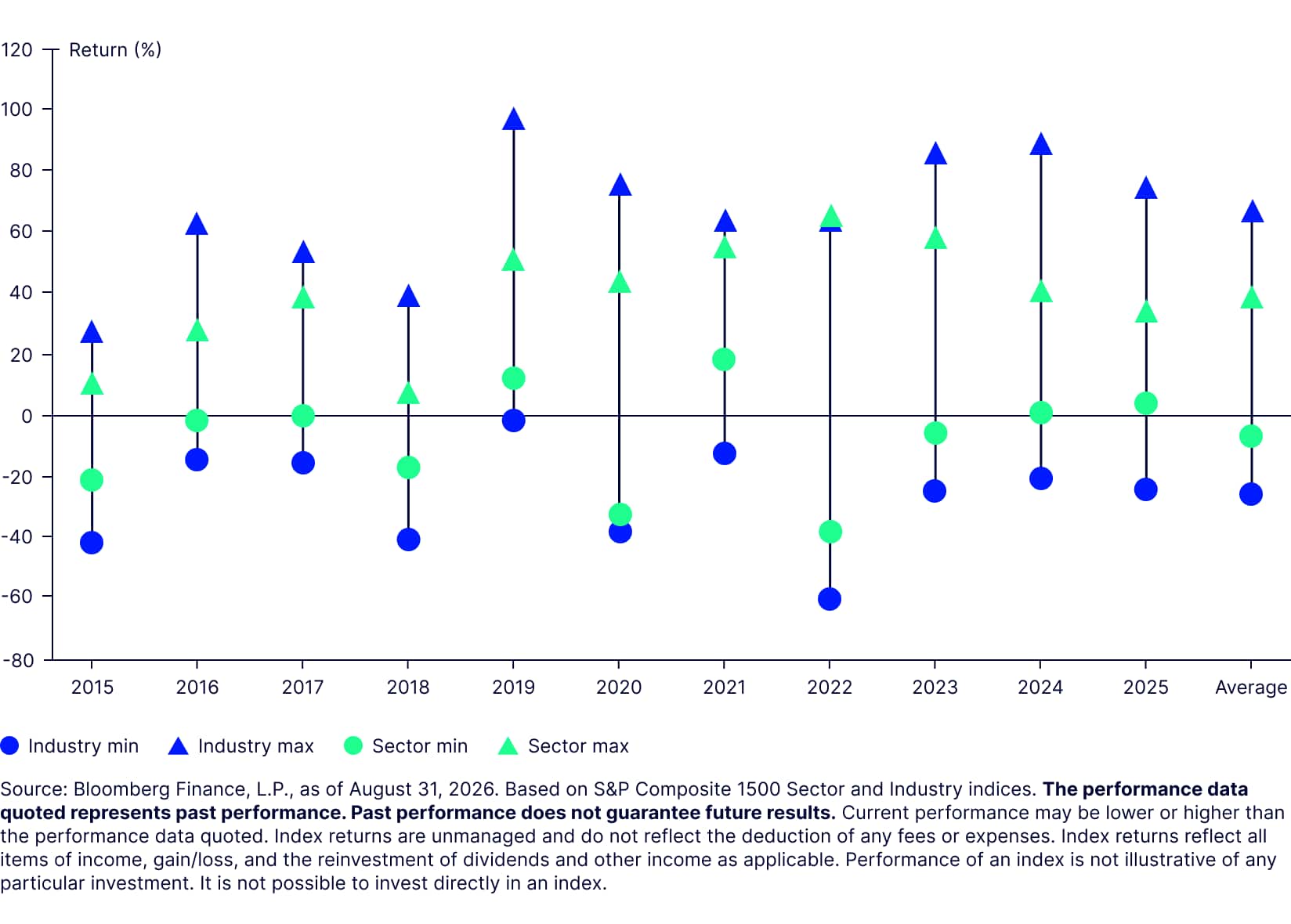
Notably, some investors use individual stocks to pursue greater alpha. But while stocks clearly provide a larger opportunity set and exhibit greater dispersion than industries, the chance of selecting stocks that will outperform their respective industry is less than half most of the time. And the chance is diminished to less than a third over a longer-term investment horizon (Figure 2). Therefore, for investors who have high convictions on industry or macro trends without strong stock picking skills, industry exposures may provide a better chance to generate alpha.
Gain exposure to secular trends and policy shifts
Over nearly two decades of consistent innovation and advances, the Technology sector has returned an annualized rate of 17.7%.4 But gains of industries within Tech have been uneven—with the best-performing Tech industry outperforming the worst by 8.9% on an annualized basis.5
Leadership shifts over time as development of new technologies creates new beneficiaries.
For instance, as cloud computing matured in the 2010s, infrastructure as a service (IaaS) cloud computing models transformed business IT infrastructure and redefined how software is created, deployed, and distributed. No longer did software development involve costly physical infrastructure and upfront investment.
Improved capital efficiency and predictable revenue streams from the new software as a service (SaaS) model contributed to software’s industry leadership in the 2010s, leading it to outperform the then-third-largest Tech industry—semiconductors—by 217% on a cumulative basis (Figure 3).
More recently, accelerating digitalization driven by the COVID pandemic and the beginning of AI revolution in the early 2020s has fueled demand for computing chips. And easy access to low-cost coding capability through AI has lowered the barrier for new entrants, threatening the SaaS business model. As a result, the semiconductor industry took charge, outperforming the software industry by 427% from the start of 2020 through the end of August 2026 (Figure 3).
Fiscal policy and geopolitics can also benefit specific industries more than they do broad sectors. For example, aerospace & defense stocks have outperformed the broad Industrials sector over the past defense spending cycle (Figure 4).
Consider that following the 9/11 attack, US defense spending nearly doubled in 10 years, increasing from 3% to almost 5% of GDP.6 And for most years during that period, the US aerospace & defense industry posted stronger earnings growth than the Industrials sector and broad market, including during two economic recessions.7 As a result, aerospace & defense outperformed 82% and 90% over the sector and broad market, respectively, on a cumulative basis (Figure 4).
And aerospace & defense continues to be supported by global defense spending increasing 16% in the past two years amid growing tensions.
Capitalize on high sensitivity to macroeconomic tailwinds
Because industry ETFs include companies with greater similarities in business focus, operation models, and market segments than the diverse companies that make up sectors, it follows that macroeconomic variables impact industries in a greater way than they do the broad sectors.
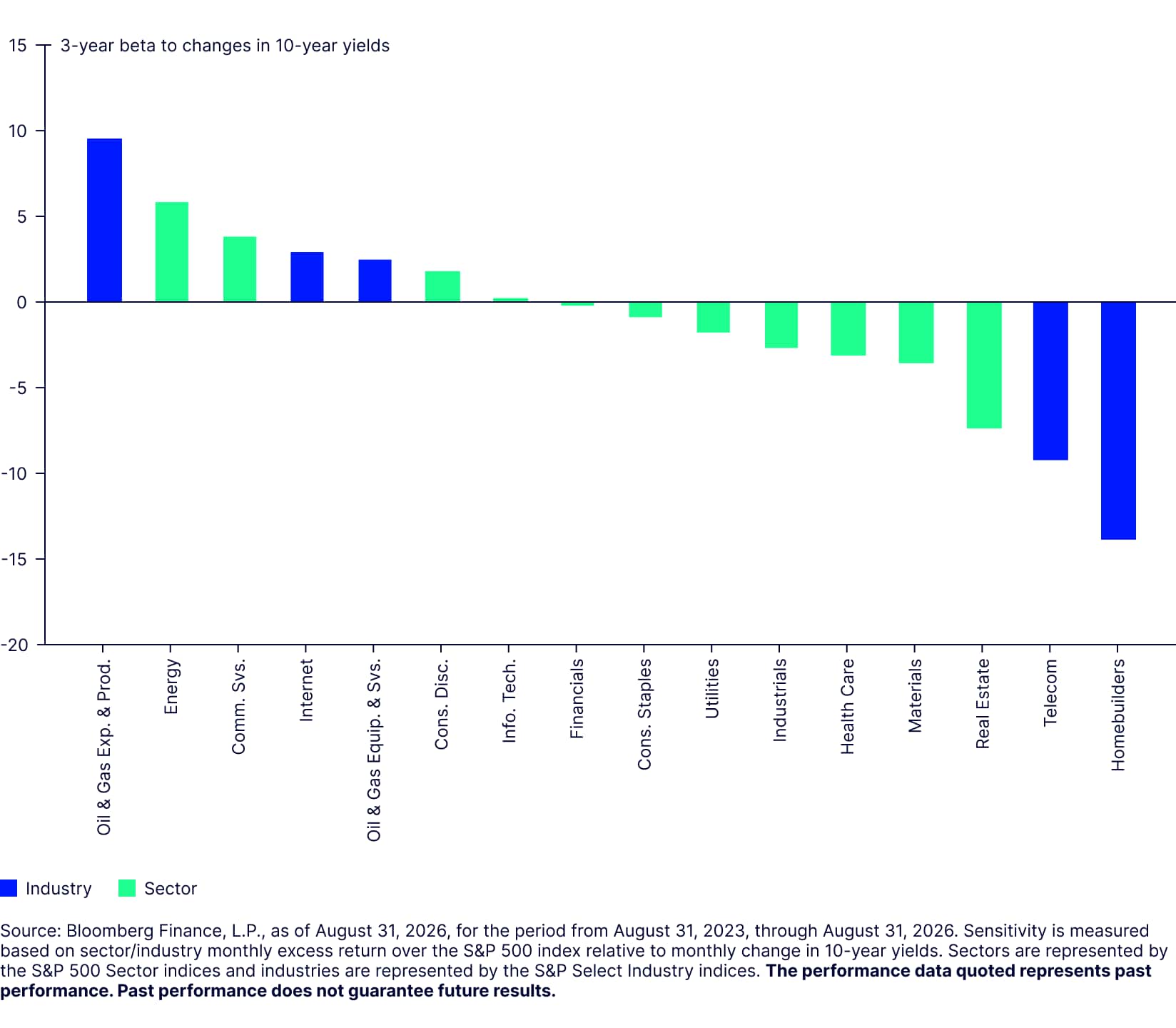
For example, while Energy and Real Estate have exhibited one of the highest positive and negative sensitivities, respectively, to 10-year Treasury yields, narrower industry exposures like the oil & gas and homebuilders industries have shown greater beta than the 11 sectors (Figure 5).
More importantly, internet industry's beta sensitivity is 14x that of its sector, Technology, while telecom industry has exhibited a significantly negative beta, even as Communication Services has shown strongly positive sensitivity to 10-year yields.8
In other words, a 10-basis point change in 10-year yields may provide greater tailwinds or a differentiated return profile for the internet and telecom industries than for the Technology and Communication Services sectors. From a capital efficiency perspective, investors may use less capital by allocating to those two industries than their respective sectors to achieve the same level of beta exposure to long-term yields in their equity portfolios.
Figure 5: Certain industries have exhibited greater sensitivity to 10-year yields
Macro events can sometimes benefit companies in the same industry, but not significant enough to move the broader sector. For example, as the Trump administration increased tariffs on steel, aluminum, and copper in the first half of 2025, the US metal and mining industry benefited from the trade protection, gaining 23.6% and beating the sector and broad equities by 14% and 13.3%, respectively.9
Over the same time period, the Materials sector lagged broad equities due to the weak performance of the chemicals industry—the largest industry in the sector and accounting more than half of the sector market cap—driven by weak demand during a manufacturing slowdown.
Adjust portfolio risk with industry bets
Due to their varied businesses, industries in the same sector may exhibit different volatility and sensitivity to broad equity moves.
For example, the insurance industry has shown lower volatility, drawdowns, and beta sensitivity to broad equities than other Financials industries and the Financials sector due to its less cyclical business and stable cash flows (Figure 6).
Investors may use insurance industry exposure to capture the benefits of higher rates on financial stocks without taking on significant market risks compared to other financial industries with higher volatility and market beta, like banks and capital markets.
Looking ahead: From enhanced returns to risk management
With 11 GICS sectors and a broad universe of industry ETFs—whose numbers have more than doubled with assets growing 11x over the past 15 years10—investors now have more ways than ever to express their views and fine-tune their portfolios. Sector ETFs offer broad exposure, while industry ETFs allow you to zero in on alpha opportunities, leadership shifts, and macro trends with greater focus.
Of course, how you select your sector and industry exposures depends on both your investment goals and risk tolerance. And keep in mind that the size of your positions and rebalancing schedule will be more critical in managing industry exposures than in managing sectors, given industry funds’ narrower exposure.
Big picture, like salt and pepper, sector and industry funds are best used together—but knowing when to reach for one over the other is what gives your portfolio real depth and flavor.
Want to learn more about our sector and industry ETFs?