Should Japan-based investors hedge local currency exposure with gold?
In mid January, Japanese government bond (JGB) yields—particularly at the long end of the curve—surged to multi decade highs as markets reacted to rising fiscal concerns and newly proposed expansionary policies. These developments placed additional downward pressure on the Japanese yen (JPY). The resulting policy driven volatility reinforced demand for safe haven assets, with gold benefiting as Japanese investors sought protection against both fiscal uncertainty and currency weakness. For Japan based investors, gold can serve as an effective hedge, helping to offset domestic bond market stress and JPY depreciation while preserving real value during periods of heightened macroeconomic instability.
The recent selloff in Japan’s bond market—and the accompanying volatility—has been driven primarily by mounting fiscal concerns. Prime Minister Takaichi’s proposed tax cuts and expanded spending initiatives are widely expected to require additional government debt issuance. This has intensified worries over Japan’s already stretched public finances, weakened the JPY, and prompted caution among both domestic and global investors towards Japanese assets. Against this backdrop, gold continues to attract strong safe‑haven demand.
A key question for Japan‑based investors, therefore, is how best to manage local bond and currency risks: should they hedge their JPY‑denominated gold exposure to eliminate USD/JPY fluctuations, or maintain unhedged gold positions that retain FX sensitivity?
The relationship between gold and the JPY
Gold is priced globally in US dollars (USD), and its price has historically moved inversely with the strength of the dollar; a stronger USD tends to weigh on global gold demand, while a weaker USD is generally supports bullion consumption. For Japan based investors, this dynamic creates FX exposure, as their returns reflect both movements in the USD gold price and fluctuations in the USD/JPY exchange rate.
To better understand how these two factors interact—and how that should inform hedging decisions—we examined 26 years of monthly data (January 2000–December 2025). Our analysis categorizes each month into four regimes based on: (1) gold returns in USD, (2) USD/JPY exchange rate moves, (3) gold returns in JPY (unhedged), and (4) gold returns in JPY with currency hedging (hedged).
The dataset classifies each monthly observation into four categories based on the direction of USD‑denominated gold returns and corresponding movements in the USD/JPY exchange rate.
Category 1: Gold in USD rises (+) and the JPY depreciates (+)
Category 2: Gold in USD rises (+) and the JPY appreciates (−)
Category 3: Gold in USD falls (−) and the JPY depreciates (+)
Category 4: Gold in USD falls (−) and the JPY appreciates (−)
In this framework, a “+” indicates a favorable outcome for Japanese investors holding JPY‑denominated gold, while a “–” indicates an unfavorable outcome.
As shown in Figure 1, Category 2 has been the most common environment since 2000 (approximately 34% of months), followed closely by Category 3 (around 30%).1 These patterns highlight that gold and the JPY often move in the same direction, consistent with their safe haven characteristics. In such periods, JPY based gold returns tend to exhibit offsetting effects—USD gold movements and USD/JPY fluctuations often counterbalance each other, even without hedging.
Hedging effectiveness varies meaningfully across different gold–FX environments, and its value can be modest in some periods and more crucial in others. As shown in Figure 2, across all categories, gold delivered an average monthly return of +1.0% in USD, while the USD/JPY exchange rate contributed only +0.2%.2 This highlights that JPY denominated gold performance (average +1.1% per month) is driven primarily by movements in the USD gold price, with currency fluctuations playing a secondary role. This makes intuitive sense, since the JPY currency cross is inherently less volatile than the gold price itself over the long-run. So on balance, the underlying asset should be the determining factor for investment returns during most periods.
Figure 3 reinforces this relationship by highlighting that, across all categories, gold‑price movements contribute more to JPY‑based returns than fluctuations in USD/JPY.
Figure 2: Average monthly returns by category
| Occurrence | Avg. Gold Return (JPY, Unhedged) | Avg. Gold Return (JPY, Hedged) | ①Avg. Gold Return | ②Avg. USD/JPY Return | ③Hedging Cost | ||
| Category 1 | 23.2% | 5.0% | 2.9% | 3.1% | 1.9% | -0.2% | |
| Category 2 | 34.4% | 2.4% | 4.6% | 4.8% | -2.3% | -0.2% | |
| Category 3 | 29.6% | -0.9% | -3.5% | -3.2% | 2.4% | -0.2% | |
| Category 4 | 12.9% | -4.8% | -3.5% | -3.3% | -1.6% | -0.2% | |
| Full‑Period Avg. Monthly Returns | 1.1% | 0.8% | 1.0% | 0.2% | -0.2% |
Source: Bloomberg Finance L.P., State Street Investment Management. Data from January 1, 2000 to December 31, 2025.
Note: Gold returns in JPY without currency hedging (unhedged) are composed of (1) gold returns in USD and (2) USD/JPY exchange rate returns. In contrast, gold returns in JPY with currency hedging (hedged) consist of (1) gold returns in USD and (3) hedging costs. As a general guideline, currency hedging offers protection during periods of JPY appreciation but may dampen returns when the JPY weakens. The performance data quoted represents past performance. Past performance does not guarantee future results. Actual hedging costs may change results.
Should Japanese investors hedge their gold exposure?
As shown in Figure 2, Category 1 saw JPY unhedged gold deliver an average monthly return of +5.0%, significantly above the +2.9% generated by hedged exposure3. In Category 2, however, hedging added value by offsetting currency losses, resulting in +4.6% for hedged positions versus +2.4% unhedged.4
In Category 3, unhedged gold again outperformed hedged positions by roughly +2.6%, supported by favorable JPY depreciation. Collectively, these three regimes represented approximately 87% of the full sample5, indicating that in most environments, JPY movements tend to enhance, rather than erode, returns for unhedged investors.
By contrast, in Category 4, sharp and rapid JPY appreciation led to a materially worse outcome for unhedged investors: average monthly returns were –4.8% unhedged versus –3.5% hedged6. Although Category 4 occurred only 13% of the time, hedging is most beneficial during such episodes, as it helps mitigate the adverse impact of JPY strength.
Across the full observation period, unhedged gold returned +1.1% per month on average, compared with +0.8% for hedged gold—a 0.3% difference driven primarily by persistent JPY weakness and average monthly hedging costs of roughly –0.2%.7
These patterns hold consistently across different sub periods.
- From 2000 to 2006, unhedged gold delivered an average monthly return of +1.2%, outperforming hedged gold, which returned +0.7% on average.8
- Between 2007 and 2019, when the JPY remained broadly stable, the performance gap narrowed. During this period, both unhedged and hedged gold generated similar average monthly returns of approximately +0.6%.9
- Since 2020, the JPY has weakened steadily, declining by an average of 0.5% per month against the USD. This depreciation provided a notable tailwind for unhedged positions: unhedged gold delivered average monthly returns of +2.1%, compared with +1.3% for hedged gold.10
Across most environments, unhedged gold delivered higher returns than hedged gold — particularly during periods of pronounced JPY depreciation, when both hedging costs and forgone FX gains weighed on hedged outcomes. This dynamic reflects the fact that gold and the JPY often move in the same safe haven direction, providing natural diversification for unhedged investors.
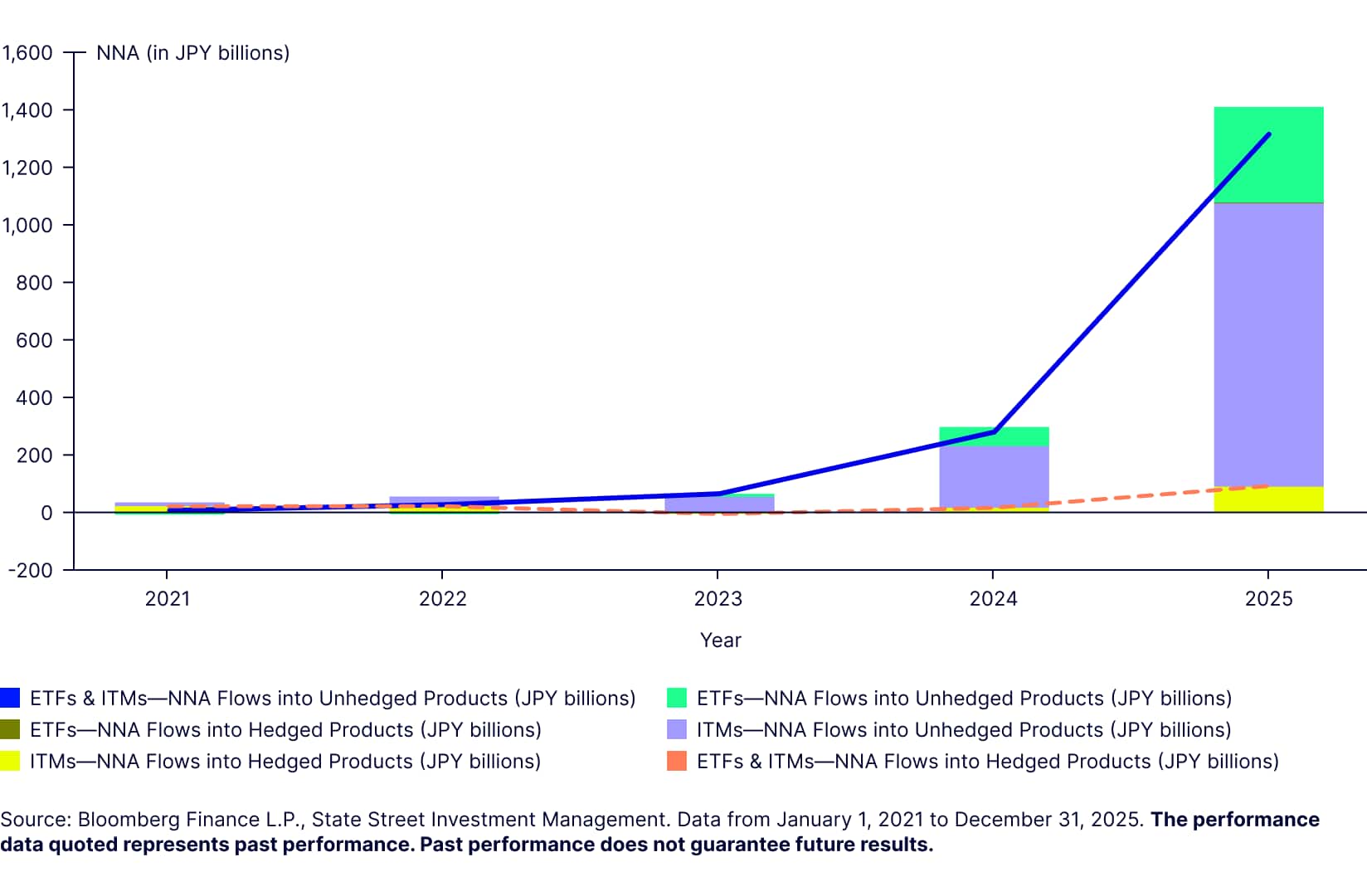
However, hedging can play a meaningful role by removing the added uncertainty of FX movements. For investors who are uncertain about the JPY’s outlook, adopting a 50/50 hedged–unhedged approach offers a balanced way to manage currency risk while retaining exposure to gold’s core return drivers. Nevertheless, unhedged products continue to be the preferred choice among Japanese investors, as evidenced by consistently stronger inflows compared with their currency‑hedged counterparts (see Figure 4). Given the broad consensus that the JPY may remain weak against the USD in the near term, this preference is likely to persist for some time.
JPY weakness and diversification demand fuel gold inflows
Gold demand among Japan‑based investors has increased sharply amid sustained JPY weakness and growing fiscal uncertainty, with unhedged ETFs and ITMs drawing significantly larger inflows versus hedged alternatives.
Between 2021 and 2025, hedged products attracted around JPY 155 billion, compared with nearly JPY 1.7 trillion for unhedged products — a divergence closely tied to the JPY’s depreciation from roughly 103 per USD in early 2021 to around 150 in 2022–202311, where it has since normalized at this softer level.
If these conditions continue, unhedged exposures are likely to continue attracting strong inflows in 2026. However, potential shifts in FX dynamics or broader macro developments warrant a measured approach. Indeed, ongoing fiscal challenges, uncertainty around the respective policy paths of the Bank of Japan and the Federal Reserve, and the ambiguous outlook for both the USD and JPY should continue to support demand for both unhedged and hedged gold strategies.
Figure 4: Net new asset flows into unhedged and hedged gold products (2021–2025)