
How the midterms could reshape the AI investment cycle
The US midterms should shift the AI trade from a focus on spending to a sharper focus on investment returns and productivity gains.

Despite the Democrats’ surprising margin of victory in the midterms, the federal policy outlook is largely unchanged. The more consequential shift may be at the state level, where greater constraints on the AI buildout could raise costs, slow deployment, and demand greater capital discipline. For investors, that may drive greater differentiation across companies and sectors without derailing the broader investment cycle.
Politics: Surprise? What surprise?
For all the astonishment at the Democrats’ margin of victory in the midterms, the House result hewed closely to the long-term trend line (Figure 1). The bigger surprise is that recent redistricting measures were expected to favor the Republicans, yet Democrats led by 12 points in the popular vote and thus offset any structural tilts. Flips of safe Republican Senate seats underscored the widespread dissatisfaction with the current policy mix.
Figure 1: Midterm gains/losses vs. presidential approval
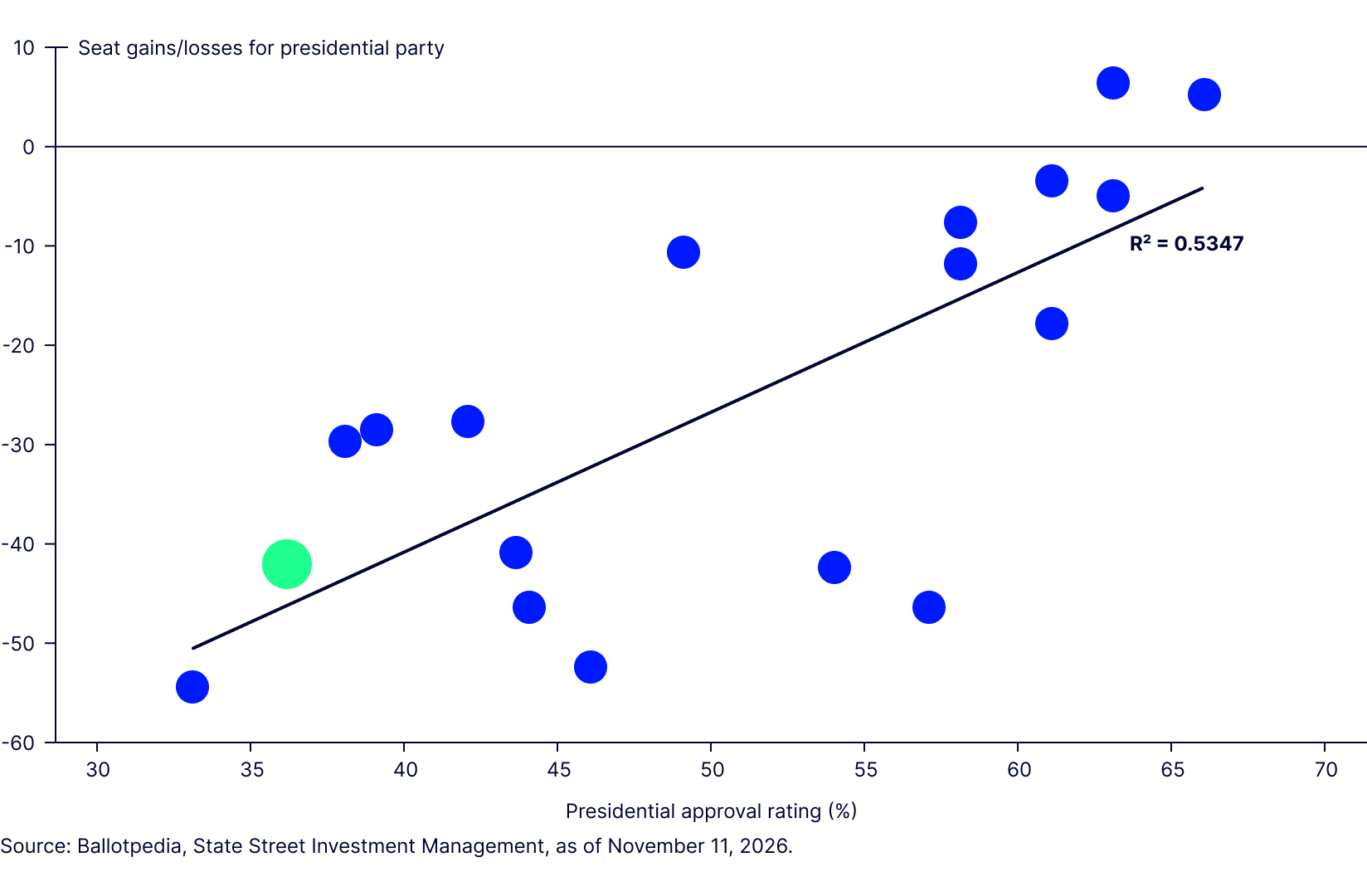
Yet the scale of the electoral shift may overstate the change in the federal policy outlook. Despite a stunning election night, little has changed from pre-election expectations. There remains limited room for bipartisanship aside from narrower thematic issues, such as possibly a higher minimum wage. Larger fiscal agreements remain unlikely, leaving room for fiscal showdowns over regular budgets and the debt ceiling.
Over the medium term, the affordability theme is not going away, while government spending is likely to remain high. That combination could eventually increase pressure for higher taxes. Continued wealth concentration, particularly in technology, could put the sector at the center of that debate later in the decade.
The election may have greater implications for the AI investment cycle at the state level. The blue wave could increase the cost and extend the timeline for future compute buildout. Notably, including Texas, eight of the top-ten states representing about 60% of future data centers are now or remain under Democratic control (Figure 2).
While local politics don’t upend geopolitical imperatives, they can affect the pace and cost of investment. In other words, the AI capex cycle may continue, but deployment may occur more slowly, and capital may be allocated more selectively. That could create greater differentiation between companies that already own compute capacity and those making significant capital commitments to build it.
Macro: A slower, longer AI buildout
If future compute becomes more expensive and takes longer to build, the implications extend beyond technology. For the broader economy, this could ultimately produce a less concentrated investment cycle, stretching the AI buildout into a flatter, longer cycle. The massive rise in AI capex as a share of GDP could start to flatten sooner and plateau at a lower level (Figure 3).
Higher costs, permitting constraints, and longer development timelines could also impose greater discipline on capital deployment. A less compressed investment boom may mean less upward pressure on rates from debt issuance and potentially less inflationary pressure from the buildout itself.
Markets: From AI spending to AI returns
These dynamics also point to more differentiation in equities. We have written about looking beyond the most crowded parts of the AI trade and considering whether it is time to lean into AI adopters.
The investment cycle may continue to ripple through adjacent sectors such as industrials, while the political shift could create a different set of catalysts in health care. At the same time, the next phase of the AI trade may increasingly depend on which companies can translate AI investment into revenue and productivity gains. Within health care, pharma could provide one of the nearer-term tests of whether AI spending can deliver measurable economic value.
A slower AI buildout could ease one source of inflationary pressure, but markets will still be looking for broader evidence of disinflation in the coming weeks. Meanwhile, Iran-related news continues to influence the near-term inflation outlook, while the midterms have not changed the fundamentals of that conflict.
Bottom line
For investors, the midterms could change the economics of the AI buildout more than its direction. A slower, more capital-disciplined expansion would not necessarily end the AI trade. But it could shift the focus from the scale of AI spending to the returns that spending can generate.