
US midterms: Limited change now, greater policy risks ahead
With Democrats expected to take control of the US House and Republicans likely to retain the Senate, the 2026 midterms are unlikely to produce major policy changes. While the election could still have incremental effects on select sectors, the more important signal for investors is that US political and policy volatility will likely remain elevated, setting the stage for potentially larger market-moving shifts during the 2028 presidential election cycle.

Midterms point to divided government
Sometimes, it’s worth putting the short-term news cycle in perspective, especially as markets try to assess whether one or both houses of Congress will flip to Democratic control.
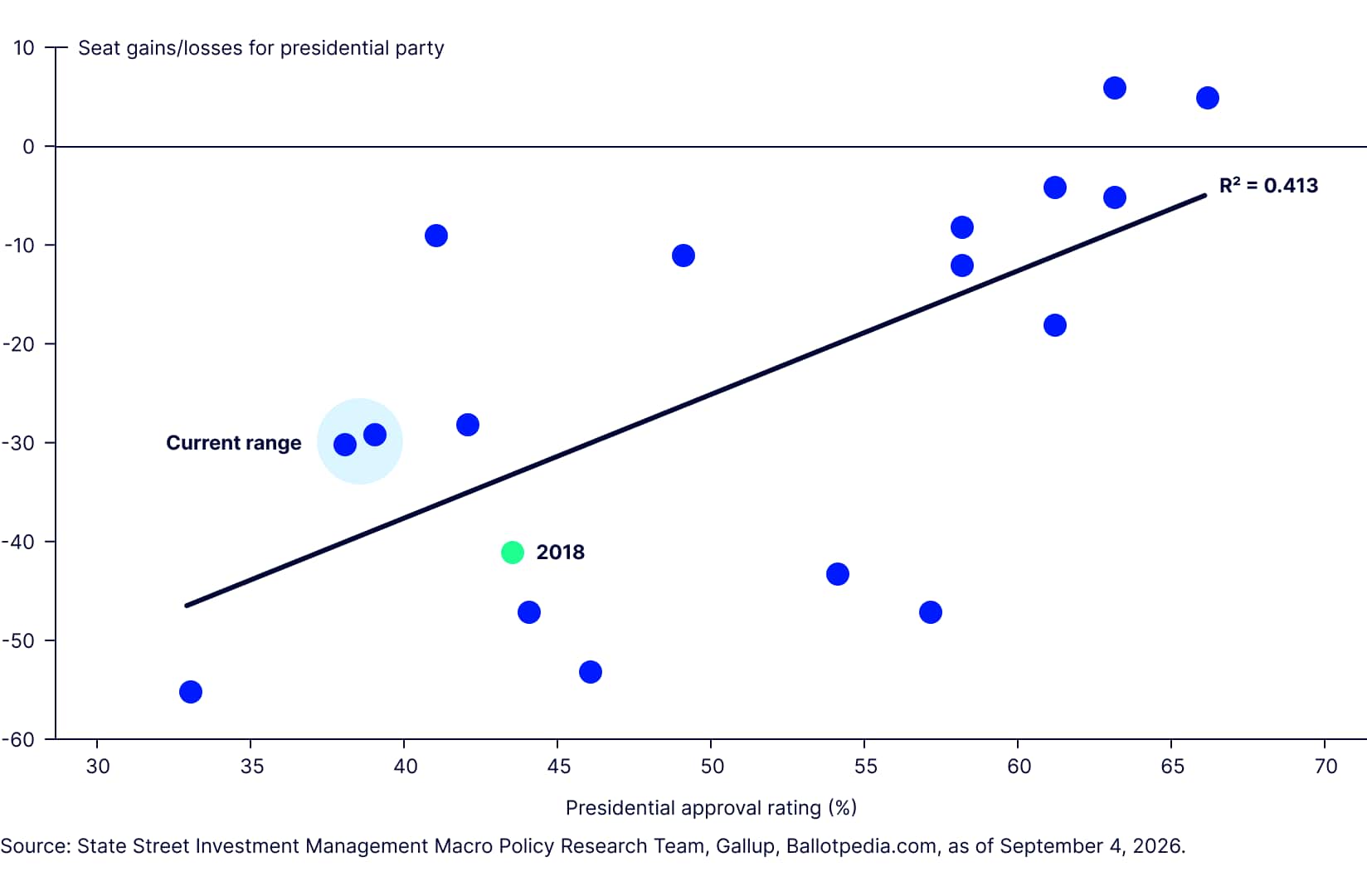
A traditional model using presidential approval ratings to forecast congressional outcomes would imply a near 40-seat loss for Republicans in the House of Representatives. Recent redistricting efforts nationwide are likely to limit those losses. But we still expect Democrats to win the House, potentially securing their largest majority since 2018.
The Senate presents a more complicated picture because state-specific dynamics play a much greater role. Democrats need to hold New Hampshire, Georgia, Minnesota, and Michigan while flipping four of the following states: Alaska, Iowa, Texas, North Carolina, Ohio, and Maine. In our view, the battle for Senate control could ultimately hinge on races in Michigan, Maine, Texas, and Alaska.
Figure 1: Midterm party gains vs. presidential approval rating
Frequent political shifts increase policy volatility
Polarized democracies like the US tend to exhibit two noteworthy features. First, the policy gap between opposing blocs is wide with an ever-shrinking shared policy agenda. Second, polarized electorates allow relatively small shifts in voter preferences to change political control. The result is more frequent change that brings about larger shifts in policy.
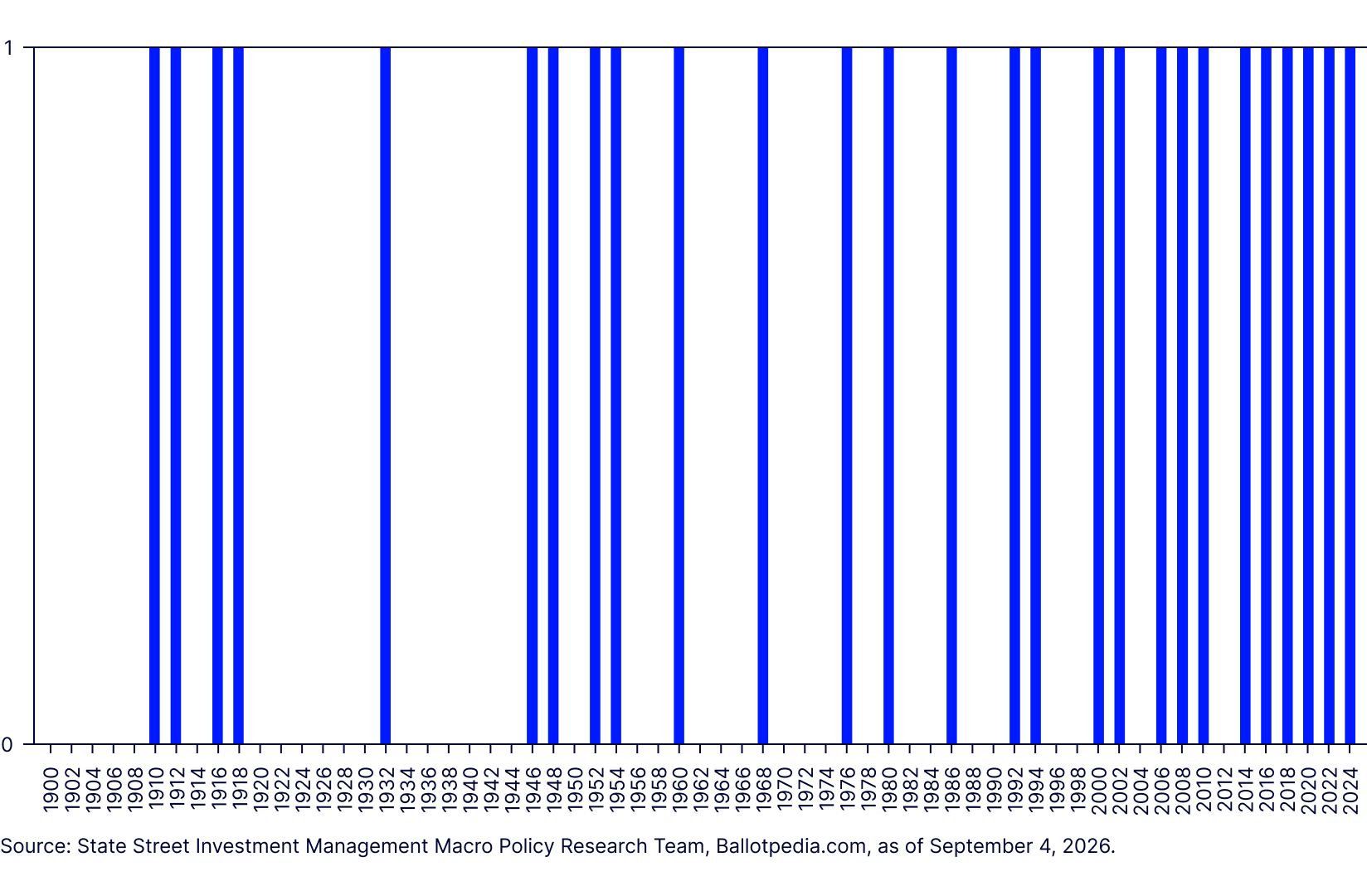
In fact, since 2000, only two federal elections—2004 and 2012—did not result in a change in party control of the House, Senate, or White House.
Figure 2: Federal elections leading to party change in one or more branches of government
Political shifts don’t translate into clear market signals
Since 1949, equity returns in midterm years have averaged 4.6%, compared with 11.3% in non-midterm years. And historical returns by the composition of government suggests a potentially favorable backdrop for the likely 2026 outcome (Figure 3).
However, the sample is too small to treat that historical pattern as a reliable market signal. Returns were generally weaker during first-term presidencies and Trump’s non-consecutive second term defies clear categorization. More importantly, in each case where equities performed poorly, the drawdown trigger was already identifiable by the summer of the midterm year rather than arriving as a surprise closer to Election Day (Figure 4).
Gridlock should limit near-term policy change
The 2026 midterm elections are unusually light on actionable policy implications, even by midterm standards. There is no overarching policy theme or debate with a meaningful prospect of producing major federal legislation after the election.
If the Democrats manage to win both chambers, there is a slightly higher chance of bipartisan legislative agreements, both for fiscal and non-fiscal issues. A divided Congress likely will struggle to pass much legislation, including budgets, raising the risk of renewed government shutdowns and a potential debt-ceiling standoff in 2027. Defense spending could remain an exception to the broader gridlock, given bipartisan support for national security priorities.
AI policy risks will build beyond the midterms
The most market-relevant theme—political risk to the AI infrastructure buildout and developing AI regulation—is not a direct function of the midterm elections. But the outcome will frame the parameters of debate and sharpen political risks ahead of 2028.
Even full control of both chambers would not be sufficient for federal policy to curtail AI-related data center construction, since it would face a presidential veto. However, Democratic gains could add momentum to state-level restrictions, particularly in Democrat-led states.
Sector effects look incremental, not transformational
For investors, divided government would largely extend current policy trends. Although gridlock would limit sweeping legislative change, regulatory, fiscal, and bipartisan initiatives could still produce targeted sector effects. Under our base-case scenario, the most important implications are likely to emerge in the following areas:
- Technology and Communication Services: AI remains a strategic priority given its importance to economic competitiveness, national security, and productivity growth. At the same time, concerns about its impact on jobs, power demand, and local communities are likely to keep the technology in the political spotlight.
Democratic gains could increase scrutiny of AI providers and the infrastructure buildout supporting them, particularly around data centers, energy consumption, and workforce impacts. While these debates may create periods of headline-driven volatility and weigh on investor sentiment, significant legislative action remains unlikely under divided government.
As a result, policy uncertainty may rise, but the AI capital spending cycle and underlying sector fundamentals should remain largely intact. - Utilities: Rising power demand from data centers and cloud computing is increasing pressure on the grid, elevating electricity affordability, reliability, and transmission investment in the policy debate. Under divided government, permitting reform, grid modernization, and nuclear power could remain areas of bipartisan support. A Democratic House could block another major round of subsidy cuts for renewables, but the wind and solar tax-credit restrictions enacted in 2025 would likely remain in place. Utilities positioned to invest in transmission and new capacity may benefit, although scrutiny of electricity costs and AI-related power demand is likely to remain elevated.
- Financials: A divided Congress would likely preserve the status quo, which may be a constructive outcome for the sector. Many of the most important regulatory decisions sit outside Congress, with agencies such as the Federal Reserve, FDIC, and SEC playing central roles. Gridlock is therefore unlikely to derail favorable regulatory developments already underway. Although bipartisan measures such as credit card interest-rate caps remain conceivable, they appear unlikely. Overall, continuity in the regulatory backdrop could support capital markets activity, bank profitability, and broader sector fundamentals.
- Health Care: Divided government could ease policy pressure on Medicaid-focused managed care companies by increasing the likelihood that certain OBBBA Medicaid cuts are delayed or softened. Life Sciences & Tools could also benefit, as significant National Institutes of Health funding cuts appear unlikely given the agency’s bipartisan support. Drug-pricing headlines are likely to persist, but congressional codification of most-favored-nation pricing appears unlikely given Republican opposition to government price controls. Even if enacted, its scope would likely resemble existing agreements, which have had limited effects on companies to date.
Midterms to set the stage for 2028
The 2026 elections are unlikely to be a major market catalyst. But they will help shape the political debate heading into 2028, when the potential for more consequential policy shifts will be considerably greater.
Get our latest US midterm elections insights
As we move closer to November, we watch the markets to help investors find opportunities. Bookmark our elections hub so we can bring to you our latest insights.