
The US-Japan yen rescue: Don’t miss the bigger story
Washington and Tokyo have turned the “160-or-weaker” yen level from a macro valuation debate into a political line in the sand. This sends an important signal to investors that could shift market consciousness. Joint intervention buys time, but the real story is Japan's return as an investable market and a Bank of Japan (BOJ) that may finally have to normalize faster.
For much of the past two years, the yen’s weakness looked like a one-way trade. The Ministry of Finance (MOF) intervened repeatedly to support the currency, but the underlying weakening trend remained. Wider interest rate differentials between Japan and ROW amid potential FOMC rate hikes and negative real rates in Japan; stimulative fiscal policy from Prime Minister Sanae Takaichi; and persistent capital outflows ultimately overwhelmed each intervention effort. Temporary reversals quickly gave way to renewed yen weakness. However, the latest intervention is different for important reasons:
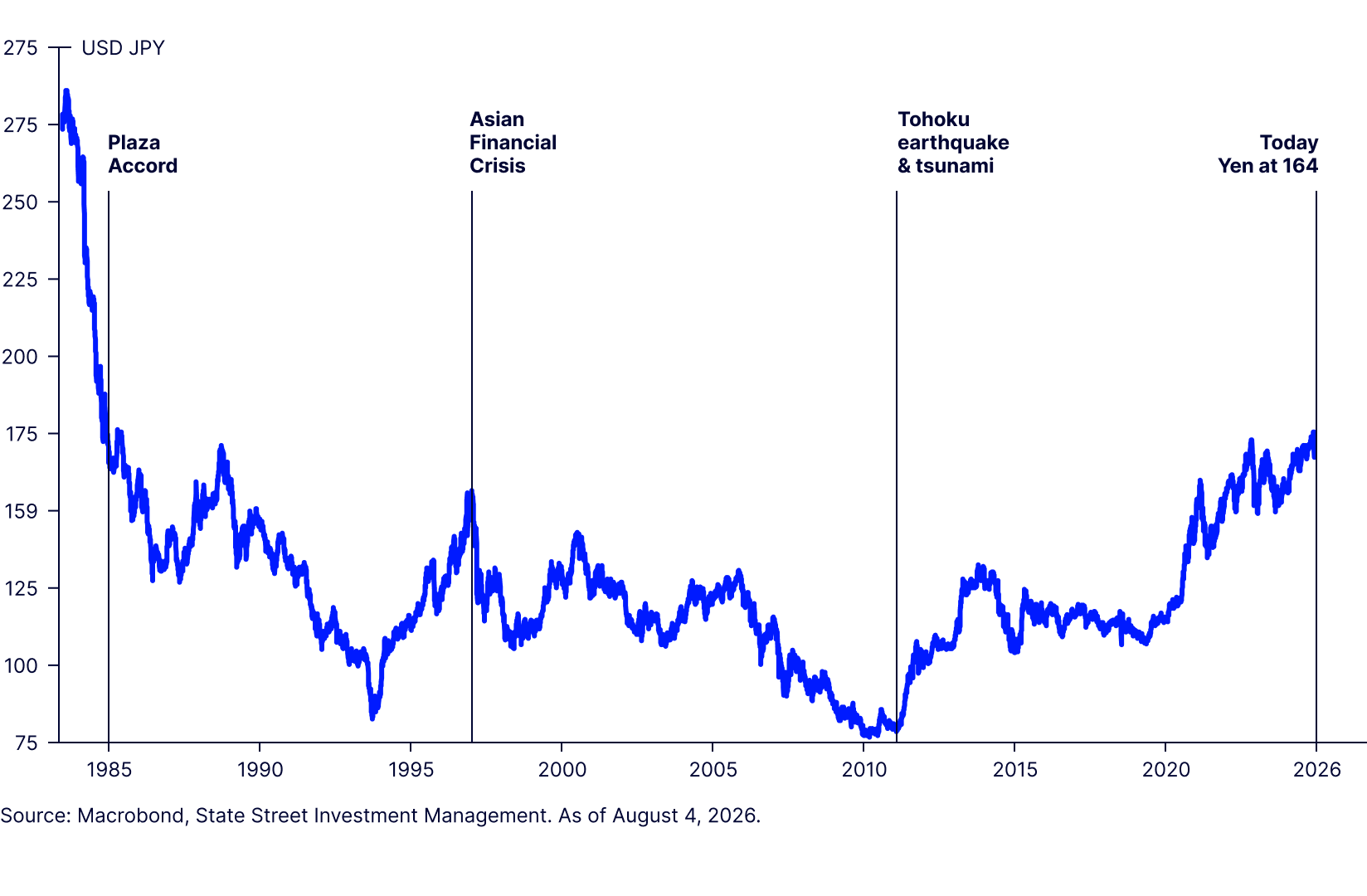
- Japan is not acting alone. The US and Japan on July 31 launched coordinated yen-buying—the first joint intervention since the 1998 Asian Financial Crisis (Figure 1).
- Markets may now be more willing to view policy as a potential backstop against yen weakness. The FIMA facility could dramatically increase Japan’s access to US dollars for FX intervention.
Even with this pivotal intervention, BOJ rate policy is key to alleviating long-term pressure on the yen. We believe that a rate hike is now in play for September, if incoming data meets expectations.
Figure 1: US-Japan joint intervention has been infrequent
Why this intervention is different
Historically, foreign exchange interventions have worked best when markets believed policymakers were willing to reinforce words with actions. The significance was not the money deployed, but the signal sent. By intervening when the yen moved weaker than the 160 level—i.e., outside a crisis—authorities have drawn a line against excessive yen weakness.
Washington and Tokyo have effectively communicated to markets that a free-falling yen is a shared concern. The coordinated response suggests authorities increasingly view a disorderly selloff in the yen as a broader financial stability risk rather than simply another movement in the FX market, and 160+ has become a political line in the sand.
That does not mean authorities are targeting a specific exchange rate. The yen remains a free-floating currency. But it does suggest that policymakers are increasingly uncomfortable with a sustained and disorderly slide in the yen.
This joint intervention changes market psychology more than fundamentals. For traders, yen weakness is no longer purely a macro call driven by interest rate differentials and growth expectations. It now carries policy risk.
That alone can discourage new short positions, encourage short-covering, and buy valuable time for policymakers.
The FIMA repo facility: A new source of intervention firepower
The most underappreciated aspect of the intervention may be the US’ Foreign and International Monetary Authorities (FIMA) repo facility.1 In theory, the MOF could defend the yen very effectively via the FIMA repo facility without selling US Treasuries, which lessens concern about spillover instability in the US Treasury market. The mechanics are straightforward:
1) Japan pledges US Treasuries via FIMA, and borrows USD from the Fed.
2) MOF sells USD and buys JPY, supporting the yen.
3) If USD/JPY falls, Japan can later buy back USD at a lower level.
4) It then repays the Fed and recovers the US Treasury collateral.
The key advantage of FIMA is that Japan gains access to dollar liquidity without dumping Treasuries and pushing US yields higher. The Federal Reserve protects Treasury market functioning while Japan obtains an intervention lever (Figure 2). Put differently, FIMA transforms Japan's US Treasury portfolio, worth over $1 trillion, into intervention-ready liquidity.
The signaling effect of this option may ultimately prove more powerful than the actual cash drawn. While this does not mean intervention capacity is unlimited, markets now know Japan can mobilize substantial dollar liquidity, with FIMA acting almost as a bazooka—but without disrupting Treasury markets. However, a risk is that intervention fails and the USD/JPY weakens. Japan would then need more yen to buy back the dollars used to repay the repo.
The heavy lifting still falls on the BOJ
Throughout the BOJ’s rate normalization cycle,2 bond and FX markets have told very different stories. Japanese sovereign rates markets have consistently endorsed the BOJ's path, with forwards pricing policy rates around 1.75% by end-2027 and higher thereafter. The yen, however, has repeatedly tested multi-decade lows, reflecting skepticism that the BOJ can tighten quickly enough to narrow rate differentials.
To be fair, the FX market's skepticism was not entirely misplaced. Although the BOJ has steadily dismantled yield curve control (YCC), negative rates, and quantitative easing (QE), normalization initially progressed at a glacial pace before evolving into a roughly six-month hiking cycle (Figure 3). That slow start helps explain why currency markets remained unconvinced.
Figure 3: BOJ's JGB buying is normalizing faster than policy rate
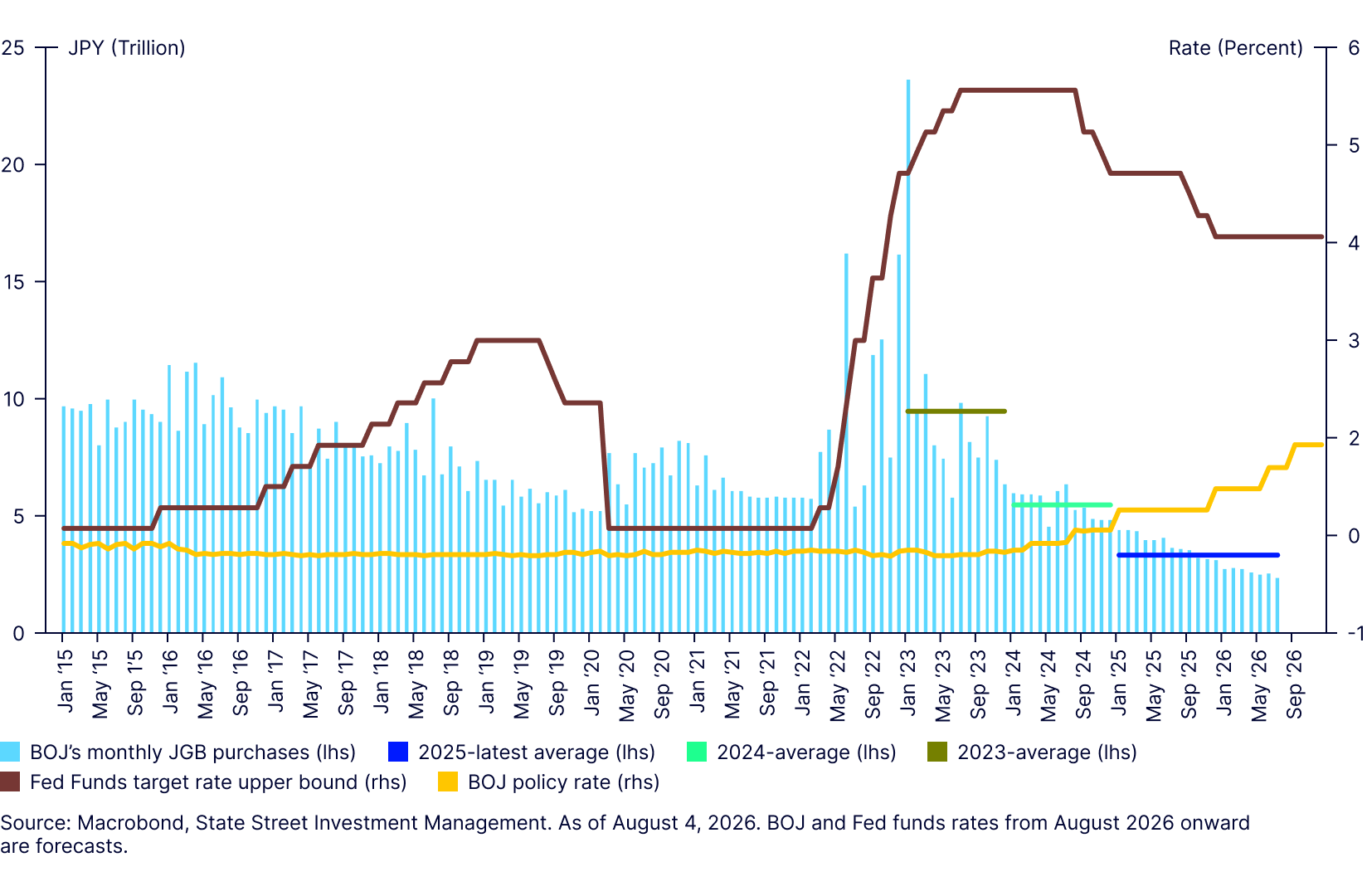
However, the latest intervention has shifted attention back to the timing of the next hike. September and October are now firmly in play, and another hike by early 2027 is increasingly plausible. The intervention itself does not change the fundamentals. Rather, it buys time for the BOJ to deliver the policy follow-through needed to support the yen.
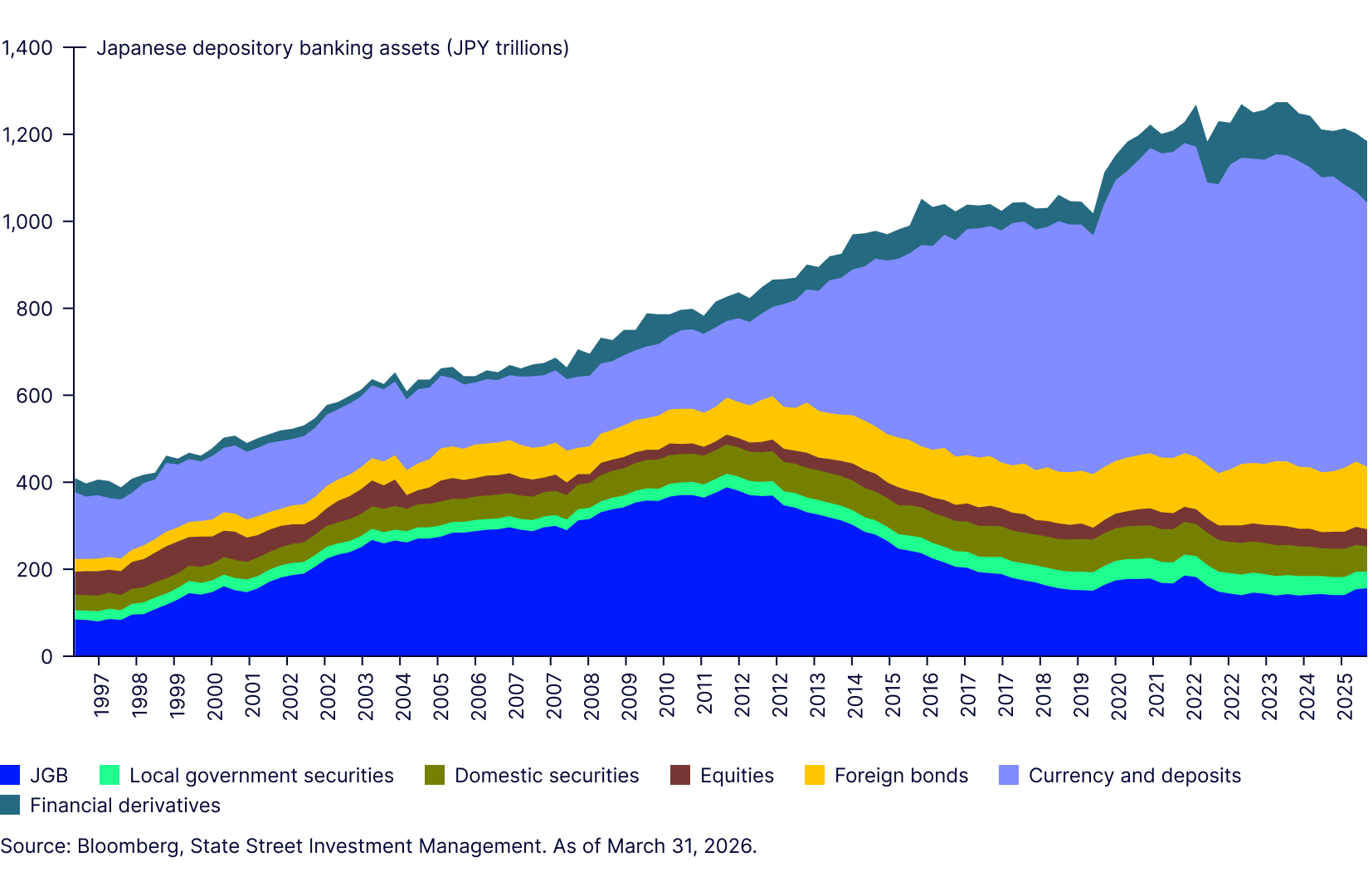
A credible path toward neutral, currently priced around 1.75%, reduces the risk that the BOJ will eventually need a far more aggressive tightening cycle to shore up the yen. Policy normalization would also have broader domestic implications. Japanese banks hold roughly ¥400 trillion in sidelined cash (Figure 4), and once the terminal rate becomes clearer, higher yields should help mobilize that liquidity into JGBs, strengthening monetary transmission and improving capital allocation across the financial system.
Figure 4: Japanese banks to tap idle yen cash (currency & deposits) for JGB investments
Avoiding policy mistakes
Ironically, the BOJ tightening needed to stabilize the yen could itself become a source of global volatility if delivered too aggressively. One option is to raise short-term rates aggressively enough to flatten the yield curve and encourage capital repatriation. But with Japanese investors holding foreign assets equivalent to roughly 82% of GDP, or about US $3.7 trillion,3 such a strategy could trigger sizeable capital flows and potential market dislocations.
Faster normalization risks disrupting carry trades, accelerating capital repatriation and tightening liquidity across markets accustomed to decades of inexpensive Japanese funding. Navigating that trade-off may prove one of the BOJ's most delicate balancing acts in the years ahead.
The bigger macro story: Japan is back
The intervention story is ultimately inseparable from a broader shift underway in Japan. For the first time in decades, Japan is experiencing a combination of structural inflation, wage growth, capital investment and improving corporate behavior and, crucially, meaningful market returns. Rather than a funding market merely exporting capital abroad, Japan is gradually becoming an investable market capable of attracting capital back home.
This matters because a stronger yen and higher rates are no longer necessarily signs of economic weakness. Increasingly, they are a consequence of a healthier economy.
Asset Implications
We remain constructive on Japan overall. A stronger AI and capex cycle should support Japanese equities, while higher JGB yields are gradually restoring domestic demand after years of BOJ distortion. We are neutral on the yen and JGBs near term as flows dominate, but we are constructive longer term. Intervention risk, BOJ normalization, growing domestic investment, and potentially lower FX hedge ratios should increasingly shift the yen from a funding currency toward an investable currency. The next major move in the yen may ultimately be higher, not lower.
The bottom line
The real story isn't the yen rescue. It's financial stability, BOJ normalization, and Japan's revival. Intervention buys time. FIMA protects the plumbing of U.S. funding markets. And markets now have a new variable to price: politics. Once financial stability concerns emerge, policy reaction functions can matter as much as macro fundamentals.
Ultimately, the success of this effort depends on whether Japan can complete its transition from a capital exporter to an investable market. That's the story investors should be watching.