
Japan is back: Investable again in the age of physical AI
Structural inflation, rising wages, BOJ normalization and improving investment returns are strengthening Japan's case across equities, bonds and currency markets.
For the first time in decades, Japan offers a compelling story across equities, bonds and currency. Structural inflation, rising wages, stronger investment returns and BOJ normalization are transforming Japan from a capital exporter into an investable market. While Korea and Taiwan may remain the higher-beta AI trades, Japan increasingly stands out as a diversified expression of the next phase of AI.
As Japan moves from deflation to reflation, investors are increasingly viewing Japan as a package, rather than a single trade. The bigger story is not AI alone, but Japan's re-emergence as an investable market and North Asia's cleaner, more complete multi-asset opportunity.
Weekly Highlights
Source: Bloomberg, as of August 7, 2026. Yield (%) in local currency terms.
Source: Bloomberg, as of August 7, 2026.
Source: Statistics Bureau of Japan, as of June 30, 2026.
Equities – AI trade is moving toward the physical economy
The first phase of AI was about building the brains: semiconductors and memory, driving outsized gains in Korea and Taiwan through a narrow group of market leaders. The next phase is about bringing AI into the physical economy through robotics, automation, precision manufacturing and industrial infrastructure.
That should play directly to Japan's strengths. As a critical link in the global supply chain and the emerging US-led "Pax Silicon" ecosystem, Japan is increasingly becoming the backbone of physical AI deployment. Japanese companies occupy key positions across semiconductor equipment, factory automation, robotics, machine tools, sensors and industrial infrastructure, allowing them to benefit regardless of where AI demand ultimately emerges.
Demographics provide an additional tailwind. Aging populations and labor shortages across the developed world are making automation an economic necessity, reinforcing Japan's role as AI broadens beyond a narrow group of hyperscalers and semiconductor winners into real-world deployment.
Bonds – More than a pension repatriation story
Markets are focused on potential pension demand for JGBs, but the bigger story is the return of yield and the end of Japan's zero-rate era. With banks holding roughly ¥400 trillion of excess cash and the BOJ gradually normalizing policy, domestic demand for JGBs is strengthening as global investors revisit an asset class largely ignored for decades.
The conversation is shifting from "Why own JGBs?" to "How much JGB exposure should investors have?"
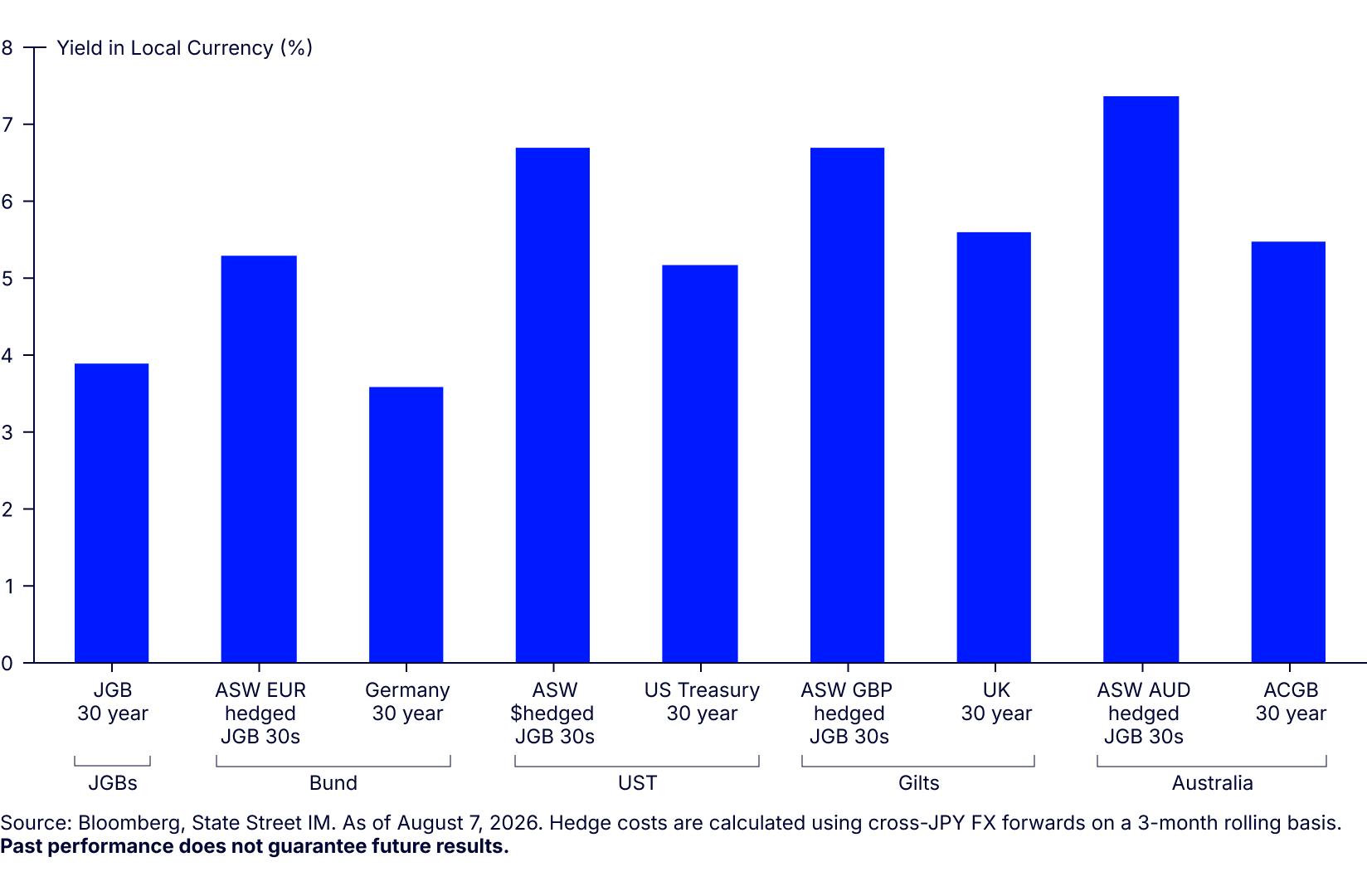
Near term, we remain neutral as investors continue searching for fair value after years of BOJ market distortion. Longer term, however, yields above 3% on 10-year JGBs and 4% on 30-year bonds are becoming increasingly difficult for domestic investors to ignore. For foreign investors, hedged yields also remain attractive, providing another structural source of demand (Figure 2).
Figure 2: FX hedging premium adds 100-200bps to hedged JGB yields
Currencies – From funding currency to investable currency
Both the yen and Korean won have traded near multi-decade lows in recent years, but the underlying flow dynamics are beginning to diverge. Korea's currency weakness has persisted despite record chip exports and strong AI-driven earnings, as foreign investors have increasingly taken profits following a semiconductor-led rally (Figure 3).
Japan's story is different.
Recent US-Japan intervention and a potentially faster BOJ normalization path should place a soft floor under the yen. For years, the currency was weighed down by ultra-low yields, negative real rates and persistent capital outflows. Those forces will not disappear overnight, but the backdrop is changing.
Higher domestic yields, BOJ normalization, stronger corporate governance, rising FDI and improved investment returns are making Japanese assets increasingly competitive. Japan's fundamentals also remain solid, supported by a current-account surplus of roughly 5% of GDP and a declining net debt-to-GDP ratio.
One underappreciated driver is hedging flows. While foreign investors have been reducing Korean equity exposure, they have largely stayed invested in Japan (Figure 3), often with high hedge ratios to capture the hedge premium. As BOJ normalization narrows rate differentials, lower hedge ratios could become an additional source of yen demand.
The yen is evolving from a funding currency into an investable currency. The next major move in the yen may ultimately be higher, not lower.
Risks
The most obvious risk is that the AI investment cycle proves overbuilt. A sharp slowdown in AI capex spending would pressure semiconductors, automation, robotics and industrial demand, weakening one of the key pillars of the Japan thesis.
A second risk is that Japan's reflation becomes too successful. If inflation accelerates materially above expectations, the BOJ could be forced into a much more aggressive tightening cycle. While gradual normalization should support the yen and improve capital allocation, an abrupt hiking cycle could trigger significant capital repatriation, disrupt carry trades and create volatility across global markets accustomed to decades of inexpensive Japanese funding.
The greatest risk to the “Japan Is Back” story may not be stagnation, but success that arrives too quickly.

Go beyond the headlines...
Skimmed the summary? Dive deeper with the full PDF—your go-to for weekly market insights and analysis.