
Assessing the investment case for climate adaptation and resilience
With some investors expecting physical climate risks to increase over the near term across a range of policy scenarios, we explore how they may assess exposure at the issuer and sovereign level, and consider the potential opportunities in adaptation and resilience solutions.
Introduction
Most investor attention in climate investing has historically focused on mitigation and transition pathways. Recently some investors have begun to focus on physical climate risks and how these may play out over the near term. This raises practical questions for those investors around portfolio exposure, issuer selection, and how physical climate risk and resilience can be reflected in portfolio construction today.
In addition, estimates of the gap in global adaptation investment levels1 have led some investors to assess investee companies’ exposure to physical risks. They also suggest there may be a growing opportunity in adaptation-related solutions. New frameworks, taxonomies, and datasets are emerging that can enable more systematic consideration of physical risks in investment processes, including research, product design, and portfolio construction for investors focused on adaptation and resilience.
Why is investor focus on adaptation increasing?
There has been an increase in climate related hazards, including more frequent extreme heat, heavier precipitation events, heightened drought conditions, and rising sea levels.2 Some investors are recognizing that in the short-to-medium term, major climate models indicate that global temperature trajectories remain relatively similar across scenarios through roughly 2040, suggesting that many of these physical risks are expected to continue increasing regardless of the future pace of decarbonization or future policy outcomes.3 For these investors, the relevance of these scientific findings lies not in forecasting distant outcomes, but in understanding how near-term physical risks may affect asset-level exposures, sector risk profiles, and portfolio resilience over the next investment cycle. After 2040, scenario outcomes diverge more sharply, with higher warming pathways likely leading to more frequent and severe hazards. For investors focused on adaptation, this suggests a two-stage approach: first, optimize portfolios toward near-term resilience, and second, prepare for longer-term shifts in sector and regional risk premia as climate effects become more differentiated. In this paper, we keep our focus on the first stage.
The adaptation investment gap: reinforcing the investment case for resilience
Despite growing recognition of the importance of adaptation, some investors see a financing gap persisting between estimated needs and actual investment flows. To these investors, this gap in the real economy presents two investment implications. First, for investors seeking to manage physical climate risks in portfolios, the adaptation gap suggests that some companies may not be sufficiently addressing their potential physical climate risk exposure. As a result, these companies may face heightened operational, financial and reputational risks that investors may need to consider. Second, for investors targeting a positive environmental or social outcome by investing in companies contributing to solutions, there may be an opportunity in identifying companies that develop and deploy adaptation solutions (e.g., drought-tolerant crops, flood mitigation technologies, and cooling solutions) if demand for resilience-related investment increases.
Incorporating adaptation and resilience in portfolio construction
For investors seeking to incorporate adaptation and resilience in portfolio construction, there are different approaches available. We discuss two of them below.
Investor approach 1: identify exposure and improve portfolio resilience
Some investors may seek to identify exposures to physical climate impacts and improve resilience by tilting toward issuers that are less exposed to these impacts and/or are effectively managing their physical climate risks. These characteristics may be associated by some investors with potential operational resilience, as well as potential financial benefits such as more stable cash flows or more favorable insurance and funding costs. In a 2025 MSCI Institute survey of 550 listed and unlisted companies across 15 countries in the nine industries MSCI identified as most exposed to physical risk, 82% of those surveyed reported that investing in operational resilience had led to positive financial or reputational outcomes, with lower insurance costs among the most commonly cited benefits.4
Datasets that could enable investors to identify such companies include, for example, physical climate risk and resilience ratings and physical climate value-at-risk (Climate VaR). Datasets may also be available for sovereign issuers through publicly available scores such as the Notre Dame Global Adaptation Initiative (ND-GAIN) Country Index. With the following two case studies, we demonstrate how these datasets may provide useful insights for investors incorporating physical risk in portfolio construction.
Case study 1: assessing corporate issuers
Recent advances in quantitative physical‑risk datasets can enable investors to evaluate issuer‑level exposure with greater precision. For example, climate value‑at‑risk (Climate VaR) metrics now overlay companies’ physical locations with modeled hazard projections under multiple warming scenarios to estimate how physical risks may impact equity values across climate scenarios.
Figure 1 shows the Climate VaR estimates for three property sector companies operating in different regions—the UK, India, and the UAE—under a 2050 Net Zero scenario. The estimated decline in equity value that would result from the financial impact of physical risks from all hazards for the company in the Middle East is far higher than that of its peers in the UK and India. In this illustration, an investor prioritizing lower physical-risk exposure might focus on the issuer with the highest estimated exposure (Company C).5
Complementing exposure‑based metrics like Climate VaR, resilience scores offer a view of how well companies may be positioned to adapt to physical risks they face, using proxies such as asset intensity, ability to relocate operations, and supply‑chain dependency. In addition, management scores assess a company’s governance and management practices addressing physical risks. These indicators can provide a view into a company’s adaptive capacity.
Looking at the resilience and management scores of the same three property companies (Figures 2 and 3), all three score similarly on resilience, so the real differentiator here is management quality: Company C’s management practices score lower than those of its peers. Combining this resilience and management view with the exposure assessment illustrates how an investor could distinguish among the three issuers: Company C stands out as both the most exposed and the weakest on management, while Companies A and B screen more favorably on these measures.
While these tools involve modeling complexities and limitations that are beyond the scope of this paper, they demonstrate that investors increasingly have access to structured data to support issuer‑level assessments of physical climate risk and resilience that can be used in portfolio construction.
Case study 2: assessing sovereign issuers
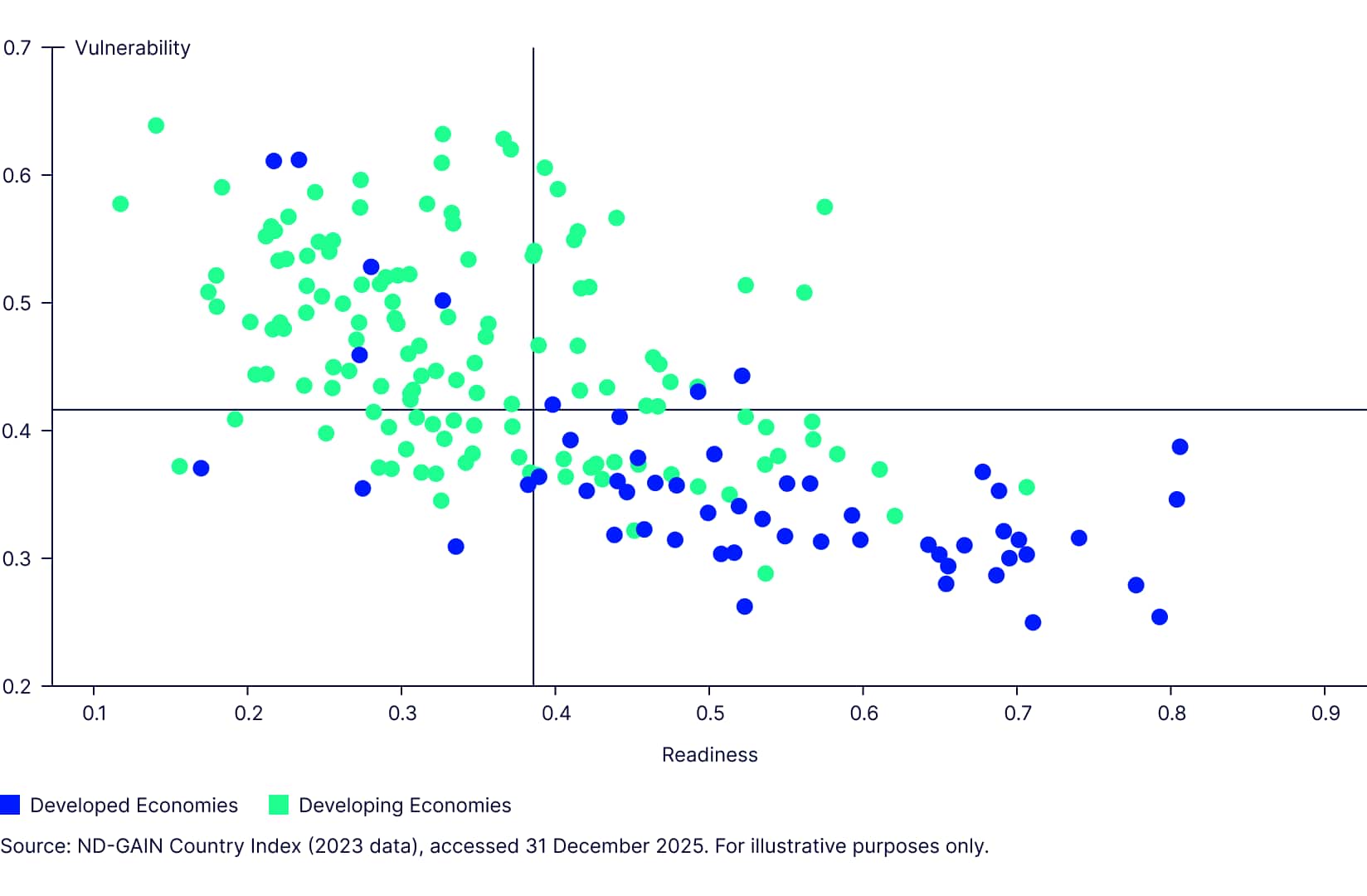
Figure 4 uses the ND-GAIN Country Index6 to illustrate how data can be used to compare countries’ readiness to adapt to climate change (horizontal axis) with their vulnerability to climate impacts (vertical axis). Developed economies generally cluster toward the right side of the chart, indicating higher institutional and economic readiness, and toward the lower half, reflecting relatively lower vulnerability. Conversely, developing economies appear more toward the left and upper portions of the chart, indicating lower readiness and higher vulnerability on average, albeit with meaningful variation across countries. The negative relationship between readiness and vulnerability is also visible: economies with stronger adaptive capacity typically experience lower relative vulnerability. A sovereign investor could incorporate this data into credit risk assessment and position portfolios toward countries with lower vulnerability and/or higher readiness.
Figure 4: Country readiness versus vulnerability, ND-GAIN Country Index
Investor approach 2: contribute to solutions targeting positive outcomes
Investors seeking to invest in adaptation and resilience solutions may look to target positive environmental and social outcomes; they may also see the following dynamics bolstering the investment case for adaptation solution providers:7
- Climate-focused investments to date have focused primarily on mitigation solutions. A growing appreciation of the near-term trajectory of climate change and the need to adapt may shift investor capital toward adaptation and resilience solutions.
- Importantly, this growth opportunity is both independent of mitigation investment and exhibits co-benefits with mitigation solutions. For example, renewable energy infrastructure needs to be appropriate for a 2°C world, and nature restoration intended to drive carbon sequestration must be resilient to climate hazards like wildfires and droughts to preserve their mitigation benefits
- Physical climate risks are location-dependent and there is overlap with nature-based solutions, which are already gaining investor attention.8
Implementation in portfolio construction can be achieved by using key performance indicators (KPIs) to identify companies that contribute to adaptation and resilience solutions.9 The market has yet to coalesce around standardized KPIs linked to these solutions, and challenges remain in the ability to classify investments related to adaptation. However, frameworks are emerging to address this that identify both corporate issuers driving adaptation-related products and services and use of proceeds linked to adaptation and resilience investments through green, social, and sustainability bonds.10
Conclusion
Many investors are recognizing that physical risks are likely to increase in the near term across a wide range of policy scenarios, underscoring the importance of understanding their implications for portfolios in the near term. At the same time, a persistent gap between adaptation needs and capital flows highlights both potential vulnerabilities within investment portfolios and opportunities to allocate capital toward solutions that strengthen resilience in those portfolios.
Investor tools, emerging datasets, and investment frameworks can support investors in assessing exposure to physical risks, evaluate issuer level resilience, and identify adaptation related investment opportunities. As investor interest in incorporating adaptation and resilience in portfolios grows, we expect portfolio implementation strategies, including the data required for implementation, to evolve and mature.
Key definitions11
These definitions primarily describe climate‑related concepts at the corporate or issuer level. For many investors, however, understanding these underlying definitions is critical, as they help translate issuer‑level climate characteristics into potential risk and return drivers. The various terms used in this article are as follows: