
Emerging markets, AI, and index concentration: Navigating a different opportunity set
The emerging market opportunity set has changed materially, with technology leadership and market concentration now playing a more prominent role in index performance. As traditional macro drivers become less dominant, investors may need to reassess how they evaluate emerging market exposure, risk, and portfolio construction.
Long-term emerging market investors may well be feeling more like tech analysts, given the current state of the asset class. One thing is clear, this is no longer the asset class of days gone by—relatively easily explained by a combination of commodity prices, global growth, rates, and the US dollar. Now, the changing leadership and concentration of the standard emerging market indices make many of these traditional drivers feel almost quaint.
Fundamentals across leading emerging market technology firms are exceptionally strong, while the global capex cycle continues to provide a powerful tailwind. As their market capitalizations have surged, these companies have come to dominate cap-weighted indices. Throw in innovation in financing—not all of it beneficial—that has given companies access to quick leverage to invest in these trends, and the volatility associated with many of these names has been nothing short of extraordinary. It’s worth noting that only a small number of stocks have been participating in this rally: as of the end of July, only about 10% of MSCI EM index names were outperforming this year and the median emerging market firm had a negative return year-to-date for 2026.*
Figure 1: Index concentration at record levels
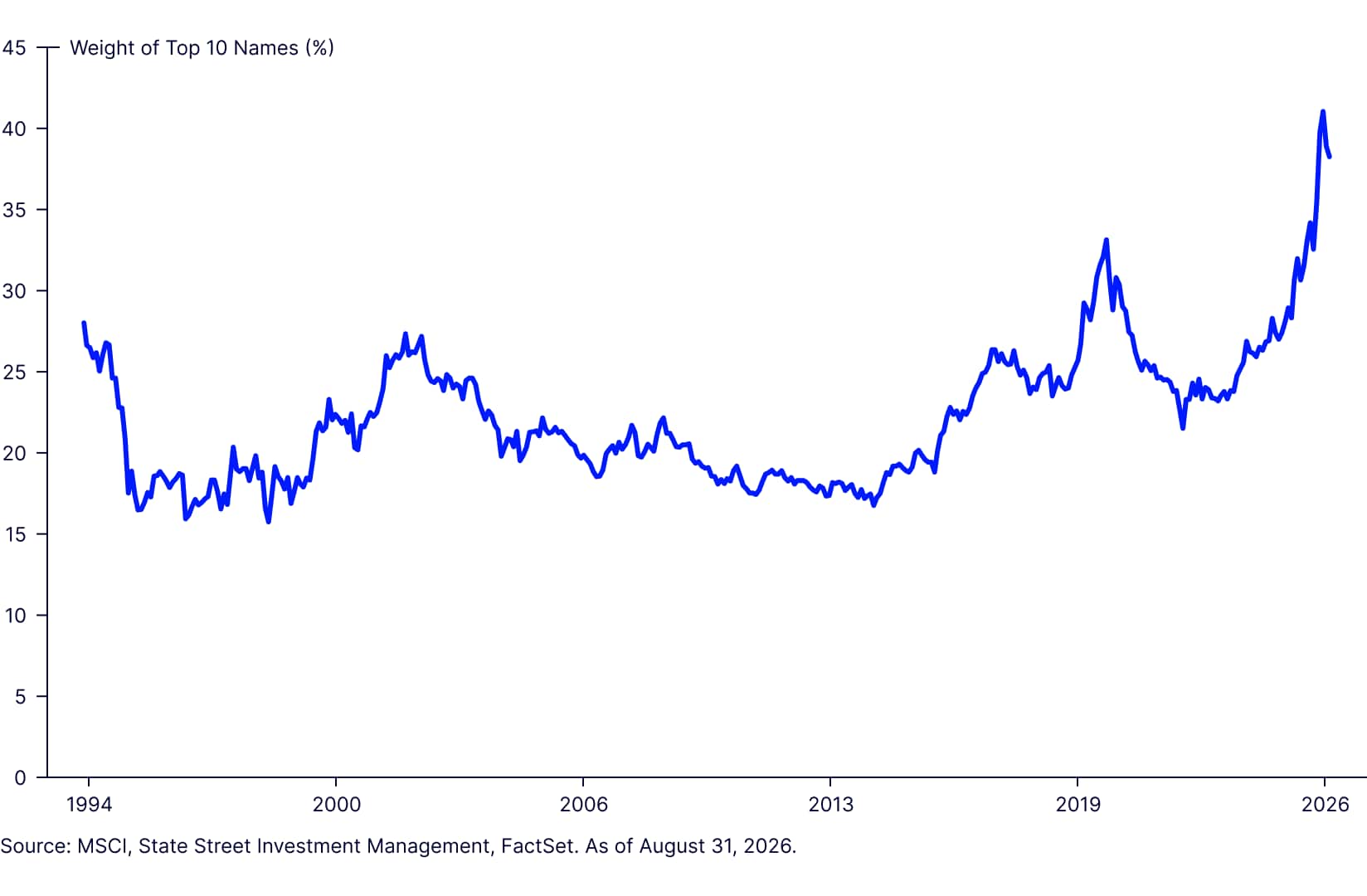
These market movements aren’t happening in a vacuum. They are being driven by the once-in-a-generation earnings power of a relatively small number of firms. The EPS estimate for the MSCI Korea index, for example, is expected to rise a whopping 300% in 2026, with a further 35%+ expected in 2027.* Given the bottlenecks in the semiconductor industry, there could be proper earnings visibility for several years. The other interesting dynamic is that EM stocks have been “under-returning” their earnings, leading to a contraction in multiples. Whether this is good, not good, or simply a curiosity remains unclear.
Case study: Korea’s AI leaders highlight concentration risk
TSMC, SK Hynix and Samsung Electronics have been among the largest beneficiaries of the global AI buildout, as surging demand for high-bandwidth memory (HBM), advanced DRAM, and data center infrastructure has driven strong earnings growth and improved industry pricing power. The enthusiasm surrounding these stocks reached another level following the launch of Korea's single-stock leveraged and inverse ETFs, which allow investors to amplify exposure without using derivatives accounts.
While similar products are common in developed markets, Korea's highly concentrated equity market has heightened concerns around concentration risk and market volatility. Given the outsized weight of Samsung Electronics and SK Hynix in the Korean market, the daily rebalancing required by leveraged ETFs can create a feedback loop in which price movements trigger additional trading flows, potentially amplifying volatility in both directions. Following the sharp pullback in Korean equities during July, regulators moved swiftly to curb perceived excesses by tightening oversight of these products. Although existing ETFs remain listed and tradeable, authorities have suspended new launches, imposed stricter access requirements, and are considering further limits on leverage and investor exposure.
Implications
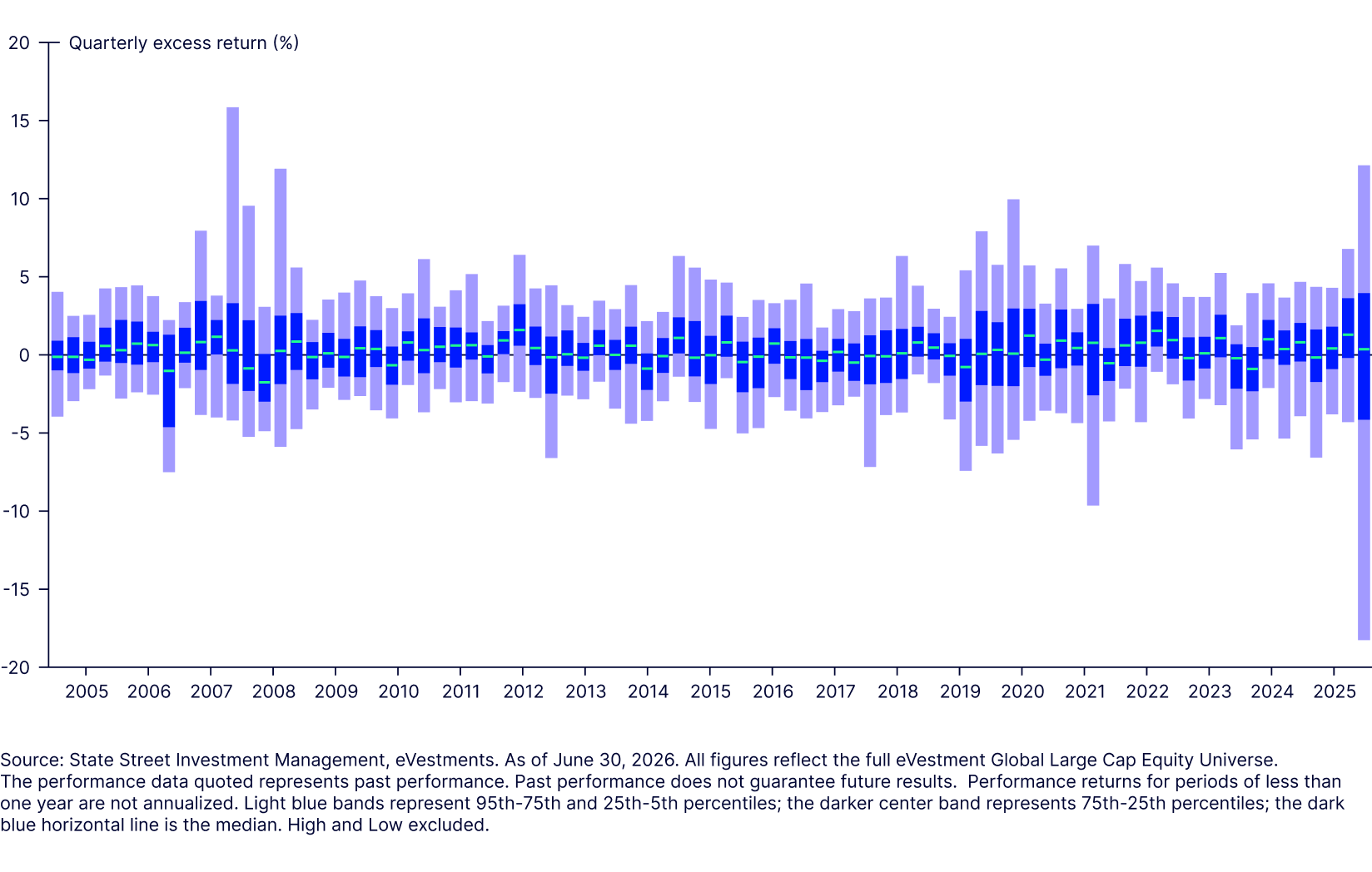
How is the impact of this being felt by investors? Amid the narrowing market concentration, the related payoffs on style bets have been growing—for better and for worse (see Figure 2). This dispersion is nearly unavoidable for managers attempting to play in one corner or another of the market.
Figure 2: Largest dispersion in active return space
Winning by not losing
Certainly, now feels like a time to be cautious with respect to positioning and to lean heavily on risk controls. Markets have experienced a remarkable run: these higher concentration levels remain elevated, and retail participation and leverage have increased meaningfully, contributing to greater volatility and, at times, less efficient price discovery. We believe, with conviction, that now is not the time to take on large style/size exposures. The impact of these will have outsized payoffs given all the risks in the market (whether geopolitical, fiscal, etc). The payoff profile is likely to be large, in one direction or another.
Periods like these are precisely where a systematic process and disciplined risk management framework is most valuable. While the path forward may not be without periods of volatility, the opportunity set remains compelling, and we have confidence in the durability of both our model and investment process. In a market environment where narratives can shift quickly and short-term sentiment often dominates headlines, we believe staying diversified, maintaining disciplined risk controls, and focusing on the strongest underlying signals remain the most effective way to deliver consistency and dependability: it is better to win by not losing.