
Treasury demand returns as yields and inflation rise
After a difficult year so far for sovereign bonds, there are signs that higher yields are beginning to draw asset managers back to some markets, notably US Treasurys. But flows suggest investors remain highly selective while fiscal and inflation risks persist.
2026 has been a difficult year so far for sovereign bond markets, marked by a large energy supply shock, higher inflation, higher short-term rates and continued concerns about fiscal sustainability. But yields may eventually reach a point where they attract long-term investors once more. Amid the volatile price action in recent months, there are tentative signs that this is beginning to occur, albeit with a high degree of selectivity (Figure 1).
Figure 1: A change in tone in asset manager fixed income flows
60-day flow percentile - relative to historic averages
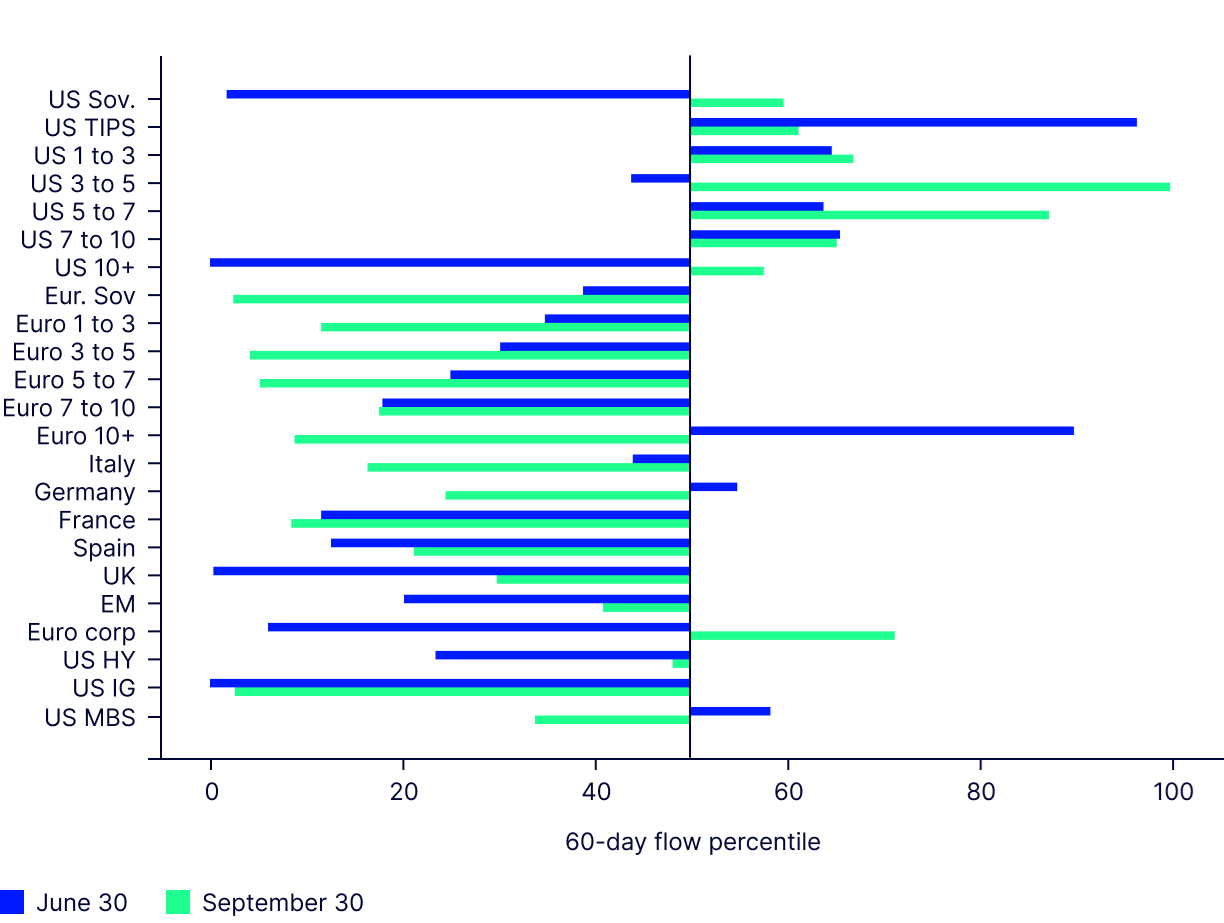
Source: State Street Markets, as at 30 September 2026. Bars show each asset class’s 60-day flow reading ranked against its distribution over the previous five years. The 50th percentile represents the midpoint of that historical distribution.
The pattern of asset manager fixed income flows was quite different in Q3, with appetite for Treasurys showing the biggest improvement among sovereign markets (Figure 1). In Q2, asset managers favoured Treasury Inflation-Protected Securities, but in the past three months, flows into 3- to 7-year Treasury bonds moved into the top quartile of their five-year range. Notably, demand for longer-dated Treasurys also moved to above their historical average, for the first time since September 2024. The more hawkish turn by the Federal Reserve in Q3 may have revived asset manager appetite for Treasurys, despite volatile price action.
Stronger demand for Treasurys did not extend to European government debt (Figure 1). Demand for European sovereign bonds as a whole fell from the 39th percentile of its five-year range at the end of June to the 2nd at the end of September. Having posted average inflows in Q2, demand for German government debt (Bunds) slumped into the bottom quartile of historical flows in Q3. Flows into Italian medium and long-term sovereign debt (BTPs) showed a similar deterioration. Demand for similar-duration French government debt (OATs) was already in the bottom quartile in Q2 and slipped into the bottom decile in Q3, ahead of the 2027 budget bill presented on 1 October. The sharpest deterioration was in long-dated euro sovereign debt, which fell from the top quartile of its five-year range in Q2 to the bottom decile in Q3. Gilts were an exception: demand had been at a five-year low in Q2 and recovered modestly in Q3. Demand for Spanish government bonds also improved slightly.
In credit, asset manager demand for European corporate bonds rose sharply in Q3, from the bottom decile of its five-year range to above the 70th percentile. That may reflect economic data that have broadly surprised to the upside. In the US, demand for investment-grade credit remained weak, but appetite for high-yield bonds moved back towards median levels.
Asset manager demand for local-currency emerging market (EM) sovereign debt moved closer to its historical median. But we think the combination of higher oil prices, a more hawkish Fed, a stronger US dollar and higher US Treasury yields is still weighing on demand for EM sovereign bonds
A closer look at demand for long bonds
For most of the past 12 months, asset manager demand for 30-year US, UK and French government bonds has run at or close to five-year lows (Figure 2). Spain and Germany were the exceptions. That changed markedly for Treasurys and gilts in the final weeks of Q3.
Amid continued price volatility, demand for 30-year Treasurys returned to close to its five-year median for the first time since the beginning of September 2025.
Higher yields and a more hawkish turn from central banks may both be factors. But demand for 30-year gilts also recovered, even though the Bank of England (BoE) held Bank Rate in September while the Fed and the European Central Bank (ECB) raised rates. That suggests yield levels may matter more than central bank policy.
This also suggests some asset managers are willing to buy longer-dated bonds despite the ongoing fiscal and political uncertainties in both the US and the UK. This does not mean, however, that fiscal and political risks are being ignored. It is telling that demand for 30-year OATs, which, like Treasurys and gilts, had been weak all year, did not recover at the end of September. Our data suggest that longer-term yields are returning to levels that may attract asset manager demand once again. But with fundamental risks still present, investors may need to remain highly selective.
Inflation: just passing through again?
The pick-up in demand for long-dated bonds comes despite what we see as the most pressing macro risk for sovereign bonds, beyond the UK and French budgets: inflation. Looking through the recent methodological changes to US Personal Consumption Expenditures (PCE) inflation, the outlook remains challenging.
State Street PriceStats data show annual inflation reaccelerating in many countries, including the US (Figure 3). Rises in August and September were not enough to take the US measure back to its May high, but they mark a clear break in the disinflationary trend that began in early summer. The US is not the only warning sign. In recent weeks, markets were surprised when September’s official Spanish inflation data reached an annual rate of 5%. The Bloomberg consensus forecast had been for a more modest rise.1 The State Street PriceStats measure passed 5% in March.
As in Q2, much of this inflation has been generated by an almost immediate pass-through into vehicle fuel prices. But headline inflation has now been higher for longer, which increases the risk of contagion into core inflation. This may also influence the new, more hawkish tilt of many central banks going into Q4 and suggests that we probably should not take for granted the nascent improvement in investor behaviour towards some fixed income markets noted at the start of this piece.
Read our Q4 Bond ETF Market Outlook, which examines fixed income strategies for the changed environment.