
The Price of Intelligence
What does AI have to do with pension scheme discount rates?
The development of AI requires substantial investment in data centres, semiconductor manufacturing, networking infrastructure and power capacity. Funding this build-out is creating significant demand for capital. Market estimates suggest AI-related borrowers have raised close to $500 billion across global debt markets this year, representing a meaningful share of overall investment-grade issuance.
Importantly, this is no longer confined to the largest technology companies. While firms such as Microsoft, Amazon, Alphabet, Meta and Oracle remain at the centre of AI-related investment, financing activity has broadened to include data centre operators, digital infrastructure providers and other businesses supporting the wider AI ecosystem. What began as a technology theme is increasingly becoming a capital markets theme.
For fixed income investors, the most immediate impact is on supply. According to Barclays Research, Tech and AI-related borrowers account for about 19% of year-to-date issuance and 38% of over 10y supply.1 Many of the companies investing heavily in AI have historically been infrequent borrowers relative to their size and cash generation. As capital expenditure requirements continue to rise, debt markets are playing a larger role in funding growth plans. The result is a growing pipeline of corporate bond issuance linked to AI infrastructure and related investment.
From a credit quality perspective, many AI-related borrowers remain highly rated and financially robust. Strong cash flows, substantial liquidity and leading market positions provide considerable support for credit fundamentals. However, strong fundamentals do not automatically translate into attractive valuations. As expectations for future growth remain high, investors must continue to assess whether credit spreads adequately compensate them for the risks associated with large-scale investment programmes and changing competitive dynamics.
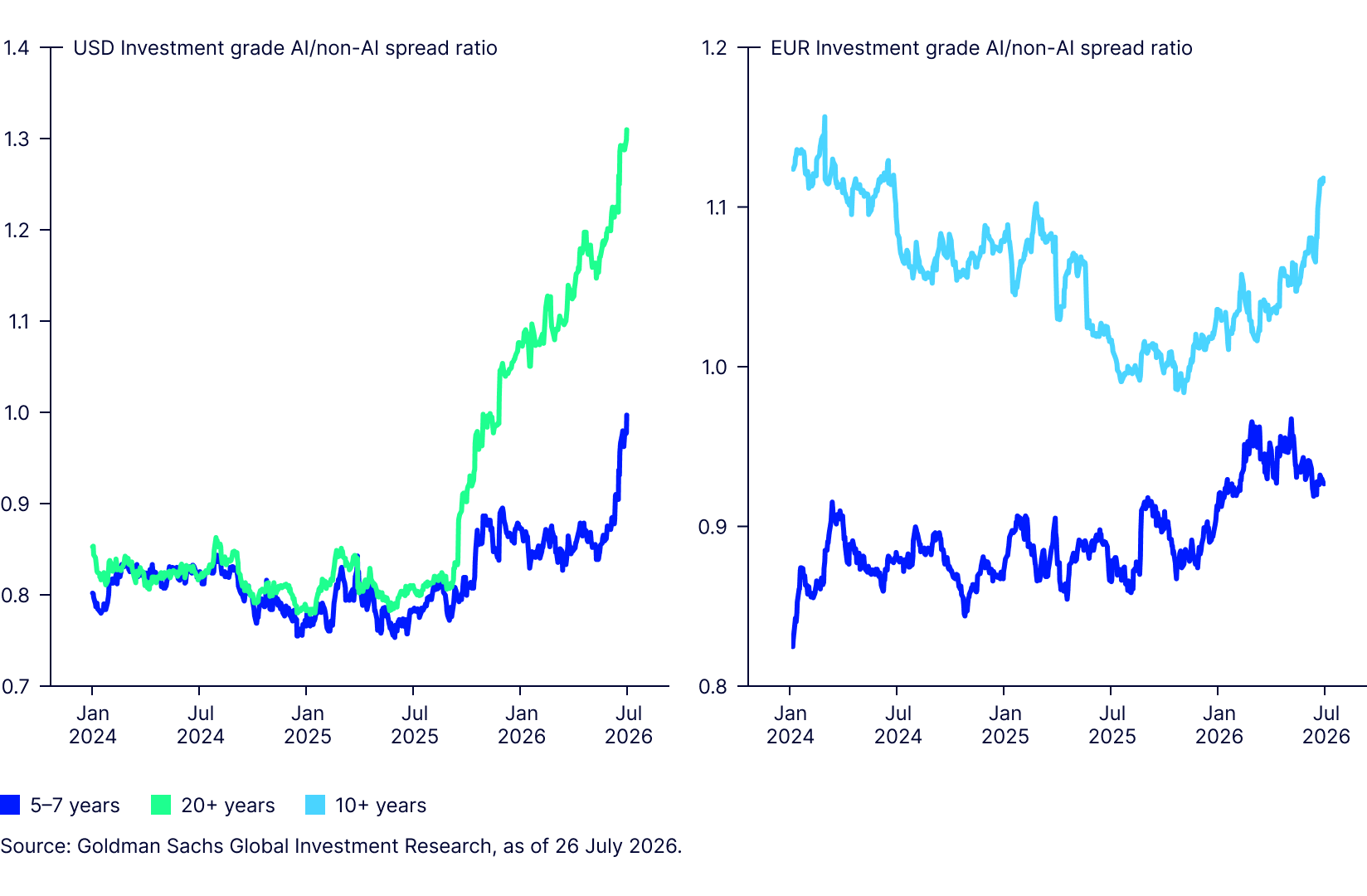
The implications may ultimately extend beyond corporate credit markets alone. The scale of investment associated with AI spans not only technology companies but also electricity networks, power generation, semiconductor manufacturing and digital infrastructure. If this investment cycle proves both sustained and productive, it could increase demand for capital across the economy and place upward pressure on real interest rates. Barclays Research now estimates that net US Treasury supply will drop from $1672bn in 2025 to $1230bn in 2026. This fall, however, is almost completely offset by an increase in issuance of corporate bonds from $726bn to $1200bn1. Some economists have argued that a period of structurally higher investment could contribute to an increase in the neutral rate of interest: the level of interest rates that neither stimulates nor restrains economic activity. While it is too early to draw firm conclusions, the possibility of a higher equilibrium level of rates is becoming increasingly relevant for long-term investors.
For pension schemes, the implications are most evident within investment-grade credit allocations, although broader market effects should not be overlooked. The emergence of a larger technology borrower base expands the investable universe and increases the availability of high-quality corporate bond supply, including longer-dated issuance that may be particularly relevant to long-term investors. This issuance may also have a direct impact on the discount rate used for pension fund liabilities, which is typically linked to long dated corporate bond spreads.
The AI narrative is often discussed through the lens of technological innovation. For fixed income investors, it is increasingly a financing story as well. The scale of investment required to support AI is helping to reshape corporate bond markets today and could ultimately influence broader capital market dynamics, including the level of interest rates. As a result, AI is becoming an important theme not only for equity investors, but also for pension schemes assessing the long-term opportunities and risks within fixed income markets.