
Real assets insights: Q3 2026 Real assets provide resilience as inflation, rates, and geopolitics remain in focus
Real assets advanced as geopolitical tensions, higher energy prices, and inflation concerns boosted commodities and natural resources, outweighing weakness in yield-sensitive real assets. Looking ahead, resilient growth, persistent inflation pressures, and geopolitical uncertainty remain supportive of real assets. Higher yields and the potential for further Fed tightening introduce additional risks, but fundamentals for real assets remain intact.
The third quarter of the year was defined by geopolitical uncertainty, resilient growth, and sticky inflation. Global economic activity strengthened during the third quarter, supported by sturdy services activity and continued expansion in manufacturing. Labor market conditions remained generally resilient, although hiring activity and wage growth moderated across some economies. Higher energy and input costs contributed to renewed inflationary pressures. Against this backdrop, monetary policy remained restrictive, with the Federal Reserve Bank and ECB both raising interest rates during the quarter.
Risk assets delivered mixed performance during the third quarter. Resilient economic growth, strong corporate earnings, and continued investment in AI-related infrastructure supported equities, while rising US Treasury yields and higher energy prices weighed on market sentiment. Developed markets (DM) outperformed emerging markets (EM), while value outperformed growth. Fixed income posted negative returns during the quarter. US Treasury yields rose sharply, with the 2-year Treasury recording its largest quarterly increase since Q2 2023, while the 10-year and 30-year yields reached their highest levels since 2002. Commodities advanced strongly, led by energy, while the US Dollar Index gained modestly.
Quarter in review
The backdrop for real assets continued to evolve in the third quarter, as markets moved further from the disinflation and monetary easing expectations that prevailed at the start of the year. Inflation risks and broader uncertainty remained central themes, as investors weighed the path of monetary policy alongside new tariffs, rising weather-related risks, and persistent geopolitical tensions, all of which reinforced the case for maintaining exposure to real assets.
The Real Assets strategy rebounded in the third quarter, delivering a 4.28% return and modestly outperforming its composite benchmark. Performance was strongest in July and August, when the strategy gained 3.68% and 3.53%, respectively, before giving back a portion of those gains with a 2.85% decline in September. The strategy remains up 15.83% year to date. For the quarter, it outperformed its composite benchmark by 26 basis points, primarily reflecting favorable tax treatment for US investors relative to the Index and the benefits of the rebalancing policy. Longer-term results also remain solid. Since its 2005 inception, the strategy has outperformed the composite benchmark by more than 26 basis points annually and generated an annualized return of approximately 5.3%.
Commodities delivered strong performance in the third quarter of 2026, with the Bloomberg Enhanced Roll Yield Total Return Index rising approximately 18.0%. Commodities had gains in each month of the quarter, with the strongest returns coming in July and August, each up almost 8%. September was not as strong but did manage to add approximately 1.9%. Quarterly returns were positive across energy, agriculture, industrial metals and precious metals, while livestock declined. Energy recorded the largest gain, followed by agriculture, while industrial and precious metals posted smaller positive returns. September was more varied: energy and the broad commodity index advanced, whereas agriculture, industrial metals and precious metals declined, and livestock rose modestly. Overall, quarterly data show positive commodity performance alongside differing sector trends in September.
Energy delivered the strongest sector return in the third quarter of 2026, with the Bloomberg Energy Subindex rising 34.4% and advancing 10.1% in September. The International Energy Agency’s September Oil Market Report described tight oil-market conditions associated with supply disruptions and declining inventories. The IEA reported that global oil production fell by 1.6 million barrels per day month on month in August, while global observed inventories declined by 95 million barrels. It also reported disruptions affecting Middle Eastern and Russian supply and indicated that crude markets tightened during the period. These developments provide context for strength recorded in energy during the quarter.
Industrial metals delivered a positive quarterly return, with the Bloomberg Industrial Metals Subindex rising 4.3% in the third quarter of 2026. The sector nevertheless declined 1.6% in September, indicating that quarterly gains were recorded despite weakness in the final month. Precious metals followed a similar pattern, as the Bloomberg Precious Metals Subindex rose 2.7% over the quarter but declined 6.8% during September. Industrial metals therefore outperformed precious metals over the quarter, while both sectors recorded negative returns in September. Despite the weaker performance in the final month, both sectors remained positive for the third quarter overall.
Agriculture recorded a strong positive return in the third quarter of 2026, with the Bloomberg Agriculture Subindex rising 12.6%. The broader backdrop reflected differing supply conditions across major crops, with tighter corn balances contrasting with increased soybean production and improved wheat supply prospects across several exporting regions. Black Sea disruptions continued to hamper grain logistics, while production challenges affected the outlook for parts of the sugar market. September performance weakened, with the Agriculture Subindex declining 5.8%, as several agricultural markets reversed some earlier gains. Nevertheless, agriculture remained the second-strongest major commodity sector over the quarter, behind energy, despite the softer September performance. Livestock underperformed the broader agriculture sector in the third quarter of 2026, with the Bloomberg Livestock Index declining 6.6%. Performance improved in September, when the index gained 0.5%. However, the monthly increase was insufficient to offset earlier weakness, leaving livestock negative for the quarter despite agriculture’s positive overall performance. Year-to-date, the commodities Index has risen 37.8%.
Global equity segments within the strategy delivered divergent performance during the third quarter. Natural resource equities, as measured by the S&P Global LargeMidCap Commodity and Resources Index, gained 9.04%, as companies involved in commodity exploration and production benefited from supply disruptions and stronger demand linked to geopolitical tensions. Energy was the best-performing subsector, supported by the ongoing US–Iran and Russia–Ukraine conflicts, which continued to constrain the flow of oil and refined products to global markets. Returns were strongest in July (+5.9%) and August (+9.1%) before declining 5.6% in September. As of September 30, natural resource equities had gained 19.6% year to date.
Infrastructure equities, as measured by the S&P Global Infrastructure Index, declined 7.45% during the quarter. The weakness was concentrated in Electric Utilities and Airport Services, while gains in Gas Utilities and Marine Ports provided only a modest offset given their relatively small weights in the index. The asset class was also pressured by rising interest rates, as infrastructure companies typically rely on substantial borrowing to build and maintain their assets, making higher refinancing costs a headwind to earnings and cash flows. Performance was nearly flat in July before declining 2.4% in August and 5.5% in September. As of September 30, infrastructure equities had gained a modest 1.2% year to date.
REITs also declined as yields moved higher during the quarter, with the Dow Jones U.S. Select REIT Index declining 5.7%. All REIT sectors posted negative returns, with specialty, retail, and residential being the worst performers. July continued the positive momentum the asset class had earlier this year and rose 2.5%, but the interest sensitive real estate securities fell 2.94% and 5.26% in August and September, respectively. As of the end of September, the year-to-date return was 10.86%.
In September 2026, TIPS underperformed comparator Treasuries by -0.18% for the period. The full TIPS Index returned -3.34% and the 1-10 year returned -2.14% while comparator Treasury indices returned -3.16% and -2.13%, respectively. Headline US Inflation was 3.4% year-over-year in August, while core PCE inflation was 3.0%. Thes figures are lower than the June prints but still elevated compared to where the year began.
Inflation remains elevated, oil prices have retraced highs, and geopolitical uncertainty remains in the background for real assets. The strategy provides balance and potential protection against persistent inflation pressures, whether driven by demand or supply shocks, while remaining well positioned for a global growth environment and persistent geopolitical uncertainty.
Investment outlook
Commodities
We maintain a constructive view on commodities, supported by both long-term structural trends and near-term market dynamics. Demand continues to benefit from themes such as AI and data center investment, electrification, and onshoring, while geopolitical disruptions, supply constraints, and resilient economic activity provide additional support in the near term. Commodities also remain an important portfolio diversifier, particularly amid elevated geopolitical uncertainty, supply chain risks, and persistent inflation pressures.
For energy commodities, we remain cautiously optimistic, as global oil markets appear fundamentally tight despite recent improvements in Middle East exports. Production losses in the region, plateauing US output, low inventories, and the eventual need to replenish strategic reserves continue to support the supply outlook, while any recovery in Chinese demand could provide an additional source of consumption. At the same time, ongoing threats to energy infrastructure and key shipping routes through the Strait of Hormuz and Red Sea leave prices vulnerable to further supply disruptions. Within refined products, rising global refinery outages and reduced Russian refinery activity continue to constrain supply, supporting a constructive outlook. While progress toward a geopolitical agreement could drive a short-term relief rally, we believe persistent supply risks and tight market fundamentals leave the balance of risks tilted to the upside.
We remain constructive on copper and aluminum, particularly copper, as persistent supply constraints and tight inventories continue to provide support despite a softer demand backdrop. Copper markets remain challenged by shortages of concentrate, disruptions to Chinese scrap supply, and ongoing mine supply risks, while aluminum inventories remain low and production growth has been constrained outside of China. Longer-term demand drivers, including electrification, grid investment, and AI-related infrastructure spending, also remain supportive. That said, we are mindful of several near-term risks, including weaker-than-expected Chinese growth, potential slowing infrastructure spending, elevated investor positioning, and higher yields weighing on economic activity. Additional copper supply disruptions failing to materialize, a recovery in scrap availability, or meaningful new aluminum production from Indonesia could also pressure prices. On balance, however, constrained supply and low inventories continue to support a favorable outlook for both metals.
The structural forces behind gold’s strong run over the past few years still support it: persistent fiscal deficits, ongoing inflationary pressures, elevated geopolitical tensions, and its value as a diversifier alongside stocks and bonds. Steady central bank buying also helps put a floor under prices. In the near term, however, the outlook is more challenged, and we have moved to a neutral position. Rising bond yields, along with resilient economic growth and strong corporate earnings, raise the opportunity cost of holding gold, which doesn't pay interest. The Federal Reserve also recently raised its target rate and has turned more hawkish, pointing to lingering inflation concerns while raising its growth projections for this year and next. Still, some factors could push gold higher. Renewed fiscal stress or turmoil in the Treasury market could set off a sharp rally. Investor flows into gold ETFs also picked up meaningfully in the third quarter, which would help gold if that continued. On balance, we have become more cautious in the near term.
Natural resource equities
Global natural resource equities remain well supported by a favorable combination of long-term structural demand drivers and constructive near-term fundamentals. Over the longer term, rising defense spending, AI-related capital investment, electrification, and ongoing grid modernization should continue to support demand for both energy and mining companies. In the near term, resilient economic growth, persistent inflation pressures, and tight commodity markets provide an attractive backdrop for the sector.
Economic activity remains healthy, supported by a stable labor market, strong corporate profitability, ongoing capital expenditures, and continued expansion across both manufacturing and services. At the same time, inflation pressures remain above levels consistent with central bank targets, with elevated producer and import prices, firm prices-paid surveys, and signs that housing-related inflation could become a more meaningful contributor in the quarters ahead.
Commodity fundamentals also remain supportive. Energy markets continue to face supply constraints, lower inventories, and solid enough demand, helping keep prices elevated despite the potential for volatility, should geopolitical tensions ease. Reduced refining capacity has also supported refining margins and elevated crack spreads imply further support. Within industrial metals, demand for key materials such as copper and aluminum remains firm, while constrained supply and lean inventories should provide ongoing support for prices and could support producer profitability.
While risks remain, including the potential for a pullback in energy prices, profit margin pressures from rising operating costs, and the strong recent performance of the asset class, our base case of continued economic expansion, sticky inflation, and positive manufacturing activity supports a constructive outlook for global natural resource equities.
Figure 3: Short and medium-term directional outlooks
| Short term | Medium term | Comments | |
| Commodities |  | | Constructive on commodities as near-term supply constraints and geopolitical risks combine with long-term demand from electrification and AI infrastructure. Tight inventories and limited supply growth further support the outlook while reinforcing commodities’ role as a portfolio diversifier. |
| Global natural resources equities | | | Positive on global natural resources as supportive near-term fundamentals, including resilient growth, sticky inflation, and tight commodity markets, combine with long-term demand from AI investment, electrification, and grid modernization. |
| Global infrastructure equities | | | Cautiously optimistic on global infrastructure as resilient growth combines with long-term demand from rising power needs, grid modernization, and AI investment, while higher interest rates temper the near-term outlook. |
| US REITs |  | | Less constructive on REITs as elevated interest rates and less attractive relative valuations lead us to favor opportunities elsewhere, despite decent fundamentals and strong balance sheets. |
| US intermediate TIPS |  | | Less constructive on TIPS as higher real yields and a hawkish policy backdrop weigh on the outlook, leading us to favor more compelling opportunities elsewhere in real assets. |
Note: The performance data quoted represents past performance. Past performance does not guarantee future results. Source: State Street Investment Management, as of September 30, 2026.
Infrastructure equities
We remain cautiously optimistic on global infrastructure equities, supported by a favorable long-term backdrop of rising power demand, grid modernization initiatives, and continued investment related to artificial intelligence. In the near term, we also expect economic growth to remain resilient, supported by strong corporate profitability, continued AI-related capital spending, stabilizing labor markets in the US, and the ongoing recovery in global manufacturing activity, which has turned expansionary.
Inflation has moderated recently but remains elevated enough to keep pricing pressures persistent, while higher energy costs continue to pose challenges outside the US. Given the inflation-linked characteristics of many infrastructure assets, this environment should remain broadly supportive for the asset class, particularly alongside healthy investor risk appetite.
That said, we have modestly reduced our optimism as several risks could create volatility and weigh on returns over the coming months. Higher-for-longer interest rates remain a key headwind, particularly for utilities and other interest-rate-sensitive segments, as sticky inflation, elevated fiscal deficits, and a more hawkish policy backdrop continue to place upward pressure on bond yields. Additionally, investor preference for perceived higher-growth opportunities, particularly AI beneficiaries and natural resource equities, may limit relative interest in infrastructure stocks. Growing scrutiny surrounding the pace, sustainability, and regulatory challenges associated with AI-related infrastructure investment could also weigh on sentiment.
While the long-term fundamentals remain compelling, we believe these near-term risks warrant a more measured outlook.
REITs
REIT fundamentals remain supportive, underpinned by resilient economic growth, healthy operating trends, and strong balance sheets. Funds from operations and net operating income continue to advance at a solid pace, while same-store net operating income growth has recovered after several years of weakness. Occupancy rates remain near pre-pandemic levels, with even the office market showing incremental improvement. Balance sheets also remain in good shape, as most REITs maintain moderate leverage, strong interest coverage, and predominantly fixed-rate debt with intermediate maturities, helping to mitigate the impact of elevated borrowing costs. Management teams have also become more willing to pursue acquisitions, suggesting commercial real estate opportunities are improving rather than deteriorating.
Despite these positives, the outlook remains constrained by a less favorable valuation and interest rate backdrop. REIT implied cap rates offer only a modest premium over Treasury yields and remain below investment-grade corporate bond yields, limiting their relative attractiveness versus fixed income. Relative to broader equities, REITs appear fairly valued. The sector continues to offer a dividend yield premium versus the S&P 500, though the current spread is modestly below historical norms.
At the same time, a higher-for-longer interest rate environment could continue to pressure sentiment and financing conditions, even if property-level fundamentals remain healthy. Beyond interest rates, REITs may face a challenging relative demand backdrop. Investor enthusiasm remains concentrated in AI, technology, and energy-related opportunities, while increasing questions around the pace and sustainability of AI-driven data center growth could temper expectations for one of the sector's most attractive growth segments.
While we maintain a positive view on REIT fundamentals, challenges persist and we currently see more compelling relative value opportunities elsewhere.
TIPS
The sharp rise in real yields has significantly improved the attractiveness of TIPS, with real yields approaching levels last seen in 2023 following the Fed's aggressive tightening cycle. At the same time, inflation appears likely to remain sticky, as underlying price pressures, elevated energy costs, and geopolitical developments continue to support the case for inflation protection.
However, near-term performance remains vulnerable to further increases in real yields and a more hawkish policy backdrop. While breakeven inflation rates moved higher during the quarter, particularly at the short end of the curve, they have begun to retrace following the Fed's September rate hike and comments from Fed Chair Kevin Warsh suggesting financial conditions are not yet restrictive. If investors increasingly price additional policy tightening and lower long-term inflation expectations, both higher real yields and softer breakevens could weigh on returns.
As a result, despite improved valuations and attractive diversification benefits, we currently see more compelling opportunities elsewhere within the real asset universe.
Inflation and real assets
We continue to expect inflation to remain elevated through the remainder of the year before gradually moving towards the Federal Reserve’s target in 2027. Recent disinflation has been encouraging, but the path ahead may prove uneven. Persistent fiscal deficits, trade frictions, energy market risks, and sustained capital investment in artificial intelligence, infrastructure, onshoring, and electrification could limit the pace of further improvement.
Recent inflation readings illustrate this tension. Inflation progress has become less consistent recently, as headline and core CPI have firmed and supercore inflation has remained sticky despite earlier signs of moderation. Moderate real wage growth, healthy corporate profitability, productivity gains, and a potential easing of geopolitical tensions could help contain price pressures. However, several measures of pipeline price pressures and structural indicators suggest that inflation risks have not fully receded.
Import prices have risen notably, while producer prices, though off their highs, remain elevated relative to historical averages and have generally trended higher since mid-2023. In addition, surveys of manufacturers and service providers indicate ongoing input cost pressures, while small business plans to raise prices remain above pre-pandemic norms. Taken together, these measures indicate that upstream cost pressures have not fully normalized, even as consumer inflation has moderated.
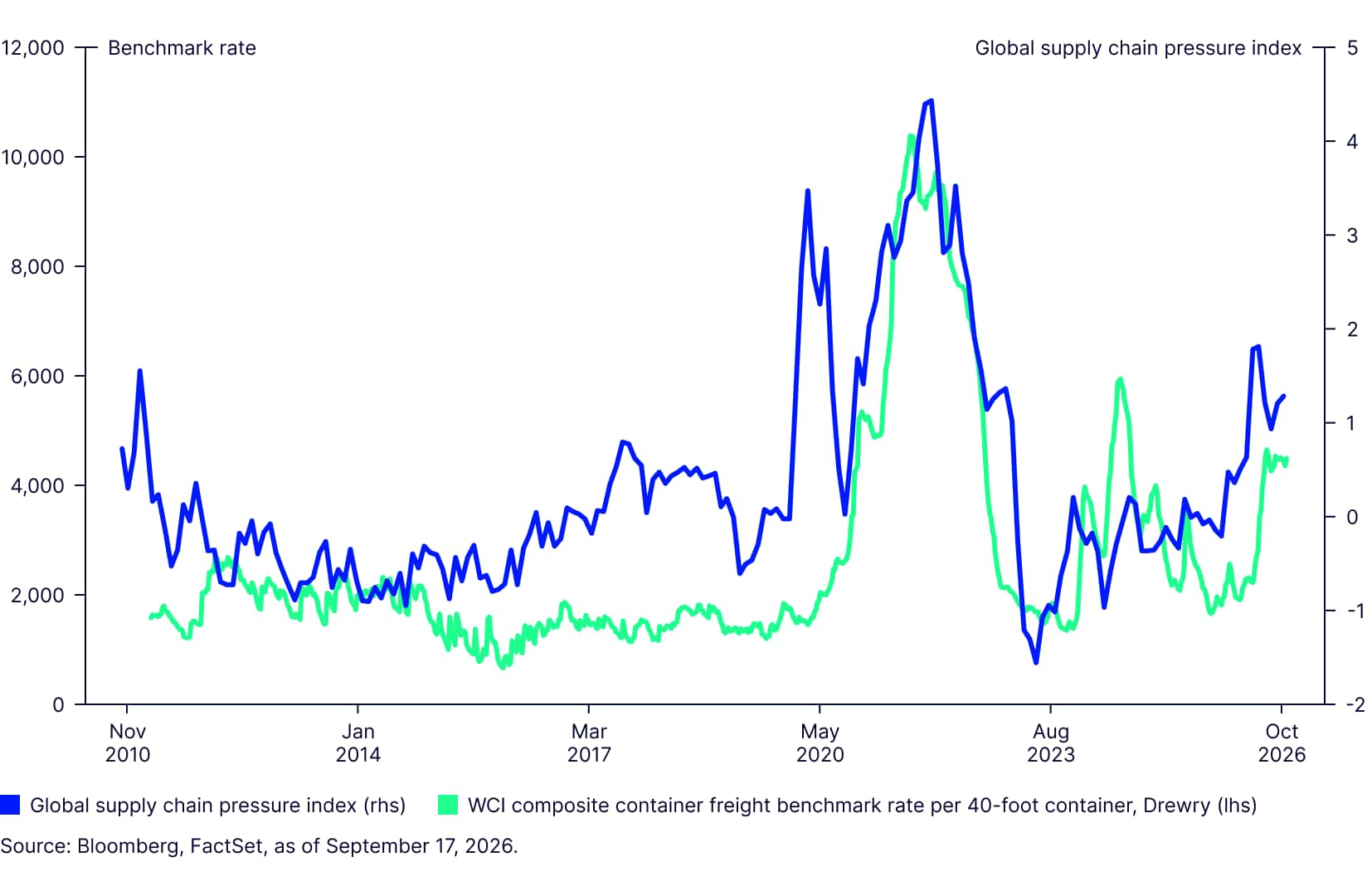
External cost pressures present an additional risk. Global supply chain stress remains elevated, while freight costs have moved higher (Figure 4). Together, these trends, along with high diesel prices, increase the cost of producing and transporting goods, creating upside risks for core inflation. Geopolitical risks, potential disruptions to critical shipping routes through the Strait of Hormuz and Red Sea, weather-related events, and persistently elevated energy prices could place further strain on transportation networks and global supply chains. AI-related investment may also contribute to price pressures at the margin by increasing demand for energy, data centers, construction capacity, and specialized equipment. Although these categories represent a relatively small share of consumer spending, the scale and persistence of this investment could add pressure to selected areas of the economy.
Figure 4: Freight costs and global supply chain under pressure
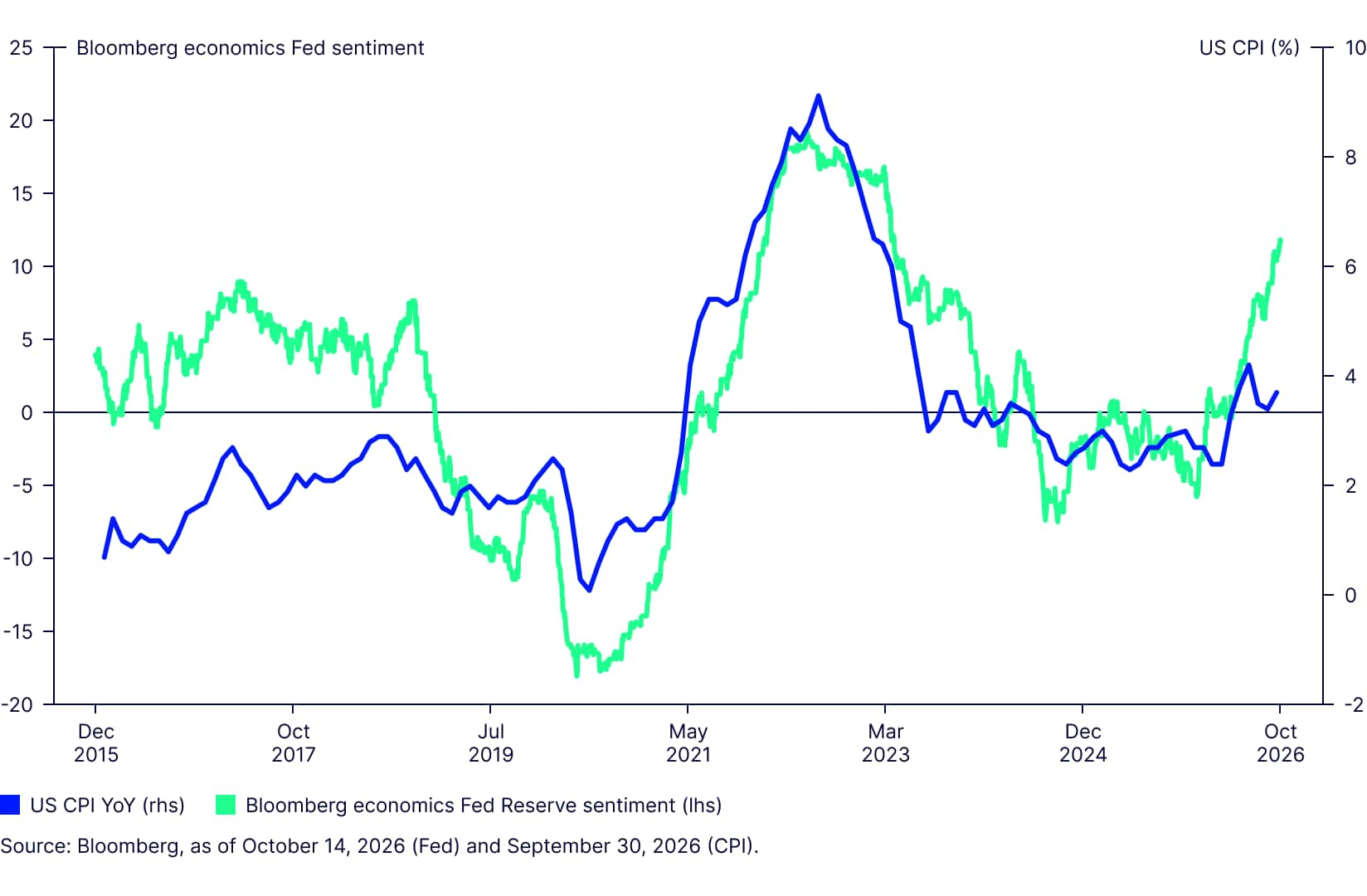
The Federal Reserve has maintained a cautious stance toward inflation as underlying price pressures remain elevated. The Committee unanimously raised rates by 25 basis points in September, citing the need to support a timelier return of inflation toward target. Policymakers also revised several inflation projections higher, signaling that they expect price pressures to remain elevated for some time. At the same time, measures of Fed communication have become increasingly hawkish (Figure 5), highlighting the risk that inflation proves more persistent than recent headline data may suggest.
Figure 5: A more hawkish Fed emerges
The composition of today’s inflation also complicates the Fed’s task. The weighted share of the CPI basket experiencing inflation above 3% remains elevated and has risen in recent months (Figure 6), indicating that above-target price pressures remain relatively broad. Although tighter monetary policy can help restrain aggregate demand, it is less effective at addressing supply disruptions and may have limited influence over strategic capital spending. Investment related to artificial intelligence, infrastructure modernization, and electrification may remain relatively resilient to modest changes in policy rates, while energy supply shocks cannot be directly addressed through monetary policy. Consequently, the path back to sustained price stability may prove longer and more uneven than in prior inflation cycles.
The San Francisco Fed’s decomposition of inflation into cyclical and acyclical components provides another perspective on the challenge facing policymakers. Cyclical inflation, which is closely tied to economic activity and labor market conditions, has eased considerably. In contrast, acyclical inflation, which reflects more structural and industry-specific influences, has risen meaningfully in recent years (Figure 7). The divergence suggests that persistent inflation increasingly reflects forces that may be less responsive to interest rates, reinforcing the possibility that inflation remains above target even as demand-sensitive pressures cool.
While structural inflation pressures remain elevated, shelter represents one of the most important categories influencing the near-term inflation outlook. Shelter inflation has been one of the most important drivers of the disinflationary process and could continue to place downward pressure on overall inflation. However, several indicators suggest this source of disinflation may be approaching an inflection point. Market-based measures of rent growth, which typically lead official inflation statistics, have stabilized and recently shown signs of firming. The Zillow Rent Index reached its strongest year-over-year growth rate since May 2025, while measures of rents on new leases have also begun to move higher. At the same time, rental vacancy rates appear to have stabilized and begun to move lower, while multifamily housing completions and units under construction have declined meaningfully from recent peaks. While current conditions do not point to a materially overheated rental market, they do suggest that shelter may become less of a disinflationary tailwind over the coming quarters, representing an important upside risk to the inflation outlook.
Recent CPI readings illustrate that the broader inflation landscape remains complex. Demand-sensitive inflation has moderated, but structural and supply-side pressures remain, and several of these forces may be less responsive to changes in interest rates. Geopolitical tensions, energy market risks, and shifting supply-chain dynamics also leave the economy vulnerable to renewed price shocks. We therefore expect the path toward price stability to remain uneven, with inflation likely to remain above the Fed’s target for some time. In this environment, we believe a strategic allocation to real assets remains an important component of portfolio construction, helping investors navigate persistent inflation uncertainty while providing diversification against broader macroeconomic and geopolitical risks.
Real assets strategy
At State Street Investment Management, we have a seasoned, diversified multi-asset strategy that combines exposure to a broad array of liquid real asset securities that are expected to perform during periods of rising or elevated inflation.
The asset allocation is strategic and utilizes indexed underlying funds. It is being used by a variety of clients as a core real asset holding or as a liquidity vehicle in conjunction with private real asset exposures. The strategy is meant to be a complement to traditional equity and bond assets, providing further diversification, attractive returns, and a meaningful source of income in the current environment.