
What is an ETF? How they work and why they’re popular
- An exchange traded fund (ETF) is a basket of securities that can be bought and sold in a single trade on an exchange.
- There are a wide range of advantages to ETFs, including targeted exposure, increased diversification, flexible trading, and more.
- ETFs have grown in popularity since they first launched more than 30 years ago. Now, there are more than 14,000 ETFs available globally.1
An exchange traded fund (ETF) is basically a basket of investments (like stocks, bonds, currencies, or commodities) that you can buy and sell in a single trade. They enable you to invest in hundreds or even thousands of securities simultaneously, without having to handpick each one yourself.
Think of it like walking into a supermarket and grabbing a cart that’s already filled with bread, milk, eggs, and whatever else is on your list—from standard food items to extremely specific ingredients needed for that new recipe you want to try.
Today’s ETF market offers that same flexibility. With more than 14,000 ETFs worldwide,2 investors can gain exposure to everything from broad-market indexes to specialized market segments.
But let’s start at the beginning. ETFs generally:
- Track the performance of an index (except for actively managed ETFs, which typically aim to outperform rather than mirror a benchmark)
- Often charge lower fees than some other investment vehicles3
- Allow you to invest in a specific segment of the market (e.g., asset class, geography, sector, or investment theme)
In short, ETFs are funds that trade like stocks and offer the diversification benefits of mutual funds. But unlike traditional mutual funds, which are priced once a day at the close of trading, ETFs are priced continuously throughout the trading day and can be bought or sold at any time during market hours. That means investors can react to market conditions and news in real-time, executing trades quickly and efficiently.
How do ETFs work?
Since ETFs trade on an exchange just like stocks, you can buy and sell shares during the day, in real time. This is known as intraday trading. Mutual funds, on the other hand, are only priced once per day, after the market closes.
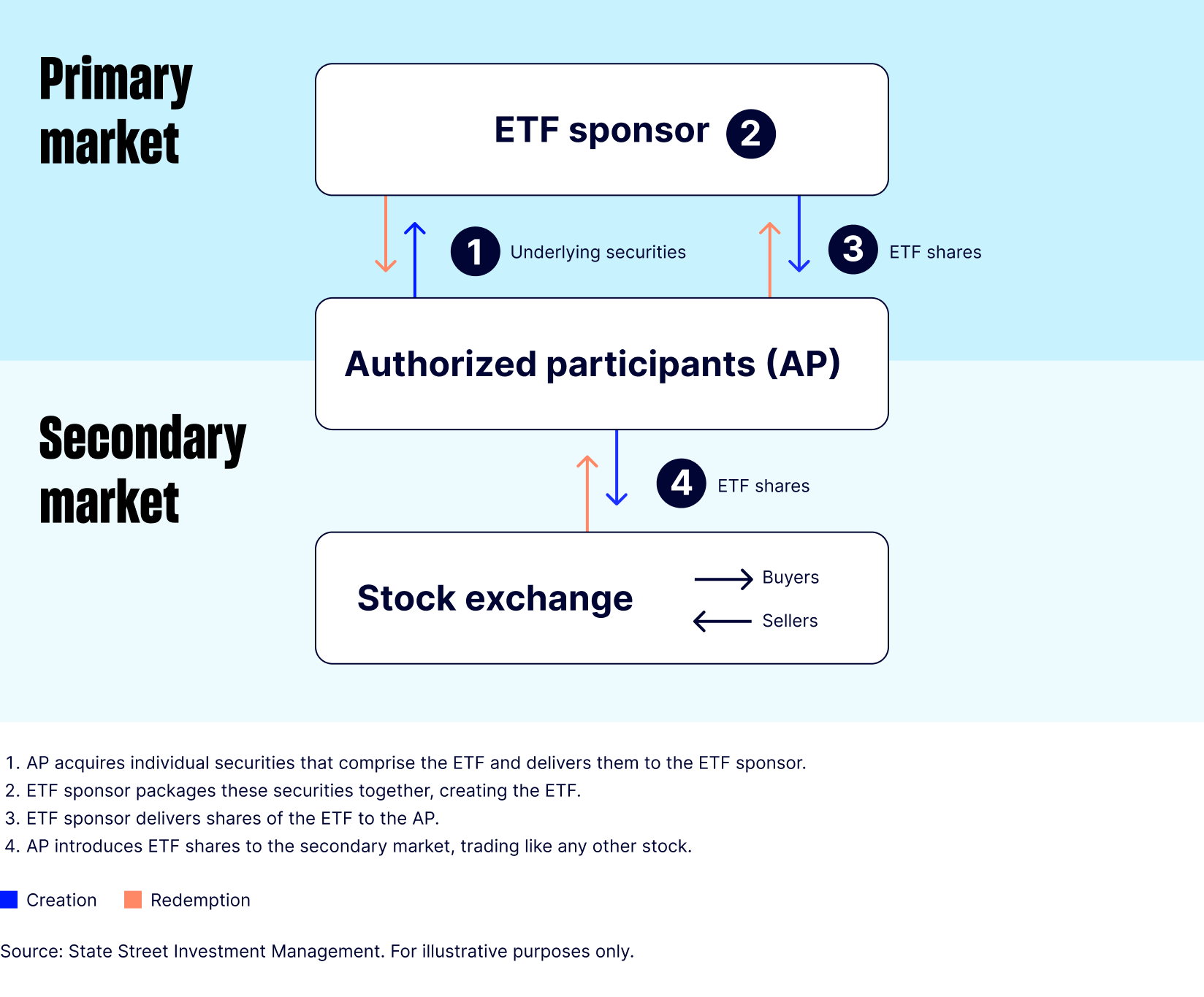
But convenience is only part of the story. Just like plenty happens behind the scenes at the supermarket to keep the shelves stocked, there’s a process called creation and redemption that keeps ETF prices aligned with the value of the securities inside the basket. It’s effectively a system of checks and balances between big institutions (who trade directly with the fund) and everyday investors (who trade shares on the exchange). This design is what helps ETFs stay liquid, efficient, and transparent.
To break it down further:
- Creation involves buying all the underlying securities and wrapping them into the ETF structure
- Redemption is the reverse process, in which the ETF is unwrapped back into the individual securities
This back-and-forth process takes place in what’s called the primary market between two parties: ETF sponsors (like asset management firms) and large financial institutions (known as authorized participants, or APs).
You, the end investor, trade these ETF shares in the secondary market (the stock exchange) like you would any other stock. The back and forth is handled for you—out of sight, out of mind.
Types of ETFs
There’s an aisle for just about anything you could need at the supermarket. Similarly, there’s probably an ETF for almost any investment goal and risk tolerance. Here are the most common categories:
- Broad market ETFs: Track major indexes (like the Nifty 50) to gain exposure to a broad range of companies.
- Bond ETFs: Focus on fixed income securities like government bonds, PSU bonds, and corporate bonds.
- International ETFs: Access markets outside India, such as USA, Europe, or emerging economies.
- Sector ETFs: Target specific sectors of the economy, like Technology, Health Care, or Energy.
- Thematic ETFs: Invest in overarching trends, such as artificial intelligence, smart infrastructure, or cybersecurity.
- Dividend ETFs: Hold companies that regularly pay dividends, offering a mix of income and appreciation potential.
- Commodity ETFs: Provide exposure to assets like gold, silver, or a broad basket of commodities.
- Smart beta or factor ETFs: Use rules-based strategies (e.g., value, momentum, low volatility) to tilt portfolios toward certain characteristics.
- Active ETFs: Invest in funds managed by professionals who aim to outperform the market or achieve specific outcomes, versus passively tracking an index.
What are the benefits of ETFs?
ETFs can offer investors several advantages:
- Diversification: Reduce the risk of putting all your eggs in one basket.
- Targeted exposure: Gain strategic exposure to specific markets and assets.
- Lower costs: Keep more of your money working toward your goals.4
- Liquidity: Trade efficiently in funds with high volume, making it easier to enter or exit positions at fair prices.
- Flexibility: Buy or sell when you want to, instead of waiting until the market closes.
- Transparency: Know exactly what you own, at practically any given time.
Increased diversification
ETFs make it easy to diversify. With one trade, you can own hundreds or even thousands of companies—meaning your performance isn’t riding on the fate of a single stock.
Targeted exposure
ETFs often track an index, allowing you to invest in a specific segment of the market, such as:
- Asset classes: Everything from stocks and bonds to commodities.
- Geographies: Global, regional, or country-specific markets, including both developed and emerging economies.
- Currencies: Some ETFs follow baskets of currencies or single ones, like the Japanese yen or US dollar.
- Sectors and industries: These include, Industrials, Health Care, Energy, Technology, and more.
- Investment themes: Ongoing trends like sustainability, cybersecurity, or autonomous vehicles.
- Style/Factors: Smart beta ETFs help position your portfolio toward attributes like low volatility, value, or momentum.
Lower expense ratios
Because most ETFs are passively managed, they typically have lower management fees and operating expenses compared to mutual funds.5 And lower expenses mean more of your returns stay in your pocket.
Added liquidity
ETFs are designed to be easy to trade, with two layers of liquidity working in your favor:
- Primary market: Large financial institutions (also known as authorized participants, or APs) can create or redeem ETF shares by swapping in or out the underlying securities. This process takes place in the primary market and helps keep prices in line.
- Secondary market: Since they trade throughout the day on an exchange, investors can make timely investment decisions.
Flexible trading
ETFs can be bought through a brokerage account at their current market price at any time during the trading day. There are no minimum holding periods, and investors can employ a wide range of trading techniques—such as buying on margin, short selling, and placing limit orders—to react to market movements.
Increased transparency
With ETFs, what you see is what you get. Most publish their holdings daily, so you can regularly evaluate holdings and performance. That transparency can help you make more informed and confident investing decisions.

Learn more about the benefits of using ETFs
Want to explore the benefits of using ETFs to build your portfolio in greater detail?
Are there ETF risks to consider?
Yes, investing is never risk-free (and if it sounds too good to be true, it probably is). As with any investment, investors should know the possible risks before adding ETFs to a portfolio:
- Inflation risk: ETFs in certain asset classes may be affected by inflation, as rising prices may impact the value of the fund’s assets over time.
- Credit risk: An ETF may be exposed to credit risk if one or more of the companies in its portfolio experiences financial difficulties or goes bankrupt. This could result in a decline in the value of the ETF’s shares.
- Liquidity risk: There is always a risk that it may be difficult to buy or sell shares of an ETF when you want to, due to market conditions or other factors.
- Tracking error: Any ETF’s performance might not perfectly match the index it follows, especially after accounting for fees.
- Complexity: Some ETFs are more complicated than others, such as leveraged, inverse, or options-based funds. While these ETFs can help achieve certain goals, it’s important to understand how they work before investing in them.
Before investing in ETFs, investors should use a due diligence process and consider their investment objectives and risk tolerance. Be sure to visit the fund’s prospectus for more information on the risks associated with a particular ETF.
ETFs vs. stocks vs. mutual funds: Breaking them down
As you weigh your options, you’ll likely come across three ways to invest in the stock market: individual stocks, mutual funds, and ETFs. The “right” vehicle for you depends on your goals and preferences.
- Buying stock grants you shares of a particular business. This is ideal if you want targeted exposure to specific companies.
- Mutual funds are pooled investments that track a market or strategy, but they only trade once a day after markets close.
- ETFs are a basket of investments you can buy or sell throughout the trading day, in a single trade. They combine the diversification benefit of mutual funds with the flexibility of stocks.
| ETFs | Stocks | Mutual funds | |
|---|---|---|---|
| Fees and trading costs | Generally low expense ratios for passive funds | Expense ratios aren’t applicable | Relatively higher fees than ETFs for management and operating expenses |
| Flexibility | Trade throughout the day at market prices | Trade throughout the day at market prices | Limited, as funds are priced once a day after close |
| Transparency | Most disclose holdings daily | Total transparency | Holdings usually disclosed quarterly |
How do you buy an ETF?
Buying an ETF is easy.
You can’t buy ETFs directly from a fund house, but you can access ETFs through Demat accounts or financial advisors. Here’s how it typically works:
- Open a Demat account. If you don’t already have one, choose a broker that fits your needs (online platforms make this process accessible).
- Search for the ETF by ticker symbol. The ticker symbol is the short, unique code under which an ETF is listed on a stock exchange.
- Decide how many shares you want to buy. Consider the price per share and your overall budget.
- Place your order. Like a stock, ETFs can be bought throughout the trading day at market prices. You can place a market order (buy immediately) or a limit order (buy only at a certain price).
That’s it! Once your order is filled, the ETF will appear in your account alongside your other investments.

7 things you should know before investing in ETFs
Whether you’re new to ETFs or looking for more information, check out our answers to some of the most commonly asked questions about ETFs.
How have ETFs changed investing?
ETFs have grown exponentially since they first emerged in 1990s. Today, investors use ETFs to precisely meet their individual portfolio needs, from finding income and gaining broad market exposure, to lowering costs and investing in difficult-to-reach markets.
Global net ETF flows 6
Total number of global exchange traded funds available. 7
Global assets under management in ETFs and ETPs. 8

Learn more about ETFs
Whether you’re new to investing or a seasoned investor, our ETF Education Hub can help you discover how to evaluate ETFs, use them in a portfolio, and more.