
Navigating rising market concentration with Enhanced strategies
Market concentration is back near historic highs, raising concerns that cap-weighted core equity allocations are becoming increasingly reliant on a narrow set of themes and names. In this article, we explore how Enhanced equity strategies may offer a disciplined, risk-aware complement.
Rising market concentration is creating growing concern among investors, particularly in traditional cap-weighted core equity allocations. While this is not new, we are at extreme levels—and the path forward remains uncertain, with concentration potentially persisting or eventually broadening.
In this environment, complementing a cap-weighted core with a balanced, risk-aware source of return that preserves core exposure can serve as a natural way to help buffer the effects of any potential broadening.
For investors who have historically relied on passive, cap-weighted approaches—and have not yet considered active or enhanced strategies—this environment may present a natural first step toward modestly expanding the toolkit in a way that remains closely aligned with core objectives.
Market concentration at historic levels
It’s become hard to ignore how much the market’s recent performance has been increasingly driven by the AI theme. Enormous amounts of capital are being redirected into capex, all in service of the AI buildout. Whether that ultimately delivers the expected ROI is a separate debate. At this point, however, there is very little resistance to spending, and the buildout continues.
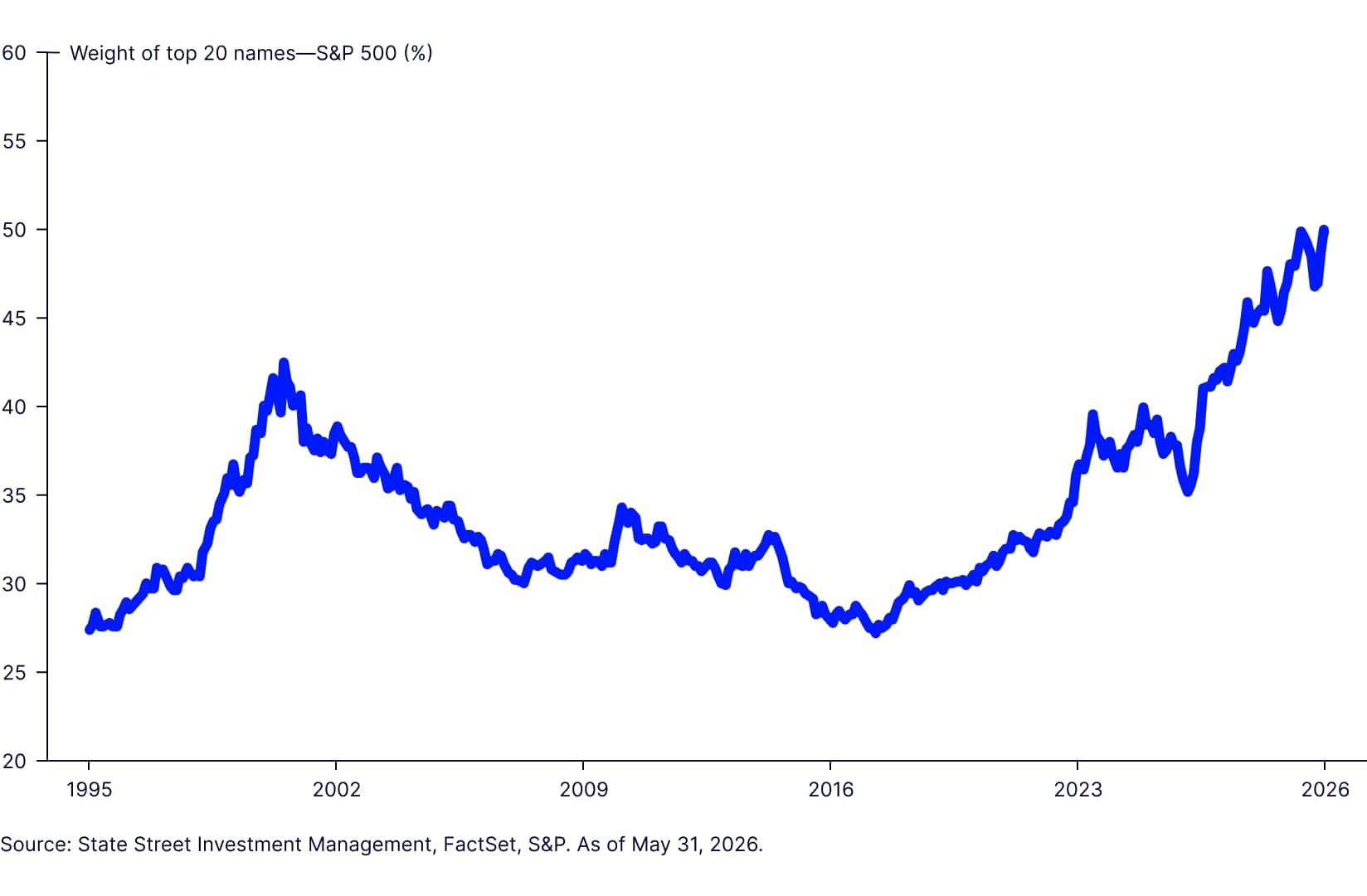
Regardless of where you think things go from here, the impact on market concentration is undeniable. Using a simple measure—the combined weighted market cap of the top 20 names—concentration is now sitting at multi-decade highs.
Importantly, this is not just a US phenomenon. Elevated concentration is also evident across other developed markets and in parts of emerging markets, albeit to varying degrees—suggesting this is a broader structural feature of today’s equity landscape rather than an isolated dynamic.
Figure 1: Top 20 concentration is now exceeding prior peaks (e.g., tech bubble).
The challenges for core allocations
This creates real challenges for zero-risk budget core allocations. By design, index-tracking portfolios are becoming increasingly tilted toward a single theme—whether you want that exposure or not. And there are limited options for investors unwilling to take on meaningful active risk.
Equal-weighted approaches have gained attention, but they come with clear trade-offs: structurally suboptimal exposures (e.g., an inherent small-cap bias), implementation inefficiencies, and a higher required risk tolerance.
Enhanced equity strategies as a solution
One potential solution worth exploring—particularly for investors who have historically stayed fully passive—is complementing a core allocation with Enhanced equity strategies. These disciplined, risk-aware approaches aim to provide similar exposure to the cap-weighted index while generating incremental alpha. They have proven effective in periods of elevated market concentration and have historically benefited from subsequent market broadening—offering the potential to enhance returns while helping offset shifts in benchmark dynamics, without compromising the stability that a core allocation provides.
Figure 2: Risk-adjusted return of top half of Enhanced and Low Risk Active managers
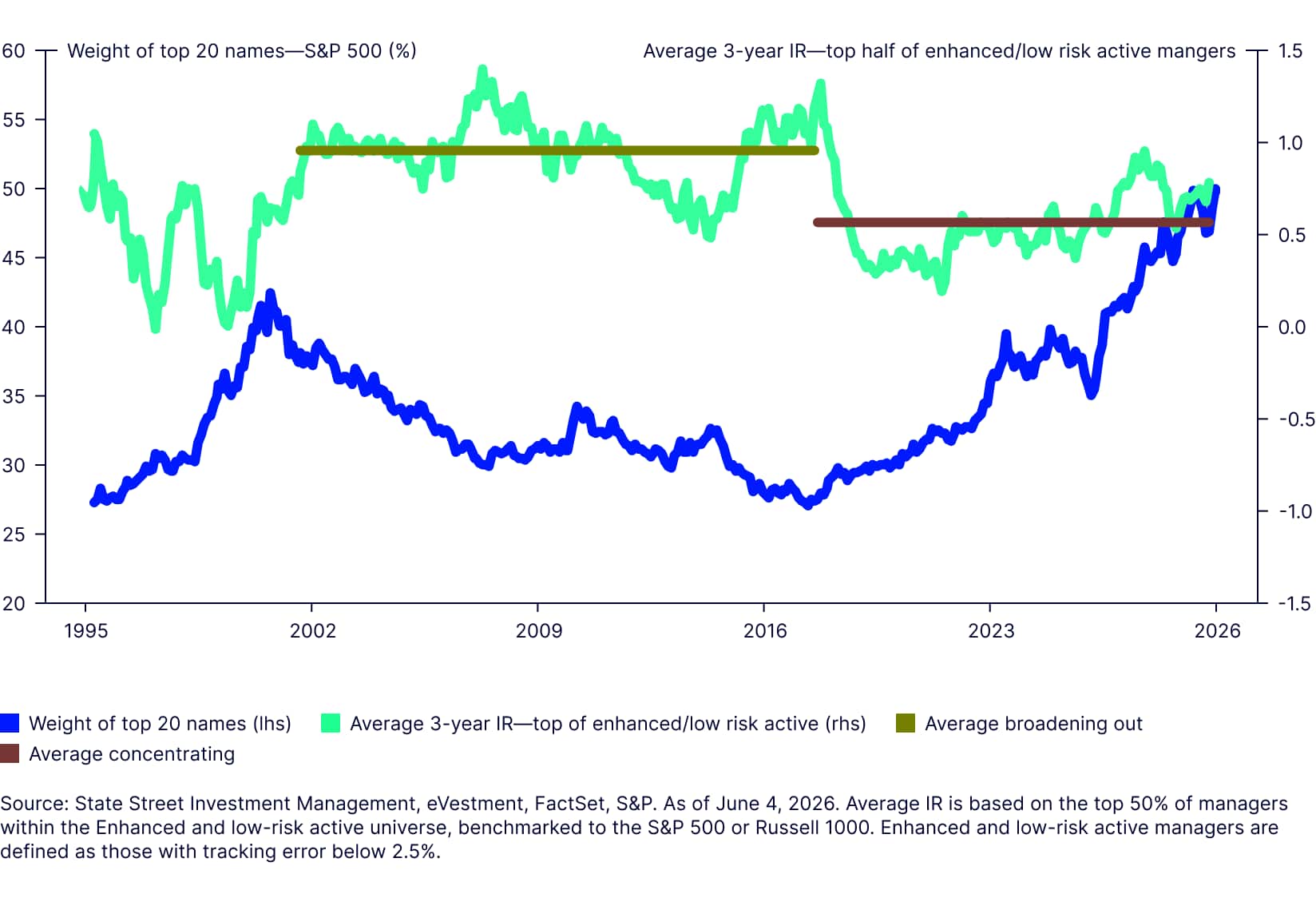
Looking back at prior episodes of elevated concentration, more risk-aware active approaches—like Enhanced strategies—tended to add value across both the up and down legs of the cycle, helping smooth the impact of any eventual reversal or broadening.
For example, the top half of managers in the Enhanced and low-risk active universe delivered an average IR of 0.96 during the post–dot-com broadening period, and 0.58 during the most recent decade of rising concentration. Notably, some of the more highly risk-controlled implementations have delivered even stronger information ratios through the current cycle.
While IRs were more challenged heading into the concentration of the dot-com era, it’s important to recognize how much the landscape has evolved since the late 1990s and early 2000s. Today’s models are more sophisticated, with richer factor diversification, and draw on a much broader set of signals and techniques—offering greater consistency and diversification both within strategies and across the competitive set.
A timely case for Enhanced equity
For investors concerned about the level of concentration in cap-weighted core allocations, Enhanced equity strategies may offer a timely way to put a modest risk budget to work. By combining benchmark-like exposure with a disciplined, risk-aware framework and the potential for incremental alpha, these approaches can help dampen the effects of shifting market dynamics while preserving the core resilience investors rely on.