
The case for systematic investing in credit
We believe that now is the time for systematic investing in credit. Advances in technology, electronic trading and market efficiency in credit have enabled the capture of value-add from a systematic, factor-based investing approach that can also serve as a meaningful diversifier to active fundamental fixed income allocations.
Live multi-year track records, along with academic data,1 show that a factor-based, systematic approach to investing in credit can drive outperformance relative to a broad benchmark index. In addition, systematic investing can provide significant benefits to investors, such as:
- Consistent, repeatable, signal-driven excess returns
- A diversifying alpha profile as compared to active fundamental managers
- A nimble process that offers robust downside protection
An important contributor to this outcome includes the availability of frequent signal updates across broad universes of securities. Credit market innovations such as electronic trading and portfolio trading have led to greater transparency and speed in corporate bond trading, facilitating the successful implementation of systematic strategies today.
However, skill is required to harness the potential benefits of systematic active fixed income (SAFI).
We provide a more in-depth perspective on implementation below.
Strong evidence for factor-based signals is driving alpha generation in credit
Within the investment grade corporate universe, some issuers and bonds have more (or less) desirable characteristics than others. For example, some companies may exhibit fundamentals such as profitability or indebtedness that are not fully reflected in their pricing. Alternatively, market sentiment may favor a different set of companies. Each characteristic that could potentially lead to outperformance (or underperformance) can be identified as an alpha factor and can be applied to create a portfolio tilt.
A systematic strategy takes an algorithmic approach that evaluates all securities in an investment universe based on their exposures to these factors to best position the portfolio. Three alpha factors that have been identified and proven to be effective2 in the investment grade corporate bond market include value, momentum, and sentiment.
A focus on value
As an illustration of value as an alpha factor, we looked at its performance over time. Value addresses how attractive (rich or cheap) a bond is relative to a group of peers with comparable bond characteristics (such as credit quality, sector, and maturity) after adjusting for differences in issuer fundamentals.
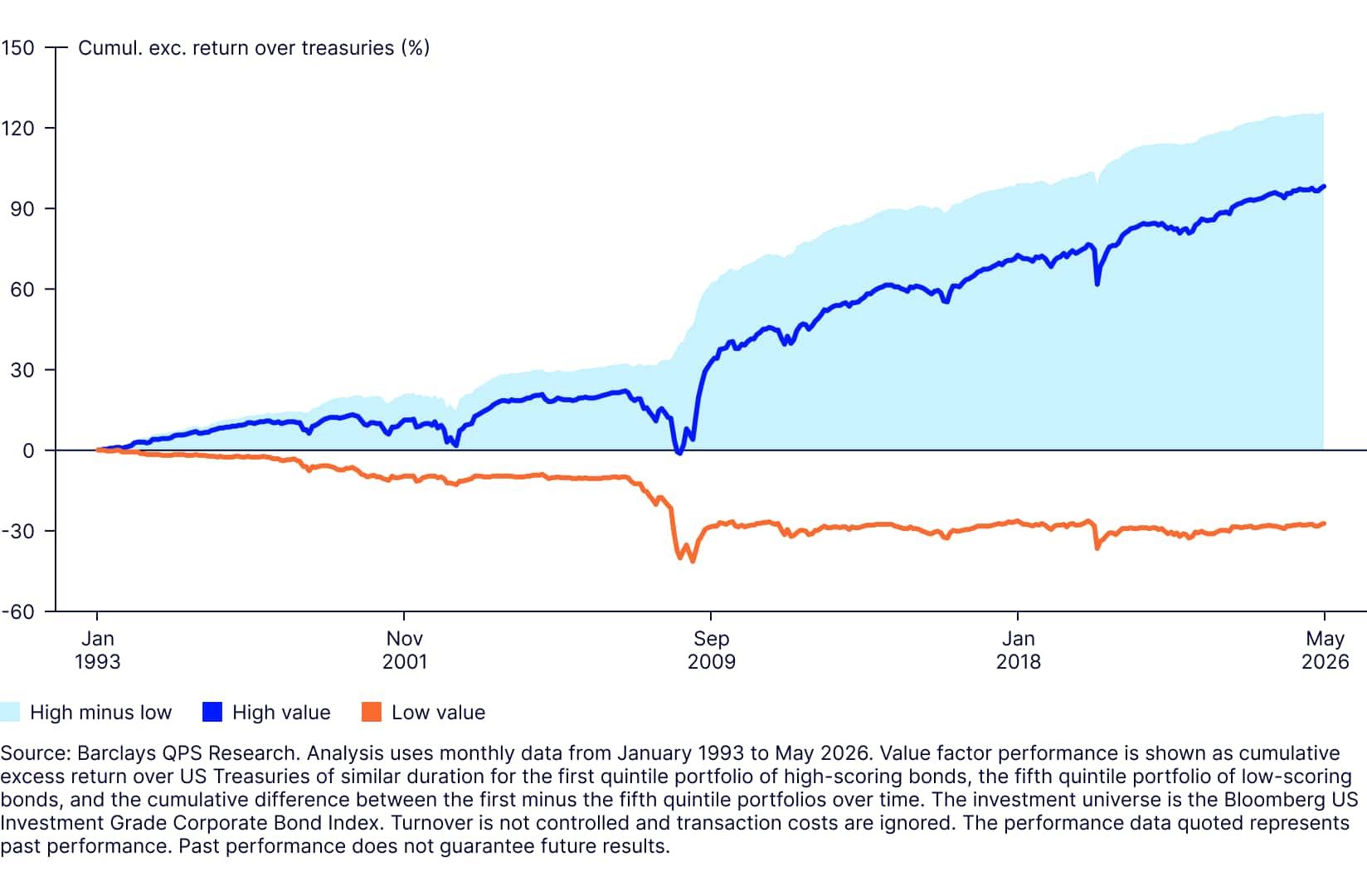
In a simple performance test, over a series of months, we partitioned the bond universe into quintile portfolios based on their value scores and measured their returns. Figure 1 shows the cumulative excess return performance (versus like-duration Treasuries) going back to 1993 of the top-quintile portfolio labeled “High Value,” the bottom-quintile portfolio, and the high-value portfolio minus the low-value portfolio.
This analysis demonstrates the predictive power of the value signal. High-value bonds have delivered consistently better performance than low-value bonds, resulting in both higher average excess returns and higher information ratios.
Figure 1: Bonds that score high on Value have outperformed
Similarly, we can use momentum and sentiment signals as alpha factors to complement the value signal. A composite signal that combines value, momentum and sentiment has been shown to deliver stable and significant alpha in corporate bond markets with strong information ratios (see Q2 2026 commentary).
Harnessing the strength of signals: a lesson in implementation
Systematic strategies rely on data analysis and implementation skill to incorporate these quantitative signals into portfolio construction—expertise that a manager needs to be able to effectively implement Systematic Active Fixed Income (SAFI) and harness its benefits. Systematic active investing aims to outperform an index by seeking opportunities to allocate to attractive securities, and away from those deemed unattractive according to these signals. These strategies aim to take a rules-based approach to decision-making, with a threefold objective:
- Maximize exposure to high-scoring bonds, continuously evaluating opportunities across a broad investment universe of securities.
- Perform highly disciplined risk management, limiting issuer concentration and deviations from benchmark risk exposures, avoiding unintended risks, and restricting the possibility of large unexpected deviations from benchmark returns.
- Control unnecessary turnover by balancing the expected benefits versus costs of each transaction.
Guardrails ensure that portfolio outcomes are driven by issuer and security selection, rather than by unintentional exposures to market risk.
Our live Systematic Active Fixed Income (SAFI) track records suggest that maximizing exposure to value and other quantitative signals with demonstrated efficacy has resulted in positive outcomes for investors.
SAFI as a key diversifier to active fundamental credit strategies
SAFI has exhibited diversifying properties in portfolios, as systematic excess returns have shown low correlation with actively managed fixed income corporate portfolios—an important property in a time of near-historically tight spreads in investment grade and high yield bonds. Looking at the SAFI US High-Quality (HQ) Corporate Bond strategies, average correlation with active strategies was 0.3 and 0.2 for the HQ Intermediate and HQ Long strategies, respectively, for the period December 31, 2023, to March 31, 2026.
Our factor-diversified investment approach, which is based on three factors that themselves have limited correlation, has helped SAFI to deliver strong results across a variety of market environments since the inception of the strategies. In each period of credit spread widening highlighted in Figure 2, momentum has outperformed when value struggled.
Figure 2: Value and momentum behave differently – helping SAFI outperform through the cycle
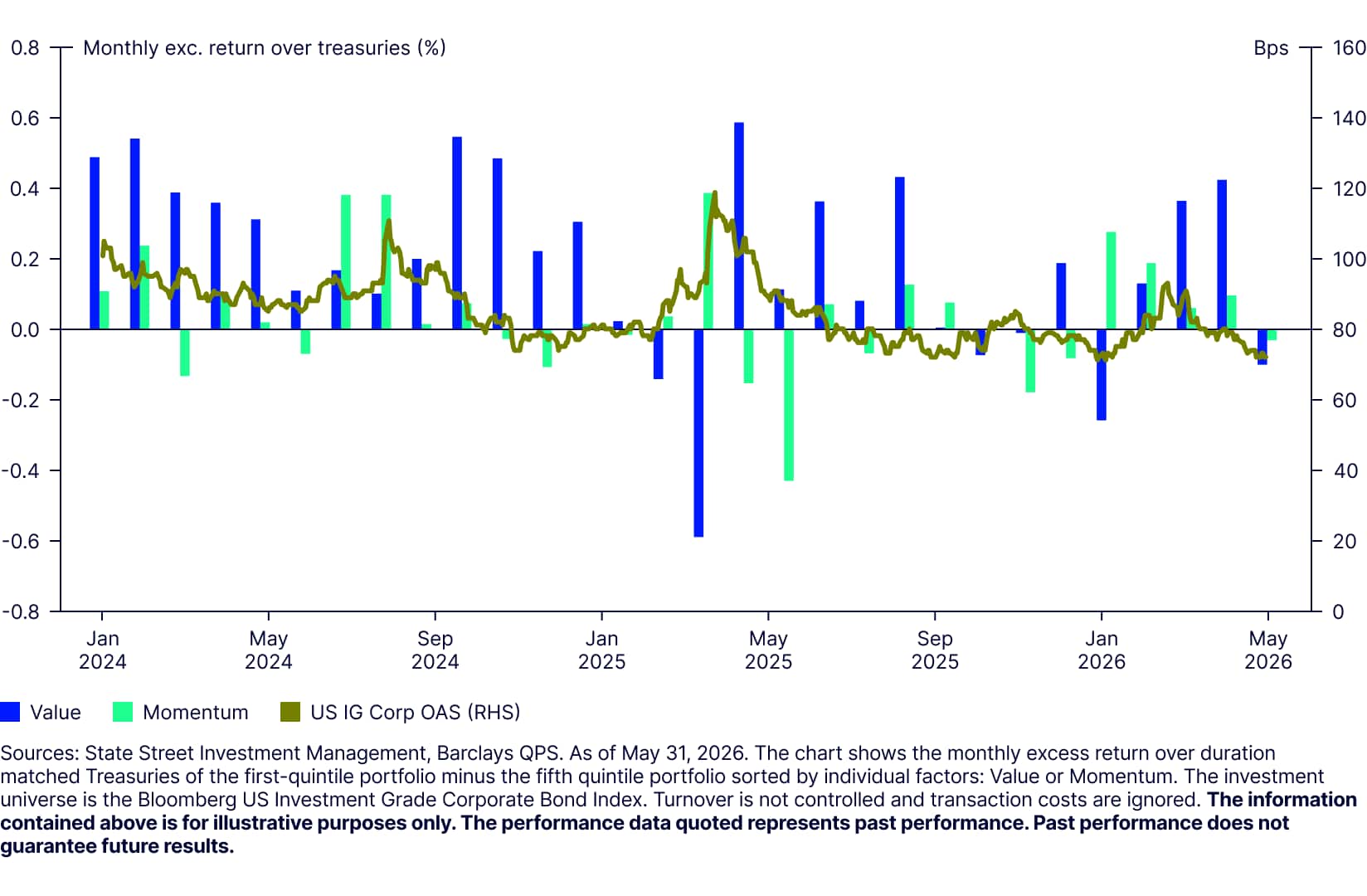
SAFI’s approach has provided downside protection during market drawdowns, and its diversifying properties make it a strong complement to fundamental active in a holistic portfolio approach.
The bottom line
The SAFI approach can provide several benefits to investors:
- Consistent data-driven excess returns. Quantitative signals based on alpha factors can help investors differentiate between attractive and unattractive opportunities in credit, and can drive above-benchmark index returns.
- A diversifying alpha profile. By drawing on multiple algorithmic signals to drive outcomes, systematic strategies can offer a differentiated excess return profile. The performance of the systematic strategy can be complementary to many fundamental active strategies, whose performance can be highly correlated with corporate bond index excess returns.
- An agile process designed to limit the impact of drawdowns. Frequent signal score updates plus a clear objective function of maximizing signal scores keeps the portfolio attuned to changes in market, sector, and/or issuer conditions—at all times, with speed, and free from well-known investor biases.
Systematic investing, like all investing, involves some risks. Risks to the systematic approach include the fact that the exposure to bonds scoring high (low) on certain signals may occasionally lead to false positives (negatives), which could cause underperformance. For example, a bond with a high value score that screens cheap relative to peers could conceivably become cheaper.
Momentum and sentiment factors are meant to guard against these “value traps,” but the scores will not achieve a 100% success rate over the long term. Rather, the approach is meant to limit left-tail risk across the distribution of performance contribution outcomes across the portfolio while skewing that distribution to the upside (for example, see SAFI turns 2: Delivering consistent alpha, controlled risk).