
Consistency as a compass in developed market equities Using Information Ratio to select disciplined, risk-adjusted strategies
In equity markets, the pursuit of high excess returns often leads to unpredictable outcomes and disappointment. We believe efficiency and predictability beats chasing returns and, in this paper, we make the case for a disciplined, risk-adjusted investment approach that seeks to maximize Information Ratio.
We have often heard the comment that “you can’t eat risk-adjusted returns.” We very much disagree and in this article, we’ll explain why and make the case that risk-adjusted returns are indeed the best way to assess the skill of a manager.
Before diving in, we would like to highlight a few key concepts to keep in mind as we explain the importance of risk-adjusted returns.
- Skill Managers should strive to generate a return for the risks they take and minimize risks where they lack ‘skill’; an essential concept when building an efficient portfolio. The optimal measure of manager skill in benchmark-relative performance is Information Ratio.
- Predictability In the real world, predictability matters. While developed equity markets offer opportunities for skilled managers to deliver alpha, they are also relatively efficient, increasingly concentrated in dominant themes, and exposed to sharp, event driven dislocations. Against this backdrop, investors remain vulnerable to managers who take on excessive risk and either lack true skill—or are simply undone by bad luck.
- Consistency Consistency matters even when skill exists over the long term, dramatic swings in performance can create challenges for asset allocators and investors managing fixed liabilities, capital needs, and governance constraints. Consistency provides confidence—supporting better planning, smoother portfolio construction decisions, and greater comfort through full market cycles.
- Core Core is always in style. In an industry prone to chasing themes and the latest shiny object, today’s hero can quickly become tomorrow’s disappointment. Markets make it difficult to consistently pick winners —whether between value and growth or the next dominant narrative—and doing so often requires true skill and a tolerance for added volatility. For investors focused on asset allocation, a conservative, risk-controlled core approach helps avoid large style bets and provides a more reliable foundation across market cycles.
Next, we will provide insights using real world-data to help enhance your asset allocation strategy in developed equities. We will also highlight the benefits of adopting a bottom-up Core approach, with an emphasis on maximizing Information Ratio, as the most effective strategy for deploying your risk budget.
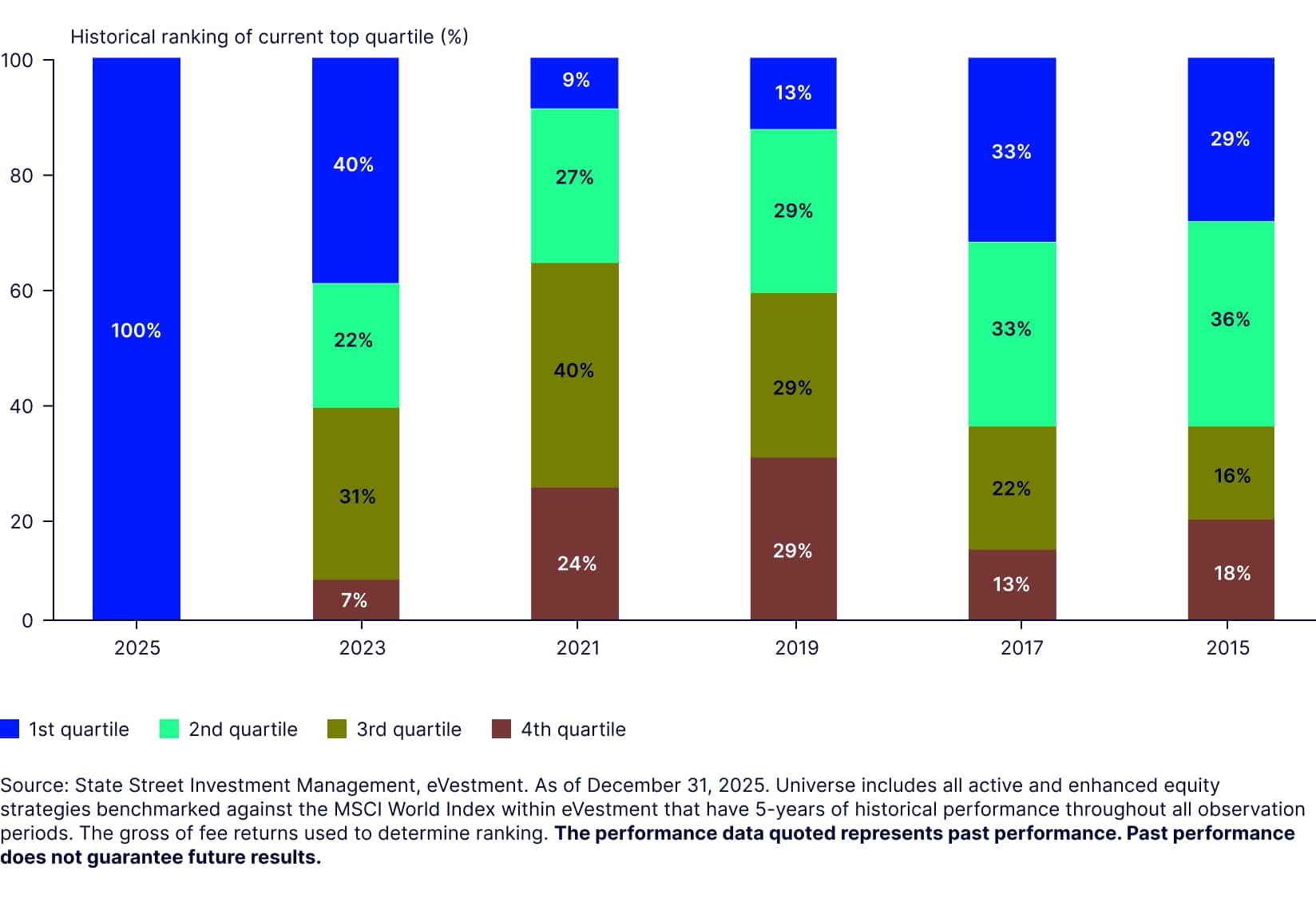
Figure 1: Don’t just chase returns
First, Information Ratio—What is it?
Information Ratio (IR) is best conceptualized as a method of measuring excess returns adjusted by their historical variability. It provides a risk adjusted framework for comparing alpha efficiency, capturing the amount of excess return generated per unit of active risk.
Information Ratio = Alpha (excess return over the Benchmark)
Tracking Error (Volatility of Alpha)
Manager selection is difficult
Evaluating managers is undoubtedly a challenging task that requires a complex and sophisticated holistic approach, focusing on multiple characteristics alongside returns. However, an overemphasis on excess returns can complicate this exercise.
To demonstrate the difficulty, let’s start by identifying the top quartile ranked strategies1 based on 5-year excess returns and trace their rank over the past 10 years in 2-year increments. Going back two years, we find that only 40% of these managers were in the top quartile two years prior. Looking back to 2021, just over 9% were in the top quartile, with nearly 65% falling in the bottom half. Extending our view back 10 years, we observe a fairly even distribution across the four quartiles.
It’s safe to say, while effective marketing can highlight favorable periods of performance, finding managers with a consistent track record over a longer-term horizon is a challenging endeavor without risk considerations. The temptation to “buy high” or chase performance is simply unhelpful to asset owners. Therefore, it is essential to focus on more than just returns.
Instead, focus on IR
Information ratio provides a better and more stable yardstick for comparison.
To prove this point, let’s first examine the variability of returns across three distinct risk cohorts based on Tracking Error (TE): Enhanced (TE <2.5%), Active (TE 2.5%-5%) and Highly Active (TE >5%). As expected, the dispersion of returns increases as we move up the risk spectrum. However, contrary to expectations, we find the average excess returns are quite similar. Although Active and Highly Active strategies have the potential of generating greater excess returns, on average there is little gain over the lower-risk Enhanced group—which comes at the cost of the increased probability of experiencing painful drawdowns.
Figure 2: Predictability matters: Understand your active drawdown risks
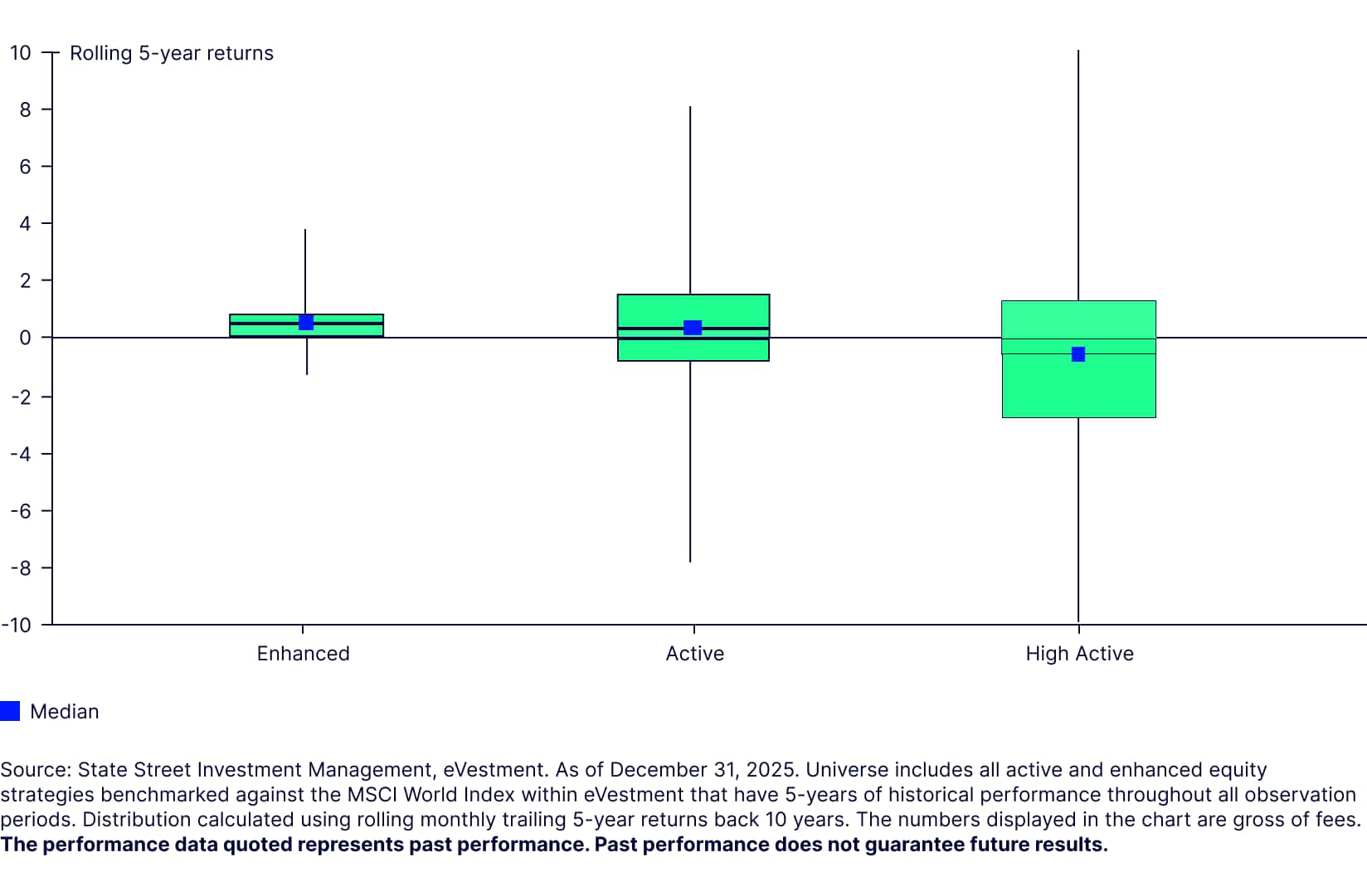
In general, higher active risk requires fewer bets with higher concentration, reducing diversification benefits. This implies that as one assumes more risk (higher tracking error) the incremental increase to excess return declines, a diminishing trade-off between risk and reward. The effect is a decay in the efficiency of the alpha (Information Ratio) or the portfolio’s return per unit of risk.
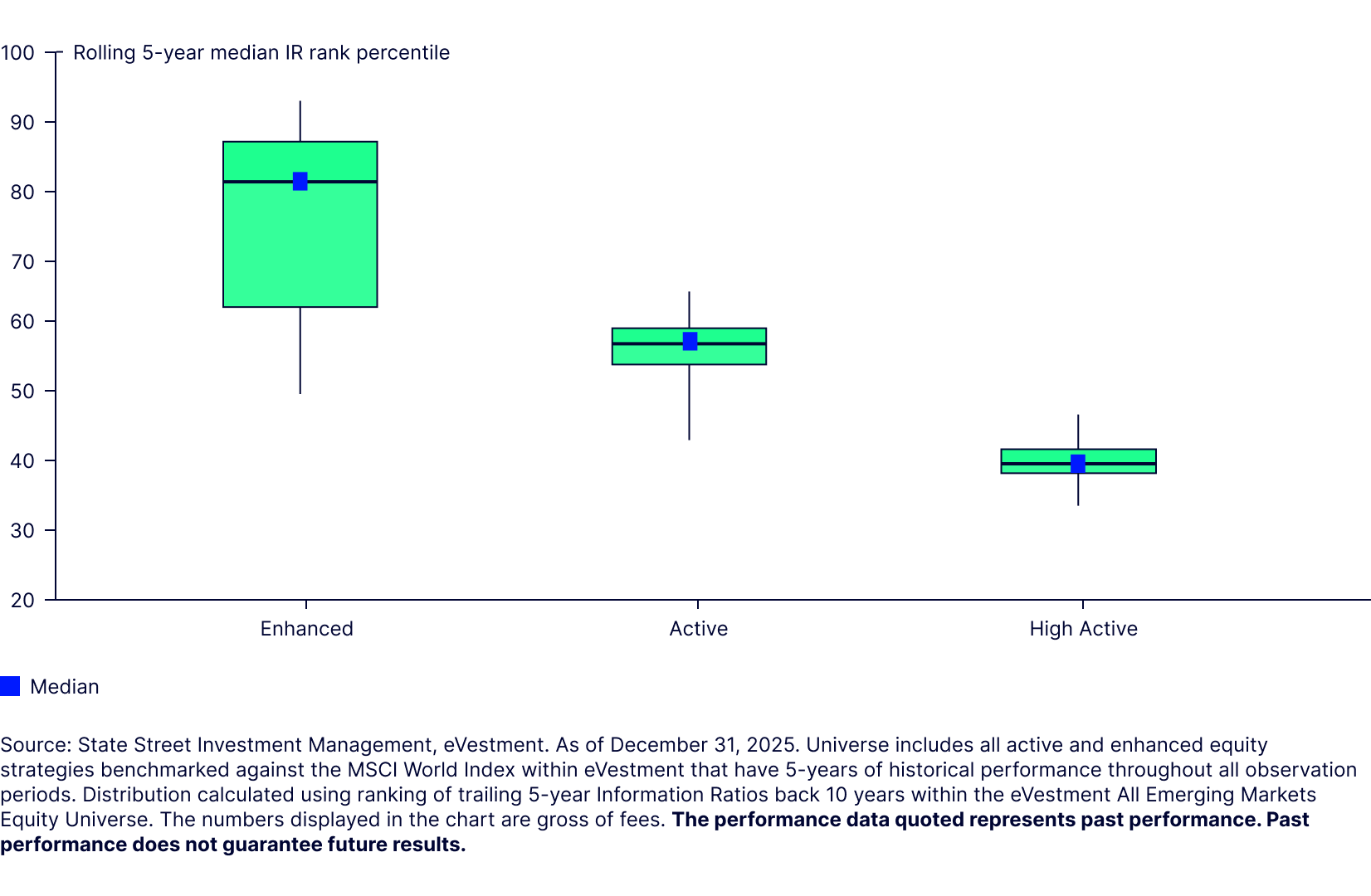
Using the same three cohorts, we find a more stable ranking of IR within the Enhanced approach.
Lower-risk Enhanced strategies are designed to offer greater consistency and predictability in risk-adjusted returns. By utilizing a highly risk-controlled approach, these strategies help minimize unintended or uncompensated risks while delivering a well-balanced and highly efficient portfolio.
Figure 3: Choosing efficiency over returns delivers consistency
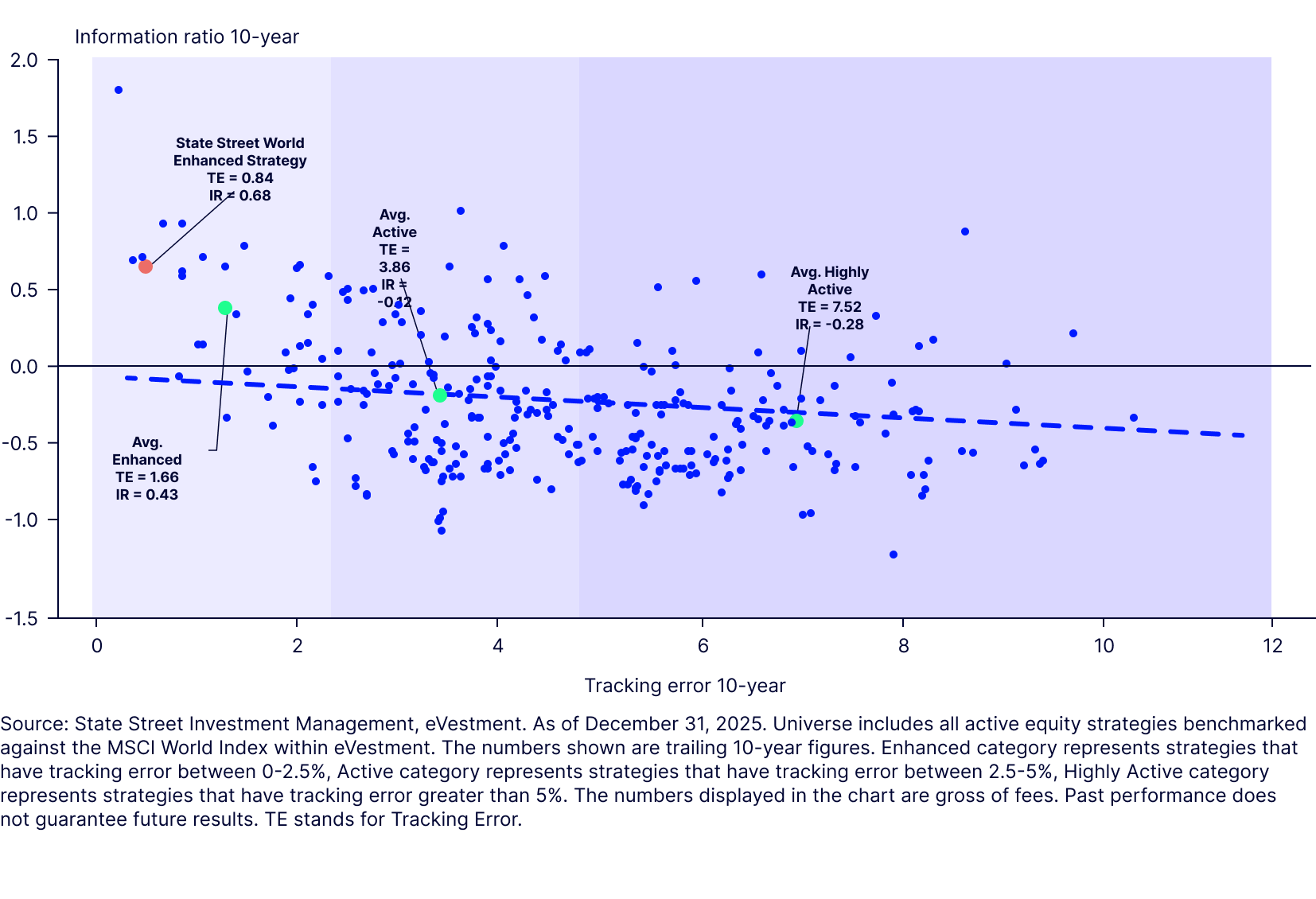
Another way to illustrate this relationship is by comparing the trailing 10-year IR and Tracking Error of the full universe of strategies, again broken down by active risk cohort. First, you’ll notice the downward-sloping trend line, which highlights the strong relationship between increased tracking error and lower relative Information Ratios (IR). Focusing on the risk cohorts, we observe the same relationship. Lower-risk Enhanced products deliver the highest IR, with an average 10-year IR of 0.61, declining to an average of 0.34 for Active products and 0.21 for Highly Active products.
Figure 4: Get rewarded for the risks you take—Mitigate the others
Core exposure offers the most stability
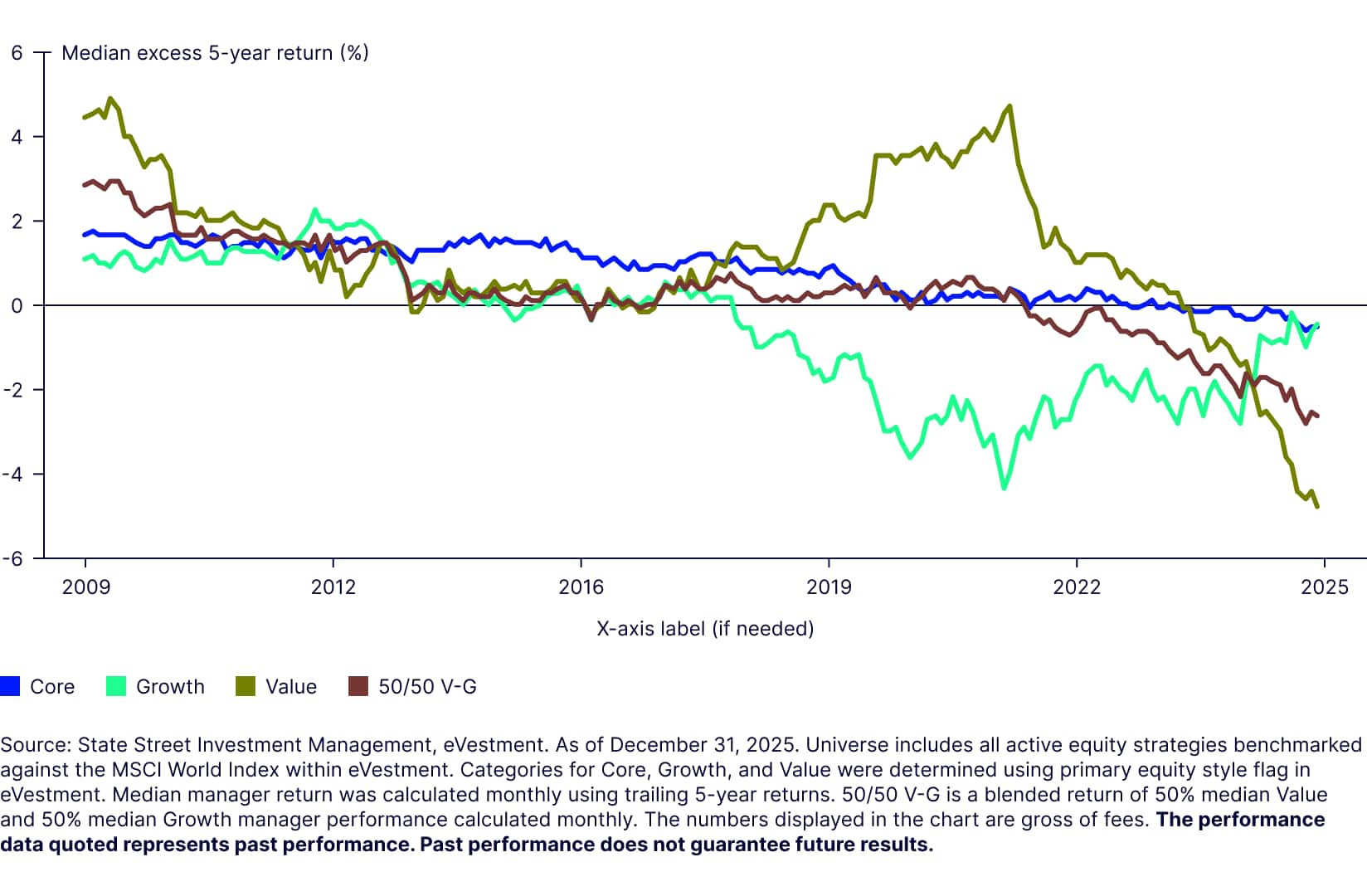
Certainly some of these effects can attributed to style, which go in and out of favor throughout the business cycle as risk appetites and economic outlooks change. We can visualize this dynamic by charting the median 5-year return for each of the three main style categories —Core, Value, and Growth. There are distinct periods when Value or Growth strategies are favored, while Core strategies offer more consistency throughout the cycle. If we were to adopt a simplistic 50/50 approach to allocating between Value and Growth managers, the end result aligns closely with that of Core managers but with weaker overall performance.
While successfully timing the Value-Growth cycle may offer incremental benefits, doing so consistently is inherently challenging. We believe a Core approach provides a more effective framework for delivering consistent alpha across changing market environments and over full market cycles.
Targeting the most rewarding risk segment
We recommend allocating your risk budget to the most efficient alpha source that offers the greatest potential for maximizing your risk-adjusted returns (Enhanced) and scaling up exposure to achieve a desired return requirement. By allocating to a highly diversified and balanced portfolio with core exposure, you can avoid style, country, sector, geopolitical, and macro risk, mitigate active drawdowns, and improve consistency and predictability.
Figure 5: Want stability? Choose core
Additionally, this approach provides a portfolio that exhibits characteristics similar to the index (beta near 1), allowing investors to scale up exposure from passive allocations if additional returns are required, all while maintaining cost efficiency.