
The future of fixed income: From income to engineered outcomes How technology, ETFs, and systematic strategies are reshaping bond portfolios
Fixed income has changed dramatically over the past few decades. Advances in technology and access to new and more complex credit exposures have unlocked new ways to use the asset class. The result: fixed income is much more than just an equity hedge or source of income; it’s increasingly a strategic allocation for building targeted exposures and solutions.
What follows is an excerpt of the full white paper. Download the full piece here.
Your bond bucket isn’t boring anymore
Fixed income has traditionally served certain predictable roles in portfolios: preserving capital, generating income, and diversifying equity risk. Historically, these roles were supported by low default rates in high-quality fixed income (such as the Bloomberg Aggregate Index) and by the tendency for bonds to be less correlated with equities. Today, however, technology and market structure changes have broadened the types of fixed income assets available to investors well beyond traditional fixed income, and beyond assets that play a purely risk-management function. Fixed income can also be used to seek alpha, gain access to complex geographies or sectors, enter private credit markets, lean into factor-based systematic implementation, and many other use cases.
Fixed income is therefore now more strategic. It offers investors a flexible toolkit for building targeted exposures and playing new, dynamic, customized roles within portfolios. This is especially important because investors can no longer assume a persistent negative correlation with equities.
Engineered Outcomes
As fixed income becomes a lever of strategic intent that enables more precise exposures, the future of fixed income will favor asset managers who can translate fixed income allocations into tailored strategies that are designed, adjusted, and optimized around specific portfolio outcomes, rather than broad market proxies.
Engineered outcomes refer to the intentional construction of fixed income portfolios to deliver predefined results such as:
- Targeted income
- Specific cash‑flow patterns
- Liability matching
- Delivery of sustainability objectives
With engineered outcomes, the desired outcome, constraints, and risk trade‑offs are explicitly specified upfront, rather than emerging indirectly from exposure to a broad market benchmark.
What’s driving fixed income into a new chapter?
Technological advancements and product innovation are two of the largest forces that are setting the stage for a new fixed income landscape in coming years. First, improvements in fixed income liquidity and transparency are well-telegraphed, and they are allowing investors to take on various levels of risk and management styles.
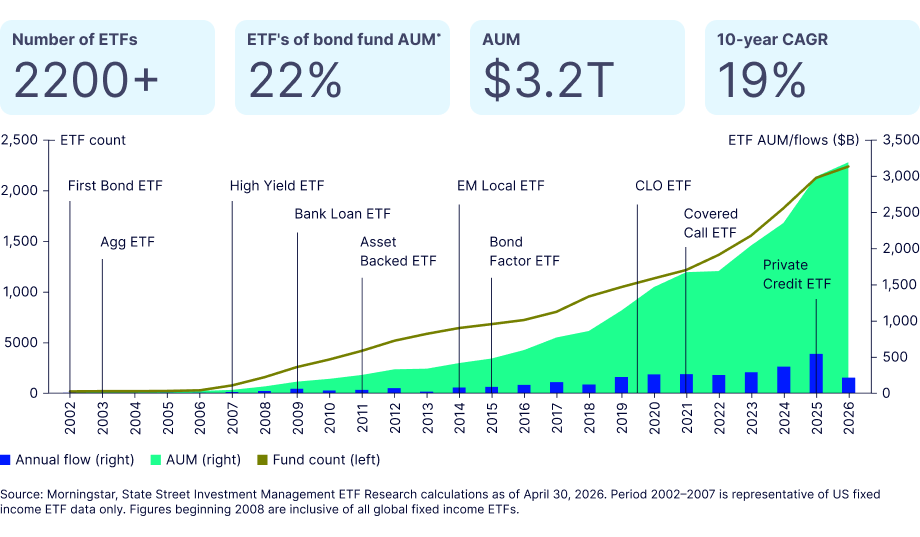
Second, exchange-traded funds (ETFs) are democratizing access to complex credit exposures (figure 1). While ETFs don’t eliminate the fundamental liquidity characteristics of the assets held, ETF liquidity reflects a combination of secondary‑market trading, and the underlying bond market’s capacity to absorb creations and redemptions. ETFs offer real-time pricing, cost-effective execution, and exposure to previously hard-to-access market segments.
Figure 1: ETFs have increased investor access to more complex fixed income subsectors
A look forward
The trends above—all of which widen the opportunity set for fixed income exposures— are paving the way for asset managers to provide more precise fixed income solutions that match each institution’s unique mandates, time horizons, cash flow profiles, liquidity requirements, sensitivity exposures, capital preservation functions, regulatory requirements, and other considerations. This outcome-oriented approach will manifest in a variety of ways, including increasing demand for customization at scale and broadening the role of asset managers.

Learn more about what’s ahead
The future landscape of fixed income will be defined by a solutions mindset. Investors can benefit from seeking managers best positioned to take advantage of the trends that will define fixed income markets in coming years.