
AI’s fiber moment: The search for enduring returns
AI infrastructure investment is accelerating, yet the telecom boom shows that essential builders may not capture most of the value. As bottlenecks shift, investors must track where economic rents migrate.
The infrastructure phase of the AI boom is in full swing, triggering one of the largest waves of corporate investment in recent memory. As shown in the Chart of the Week, capital expenditures among major hyperscalers have grown faster than free cash flow as these companies invest aggressively in chips and data centers. The telecom boom of the late 1990s offers a useful reminder, however: investment expands capacity, and expanding capacity can move scarcity and economic rents to new parts of an ecosystem. Understanding where future constraints may emerge could prove just as important as identifying the beneficiaries of the current cycle.
Weekly highlights
Source: FactSet. Data as of 6/30/2026, calculated in USD millions. Hyperscaler group includes: Microsoft, Amazon, Alphabet (Google), Oracle, and Meta.
Source: FactSet, MSCI. The weight is calculated in USD of the Semiconductor Industry as defined by the MSCI ACWI Index. Data as of 10/19/2026.
Source: FactSet, S&P, State Street Investment Management. Data as of 10/19/2026, referencing Information Technology sector of S&P 500.
Fiber mattered, but its builders struggled
The internet era illustrates how supply chain constraints and economic rents can migrate as technologies mature. In the late 1990s, investors focused on the companies building the fiber-optic networks, yet much of the long-term value ultimately accrued to firms that leveraged increasingly abundant connectivity to create new products and services. As explored in The wrong lesson from the dot-com bubble | State Street, the winners changed as bottlenecks evolved. In other words, the infrastructure was essential even when its original builders did not capture most of the value it enabled, with Global Crossing and WorldCom as notable examples. These were firms that aggressively financed the buildout of the fiber groundwork, yet later entered bankruptcy due to poor financial management as demand and capacity dynamics changed across the value chain.
Bottlenecks shift across the AI stack and across borders
Today, different parts of the US AI ecosystem appear to be developing at different speeds. Compute and data-center capacity have already scaled rapidly, while power, grid connectivity, and enterprise-wide adoption remain in earlier stages. Progress in one layer can expose constraints in another, shifting the bottlenecks across the supply chain.
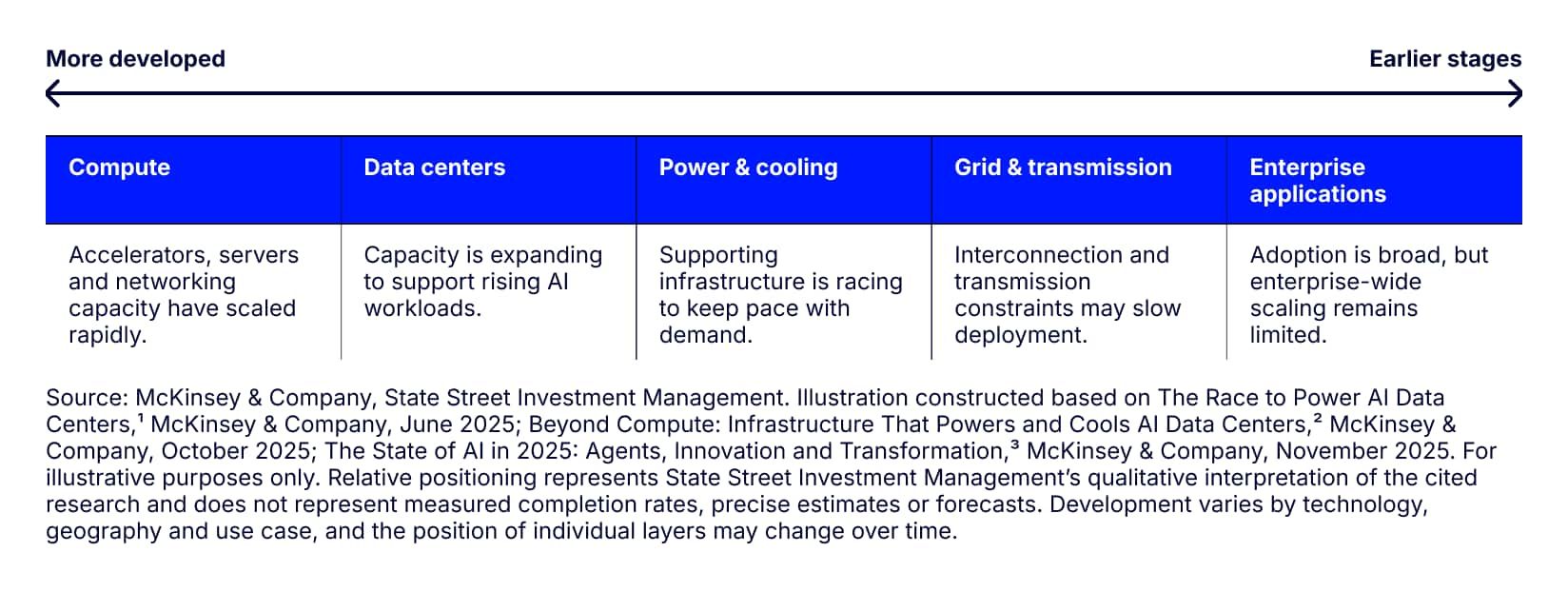
Taking a global view beyond the US, no country controls the entire AI stack, and national advantages differ considerably by layer. The US remains a leader in AI models and hyperscale computing infrastructure; Taiwan plays a critical role in advanced semiconductor manufacturing; and South Korea contributes key memory technologies. Meanwhile, other countries provide important inputs such as raw materials and energy, which add further to geographic dependencies.
Top countries across AI-related industries
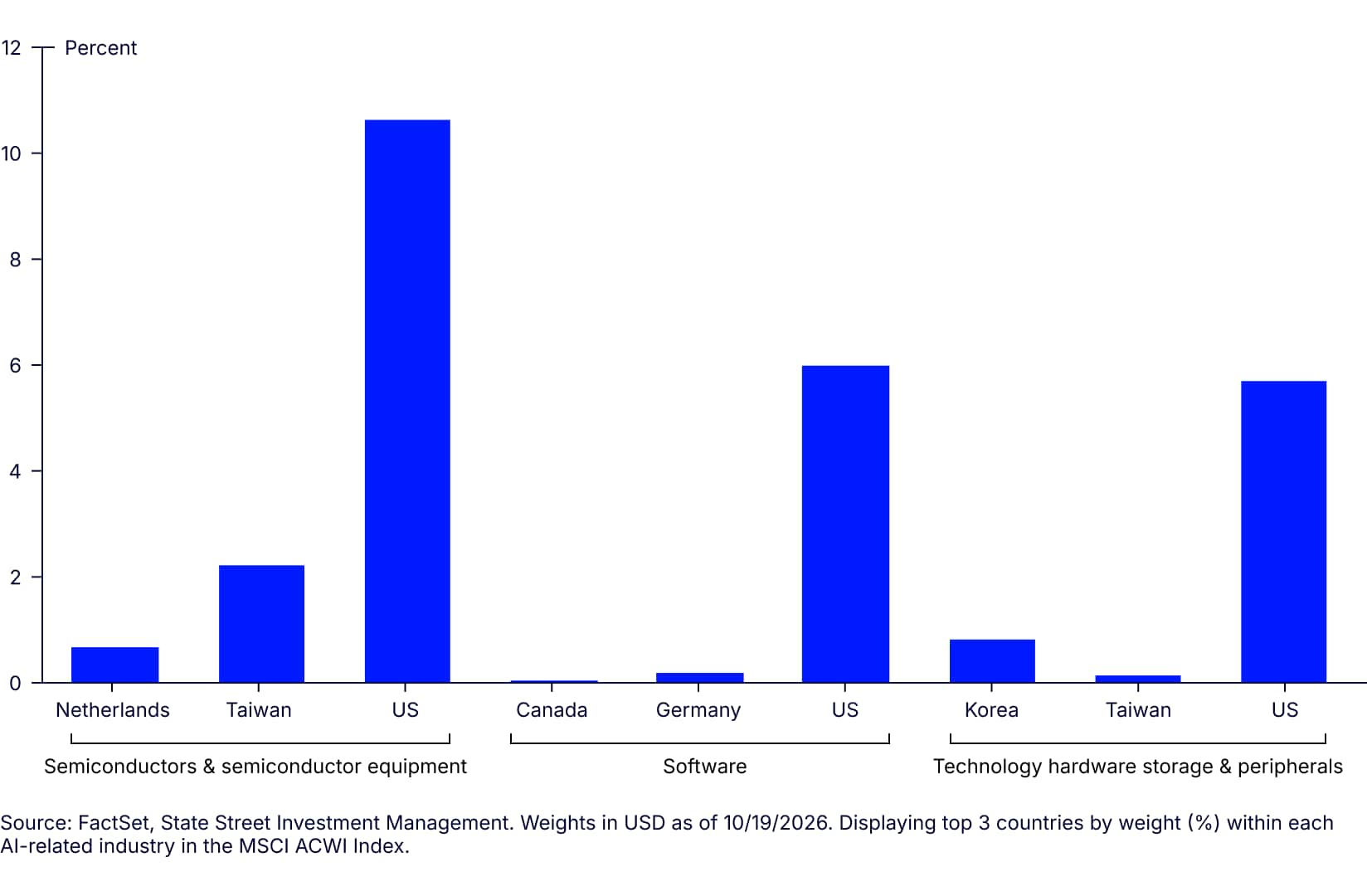
As shown in the chart above, leadership across industries critical to the AI buildout varies by country. While the US remains a dominant presence amongst the industries highlighted in the AI stack, Taiwan plays an important role in the semiconductor industry, and South Korea within technology hardware storage. Other countries, including the Netherlands, Canada, and Germany, also offer exposure to key AI-related industries. This geographic specialization reinforces the idea that as investment removes constraints in one layer and imposes them in another, AI leadership may continue to broaden across countries as well as industries.
As scarcity shifts, leadership may broaden
Today’s AI leaders benefit from genuine scarcity in areas of the value chain such as compute and cloud capacity. However, companies that attract capital also invite competition, gradually reducing scarcity. Falling unit costs may accelerate adoption while making it more difficult for undifferentiated infrastructure providers to sustain margins. Investors should therefore distinguish between volume growth and economic rent capture. As the telecom boom demonstrated, strong demand does not necessarily translate into attractive returns on incremental capital.
Under this framework, as AI infrastructure becomes more available and less expensive, value may increasingly move toward companies that use the technology rather than those that build it. For example, the long-term beneficiaries may include healthcare companies that improve productivity through automation, financial institutions that combine AI with complex operational needs, and industrial firms that embed AI into processes such as manufacturing and logistics.
The accompanying chart suggests analysts may already expect some of this broadening to occur. While Information Technology continues to command the strongest earnings growth expectations, projected growth moderates further into the forecast horizon. Health Care, which displays the second-strongest growth expectations in the near term, also shows a more pronounced slowdown by 2028. Meanwhile, earnings growth expectations for Industrials and Financials remain comparatively resilient across both forecast periods, showing some improvement going into 2028. Although these estimates are not a direct measure of AI adoption, the varying growth trajectories may reflect expectations that the benefits of the AI buildout will accrue to different industries at different stages of the cycle. Some sectors may be positioned to benefit earlier from infrastructure spending and initial deployment, while others may see greater gains as AI adoption broadens and productivity improvements become more widespread.
Investment Implications
Near-term demand for AI infrastructure remains powerful, but the scale of investment raises the hurdle for future returns. Investors should look beyond demand growth to assess whether capacity remains differentiated and AI-related revenues can generate attractive returns on incremental capital. The telecom boom offers a useful reminder: fiber-optic networks were essential to the internet revolution, but many of the companies that laid the fiber captured less value than the platforms and services later built on top of it. The infrastructure being built today will underpin the next phase of adoption, but today’s builders may not be tomorrow’s primary beneficiaries. For investors, the challenge is to identify where economic rents migrate as parts of the AI stack become cheaper and more abundant. Over time, the distinction may be less between companies that build AI and those that do not, and more between those that built the infrastructure and those that use it most effectively.
Source: FactSet, MSCI, S&P, McKinsey & Company, State Street Investment Management. Data as of 10/19/2026 unless otherwise stated. Charts referencing hyperscalers includes: Microsoft, Amazon, Alphabet (Google), Oracle, and Meta.

Go beyond the headlines...
Skimmed the summary? Dive deeper with the full PDF—your go-to for weekly market insights and analysis.