
AI is becoming a credit-cycle story, not just a technology story
Global Credit Research - Global Fixed Income Solutions Team
The market debate over artificial intelligence is still largely framed around model competitiveness and the search for technology winners and losers. For credit investors, that framing is too narrow. In the near-term, the more important questions are how companies are financing the infrastructure buildout, which tech names can convert AI investment into durable cash flow, and which may be disrupted before their balance sheets have time to adapt.
By focusing on cash flows and fundamentals — not just model releases or disruption narratives that may take longer to play out — fixed income investors can better assess the implications for debt markets and fixed income exposures.
What matters for credit in AI now? The first phase is about productivity, not disruption
In general, the AI story can be viewed through both a short-term and a long-term lens. In the near term, AI's impact is proving more evolutionary (improving efficiency in existing workflows) than revolutionary (replacing existing systems or staff and completely replacing existing business models). For credit investors, this distinction matters. Productivity benefits can improve margins, strengthen free cash flow, and support deleveraging. Disruption, by contrast, tends to pressure revenues, compress margins, and weaken credit fundamentals.
Across multiple sectors, the earliest benefits are appearing through productivity gains, workflow automation improvements, data analysis advancements, and operational efficiency gains rather than widespread business-model disruption. For example, financial institutions are using AI to enhance underwriting, fraud detection, compliance, customer service, and operational processes. Healthcare organizations are applying AI to administrative workflows, diagnostics, imaging, scheduling, and revenue-cycle management. Structured finance participants are leveraging AI to improve screening, due diligence, and analytical workflows (Figure 1).
Figure 1: A wide range of sectors benefit from innovation spillovers
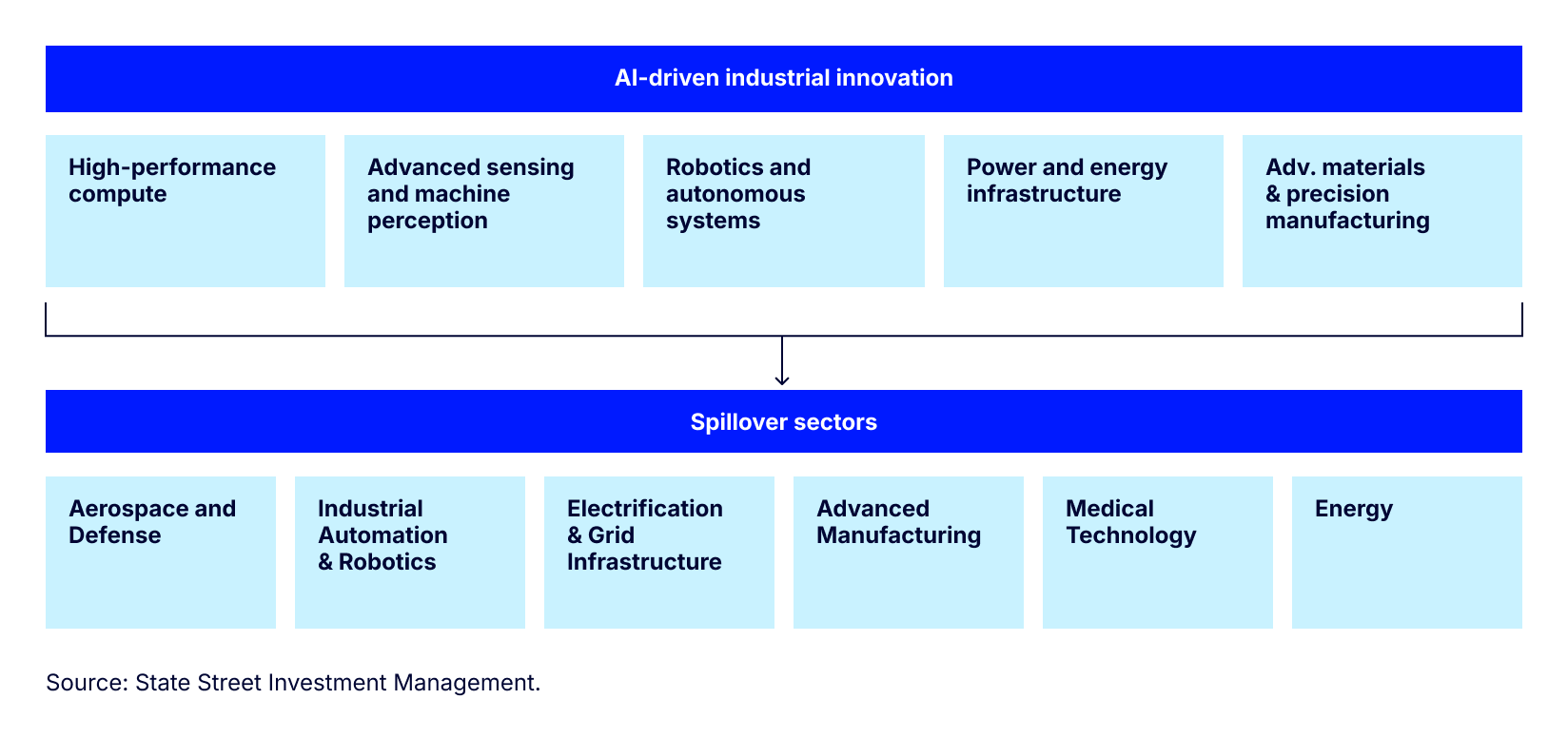
Today, the market is pricing future disruption faster than appears justified by deterioration in fundamentals. From a credit perspective, what matters more are financing details and credit resilience—not disruption, which is not yet the dominant force in today’s credit cycle. The long-term potential remains transformative, but the path from technological capability to economic disruption is likely to be longer and less linear than current market narratives suggest.
The real AI story is capital intensity
In our view the most immediate credit impact of AI is not technological disruption. Rather, it is the unprecedented wave of capital spending required to build the infrastructure that enables it (Figure 2).
The AI ecosystem is creating a massive investment cycle across data centers, networking, power infrastructure, semiconductors, cloud architecture, and digital connectivity. Large hyperscale technology companies are committing extraordinary amounts of capital to support future AI demand, fundamentally changing the composition of corporate investment spending. This has two important implications:
- First, credit markets are becoming a critical funding mechanism for the AI buildout. Debt issuance is increasingly supporting infrastructure expansion, creating a growing link between AI adoption and credit-market supply.
- Second, the benefits of AI are not confined to technology companies. Industrials, utilities, infrastructure providers, equipment manufacturers, and real-asset owners also sit within the AI value chain. In many cases, some of the most attractive credit opportunities may come from businesses enabling AI rather than from companies developing AI itself.
Financing the AI buildout: Understanding the impact on credit markets
Investment grade credit: More aggressive credit posture, but from stronger balance sheets
Nowhere is this financing dynamic more visible than in investment grade (IG) credit. Hyperscalers have rapidly increased their presence in the IG market as they finance data-center expansion, cloud infrastructure, networking, and AI-related investments. In doing so, this group’s significant debt issuance and stronger credit profiles are improving the overall index credit quality (Figure 3).1 This has created an unusual combination for credit investors: higher capital needs and debt-funding requirements, but from stronger-credit-quality issuers.
Figure 3: The share of names AA and above has increased
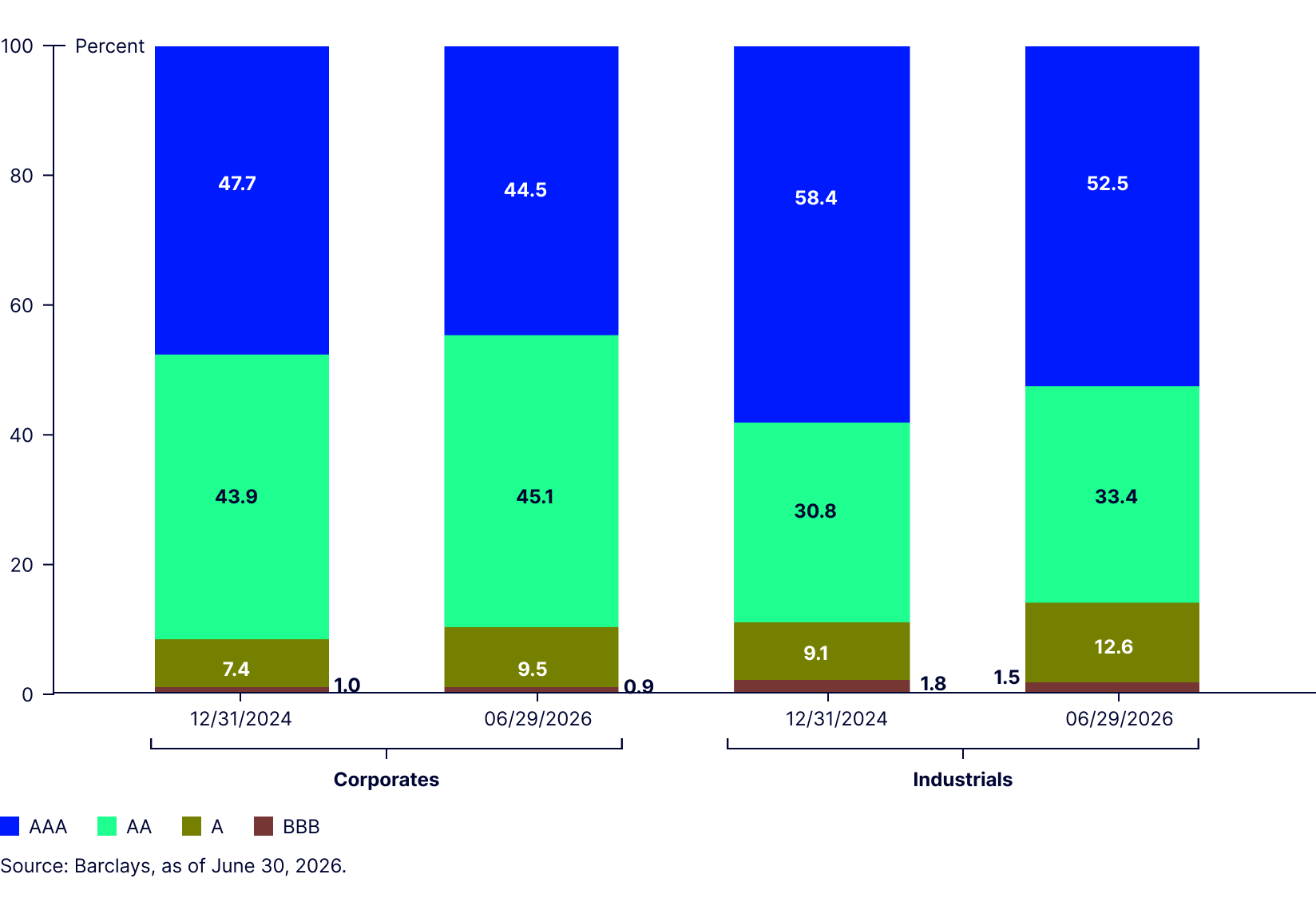
Hyperscalers are also becoming some of the largest issuers in benchmark indices (Figure 4). This concentration will likely continue to build as capital programs are debt-financed in the public markets.
Figure 4: Soaring AI-related issuance is contributing to higher overall IG supply
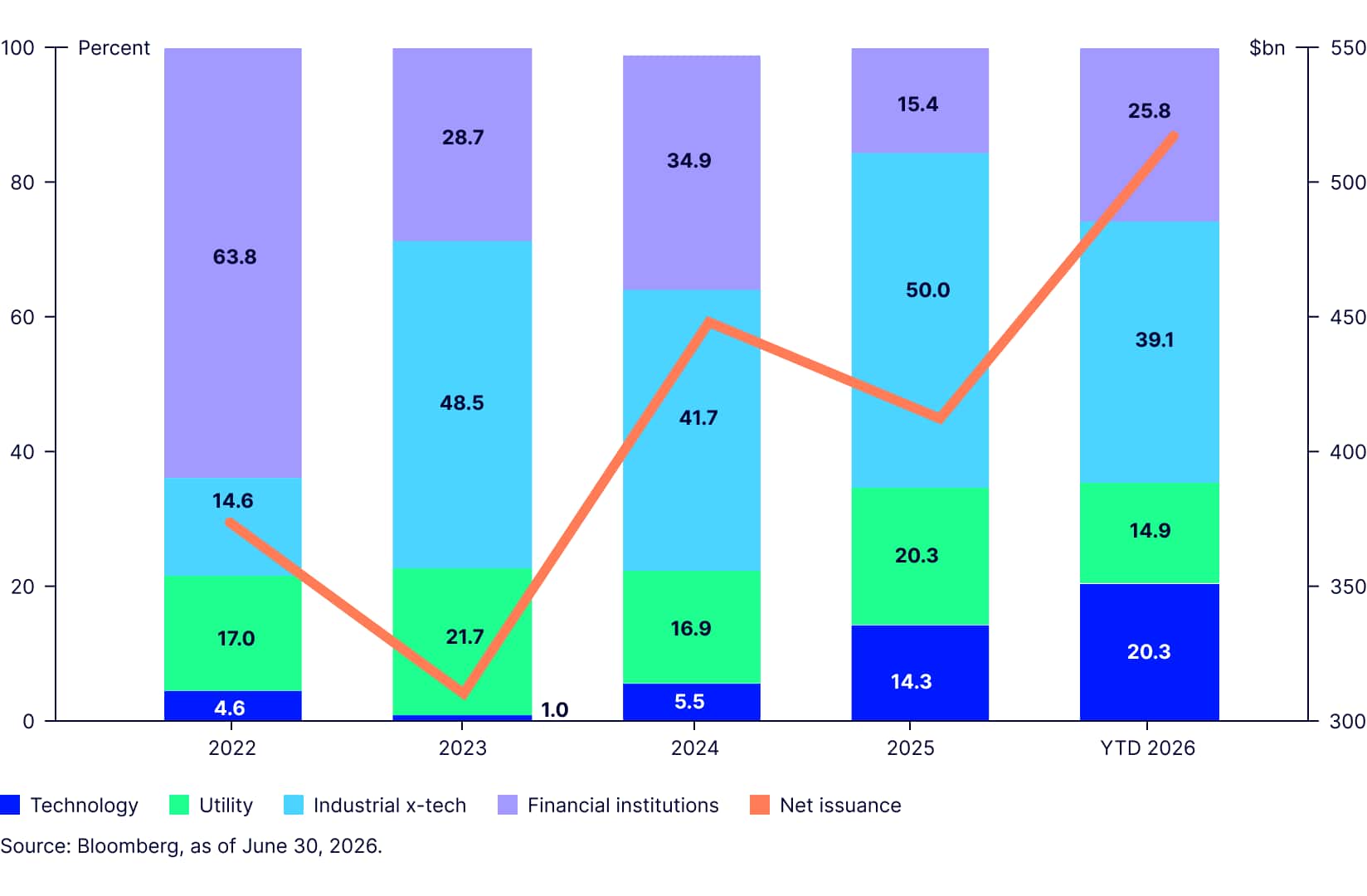
Historically, large investment cycles often raised concerns about leverage and balance-sheet deterioration. In the current cycle, many of the primary issuers are among the strongest credits in the market. As a result, hyperscalers are simultaneously increasing capital intensity and driving a growing proportion of high-quality issuers within benchmark indices.
Structured Credit: The infrastructure layer of AI
Structured credit provides a clear example of how the AI theme extends beyond technology. The rapid expansion of data-center financing has created a growing opportunity set within securitized markets. Importantly, many of these structures are not direct investments in AI technology. Instead, they support stabilized real estate, long-term lease contracts, and infrastructure assets that underly AI deployment.
Many investors seeking AI exposure focus on software, semiconductors, or technology equities. Structured-credit investors can often access the infrastructure beneficiaries of AI through contractual cash-flow streams rather than direct technology risk.
As AI adoption expands, data centers are increasingly seen as essential infrastructure. The investment opportunity may therefore be less about predicting the next technological winner and more about underwriting durable cash flows linked to sustained demand for digital capacity.
Leveraged finance: Markets are pricing greater risk faster than fundamentals are deteriorating
The most striking divergence between the perception and reality of disruption is within leveraged loans. Technology and software borrowers represent a significant portion of US leveraged finance markets, leading investors to focus heavily on AI disruption risk to legacy business models. In the first quarter of 2026, the discount margins of software and IT services loans in the broadly syndicated market widened meaningfully (Figure 5), and the distressed ratio in that sector spiked relative to the broader loan indices. The sharp market repricing reflected investor concerns over future business-model disruption amid high legacy leverage and upcoming refinancing needs.
Yet, the sell-off was indiscriminate. While some borrowers undoubtedly face elevated disruption risk and the share of CCC and below rated loans in US tech and tech services is rising gradually, a broad-based deterioration in fundamental credit metrics is unlikely at this stage.
Therefore, in the leveraged loan market, the valuation correction has created opportunities for investors willing to distinguish between businesses facing genuine existential threats and/or over-levered balance sheets on one hand, and those with sustainable business models and capital structures simply experiencing valuation compression on the other.
Credit sector implications
Financials: Trust and data remain the ultimate moat - until they don't
Financial institutions appear well positioned to benefit from AI-driven productivity gains over time. As AI becomes more widely available, technological capabilities may become commoditized. However, two elements of financial institutions may serve as durable moats in an AI-enabled economy: proprietary data and customer trust.
- Banks, insurers, and asset managers continue to benefit from regulatory frameworks, client relationships, distribution networks, and decades of accumulated data. AI companies have shown an interest in accumulating data that helps drive AI models.2
- Trust may become more valuable amid cybertechnology threats—an important counterpoint to banks’ strong access to data. The same technologies that increase productivity also increase operational and cyber risk. A significant AI-enabled fraud event, model failure, data leak, or cybersecurity breach could erode trust far more rapidly than institutions can build it.
History suggests that reputation is accumulated slowly, but can be lost almost overnight. For financial institutions, therefore, AI may simultaneously increase the value of trust while increasing the fragility of that trust. Governance, cybersecurity, model controls, and data stewardship are likely to become increasingly important credit differentiators.
Healthcare and Technology: similar themes, different outcomes
The healthcare and technology sectors illustrate the importance of distinguishing between adoption and monetization. Health care is adopting AI to increase efficiency and productivity; within technology, hardware is monetizing the AI buildout, while software companies are at risk from disruption.
- Healthcare: The administrative side of healthcare organizations appears well positioned to benefit from AI through workflow optimization, productivity enhancement, and administrative efficiency. The impact to clinical labor is more augmentation than replacement: the persistent shortages of clinical labor could enable AI to increase the productivity of clinicians instead of eliminating clinical positions.
- Technology presents a more nuanced picture. AI beneficiaries - including hardware suppliers, semiconductors, and services - appear positioned to capture significant demand growth. Software companies, however, face a more uncertain outlook due to AI displacement risk, valuations, and high leverage and unease over the degree and feasibility of long-term disruption.
Markets are increasingly differentiating between firms that can monetize AI and those whose products may eventually be disrupted by it. The result is growing dispersion between potential winners and losers, even within the same subsector.
For credit investors, this means security selection is becoming increasingly important. Broad sector exposure may be less effective than issuer-level analysis focused on competitive positioning, cash-flow durability, and refinancing capacity.
An emerging constraint: The social license to build
One short-term risk that receives far less attention than supply-demand forecasts is whether the pace of infrastructure expansion could ultimately collide with local resistance. Data centers require significant power capacity, land, water resources, transmission infrastructure, and increasingly visible physical footprints. While global AI demand appears robust, local communities are beginning to question whether they should bear the associated environmental, energy, and infrastructure costs.3
Historically, infrastructure projects have often faced "Not In My Back Yard" opposition despite broad recognition of their economic importance. AI infrastructure may prove no different.
For credit investors, this introduces a new variable: execution risk. Delays in permitting, transmission buildout, power availability, environmental approvals, or local opposition could slow deployment timelines, increase costs, and affect expected returns across portions of the AI ecosystem. The ultimate bottleneck may not be capital availability, but society's willingness to accommodate rapid expansion.
The long-term question for credit markets: Productivity or labor displacement?
If the near-term AI story is about financing, the longer-term question is whether those productivity gains eventually reshape labor markets. The largest unanswered question surrounding AI is ultimately macroeconomic, rather than technological. If productivity gains materialize without meaningful labor displacement, AI could prove highly supportive for economic growth, corporate profitability, and credit fundamentals. Companies would produce more with existing resources, margins could expand, and growth could accelerate without triggering inflationary pressures.
However, there is a less benign scenario. Many current AI applications focus on supporting workers rather than replacing them. Over time, that distinction may blur. As systems become more capable, firms may increasingly substitute technology for labor across administrative, analytical, customer service, and knowledge-based functions.
The key uncertainty is whether AI creates new categories of employment quickly enough to offset jobs that become automated. For credit markets, this question matters enormously. A meaningful reduction in labor demand would have implications for consumer spending, household credit performance, housing demand, auto finance, and broader economic activity. The first-order beneficiaries of AI productivity could therefore create second-order headwinds elsewhere in the economy. This remains one of the most important long-term risks that investors are not yet able to quantify with confidence.
The bottom line: Focus on the financing cycle
AI should not be viewed solely as a technology theme. In the near-term, it is a financing cycle, an infrastructure cycle, and a credit cycle.
The best opportunities may emerge where investors focus on the flow of capital rather than headlines about technical innovation. Some of the most attractive beneficiaries may be issuers providing infrastructure, financing, power, networking, real assets, or mission-critical services rather than the companies building the AI models themselves.
At the same time, investors should be attentive to two underappreciated risks: trust erosion from AI-enabled cyber events and societal resistance to infrastructure expansion. Over the longer term, the key risk is that productivity gains eventually evolve into labor-market disruption.
Ultimately, AI is likely to create greater dispersion across credit markets rather than generate a single directional outcome. The winners will be the companies capable of funding, monetizing, and governing AI while preserving stakeholder trust and navigating the economic consequences of technological change.