
GCC bond markets: Finding value in a changing fixed income landscape
The continued evolution of Gulf Cooperation Council (GCC) bond and sukuk markets is creating a more differentiated opportunity set for fixed income investors. In this article, we explore how macroeconomic shifts, sovereign fundamentals, issuance trends, and curve dynamics are shaping opportunities across GCC fixed income markets.
Over the past decade, fixed income markets in the GCC have undergone a transformative shift as global macro forces, regional initiatives, and evolving investor dynamics converge. What was once a relatively narrow market, dominated by sovereign borrowing, international US-dollar issuance, and a limited number of large government-related entities, has developed into a much broader financing ecosystem. Saudi Arabia has been central to this evolution, combining strong credit fundamentals and deep investor demand with the region’s largest and most active debt market. The region’s fixed income markets now span high-grade sovereign and government-related issuers alongside a growing range of corporate and higher-yielding credits, offering investors a combination of resilience, diversification, and yield opportunities.
Evolving macroeconomic environment: A test of market resilience
Fixed income has traditionally played a defensive role in portfolios during periods of market uncertainty. However, the ongoing Iran war has tested the resilience of GCC bond markets, prompting a reassessment of regional risk that has so far been more visible in market pricing and liquidity than in broad-based credit deterioration. Following the escalation of the conflict, GCC bond and sukuk spreads widened sharply as investors demanded greater compensation for geopolitical risk, although much of the initial widening subsequently reversed.
This regional shock has coincided with a challenging global rates environment. Higher energy prices have reinforced inflation concerns, while persistent US fiscal deficits, elevated debt-service costs, and heavy Treasury issuance have added pressure to longer-term yields. For dollar-pegged GCC economies, tighter global financial conditions therefore represent an additional headwind, even as underlying sovereign and corporate credit fundamentals vary significantly across the region.
Figure 1: Global fixed income performance
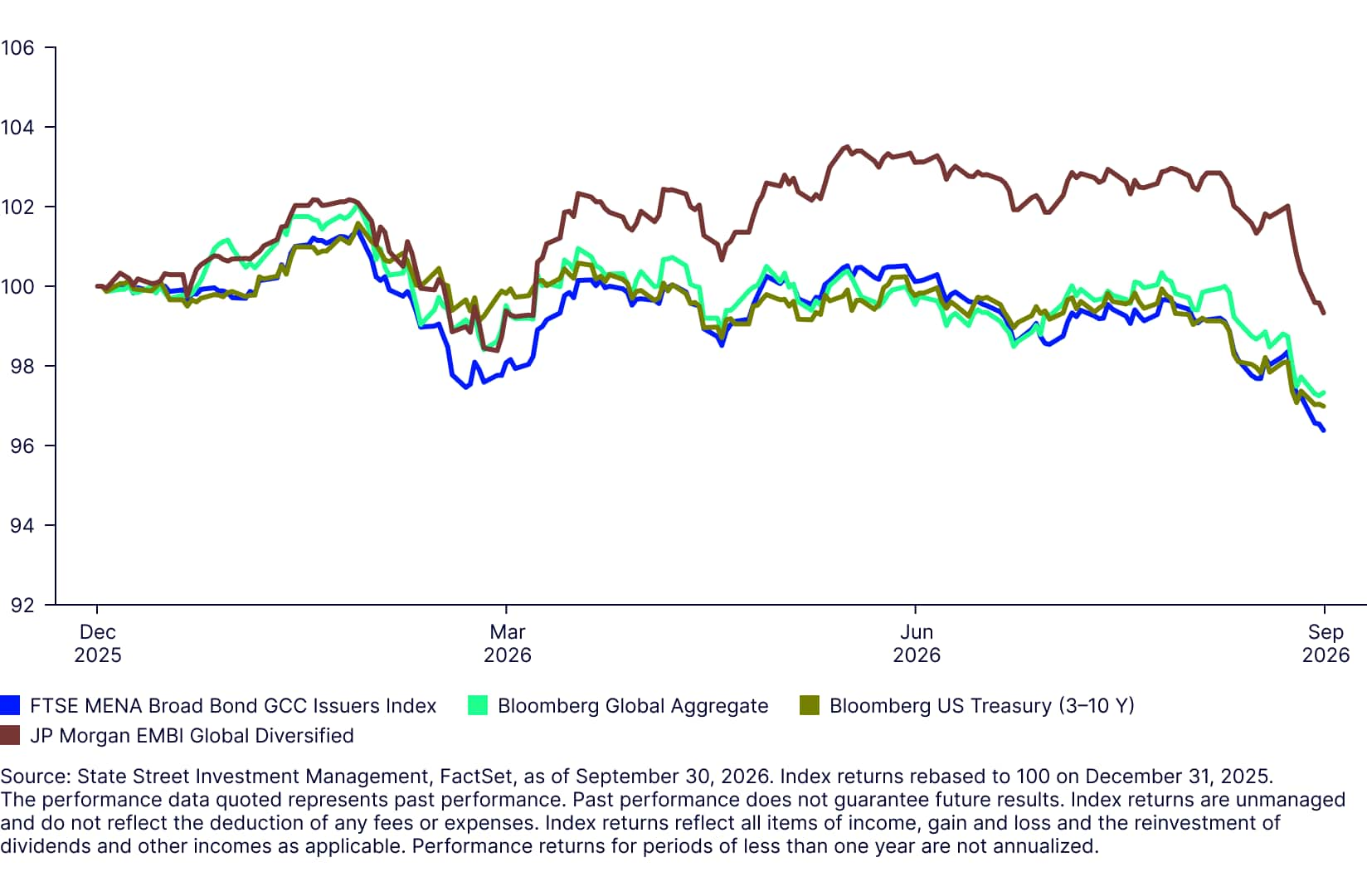
Domestic macroeconomic conditions have also become more differentiated, illustrating how the conflict is transmitting unevenly through production, fiscal balances, and inflation across GCC economies. In Saudi Arabia, real GDP for Q2 2026 contracted 4.8% year on year, while non-oil activity still grew 0.6%.1 At the same time, Qatar’s deficit has widened two-fold to QAR21.8 billion from Q1 to Q2 2026.2 However, crude oil exports from key producers in the region have rebounded in September, with at least 16.5 million barrels per day leaving the region between September 1-28,3 matching the pre-war average. The share of the region's crude exported without crossing Hormuz has risen to 40%, up from 17% before the war, as more oil moves through Saudi and UAE pipelines.
Oil-driven fiscal dynamics and ambitious economic diversification agendas
Higher oil prices do not automatically translate into stronger fiscal revenues for GCC exporters. Receipts depend not only on the benchmark price but also on the volume and net value of hydrocarbons physically produced and exported. Disruptions to production, shipping, insurance, refining capacity, and alternative export routes can therefore constrain realized revenue even when Brent prices are elevated, while higher freight, insurance, and security costs can further weaken the fiscal pass-through. The ongoing Iran conflict has highlighted this distinction, as disruption at the Strait of Hormuz constrained regional exports despite efforts to redirect flows through alternative routes, such as Saudi Arabia’s East-West Pipeline and UAE’s Abu Dhabi Crude Oil Pipeline.
Brent crude fell sharply during periods of ceasefire and de-escalation but has since moved higher again as geopolitical and supply risks have persisted. The December Brent contract settled at $102.31/bbl on October 1. At present, there is little evidence of a durable near-term de-escalation, while recent disruption to Saudi Arabia’s East-West Pipeline underscores the vulnerability of alternative export infrastructure. Our base case remains one of recurring periods of pressure, negotiation, and partial de-escalation until a broader settlement is reached. Against this backdrop, we expect Brent to remain volatile within a broad $80–$110/bbl range through year-end, with outcomes highly sensitive to supply disruptions and the path of diplomatic negotiations.
Figure 2: Fiscal balances and breakeven oil prices across GCC countries
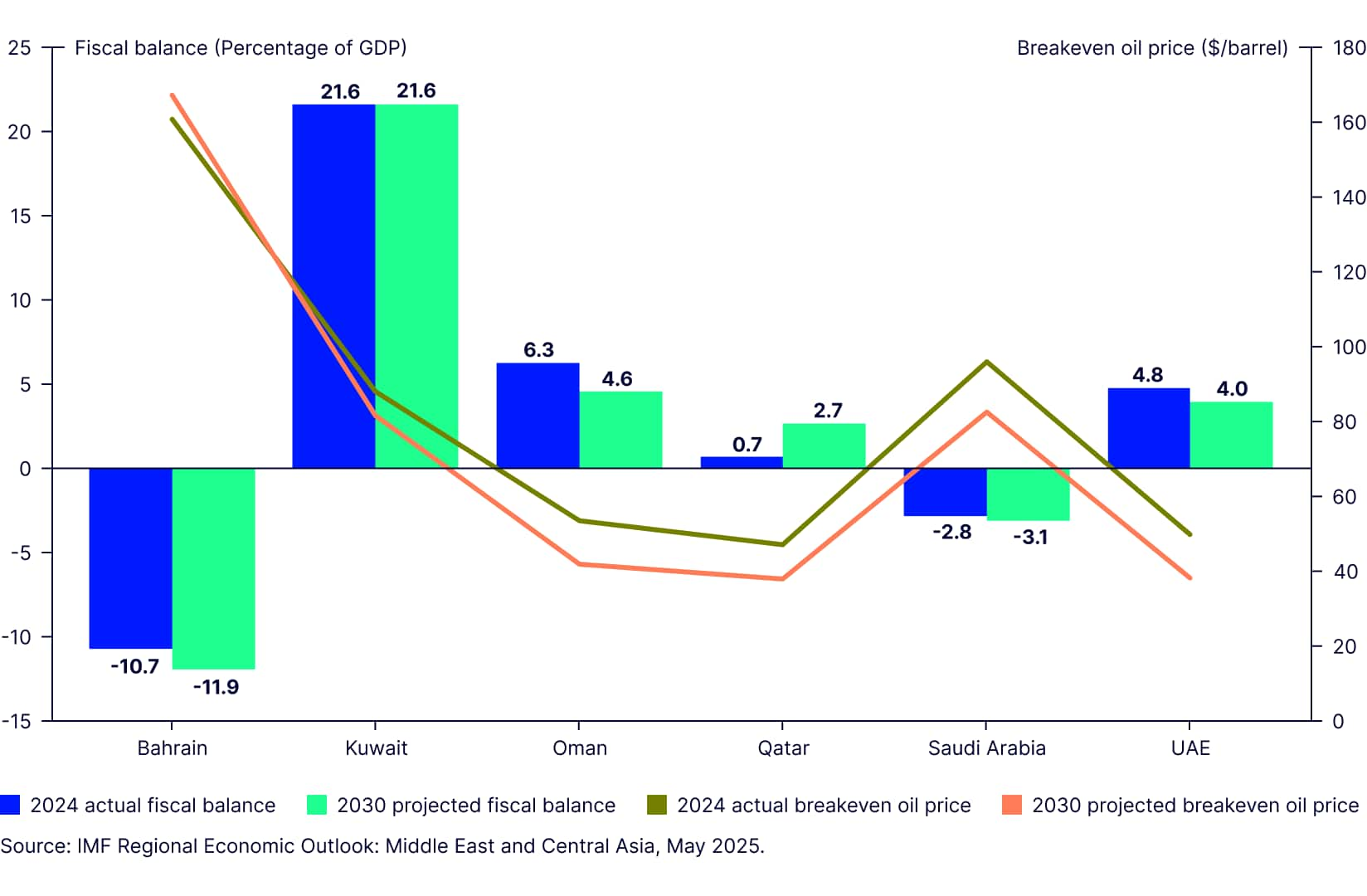
The IMF’s 2026 outlook highlights how the fiscal benefits of higher oil prices may be offset by production and export disruptions, potentially weakening fiscal and external balances in directly affected exporters.
Fixed income investors should therefore look beyond benchmark oil prices to export continuity, realized hydrocarbon revenues, and revenue volatility, all of which can influence GCC borrowing requirements, issuance plans, and fiscal consolidation. The IMF’s April 2026 outlook assumes an average oil price of $82.22/bbl in 2026 and $75.97/bbl in 2027, up from $67.74/bbl in 2025,4 providing potential fiscal relief but leaving outcomes highly sensitive to geopolitical and export-disruption risks. Fiscal breakeven oil prices are therefore useful but incomplete measures of sovereign credit risk. The GCC median oil price is estimated to decline from about $71/bbl in 2024 to $62/bbl by 2030, with the UAE, Oman, and Qatar near $40/bbl, Saudi Arabia and Kuwait around $82/bbl, and Bahrain at $167/bbl.5
Strong policy frameworks and, in several cases, substantial accumulated fiscal and external buffers provide an important source of resilience. Ultimately, the credit impact of higher oil prices will increasingly depend on each sovereign’s ability to translate benchmark price gains into durable fiscal revenues, reinforcing the importance of export resilience, fiscal buffers, and economic diversification.
Economic diversification is strengthening the GCC’s underlying economic base while also contributing to the expansion of fixed income issuance. By broadening sources of economic growth and, over time, government revenues beyond hydrocarbons, national Vision programs can enhance fiscal resilience. At the same time, substantial infrastructure and strategic-investment requirements are creating sustained financing needs. Saudi Arabia provides the clearest example: real GDP grew 4.5% in 2025, its strongest pace in three years, supported by both oil and non-oil activity. Non-oil activity has expanded substantially over the past decade, accounting for around 55% of real GDP in 2025.
Figure 3: GCC countries’ average annual real GDP growth (YoY %), 2016 to 2025
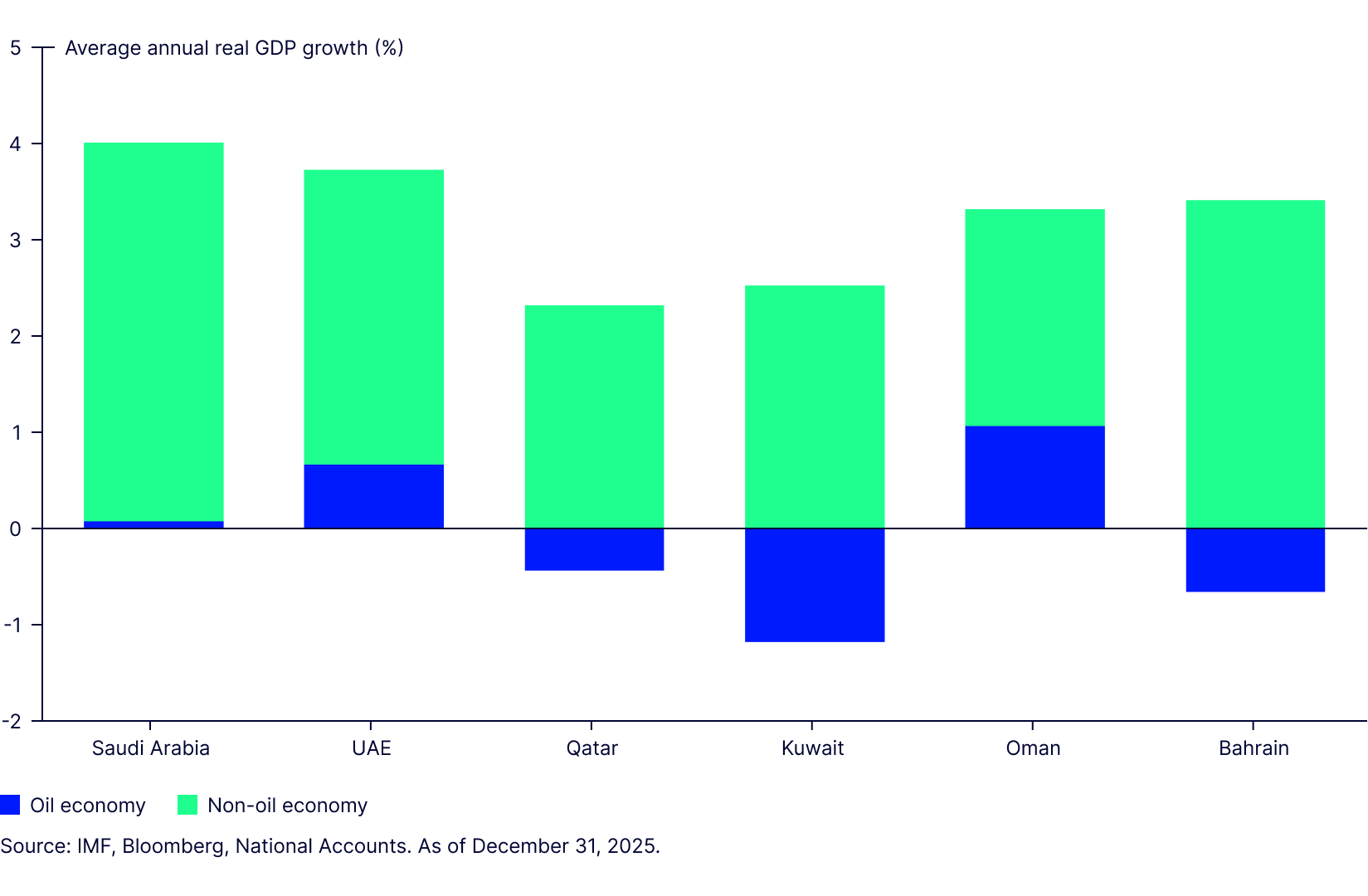
For bond markets, diversification is gradually broadening the GCC’s economic base while supporting a durable pipeline of sovereign, quasi-sovereign, and project-finance issuance. Saudi Arabia’s Public Investment Fund (PIF), with more than $900 billion in assets under management, illustrates this trend, both as an issuer and through the substantial investment programs associated with the Kingdom’s transformation agenda. More broadly, this represents a structural shift from more episodic borrowing toward the regular use of debt markets to finance national development, budgetary requirements, and refinancing. For investors, this combination of stronger non-oil growth, persistent funding requirements, and increasingly diverse issuance means that GCC fixed income is becoming less a single regional trade and more a market in which issuer and curve selection matter.
Where can you still find value in the GCC fixed income market?
Although GCC fixed income has become more resilient and globally integrated, opportunities are increasingly driven by relative value rather than outright yield alone. Common exposure to US rates and dollar pegs continues to shape the region’s curves, but the conflict has also demonstrated that regional risk does not reprice uniformly. GCC spreads widened following the initial escalation before higher-quality credits recovered much of the move, while lower-rated and higher-beta segments experienced more persistent repricing. This dispersion creates opportunities for relative-value analysis, particularly where differences in spreads, curves, or issuer risk appear greater than differences in underlying fundamentals would warrant.
Credit quality as a source of sovereign differentiation
GCC sovereign ratings remain broadly strong, but with clear differentiation across markets. UAE (Abu Dhabi), Qatar, and Kuwait sit at the upper end of the GCC sovereign rating spectrum, supported by substantial sovereign assets, strong external buffers, and relatively low net debt, helping anchor their comparatively strong credit profiles. Saudi Arabia also remains firmly investment grade, with strong fiscal and external buffers and ongoing economic diversification supporting its credit quality, although rising borrowing requirements and substantial sovereign and government-related issuance create a heavier supply backdrop. At the other end of the spectrum, Oman’s return to investment grade status earlier this year reflects significant fiscal consolidation, deleveraging, and improved external balances, supporting the structural compression in its sovereign risk premium. Bahrain remains the GCC’s clear credit outlier, with speculative-grade ratings reflecting high government debt, persistent fiscal deficits, limited external buffers, and significant refinancing requirements.
Figure 4: GCC countries’ credit ratings and sovereign curve spreads
| GCC country | Rating (S&P/Moody's) | USD sovereign curve spread vs US Treasuries (September 2026), bps | Government debt (% of GDP) |
| Bahrain | B / B2u | 275-330 | 148% |
| Kuwait | AA- / A1 | 50-90 | 14% |
| Oman | BBB- / Baa3 | 55-120 | 33% |
| Qatar | AA / Aa2 | 35-80 | 43% |
| Saudi Arabia | A+ / Aa3 | 55-115 | 32% |
| UAE | AA / Aa2 | 20-70 | 31% |
Source: Bloomberg, as of September 2026.
Sovereign yield curve and spread dynamics
GCC sovereign yield curves have experienced repricing over the past six months, with movements increasingly differentiated by fiscal strength, funding requirements, issuance dynamics, and credit quality. US Treasury yields remain an important common driver, particularly for USD-denominated GCC debt, while country-specific fiscal and supply dynamics are contributing to greater dispersion across regional curves.
Saudi Arabia stands out for the depth of its domestic debt market and the scale of its funding requirements. Its sovereign curve remains positively sloped, against a backdrop of substantial government issuance and continued financing needs. This supply dynamic is particularly relevant further out the curve, where longer-duration issuance forms an important part of the Kingdom’s debt-management strategy. In the local riyal (SAR) sukuk market, the upward-sloping curve similarly provides higher yields at longer maturities, reflecting a combination of global rate conditions, duration risk, and domestic supply dynamics.
Figure 5: Saudi Arabia sovereign and sukuk yield curves
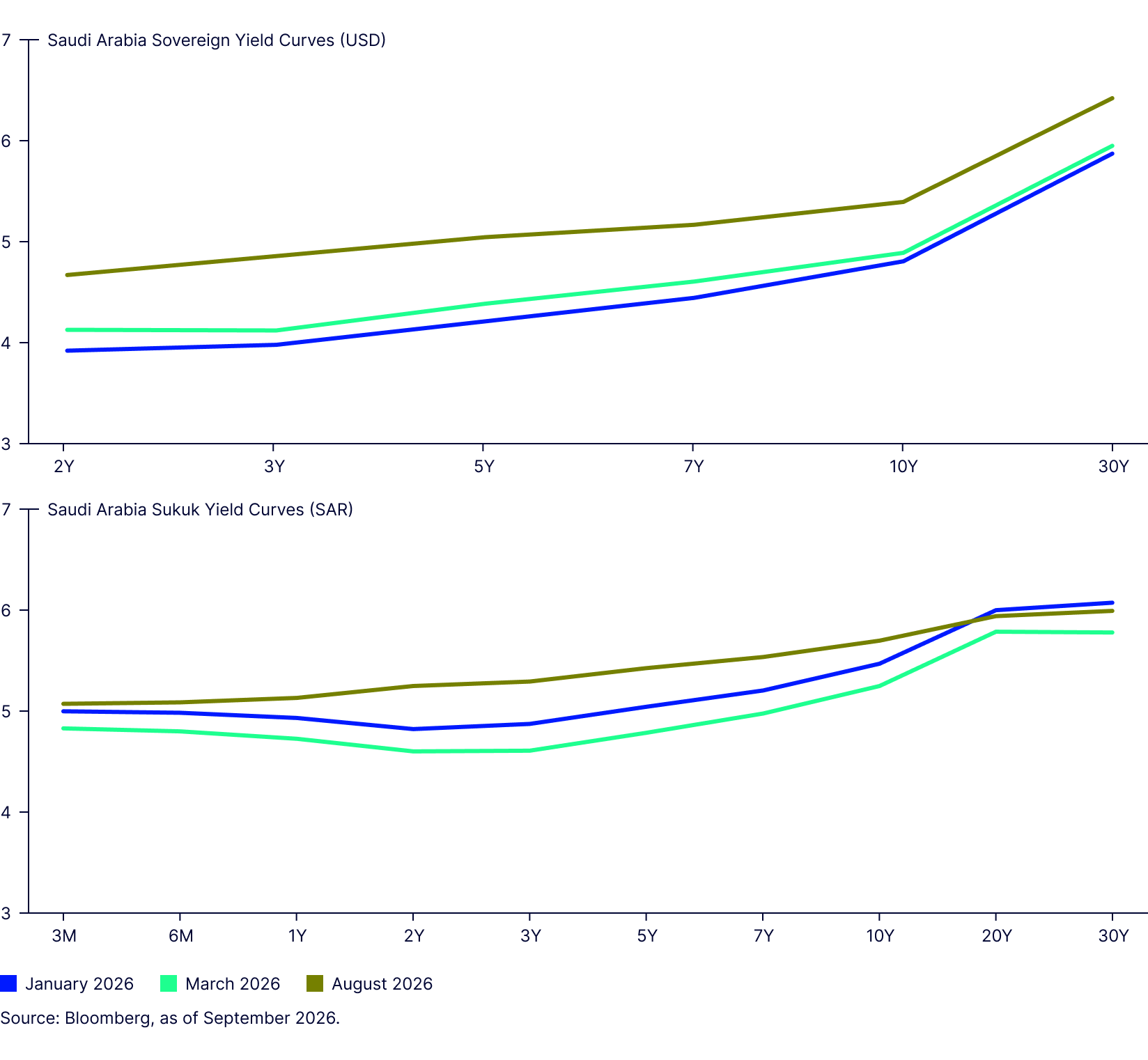
The onset of the conflict at the end of February triggered a repricing of geopolitical, export disruption, and liquidity risks across GCC markets, although the magnitude and timing of the adjustment varied by sovereign. Since then, the initial regional risk repricing has given way to greater issuer-level differentiation, as policy support, sovereign buffers, and resilient local demand helped stabilize stronger credits. Against a common global rates backdrop, relative performance has increasingly reflected sovereign credit quality, fiscal and refinancing risks, issuance supply, and market liquidity rather than uniform regional risk aversion.
Figure 6: Change in spreads vs equivalent-maturity US Treasury (bps)
| Maturity | US Investment Grade (USD) | Bahrain Sovereign (USD) | Saudi Arabia Sovereign (USD) | Saudi Arabia Sukuks (SAR) | Oman Sovereign (USD) | Qatar Sovereign (USD) | UAE M-Bills (AED) |
| 3M | 21 | 8 | 26 | 21.1 | |||
| 6M | 8 | -7 | 11 | -9.3 | |||
| 1Y | -5 | -21 | -6 | -13.8 | |||
| 2Y | -12 | 93 | -32 | -22 | -3 | ||
| 3Y | -10 | 70 | -19 | -24 | -20 | 0 | |
| 5Y | -7 | 45 | -23 | -25 | -22 | 2 | |
| 7Y | -4 | 36 | -24 | -25 | -19 | 3 | |
| 10Y | -2 | 29 | -21 | -27 | -16 | 5 | |
| 20Y | -9 | 15 | -46 | -12 | 7 | ||
| 30Y | -8 | 3 | -9 | -34 | -6 | 7 |
Source: Bloomberg, as of September 2026. Change in spreads reflects difference in spreads at the end of the month for March 2026 vs August 2026.
Among GCC sovereign issuers, Qatar and the UAE continue to command some of the tightest credit spreads (as shown in Figure 4), reflecting strong sovereign balance sheets and substantial financial buffers. Qatar’s longer-term credit strength is further supported by its low-cost liquefied natural gas (LNG) resource base and expansion of North Field production capacity. In the near term, however, damage to two LNG trains at Ras Laffan has removed approximately 17% of Qatar’s LNG export capacity, with repairs now expected to take around three years. Qatar's substantial financial buffers provide an important cushion against this shock.
Saudi Arabia remains the region’s largest and most active debt issuer, supported by deep investor demand, substantial financial buffers, and the scale of its economy. Sovereign risk pricing has proved resilient through the conflict, with spreads retracing much of the initial risk-related adjustment and, on some measures, moving below pre-conflict levels. While Saudi spreads remain wider than those of some higher-rated GCC peers, substantial funding requirements and issuance volumes provide an important source of relative-value differentiation along the curve.
Oman has experienced one of the GCC’s most significant sovereign credit improvements in recent years. Its sovereign spreads have proved particularly resilient through the conflict, supported by stronger fiscal and external positions and its comparatively favorable access to export routes outside the Strait of Hormuz. Omani sovereign debt continues to offer a yield premium relative to higher-rated GCC peers, reflecting its lower credit rating despite the structural improvement in its credit profile.
Bahrain remains the region’s clear credit outlier, offering materially higher yields than its GCC peers against a weaker fiscal position, higher government debt, and more limited external buffers. Regional financial support and ongoing fiscal reform remain important mitigating factors, but Bahrain continues to carry greater credit risk than other GCC sovereign issuers.
Credit differentiation across GCC sovereigns remains driven by variations in fiscal strength, external balances, debt levels, and issuance needs. Qatar, Abu Dhabi, and Kuwait sit at the upper end of the region’s sovereign credit spectrum, supported by substantial sovereign wealth assets and robust balance sheets. Saudi Arabia serves as a key GCC benchmark issuer, combining strong credit fundamentals with the region’s largest and most active debt market. Oman, meanwhile, has benefited from significant improvements in its fiscal metrics and broader credit profile, while Bahrain remains the region’s higher-yielding credit outlier, with ongoing regional financial support providing an important mitigating factor. Taken together, the dispersion in sovereign fundamentals and market pricing reinforces the importance of relative-value analysis across GCC curves, particularly where differences in spread compensation exceed differences in underlying credit risk.
Refinancing resilience and sovereign maturity profiles
Beyond movements in global and GCC yields, refinancing requirements and sovereign debt maturity profiles are becoming increasingly important sources of differentiation. Developed markets face sizeable near-term refinancing needs at progressively higher funding costs. The United States, for example, has ~$40 trillion of federal debt outstanding as of September 2026. As of mid-2026, around one-third of publicly held marketable debt was due to mature within 12 months, while its average maturity stood at approximately 71 months.6 This creates substantial refinancing exposure at a time when funding costs remain elevated: as lower-coupon debt matures and is refinanced at prevailing rates, the government’s average funding cost is rising.
The aggregate GCC government debt profile appears more favorable. Although the region’s weighted-average sovereign coupon is higher, reflecting a modest credit premium, GCC sovereigns have generally extended their maturity profiles, with a weighted-average maturity exceeding 7 years. Higher US rates transmitted through the region’s dollar pegs can still exert upward pressure on borrowing costs, but longer-dated maturity profiles and, for several GCC sovereigns, substantial fiscal and external buffers help mitigate near-term refinancing risk.
Figure 7: Sovereign debt profile
| Region/Country | Weighted average fixed coupon (%) | Weighted average maturity (years) | Total debt outstanding ($bn) | Total issues |
| Bahrain | 6.2 | 5 | 48.3 | 86 |
| Kuwait | 4.2 | 4.2 | 43.4 | 35 |
| Oman | 5.9 | 6.9 | 35.4 | 79 |
| Qatar | 4.6 | 8 | 115.2 | 70 |
| Saudi Arabia | 4.2 | 8.7 | 500.5 | 288 |
| UAE (Abu Dhabi) | 3.6 | 11.6 | 66.3 | 20 |
| GCC | 4.8 | 7.4 | 809.1 | 578 |
| United States | 3.4 | 5.8 | 40,000.10 | 492 |
Source: Bloomberg, as of September 2026. Sovereign debt includes USD denominated and local currency denominated debt.
However, the regional average conceals significant differences in sovereign debt profiles. The UAE (Abu Dhabi) has a relatively long-dated sovereign debt profile, with a weighted-average coupon of 3.6% and a weighted-average maturity of 11.6 years. Qatar also retains a comparatively well-distributed maturity profile despite greater pressure on hydrocarbon export revenues following the escalation of the Iran conflict. Its sovereign debt has a weighted-average maturity of 8 years and a weighted-average coupon of 4.6%. Qatar’s long-dated debt profile and substantial financial buffers provide meaningful protection against near-term refinancing pressure.
Kuwait sits at the shorter-duration end of the regional spectrum, with a weighted-average coupon of 4.2% and a weighted-average maturity of 4.2 years, implying more frequent refinancing than some GCC peers. After a hiatus of almost 8 years, Kuwait returned to international debt markets in October 2025, raising $11.25 billion through three-, five-, and ten-year bonds. Despite elevated geopolitical risk, investor demand for Kuwaiti sovereign debt remained strong. This was evidenced by the July 2026 US$6 billion sovereign bond issuance across three-, five-, and ten-year maturities against an order book exceeding US$18 billion, pricing at spreads of 70, 75, and 85 basis points over US Treasuries, respectively—among the tighter levels available across the broader emerging-market universe.7 Domestically, the Ministry of Finance has continued to issue Treasury Bonds and Public Debt Tawarruq across multiple maturities through the Central Bank of Kuwait, helping establish a domestic sovereign yield curve.
The evolution of GCC debt issuance
Issuance trends provide some of the clearest evidence of the structural deepening of the GCC debt markets. Sovereigns, government-related entities, and corporates increasingly use bonds and sukuk as regular funding instruments for budget financing, refinancing, and economic-diversification projects.
Figure 8: Primary market bond issuance in the GCC region over the last decade
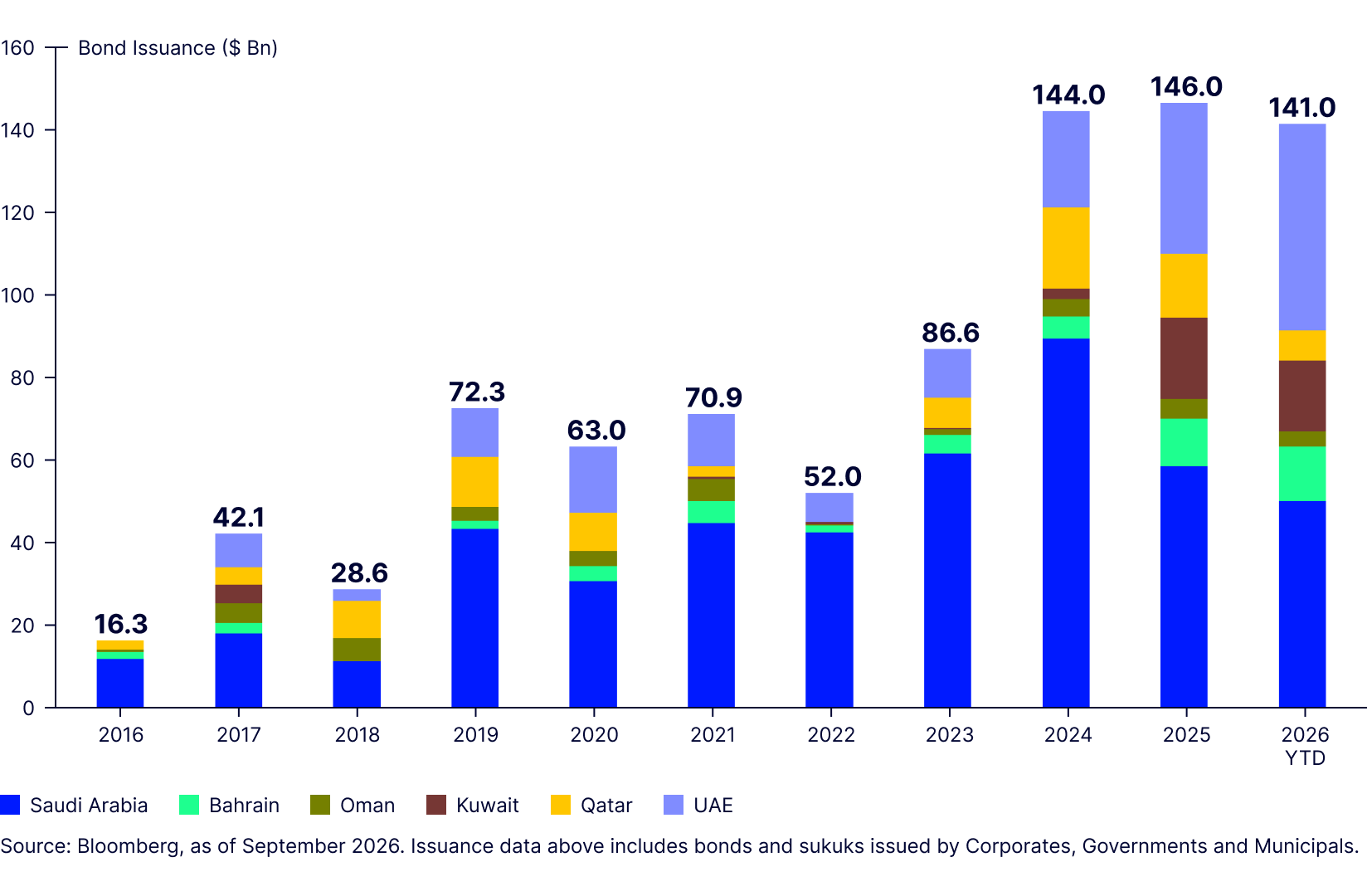
Over the past decade, the market has evolved from a heavier reliance on episodic sovereign borrowing toward a broader and more diversified debt capital market ecosystem. Primary bond issuance has risen from US$16.3 billion in 2016 to more than US$140 billion annually since 2024. The initial increase between 2016 and 2019 reflected regional governments' efforts to finance fiscal deficits following the oil price downturn, with Saudi Arabia accounting for the majority of issuance. Volumes moderated during 2020-2022 as stronger oil prices, fiscal consolidation measures, and improved government revenues reduced financing needs in some markets.
Beginning in 2023, primary market issuance entered a new phase of expansion, rising from US$86.6 billion in 2023 to a record US$144 billion in 2024, as governments, corporates, and government-related entities capitalized on strong investor demand to fund fiscal deficits, refinance existing liabilities, and support large-scale economic diversification and infrastructure programs. The record issuance volume underscored both the region's growing financing needs and the increasing depth and sophistication of GCC debt capital markets. Primary market issuance has remained elevated since 2024 and reflects increasing contributions from the UAE, Kuwait, and Qatar.
GCC bond markets experienced a brief disruption as the Iran war escalated this year, but the subsequent reopening was rapid and substantial. Despite a slowdown from the first to second quarter of this year, primary issuance reached a total of $141.0 billion for the year so far,8 strongly indicating that total primary market issuance for 2026 will exceed what we saw in 2025. The solid primary market issuance since the beginning of the conflict underscores that the shock delayed rather than derailed established funding programs. This resilience reflects strong sovereign balance sheets, pre-funded maturity profiles, deep domestic liquidity, and sustained institutional demand.
The sustained rise in GCC bond issuance underscores the region's transition from an oil-driven funding model to a more diversified capital market ecosystem. From primarily serving as a source of fiscal financing following the oil price downturn, bond markets have developed into a key funding channel for infrastructure investment, diversification initiatives, refinancing activity, and corporate expansion. As governments continue to advance long-term development agendas and capital markets mature further, GCC fixed income markets are likely to remain an increasingly important component of the region's financial landscape.
The road ahead
The GCC fixed income market has evolved into a larger, more liquid, and increasingly diversified component of the global emerging-market universe. The 2026 conflict tested that progress, triggering an initial repricing of geopolitical risk before markets increasingly differentiated across issuers according to underlying fundamentals. Strong external and fiscal buffers and predominantly investment-grade ratings and extended maturity profiles have supported resilience in markets such as the UAE, Qatar, and Saudi Arabia, while Oman’s improving fundamentals have contributed to a significant reassessment of its sovereign risk premium. Bahrain remains the principal exception, where weaker fiscal metrics and greater refinancing needs continue to command a substantial risk premium.
For investors, the opportunity is therefore increasingly about selection rather than broad regional exposure. Dollar pegs continue to transmit US rate dynamics into regional fixed income markets, while substantial sovereign and government-related issuance can influence relative pricing across curves and maturities. At the same time, longer-dated maturity profiles, substantial financial buffers, and established market access help mitigate near-term refinancing pressure for several GCC sovereigns. Continued issuance linked to diversification programs, infrastructure, and refinancing should further deepen both conventional bond and sukuk markets. Against this backdrop, the GCC can offer a combination of high-grade defensive exposure, selective carry, and lower currency risk, but future returns are likely to depend more on disciplined country, sector, and maturity positioning rather than broad-based spread compression.

Unlock the potential of Saudi Arabia's diversifying economy