
The rise in systematic credit investing
In this white paper, we provide an overview of systematic investing as it applies to active management of credit portfolios. We also outline the key elements required to build a successful systematic strategy, which include: data-driven signals, adequate risk management, and efficient implementation.
The following is an excerpt from the full white paper. Please find the full publication here.
Executive Summary
Systematic investing is based on the objective application of quantitative models informed by historical data throughout all stages of the investment process, including sector timing, security selection, portfolio construction, transaction cost optimization, and risk management. This form of investing, featuring a disciplined, diversified, and scientific approach to risk taking, has grown in popularity over the past two decades, particularly for equity portfolios.
In credit portfolio management, systematic investing has been slower to take hold. Credit portfolio managers have long taken a quantitative approach to risk, but a more qualitative fundamental approach to many other aspects of the management process. When controlling portfolio yield curve and industry exposures, managers employ quantitative risk models based on the variances and correlations of a set of risk factors. However, the selection of issuers and bonds has traditionally been based on a detailed bottom-up fundamental analysis. A positive view of a company’s fundamentals has been a prerequisite for investing in its bonds. Essentially, this approach to credit portfolio management uses quantitative models to manage beta, but relies on fundamental analysis to generate alpha.
Many factors have contributed to the slower adoption in credit portfolios relative to equity. Credit markets are more complex, less transparent, and less liquid, complicating the implementation of systematic strategies. However, recent developments have lowered these frictions, paving the way for credit portfolios to reap the benefits of systematic investing.
Introduction
The piece is organized as follows:
Section 1—Introduction
Section 2—The basics of systematic credit investing We summarize the basic building blocks that comprise a systematic portfolio management process. First, we review the theoretical advantages of this approach, in which objective quantitative models are used to inform a diversified set of active risk exposures. Next, we address the associated concepts of risk factors and security selection signals, which form the basis for developing active views.1 We discuss the measurement and control of systematic risk, as well as the monitoring of bond liquidity and steps to limit transaction costs. Optimal portfolio construction needs to continually steer the portfolio towards issuers with high systematic signal rankings and away from low-ranked companies. At the same time, portfolio risk exposures, along other dimensions, need to be carefully controlled and unnecessary turnover avoided. Finally, we discuss the execution capabilities that are essential for implementing these strategies efficiently in the real world, given liquidity conditions, the availability of credit securities and the market impact of trades.
Section 3—Systematic investing in credit is now feasible We survey the liquidity and trading environment for credit securities. We analyze the key differences between equity and credit markets that slowed the adoption of systematic investing in the latter. We then review a number of recent changes in the credit trading environment relating to liquidity and transparency that have improved the prospects of systematic credit investing. These include a number of regulatory developments, as well as rapid growth in electronic trading, credit exchange-traded funds (ETFs), and portfolio trading.
Section 4—Case study: developing a realistic systematic credit strategy We present a detailed case study of a systematic credit strategy utilizing value, momentum and sentiment signals derived from both credit and equity markets. We discuss several practical aspects of strategy implementation, including risk constraints, signal combination methodologies and transaction cost optimization. We backtest the combined strategy over the past two decades and show that its performance after transaction costs compares favorably to the reported track records of fundamental active managers. We also show that due to the low correlation between the performance of these two management styles, systematic active investing complements fundamental active strategies.
This paper is not a description of a specific systematic strategy. Rather, our goal is to highlight trends leading to broader adoption of systematic credit strategies, discuss considerations in forming these strategies and illustrate them by providing an example. We hope to draw the attention of credit investors to this investment style.
Section 5—Key takeaways
The basics of systematic credit investing
At the core of a systematic strategy lies a set of objective rules developed to optimize portfolio performance. These rules typically include two key stages. The first identifies which securities are more or less likely to perform well in the coming period, given the combined input from multiple mathematical models informed by historical data. The second finds the optimal way to tilt the portfolio towards the favored securities and away from the less-preferred ones, by taking many small active risk exposures—rather than a few large ones, and staying within the desired risk limits and controlling transaction costs. In this section, we review the key elements of this approach: strategy breadth, factors and signals, controls on risk and liquidity, portfolio optimization, and execution.
Strategy Breadth: The Key to Efficient Risk Taking
The key difference between systematic and traditional fundamental investing is the shift away from reliance on subjective analyst views. An analyst who studies a particular company in depth may develop a deep and comprehensive understanding of its business and financial condition, including the state of its management, the competitive environment in which it is operating, and its prospects. However, a human analyst may also be subject to behavioral biases, while a systematic strategy will carry out a purely impartial mathematical analysis. Furthermore, fundamental analysts typically cover just a small number of issuers and revisit their views infrequently, due to the effort required to carry out an analysis of this type. As a result, an investment program that relies on the subjective views of analysts typically takes a relatively small number of large active issuer exposures based on high-conviction calls. A systematic strategy, by contrast, is applied to every security in the investable universe, from which it produces a large number of small risk exposures, thus improving portfolio diversification and reducing risk.
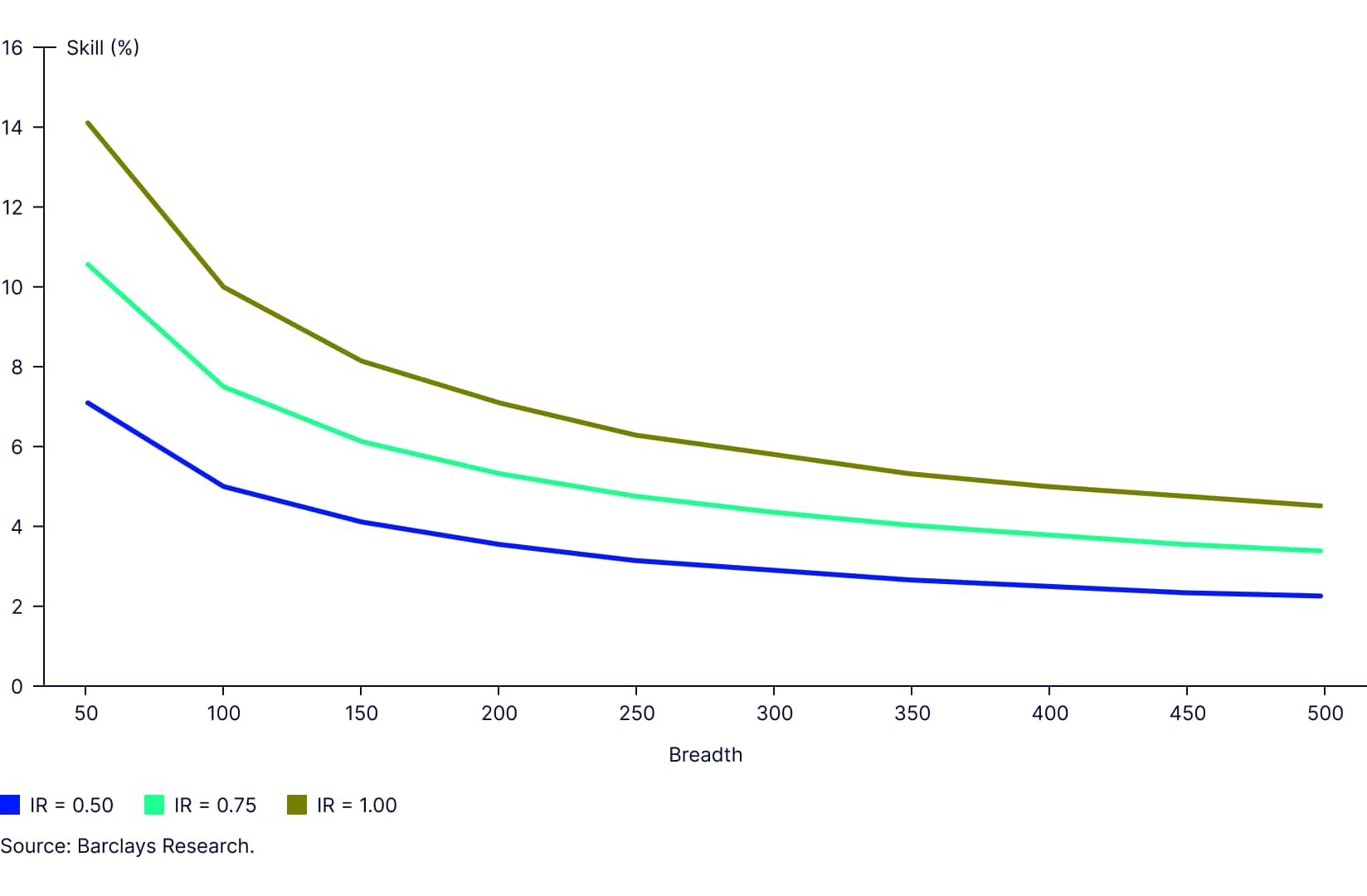
The difference between these two approaches can be quantified using the “Fundamental Law of Active Management” developed by Grinold and Kahn.2 They approximate the information ratio (IR) achievable by an active strategy (the average outperformance per unit of active risk) as a function of two key strategy attributes: breadth and skill. They define breadth (BR) as the number of independent investment decisions (or the number of independent underlying return forecasts) made by the manager each year. Skill is represented by the information coefficient (IC), defined as the correlation between the manager’s return forecasts and the subsequently realized returns (assuming that IC is the same for all forecasts). The achievable IR is then given by:
IR = IC ∙ √BR
Figure 1 shows the level of skill required to achieve a given information ratio according to this formula, as a function of strategy breadth. To achieve an information ratio of 1.0 with a breadth of 500 requires a skill level of just 4%, but to achieve the same information ratio with a breadth of only 100 would require skill of 10%. Even if a fundamental analyst may have a small advantage in the skill of each individual view, a systematic approach can overcome this edge by dramatically increasing strategy breadth.
Figure 1: Skill needed to achieve a given information ratio (IR), as a function of strategy breadth.
Learn how systematic investing presents investors with an attractive alternative to fundamental active management. In our case study, we show that the backtested risk/return performance of a systematic credit portfolio compares favorably to the historical track record of active credit managers and has low correlations with their active returns. Read the full white paper here.