
Bond caution persists as inflation relief comes into doubt
Investors enter the second half of 2026 heavily overweight equities and underweight bonds, with demand for inflation protection near five-year highs. Some third-quarter inflation relief remains possible, but renewed US-Iran hostilities and higher oil prices have made that outlook less certain.
In an echo of the first half of 2025, the first half of 2026 threw a series of macroeconomic policy and political challenges at financial markets. Once again, investor sentiment proved resilient, but underlying concerns about fixed income remain.
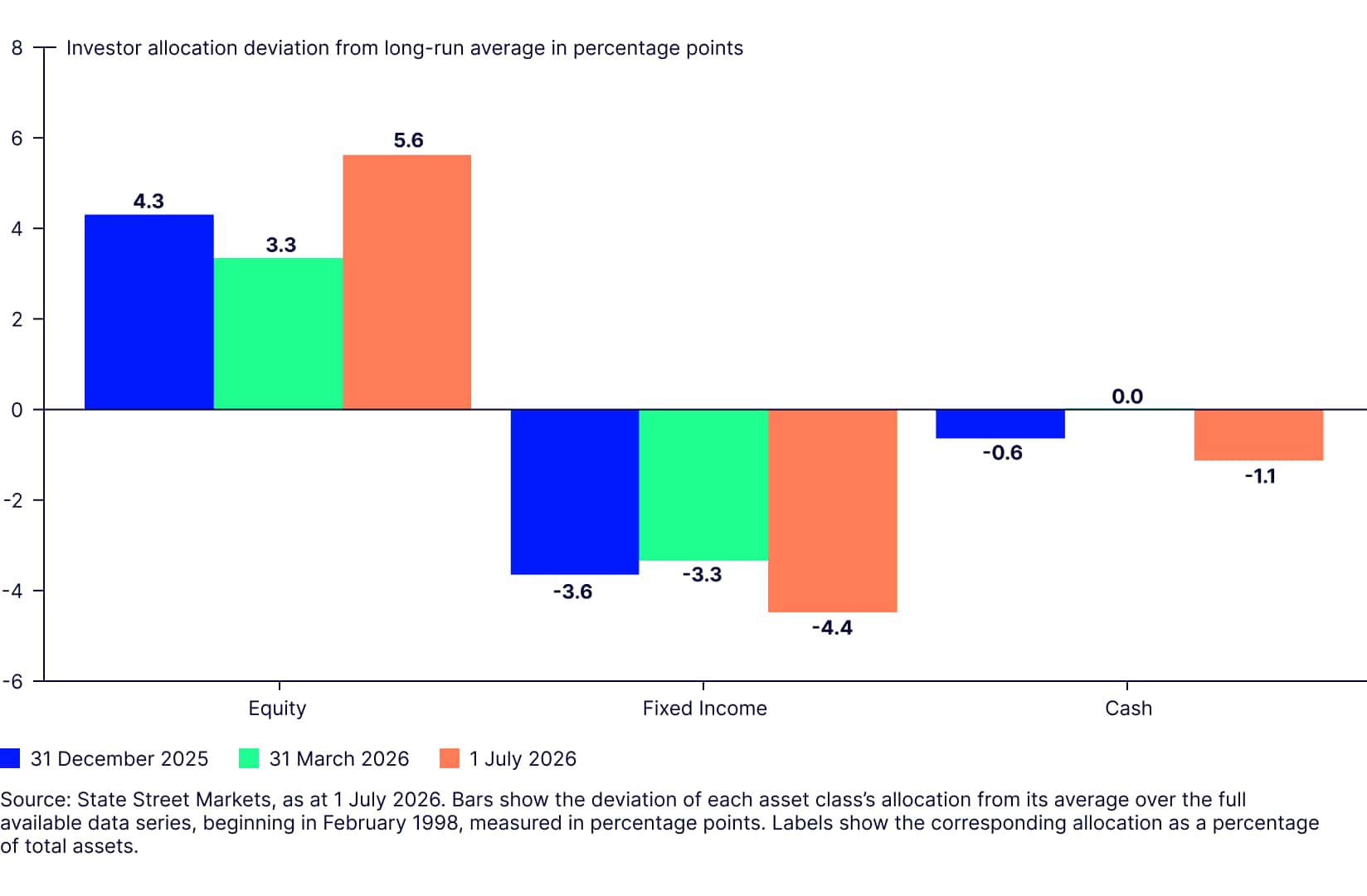
Asset managers began 2026 with a significant overweight in equities relative to bonds. Despite a brief dip in March, that equity allocation is now even further above its long-run average (Figure 1). As we explore in our recent mid-year update, such overweights to equities relative to bonds have typically only been seen close to financial bubbles, such as in the late 1990s and 2006/07. Subsequent equity returns over the following 12 months have been either very positive or very negative, but rarely average. The main takeaway is to expect volatility when investors are this optimistic about equities and this pessimistic about fixed income.
Figure 1: Asset managers’ allocations relative to long-run averages, 2026 year-to-date
In terms of investor flows, as Figure 2 shows, the sharpest positive shift in the second quarter was a surge in demand for inflation protection via US Treasury Inflation-Protected Securities (TIPS). TIPS demand was close to a five-year high. The more mixed inflation outlook raises the question of whether this elevated demand for inflation protection will persist.
Figure 2: Asset manager fixed income 60-day flow percentiles
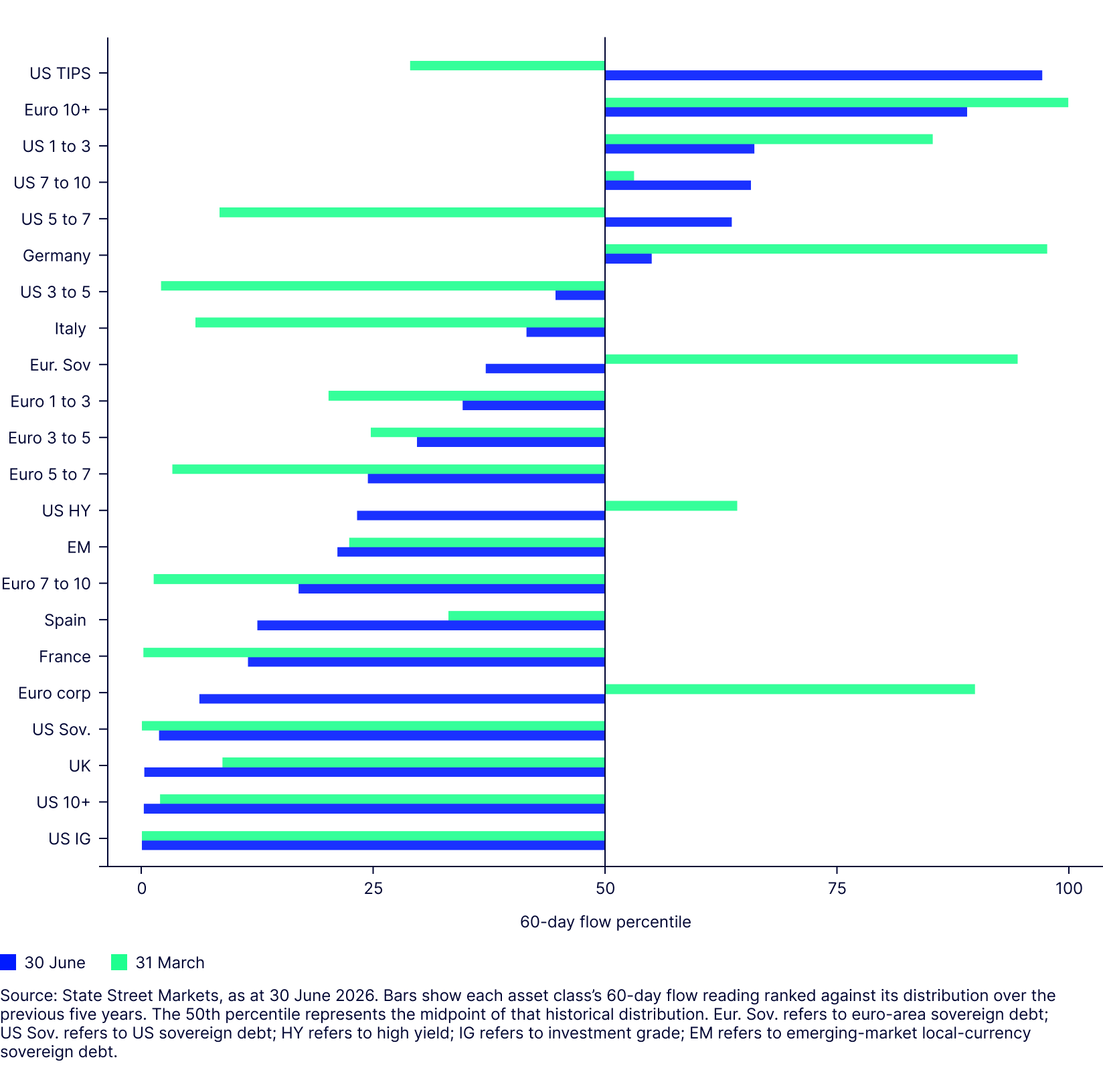
Several behavioural themes persisted through the quarter. Demand for long duration in the US remained notably weak, in contrast with robust demand for longer-dated European debt. This preference for long-dated eurozone over US equivalents perhaps reflects more favourable fiscal dynamics, or the European Central Bank’s early move to raise rates in response to energy-driven inflation pressures.
Demand for UK debt, meanwhile, was weak in the first quarter, even before the change of prime minister began to dominate headlines late in the second quarter. Investors will watch closely in the third quarter to see what this means for commitments to the UK’s fiscal rules. Further along the risk spectrum, demand for emerging-market local-currency sovereign debt also remained muted. Appetite for both US high yield and European corporate credit softened over the second quarter, with European credit posting the sharpest reversal of the quarter.
These trends suggest investors remain willing to take risk in equities, partly because the outlook on fixed income is much more cautious. This is understandable: a more stagflationary backdrop would be uncomfortable for bonds, while corporate earnings, albeit concentrated in a narrow group of technology stocks, remain strong.
Inflation outlook
After a benign set of June inflation prints, the third quarter was expected to bring some relief on the inflation front. That is now in some doubt. Oil prices have partially reversed their recent declines, meaning the sharp fall in vehicle fuel prices seen in June is likely to pause in July and could reverse in August if hostilities in Iran continue to put upward pressure on crude (Figure 3). While the peak in developed-market inflation is probably behind us, the rebound in oil prices so far in July is a reminder that disinflation cannot be taken for granted.
Beyond this, central banks and fixed income markets will refocus on the growth and fiscal outlooks. The damage done to real incomes by the spike in inflation is not yet clear in the data, and the combination of medium-term growth risks and challenging fiscal dynamics is likely to continue weighing on demand for duration.
Read our Q3 Bond ETF Market Outlook, which examines fixed income strategies for the changed environment.