
What higher treasury yields mean for sector performance
A 5% 10-year Treasury yield may capture headlines, but it is not an automatic signal to play defense with equity portfolios. While higher yields can raise borrowing costs and pressure stock valuations, they don’t affect every sector the same. History suggests there is a more nuanced story.
With the 10-year Treasury yield surpassing 5% in September following a historically rapid six-month climb,1 the yield question is back in focus. To evaluate the current landscape, we examined how sectors have historically performed when yields were elevated, and how leadership changed when yields rose sharply. Rather than yield level alone, the more relevant questions for investors and their allocation decisions likely focus on what is driving yields higher, and what is the fundamental strength of an individual sector?
Elevated yields create different sector opportunities
US equity history since 1989 has shown S&P 500® returns have been modestly lower during periods of higher Treasury yields, but the difference is small, and by no means indicates higher yields represent a universal headwind for equities. During periods when the 10-year Treasury yield exceeded 5%, the S&P 500 delivered a 5.6% average return on a forward six-month basis, with positive returns 73% of the time, compared with an average six-month forward return of 6.1% for the S&P when yields were below 5%.2
Beneath the headline, sector returns varied significantly. Health Care and Financials generated the strongest forward relative returns to the S&P 500, and with greater consistency than other sectors, while Materials and Utilities lagged.3 (Figure 1) Technology ranked third based on average forward relative return, although the range of its forward relative return was significantly wider than those of Financials and Health Care.4
Because most observations of 10-year Treasury yield above 5% occurred before 2002, we focus our fundamental analysis on this period to better understand the sector performance observed in high-yield environments. To maintain comparability across historical periods, Communication Services is excluded from this analysis because the 2018 GICS restructuring materially changed the sector’s composition, broadening it from traditional telecommunications companies to include interactive media and entertainment companies. Real Estate is also excluded due to its limited history, as it only became a standalone GICS sector in 2016.
Looking beyond yield to evaluate sector strength
Historical evidence points to two fundamental characteristics that can help sectors navigate a higher cost of capital: financial leverage and earnings growth. Lower leverage may reduce exposure to rising financing costs and give companies greater flexibility in higher financing cost environments. Consistent with this dynamic, debt-to-equity ratios for Technology (41%) and Health Care (44%), two of the sector leaders, were lower than most sectors, while Utilities (111%) and Consumer Discretionary (183%) were more leveraged.5 Financials were the notable exception with a significantly higher median debt-to-equity ratio (452%) than other sectors during that period, reflecting a business model that naturally operates with greater leverage.6
Sector earnings growth represented by the S&P 500® Sector Indices also showed a positive relationship with average subsequent six-month relative performance when 10-year Treasury yields were above 5% (Figure 2). Health Care and Financials generated the strongest relative returns, supported by earnings compound annual growth rates (CAGRs) greater than 10% during the 1990s, while Materials and Utilities experienced earnings declines.7
Sector-specific earnings drivers played a meaningful role in shaping their growth profile. In the 1990s, Health Care earnings benefited from the expansion of managed care as well as pharmaceutical and medtech innovation, while Financials earnings were supported by the recovery from the Savings and Loan Crisis in the early 1990s, followed by financial deregulation and growing capital-markets activity later in the decade.8 By contrast, Materials faced excess capacity and weaker Asian demand following the 1997 Asian Financial Crisis, weighing significantly on earnings growth, while industry restructuring and increased competition in Utilities challenged the sector’s regulated-monopoly business model and profitability.9
Figure 2: Earnings growth helped differentiate sector performance during periods of elevated yields
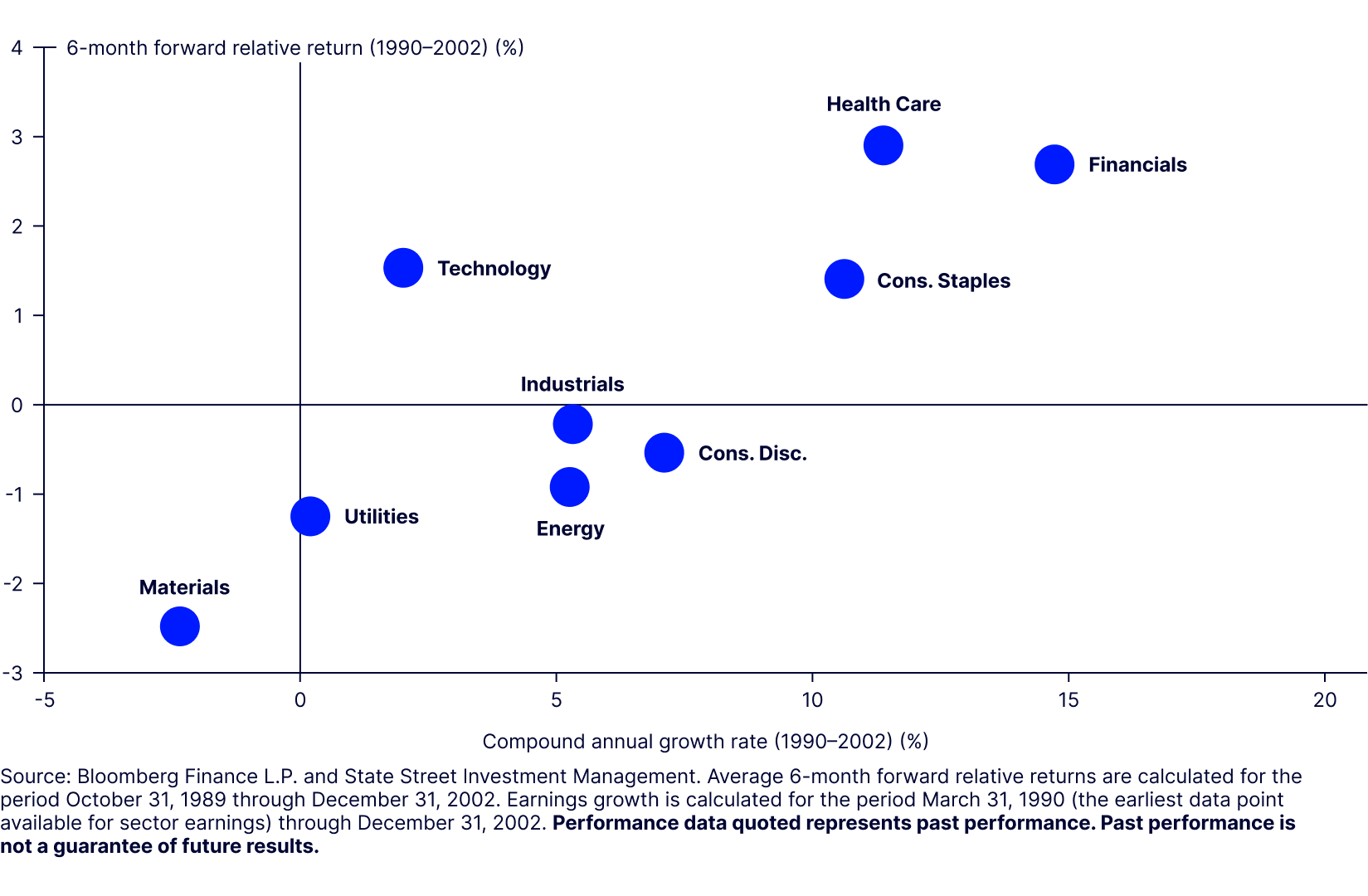
Ninety-seven percent of observations with 10-year yields above 5% occurred before 2002,10 under a significantly different macroeconomic and sector fundamental backdrop. Investors should not expect historical sector rankings to repeat in today's market. Rather, the more relevant lesson is the underlying framework: when yields are elevated, earnings strength, balance sheet resilience, and the ability to absorb higher financing costs may help differentiate sector outcomes.
Rapidly rising yields present tactical opportunities
The level of yield is only one dimension of the rate environment. The speed of the increase may also shape sector leadership, particularly during periods of unusually large rate moves.
When 10-year Treasury yields rose rapidly, defined as a six-month increase of at least one standard deviation above the historical average since 1989, the fundamentals of growth and cyclical sectors remained broadly favorable. Technology and cyclical sectors, including Energy, Materials, and Financials, outperformed, while defensive sectors lagged.11 This illustrates how rapidly rising yields can coincide with accelerating economic activity or higher inflation, an environment that can favor more economically sensitive sectors.
However, over the subsequent six months, broad cyclical leadership tended to reverse. Technology assumed leadership, while Health Care moved from a laggard during the yield increase to the second-strongest sector after the 6-month window. In contrast, Energy, Materials, and Financials shifted from outperformance during the rise in yields to underperformance in the following 6-month period.12
Technology’s resilience is noteworthy given that conventional valuation frameworks suggest higher discount rates often disproportionately weigh on long-duration growth assets. However, when rising yields have coincided with improving earnings, strong fundamentals have provided an offset. Technology outperformed during rising yield periods accompanied by improving earnings in 2016, 2018, 2023, and 2026, while periods in which higher rates coincided with weakening earnings fundamentals were more challenging. (Figure 4)
Figure 4: Stronger forward earnings have helped Tech weather rising yields
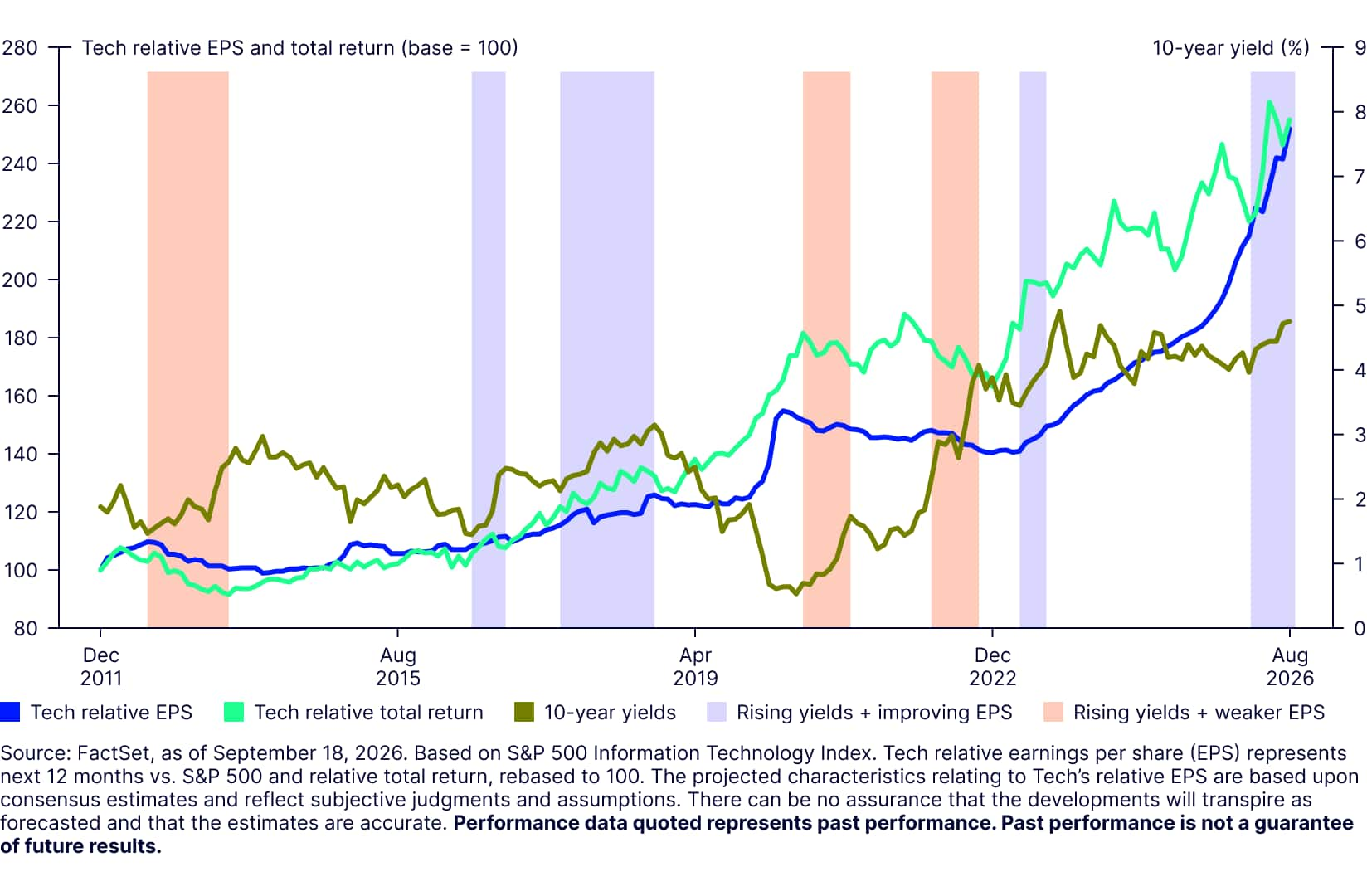
Health Care’s performance reversal may reflect a shift toward quality as cyclical momentum faded, with the sector’s lower leverage and strong cash flows becoming more attractive in a higher-yield environment, especially in relation to other defensive sectors.13
Sector performance depends on more than yields
Higher yields alone do not determine sector winners and losers. Historical evidence points to several more useful questions: Why are rates rising, and which sectors have the fundamentals to withstand the higher cost of capital?
For sector allocations, that distinction matters. When rising yields accompany resilient growth and earnings, higher discount rates alone may not justify abandoning growth-oriented exposures. Technology's historical experience illustrates why earnings strength can matter alongside valuation sensitivity. But when higher yields begin to constrain a sector’s growth outlook and erode fundamentals, balance sheet and cash flow characteristics are likely to be increasingly relevant and warrant scrutiny.
The takeaway for investors: Look beyond the direction of yields to what is driving them, and whether sector fundamentals can hold up.