
The AI value chain: Why supply may lag demand How physical constraints may shape the next phase of AI growth


As demand for AI accelerates, the key question is whether compute supply can keep pace.
Much of the market’s attention has focused on the AI CapEx cycle, particularly the development of AI models and demand for inputs such as advanced microchips. But this is only part of the story.
Behind the AI buildout is a vast value chain, stretching from electricity grids and critical materials to data centers and advanced manufacturing. It is generally taken as given that supply will follow demand. But the assumption of an elastic supply chain is a bold one; the value chain is constrained at multiple nodes and in multiple ways, particularly at the frontier of the buildout, where specialized materials, equipment, and labor dominate. It cannot scale quickly or evenly.
Scarcity may be as important as demand growth in shaping how investors think about the AI buildout. We expect compute supply to lag demand over the medium term, even under relatively conservative demand assumptions. The resulting scarcity should keep the price of compute, the essential input into the AI economy, relatively elevated in the medium term and suggests caution around expectations for the speed of AI adoption. At the macro level, this dynamic should also generate near-term inflationary pressures while laying the foundation for longer-term productivity gains as AI diffuses across industries.
Physical AI value chain
We classify the physical AI value chain into five nodes, which represent the physical assets that support AI models (Figure 1).
Figure 1: The physical AI value chain

The AI infrastructure value chain begins with the minerals and metals essential to the AI buildout. These range from widely used commodities such as copper and tin to more specialized materials such as gallium and germanium. Each is sourced, processed, and refined before being supplied to downstream industries as an input for semiconductors, electrical equipment, and other technologies that underpin the AI ecosystem.
Next comes the physical infrastructure and equipment that make data processing possible: power plants and grid networks that supply the electricity demanded by AI; specialized power management and cooling technologies that enable high-density computing; and the construction of data centers, where these systems come together.
The final stage is the equipment where data processing takes place: the chips, servers, and networking equipment that convert electricity and data into AI training and inference. Each link in the chain is essential, and constraints at any stage can influence the pace, cost, and economics of AI adoption.
The value chain faces multiple supply constraints, not a single bottleneck
Unlike previous technology cycles, which were often limited by one dominant factor, AI infrastructure faces simultaneous constraints across multiple nodes (Figure 2). The most acute pressures appear in data processing (node 5) and power generation (node 2). Moreover, the ecosystem is rapidly growing. As it expands, resolving one bottleneck often exposes another—for example, advances in processor performance have shifted attention toward the limitations of data center power and cooling infrastructure.
Figure 2: AI value chain scarcity heatmap
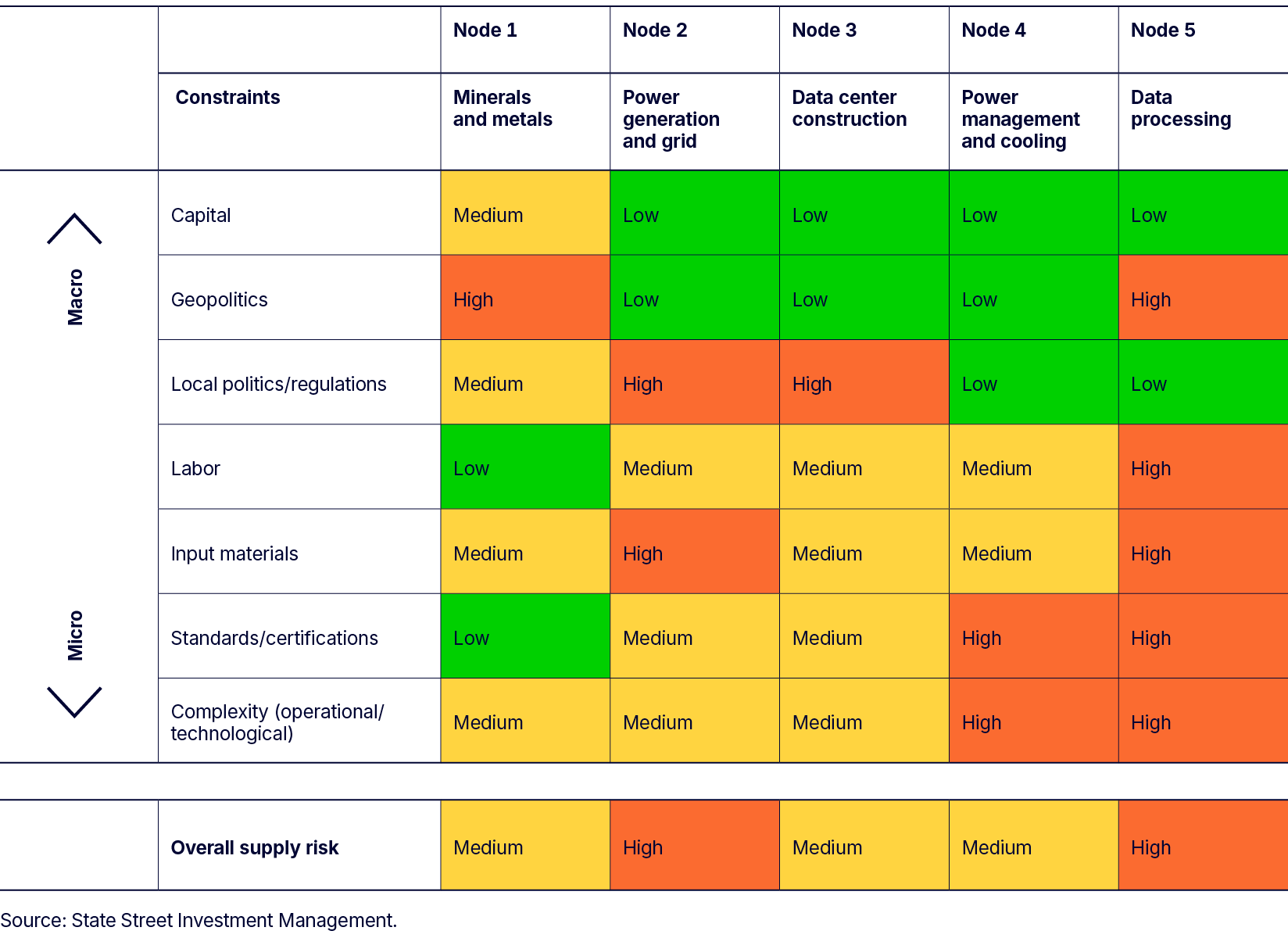
The scarcity heatmap highlights an important point: capital is not the only factor shaping the supply response. While investment has already begun responding to AI-driven demand, supply remains constrained by a range of factors that are difficult to scale, substitute, or replicate. These constraints range from geopolitics and permitting to labor availability, manufacturing complexity, and supply-chain concentration.
Geopolitics constrain supply upstream and downstream
Geopolitical risk is concentrated upstream and downstream, where the industry is exposed to global hotspots. Mining has always been shaped by geopolitical considerations, but the focus today is increasingly on China, which dominates the mining and refining of certain niche minerals in particular (Figure 3).
Downstream, advanced semiconductor manufacturing remains highly concentrated in parts of Asia, particularly Taiwan. As AI leadership becomes a central arena of US–China strategic competition, these geographic dependencies represent significant strategic vulnerabilities. The risk is not supply per se, but rather secure supply.
Politics constrain supply where AI encroaches on communities
Political and regulatory constraints are emerging as AI infrastructure encroaches on local communities. Concerns range from water consumption, air quality, and pressure on electricity prices to the physical impact of new infrastructure and data centers on the local landscape. These tensions can be amplified by broader concerns about AI's impact on jobs and society. Reflecting this pushback, New York became the first US state to impose a moratorium on data center construction.1 More broadly, permitting and local opposition are making data center development more complex, contributing to multi-year lows in North American data center vacancy rates (Figure 4).
Complexity constrains supply downstream
As the AI supply chain moves downstream, the binding constraints become less about adding capacity and more about scaling specialized capabilities.
Skilled labor, advanced materials, certification requirements, and technical complexity all become harder to replicate at speed. Manufacturers cannot simply produce more units; they must also expand engineering expertise, secure customer approvals, provide field support, and integrate across complex technology ecosystems. In many cases, these capabilities prove more difficult to scale than physical production capacity itself.
One manifestation of this growing complexity is the rapid increase in the power requirements of leading-edge AI chips (Figure 5). As thermal design power (TDP) rises, supporting infrastructure must evolve alongside compute, creating new challenges for power delivery, cooling, and system integration.
Downstream, the supply chain is inherently fragile
As technological complexity increases, critical capabilities tend to become concentrated in a small number of highly specialized suppliers. This growing dependence on a handful of key nodes creates vulnerabilities that can reverberate across the entire value chain in the event of a disruption, manmade or natural.
Supply chain scarcity is creating innovation spillovers
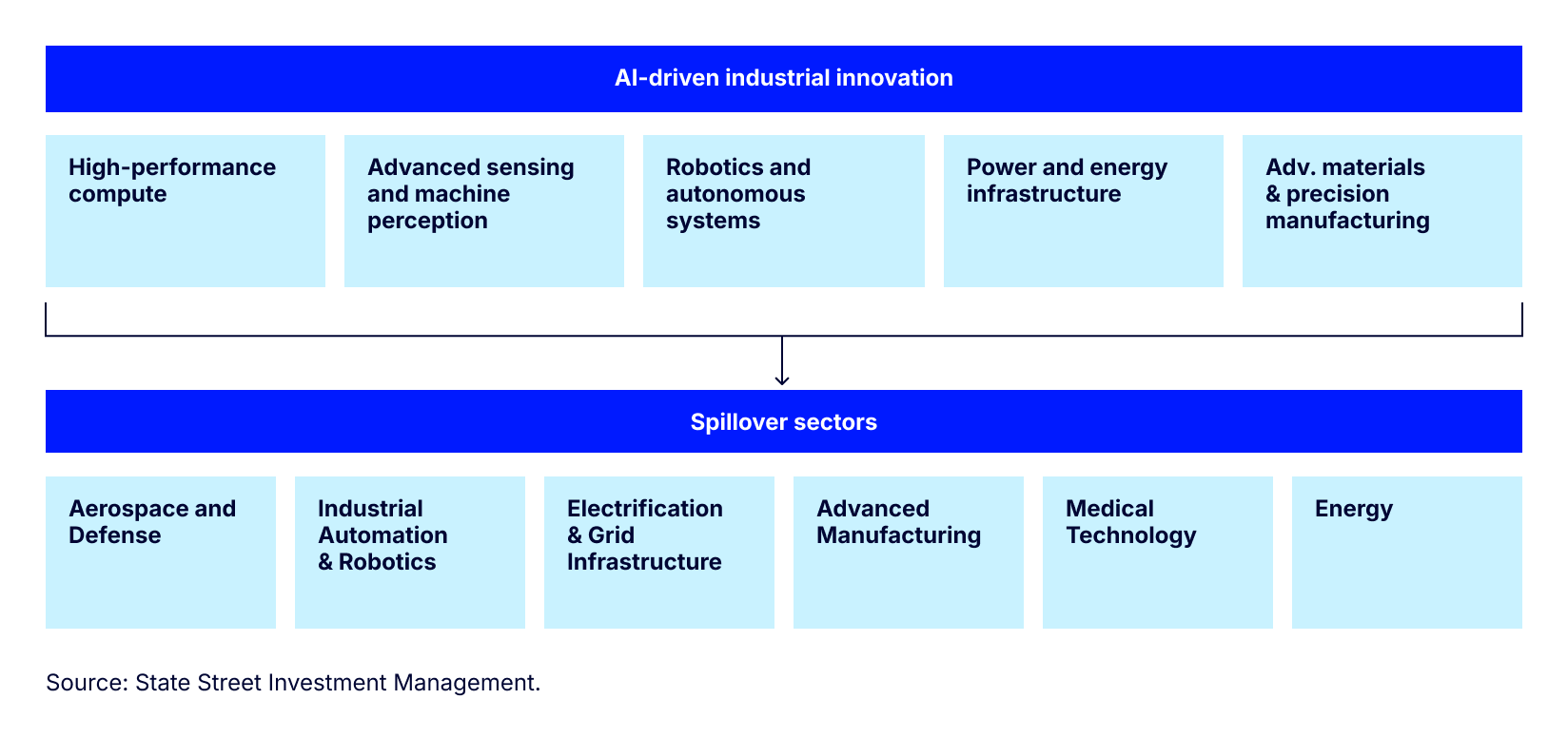
Bottlenecks across the value chain also catalyze innovation (Figure 6). At the macro level, much of the attention around AI innovation focuses on the adoption of AI tools themselves. But innovation is also occurring on the supply side. R&D across the nodes is leading to advances in compute power, sensors, robotics, power systems, and precision manufacturing. As these innovations diffuse into other sectors, they improve productivity and create growth opportunities across the broader economy. In this sense, AI is not only a tech story, it’s also a broader industrial transformation story.
Figure 6: Bottlenecks as driver of economic activity

Investment implications
The central investment question is whether AI infrastructure can scale fast enough to meet demand. We highlight five implications for investors.
1. Infrastructure capacity may remain scarce
Current supply conditions do not yet resemble a classic infrastructure overbuild. The AI infrastructure cycle differs from the late-1990s fiber-optic buildout, when capital investment ultimately ran ahead of realized demand. In AI, physical supply remains constrained across multiple parts of the value chain, suggesting that infrastructure capacity is not obviously running ahead of demand.
This does not eliminate concerns about valuations, business models, or the monetization of AI use cases. But it suggests that the strongest “bubble” argument may lie outside the physical infrastructure buildout itself.
2. Demand may outpace compute capacity growth
We expect growth in compute power to be dictated by physical supply constraints. Demand for data center capacity is expected to grow at a compound annual growth rate of roughly 20% over the next five years (Figure 7). But actual capacity growth is also a function of supply. Rolling bottlenecks—from power access and grid equipment to cooling systems, memory, advanced packaging, and critical materials—and supply chain fragility suggest that irreplaceable inputs could constrain the pace of compute expansion.
Demand growth and workload composition remain uncertain, and both could either ease or exacerbate supply pressure. Even so, we believe the supply shortfall is likely to remain a multi-year phenomenon.
As a result, compute costs may fall more slowly than anticipated, potentially delaying AI adoption and challenging assumptions embedded in some AI-related cash flow forecasts. Value-based pricing models that align compute intensity with economic value may offset some of this pressure, but they do not eliminate the underlying supply constraints.
3. AI buildout may add near-term inflation pressure
We expect near-term pressures from the AI CapEx cycle to be inflationary. Until AI tools deliver broader productivity gains, supply-side pressure on prices will predominate within the AI value chain. For example, prices for consumer electronics are rising because of the AI buildout (Figure 8). In turn, this should keep pressure on interest rates, impacting the cost of capital that fuels the supply buildout. This reflexive dynamic does not appear to be ending over a medium-term horizon.
4. Innovation spillovers may support productivity growth
The widespread adoption of AI, combined with innovation in the AI infrastructure supply chain, is accelerating innovation in key industrial technologies (Figure 9). As these advances diffuse through the economy, they have the potential to raise productivity and lower costs, as well as support stronger, less inflationary growth.
From a sector perspective, there is a notable clustering of second-order beneficiaries. Some sectors are better positioned than others to capture the benefits of innovation without having spent the R&D funding themselves (Figure 9).
Figure 9: Sectors benefitting from innovation spillovers
5. Scale and vertical integration become strategic assets
Access to scarce inputs may become a strategic advantage. In a constrained ecosystem, scale, vertical integration, and supply-chain security can matter as much as technological capability. Firms that secure critical materials, manufacturing capacity, infrastructure, and long-term supply agreements may be better positioned to scale and capitalize on AI-related demand.
Infrastructure may matter as much as innovation
These dynamics point to a broader conclusion: the next phase of AI growth may depend as much on the infrastructure that supports compute as on advances in AI models themselves.
While innovation continues to drive demand higher, the pace of adoption also will be shaped by the ability of power systems, manufacturing networks, supply chains, and critical inputs to scale.
In that sense, the AI story is about more than technological progress—it’s also about the infrastructure and constraints that determine how quickly that progress can be delivered.