
Sector Market Perspectives: Q4 2026
The macro narrative has become more challenging since our previous quarterly update, with higher energy prices, rising bond yields, elevated geopolitical risks, and renewed uncertainty around the Federal Reserve’s (Fed) next moves. Yet despite these headwinds, the US economy has continued to demonstrate resilience, with underlying growth and earnings fundamentals remaining intact even as higher Treasury yields have weighed on equity valuations.
US Sector Strategy & Research team
We expect the US economy to remain resilient over the next 6- to 12-month time horizon, despite uneven consumer spending across high- and middle/low- income households. Growth continues to be supported by healthy corporate balance sheets, robust business investment, and a manufacturing sector that remains in expansion mode. The economy is also benefiting from a powerful investment cycle driven by AI infrastructure spending, fiscal incentives supporting capital formation, and defense-related investment—sources of demand that appear less sensitive to modest increases in interest rates.
Resilience is also evident in corporate profits. Following a strong Q2 earnings season that lifted 2026 S&P 500® earnings growth expectations to 32%, the index is projected to deliver a fourth consecutive year of double-digit earnings growth in 2027, supported by positive earnings revisions across most sectors.1 Technology earnings continue to lead, but the benefits of the AI investment cycle are increasingly extending beyond Tech. Sectors such as Industrials that are providing the physical infrastructure to support AI adoption including power, data center construction, industrial, and infrastructure-related businesses, continue to experience strengthening demand.
At the same time, higher interest rates have added pressure, with rising capital intensity and a higher cost of capital contributing to a valuation reset across many AI infrastructure players—despite underlying fundamentals continuing to improve. We see little evidence that demand for AI infrastructure is nearing a peak, as lower model costs and improving capabilities continue to enhance the economics of AI adoption. Meanwhile, supply constraints are increasingly concentrated in power availability, data center capacity, and supporting infrastructure, strengthening the pricing power of companies enabling the AI buildout. This combination of resilient earnings, durable demand, and more reasonable valuations continues to support a constructive outlook for key beneficiaries of the AI ecosystem.
Geopolitical uncertainty and the risk of prolonged energy supply disruptions remain important sources of near-term volatility and may keep energy prices elevated. However, further price increases may be difficult to sustain as higher prices could weaken demand, while a lasting resolution to the US-Iran conflict could reverse much of the recent increase. Therefore, we believe the resulting impact is more likely to influence near-term inflation and market volatility rather than materially altering the medium-term earnings outlook supporting our sector views.
Our overall sector positioning remains largely unchanged, reflecting our conviction that the fundamental drivers supporting our views remain intact. One exception is Materials, which we are downgrading to Neutral as its weaker earnings sentiment, reduced upside potential for precious metals in a higher-rate environment, and easing concerns around US dollar debasement create a more balanced risk-reward profile.
Figure 1: Summary of sector market perspectives
| Sector | View | Change | Rationale |
| Technology | Positive | — | Despite risks from higher yields and rising capital intensity, we remain positive as durable AI demand, accelerating adoption and monetization, broad-based earnings upgrades, and more attractive valuations support the sector’s continued leadership . |
| Communication Services | Neutral | — | We are remaining neutral as digital advertising and AI monetization continue to support interactive media, though elevated AI investment spending, weaker earnings sentiment, and structural challenges across Telecom and Media create a more balanced risk-reward profile. |
| Financials | Positive | — | We remain positive as robust loan growth, stronger capital markets activity, and regulatory tailwinds remain intact, supported by our view that the market is overpricing future rate hikes and the recent yield curve flattening is unlikely to halt the credit cycle. |
| Real Estate | Neutral | — | We remain neutral as improving fundamentals across several subsectors are balanced by headwinds from higher interest rates. |
| Consumer Discretionary | Negative | — | We remain negative as stretched and uneven consumer spending, elevated inflation, and mounting affordability pressures from higher rates weigh on the sector's growth outlook. |
| Consumer Staples | Negative | — | We remain negative amid consumer pressure, weak volumes, and limited catalysts across key subsectors, while valuations remain insufficiently attractive to offset these headwinds. |
| Industrials | Positive | — | We remain positive as AI‑driven investment, broadening manufacturing recovery, and increasing defense spending continue to support durable and increasingly broad-based growth. |
| Materials | Neutral | ↓ | We are downgrading the sector from positive to neutral as weaker earnings sentiment, reduced upside potential for precious metals in a higher-rate environment, and easing concerns around US dollar debasement create a more balanced risk-reward profile. |
| Energy | Neutral | — | We remain neutral as geopolitical uncertainty and energy supply disruption risks keep oil prices elevated in the near term, but any durable resolution to the US Iran conflict could reverse recent gains, creating a more balanced risk-reward profile for the longer term. |
| Utilities | Neutral | — | We remain neutral as affordability, political, and rate pressures persist, but more attractive valuations and less crowded investor positioning may limit further downside, with political noise potentially easing after the midterms. |
| Health Care | Positive | — | We remain positive as fundamental improvements continue to broaden, driven by strong biopharma innovation, a more tangible Life Sciences Tools & Services recovery, and improving managed care trends. |
Source: State Street Investment Management, as of September 28, 2026. Green shading indicates positive views. Orange shading indicates negative views.
Our highest-conviction sector views this quarter include Technology, Industrials and Health Care. Technology continues to benefit from a durable AI investment cycle. Industrials remain positive and tied to rising capital expenditures, expanding manufacturing activity, defense spending, and the AI-related infrastructure buildout. Health Care complements these cyclical opportunities through innovation-driven growth and defensive characteristics in an uncertain macro environment.
Technology: AI adoption and earnings momentum remain powerful tailwinds
Quarterly perspective: Despite risks from higher interest rates and rising capital costs, we remain positive on Technology as durable AI demand, accelerating adoption and monetization, broad-based earnings upgrades, and more attractive valuations support the sector’s continued leadership.
While investors continue to debate the sustainability of AI capex growth, we believe growing evidence of demand and monetization continues to support a constructive outlook for the sector. US enterprise AI adoption has continued to climb,2 while large language model usage has expanded rapidly as token prices and costs per task have declined.3 Lower-cost, open-weight models are likely to further accelerate adoption by offering more cost-efficient options for a broad range of tasks, improving customization, and lowering barriers to entry for enterprises. As AI becomes more affordable and accessible, we expect usage and compute demand to expand across industries, benefiting cloud providers, semiconductor companies, data infrastructure providers, and cybersecurity firms that enable organizations to deploy and manage AI applications at scale.
The key debate among investors is whether monetization can keep pace with unprecedented capital investment, but encouraging signs of AI monetization appear to support the level of capital investment. Hyperscalers’ cloud computing revenue growth is expected to accelerate to 45% in 2027, while contracted demand is projected to increase to $2.9 trillion.4 This demand backdrop supports another year of substantial investment from hyperscalers whose capital expenditures are expected to rise 37% to reach ~$1.1 trillion in 2027.5 While investors have expressed concern over increasing debt issuance and off-balance-sheet financing commitments, we view these funding decisions as prudent given strong balance sheets and expanding AI-related revenue opportunities.
Tech’s continued earnings strength reflects strong growth momentum. The sector is expected to lead S&P 500 earnings growth next year, accounting for 81% of total earnings growth,6 while earnings expectations continue to move higher. Consensus estimates for 2027 Technology earnings growth have increased from 27% in June to 40% as of mid-September, leading upside revisions to growth across sectors.7 And growth remains broad-based across the sector, with all underlying industries except IT Services expected to outpace the S&P 500 next year.8 While semiconductor earnings growth is projected to moderate from this year's near-100% pace, its expected 62% growth rate in 2027 would still rank among the strongest across all S&P 500 industries.9 Software earnings expectations also have continued to improve as certain segments of software providers demonstrate their increasing capability to monetize AI demand.10
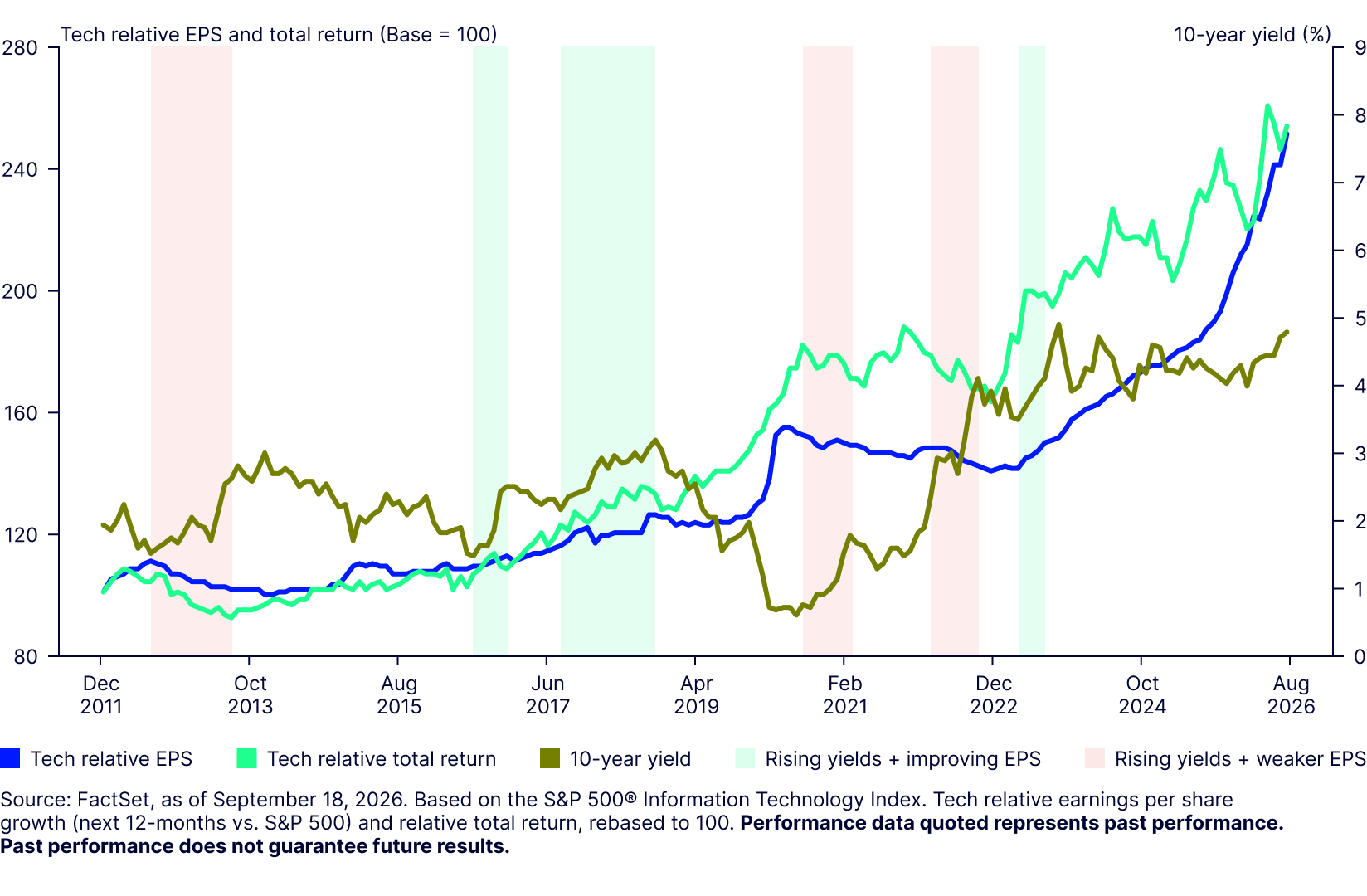
Rising interest rates and higher long-term bond yields remain a common source of investor concern given Technology's growth-oriented profile. However, historical evidence suggests that higher yields alone have not necessarily undermined the sector's performance. While higher yields can pressure valuation multiples, earnings growth may be sufficient to offset valuation headwinds.
Environments characterized by rising yields alongside an improving growth and earnings outlook, such as the periods 2016, 2018, and 2023 (Figure 2), have led to Tech sector outperformance. In contrast, periods when higher rates coincided with weakening earnings fundamentals, such as 2012-2013, 2020-2021, and 2022, proved more challenging.11 Given continued earnings upgrades and strong AI demand visibility, we believe the current environment more closely resembles the former than the latter, with the sector’s forward P/E falling 20% this year to its lowest level since 2022, while strong earnings growth has helped drive returns above 20%.12
Figure 2: Stronger earnings have historically helped Tech weather rising 10-year yields
Overall, we believe the positive view on Technology remains intact with earnings and demand visibility outweighing the risks associated with rising capital intensity and higher yields. Durable AI demand, accelerating adoption, expanding monetization, and strengthening earnings momentum should continue to support the sector's leadership position.
Industrials: Capital investment and infrastructure spending support growth
Quarterly perspective: We remain positive on Industrials as AI-driven infrastructure investment, a broadening manufacturing recovery, and increasing defense spending continue to support a broad-based industrial expansion.
Industrial growth is becoming increasingly broad-based. Manufacturing activity has remained in expansion territory through the summer, supported by strength in production, new orders, and employment.13 Strong order backlogs—particularly within capital goods—continue to point to healthy underlying demand driven by business investment.14
While higher rates could introduce uncertainty in business investment, history suggests that Industrials often remain resilient following rate hikes. Notably, ISM Manufacturing PMI has generally stayed in expansion territory, though moderated, after the Fed tightening,15 while the sector has outperformed the broader market on average over the 12 months following increasing expectations of Fed tightening.16 Rising rates may be less of a headwind for sector performance when accompanied by stronger growth, business investment, and capital spending—as appears to be the case today.
The durability of AI buildout remains an important sector tailwind. Hyperscalers' CapEx plans continue to trend higher, with 2027 projections reaching $1.1 trillion—up 19% since June.17 Although permitting concerns in certain states may delay or redirect some data center projects to geographies with more local policy support, robust compute demand continues to drive the need for new capacity. Lengthy grid connection timelines also are accelerating a shift toward off-grid and on-site power generation, enabling faster deployment and supporting the AI infrastructure opportunity across microgrid power generation and transmission, cooling systems, and construction services.
The earnings outlook is also broadening beyond AI-related beneficiaries. Ten of 12 underlying industries within the Industrials sector are expected to deliver double-digit earnings growth in 2027, with estimates revised higher across most industries since June.18 Aerospace and defense remain a key area of strength. For example, in commercial aerospace, strong order backlogs provide demand visibility, while the combination of aging fleets, persistent replacement demand, and long aircraft lead times reduce cancellation risk—even as oil prices remain elevated. In defense, heightened geopolitical tensions, rising allied budgets, inventory replenishment, and investment in next-generation capabilities support a durable order and earnings cycle.
Industrials valuations remain elevated, but we continue to view them as justifiable within the context of a still-maturing industrial expansion. We believe the manufacturing expansion still has room to run, as the current upcycle remains less mature than many historical expansion phases and continued earnings upgrades reinforce improving demand and restocking trends. Even if valuation expansion becomes more limited, above-market sector earnings growth and improving breadth may continue to support relative performance into 2027.
Health Care: Improving fundamentals complement defensive characteristics
Quarterly perspective: We maintain our positive view on Health Care, with conviction strengthening as improving fundamentals broaden across the sector. Strong biopharma innovation, a more tangible recovery in Life Sciences Tools & Services, and early signs of improvement in Managed Care are creating a favorable setup.
Health Care outperformed the broader market over the past three months,19 led by Biopharma and Life Sciences Tools & Services. Q2 2026 earnings exceeded expectations by 18.1%, representing the largest upside surprise across the 11 sectors after adjusting for equity investment gains by major Tech players.20 Positive clinical developments and improving end-market demand further strengthened investor confidence.
Biopharma remains a key source of strength. Second-quarter results showed broad operational momentum, with large-cap biopharma companies generally delivering strong earnings and revenue performance, with several companies elevating their outlook.21 Innovation is also creating new growth opportunities, particularly in oncology, where positive Phase 3 data for Moderna and Merck’s personalized mRNA cancer therapy strengthened confidence in the potential of individualized cancer therapies. M&A remains another catalyst as large biopharma companies seek external innovation to replenish pipelines ahead of looming patent cliffs. Encouragingly, investors have generally rewarded acquisitions year to date that strengthen long-term growth prospects, rather than automatically penalizing buyers.22
Recovery signals are also emerging in Life Sciences Tools & Services and Managed Care. In Life Sciences, improving biotechnology funding is beginning to translate into stronger customer activity. Demand from large pharmaceutical companies has largely normalized and smaller biotechnology customers are gradually returning. Demand in China is also showing early signs of recovery, particularly for pharmaceutical and food-safety testing.23 In Managed Care, better-than-expected Medicare Advantage medical loss ratios and favorable Medicaid rate updates point to early stabilization.24 More broadly, insurers’ pricing actions provide scope for further margin improvement as elevated medical cost trends gradually moderate.25
Beyond these improving fundamentals, the policy backdrop also could become modestly more supportive. Under our base case of a divided Congress following the midterm elections, the risk of significant Medicaid and NIH funding cuts may decline. Drug pricing headlines may persist, but Republican opposition to government price controls makes codification of most-favored-nation pricing less likely.
The sector also has historically performed well following sharp increases in long-term yields. Since 1990, Health Care has returned an average of 8.5% over the next six months and 18% over the next 12 months following the largest increases in the 10-year Treasury yield—second only to Information Technology.26
Looking ahead, while the U.S. economy remains resilient, bouts of volatility may emerge as markets reassess valuations of AI-related exposure, the outlook for Fed policy, and geopolitical risks. Health Care’s defensive characteristics supported by the relative inelasticity of demand may help mitigate portfolio volatility, while increasingly visible structural growth opportunities provide upside potential.
Overall, we believe Health Care’s improving fundamentals increasingly complement its traditional defensive attributes. While valuations have risen and the recovery remains uneven across industries, broader earnings strength and accelerating innovation support our positive view. In a market increasingly focused on AI valuations, rates, and geopolitical risks, Health Care offers a compelling combination of resilience and growth.