
The cognitive tug of war

A client can be deeply experienced, financially sophisticated, and entirely capable—and still find an unfamiliar decision more challenging than it once was. Two cognitive strengths help explain why.
Fluid intelligence—the ability to process new information, and solve novel problems—generally becomes more challenging with age. Crystallized intelligence—the knowledge, pattern recognition, and judgment built through experience—tends to remain stronger for longer.1 For advisors, the implication is not to make advice less sophisticated. It is to make sophisticated advice easier to use. Understanding the cognitive factors at work helps advisors and clients discuss decision-making challenges objectively, rather than viewing them as a personal shortcoming.
Two strengths, moving differently
Research on financial decision-making across the life cycle suggests that accumulated experience can offset some age-related declines in fluid processing. In one widely cited study examining ten types of credit transactions, researchers compared outcomes such as interest rates paid and certain avoidable fees and found that these costs were lowest, on average, among people in their early 50s.2 It’s a broad population trend, but not a prediction about any one person based on age alone.
Figure 1: Fluid intelligence declines over time; crystallized intelligence remains stronger for longer
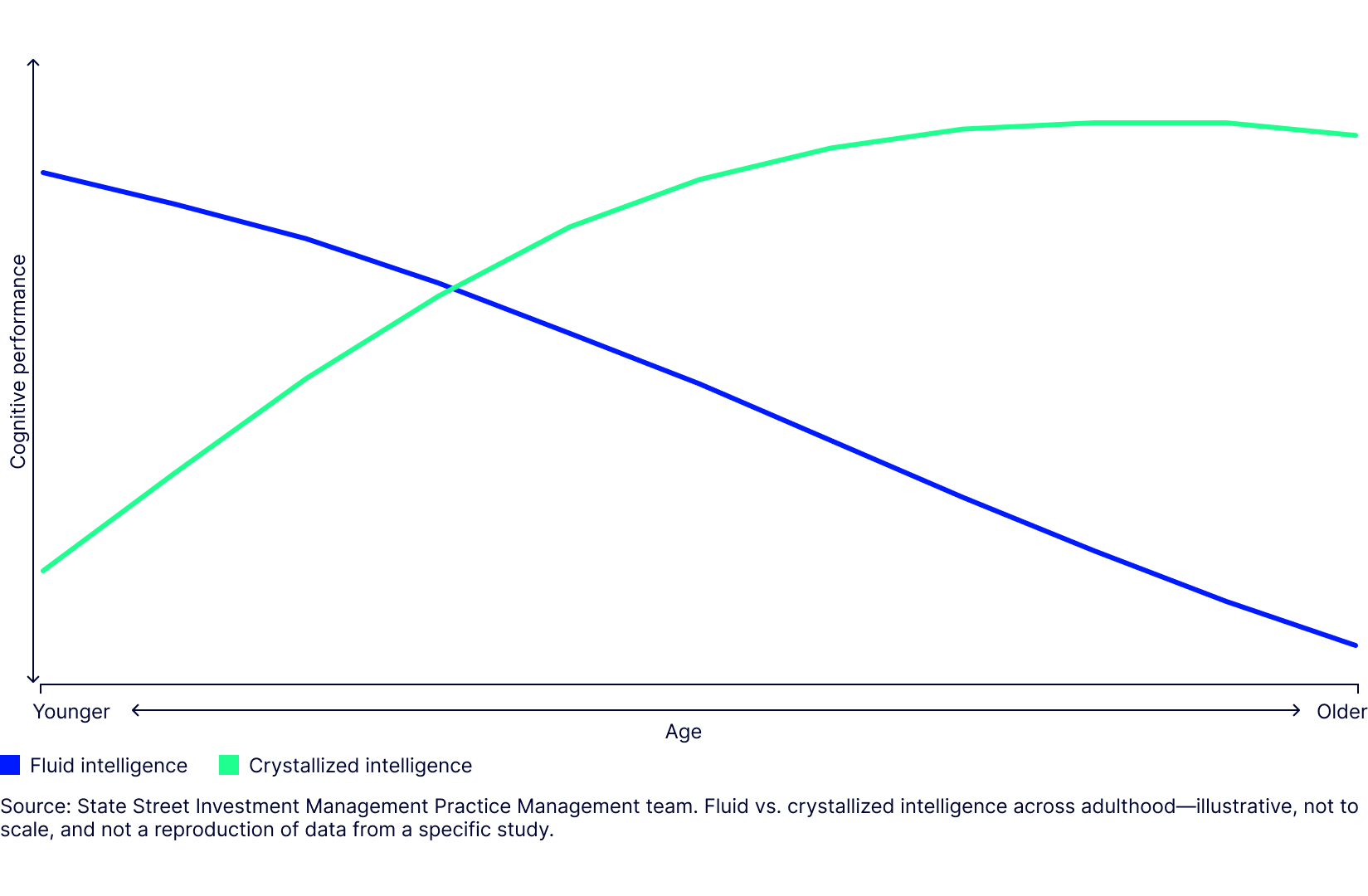
That distinction matters in practice. A client may bring tremendous judgment to a familiar financial question and still need more structure around something novel, complex or emotionally loaded. The point is not to identify a cognitive ‘peak.’ It is to understand which strengths a decision is asking the client to use.
What changing cognitive strengths can look like in the client relationship
The science becomes useful when it puts language around behavior advisors may already recognize without turning normal variation into a diagnosis. Research also suggests that people experiencing a meaningful shift in their own decision-making may not always be the first to recognize it.3
Experience becomes the shortcut
A client says, “I've always kept several years of expenses in cash. It got me through 2008.” That rule may have been sensible in the circumstances that created it. But experience-based shortcuts can persist after the environment, goals, or trade-offs have changed.
The goal is not to challenge the rule because it may be outdated, but to start with what made it useful, then test whether it still serves the client's life today.
Complexity becomes friction
A recently widowed client is suddenly responsible for decisions a spouse or partner once handled. More charts, choices, and product features may look like better education. For the client, they may simply make an unfamiliar decision harder to navigate.
The issue may not be sophistication. It may be cognitive load. Reducing avoidable complexity can make it easier to engage with an unfamiliar decision without reducing the rigor behind the recommendation.
Protection can become overprotection
A financially secure retiree has more than enough to support the life she planned for, yet finds it increasingly difficult to spend. The underlying instinct is understandable: losses later in life can feel harder to replace.4 But a sensible preference for protection can become disconnected from the client's actual capacity, goals, and time horizon.
The goal is not to persuade someone out of caution. Reconnect the decision to the plan: What are we protecting the money for? What does the math support? What would a good use of these resources look like now?
Design the decision, not the answer
Behavioral finance is most useful here not to steer older clients toward a predetermined choice, but to shape a decision environment that respects accumulated judgment and reduces avoidable friction.
Reduce the load, not the sophistication
Keep the analytical rigor. Be more selective about what must enter the client conversation. A sophisticated Monte Carlo model may remain central to the planning process without requiring every variable to carry equal weight when the client needs to make a decision.
In practice: lead with the decision, the trade-off, and the implication for the client's goals. Make additional detail available rather than making it the price of entry.
Use experience as an asset, not an obstacle
Crystallized intelligence is an asset. Connect unfamiliar choices to decisions, values, and patterns the client already understands. Explore what has guided similar decisions in the past, what has changed, and which principles still apply.
A question that can help: “You've navigated periods of uncertainty before. What mattered most to you then—and what is different about the decision in front of us now?”
Build the architecture before the moment
Trusted contacts, family communication, decision protocols, and other safeguards are most empowering when clients choose them proactively. This is not about predicting decline, but about making the financial system easier to navigate if illness, grief, caregiving, fraud, unfamiliar responsibilities, or normal cognitive change makes decision-making harder at some point.
Build it into the planning rhythm: “If a financial decision suddenly felt harder than it does today, what would you want us—and the people you trust—to already know?”
Advice that adapts with the client
The opportunity is not to make financial decisions less sophisticated as clients age. It is to make sophisticated advice easier to use.
That may mean simplifying the information rather than the analysis, drawing on experience rather than introducing more choices, or putting structure around a decision before circumstances make it harder.
The financial plan changes as a client's life changes. How advice is delivered should be able to adapt, too.
Decision-making resilience takes that idea into the practice itself, with six ways advisory teams can build the conversations, roles and safeguards into the client experience.