
The total cost of ownership
Investors need to look beyond an ETF's expense ratio to gauge a fund's true total cost of ownership. Focusing on the headline fee alone can prove costly over time. Because ETFs trade like stocks on an exchange, trading costs also form part of the total cost of owning an ETF — and these costs can vary significantly.
In today's environment, it's no surprise that costs are top of mind. Many investors zero in on a fund's expense ratio to decide whether it is "low cost." But when selecting an Exchange Traded Fund (ETF), it pays to look beyond that single number to assess the fund's total cost of ownership. Overlooking the fuller picture can erode a portfolio's total return over the long run.
An expense ratio doesn’t capture the full cost of an ETF
The expense ratio reflects only what it costs to hold an ETF — one important component of the total cost of ownership, but not the whole story. It represents the portion of your investment charged annually for management and fund operating costs. All else being equal, a lower expense ratio is a positive for investors.
Because ETFs trade like stocks on exchanges, a range of trading costs also contribute to the total cost of ownership. These can fluctuate meaningfully, driven by factors from a fund's trading volume to prevailing market volatility.
- Bid/ask spreads: This is the difference between the price a buyer is willing to pay for shares and the price at which a seller will sell. It is driven by several factors including the ETF’s trading volume and the liquidity profile of the underlying securities. For example, as an ETF’s size and trading volume increases, so does its profile in the market, attracting a broader range of investors, traders and liquidity providers. The increased competition leads to tighter bid/ask spreads, making trading more cost-effective.
- Commissions: Trading commissions have declined over time due to competitive forces. Some wealth management platforms now offer certain ETFs to trade for free. Even so, commissions shouldn't drive the decision on their own — a high expense ratio or a wide bid/ask spread can easily outweigh any commission savings.
Figure 1: The total cost of ETF ownership

Time horizon matters
Before selecting a fund, consider how you intend to use it. The ETF that best suits your needs often depends on whether you plan to hold it for the short or long term.
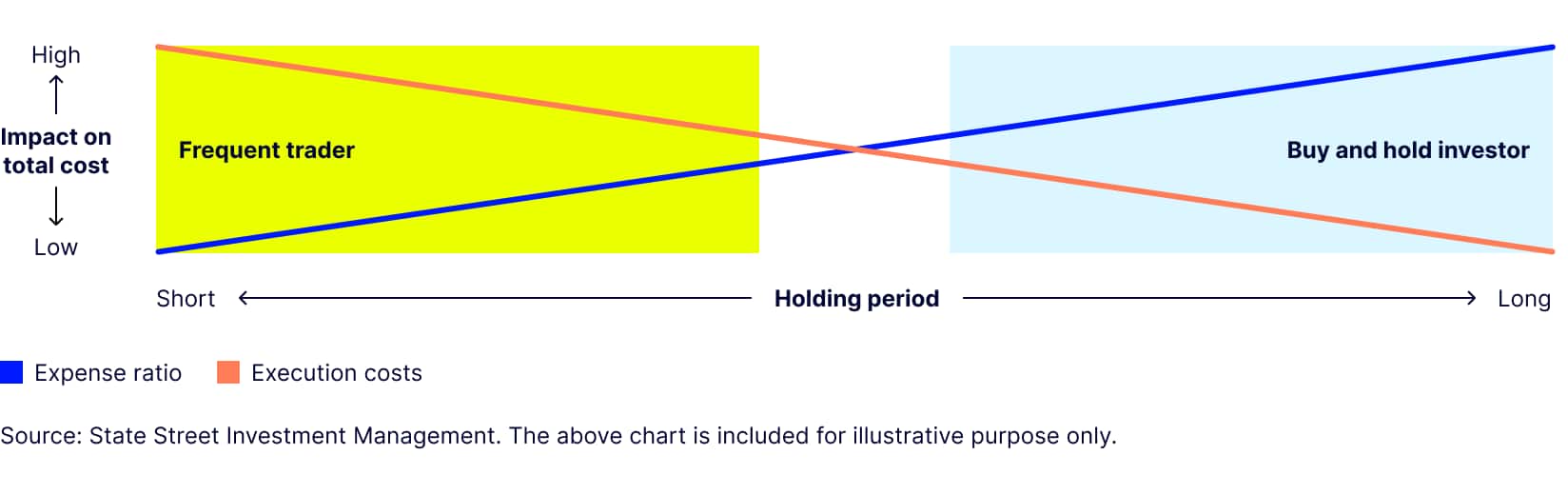
For investors who trade frequently to fine‑tune portfolio exposures, execution costs — spreads and commissions — are likely to be the dominant consideration. For a buy‑and‑hold strategy, the annual management fee tends to be the more important factor in the total cost of ownership.
Figure 2: The total cost of ownership through a holding period lens
Striking the right balance
There is no one‑size‑fits‑all approach to optimising total cost of ownership; it helps to weigh your circumstances more broadly. If you rebalance regularly, for instance, the frequency of rebalancing will affect trading costs — the more often you rebalance, the higher those costs. Likewise, higher portfolio turnover feeds directly into trading costs, and therefore into the total cost of ownership.