Issued by State Street Global Advisors, Australia Services Limited (AFSL Number 274900, ABN 16 108 671 441) ("SSGA, ASL"). Registered office: Level 14, 420 George Street, Sydney, NSW 2000, Australia · Telephone: 612 9240-7600 · Web: www.statestreet.com/im
State Street Investment Management is the business name for State Street Global Advisors, Australia, Limited (AFSL 238276, ABN 42 003 914 225) (“State Street IM”), the parent entity of SSGA, ASL.
SSGA, ASL is the Responsible Entity and the issuer for the State Street Managed Funds, which are unlisted, and the State Street ETFs which are quoted on the AQUA market of the ASX or listed on the ASX.
This material is general information only and does not take into account your individual objectives, financial situation or needs and you should consider whether it is appropriate for you. You should seek professional advice and consider the Product Disclosure Statement, available at ssga.com, before deciding whether to acquire or continue to hold the Funds. Target Market Determinations are also available at ssga.com. This material should not be considered a solicitation to buy or sell a financial product or security.
To achieve its investment objective, the Funds will obtain investment exposure to loans and other debt instruments through units in a US domiciled ETF (“Underlying Fund”). In addition to the investment in the Underlying Fund, currency hedging is implemented using rolling one-month forward currency contracts.
Blackstone Liquid Credit Strategies LLC is the Sub-Adviser of the Underlying Funds. State Street Global Advisors, Australia Services Limited is not affiliated with Blackstone Liquid Credit Strategies LLC.
Investing involves risk including the risk of loss of principal. Please refer to the product disclosure statement for the specific risks associated with investing in the fund.
ETFs trade like stocks, are subject to investment risk, fluctuate in market value and may trade at prices above or below the ETF’s net asset value.
Actively managed ETFs do not seek to replicate the performance of a specified index. These investments may have difficulty in liquidating an investment position without taking a significant discount from current market value, which can be a significant problem with certain lightly traded securities. The Fund is actively managed and may underperform its benchmarks. An investment in the fund is not appropriate for all investors and is not intended to be a complete investment program. Investing in the fund involves risks, including the risk that investors may receive little or no return on the investment or that investors may lose part or even all of the investment.
Investments in Senior Loans are subject to credit risk and general investment risk. Credit risk refers to the possibility that the borrower of a Senior Loan will be unable and/or unwilling to make timely interest payments and/or repay the principal on its obligation. Default in the payment of interest or principal on a Senior Loan will result in a reduction in the value of the Senior Loan and consequently a reduction in the value of the Portfolio’s investments and a potential decrease in the net asset value (“NAV”) of the Portfolio.
Investing in High Yield Fixed Income Securities, otherwise known as “junk bonds”, is considered speculative and involves greater risk of loss of principal and interest than investing in investment grade fixed income securities. These Lower-quality debt securities involve greater risk of default or price changes due to potential changes in the credit quality of the issuer.
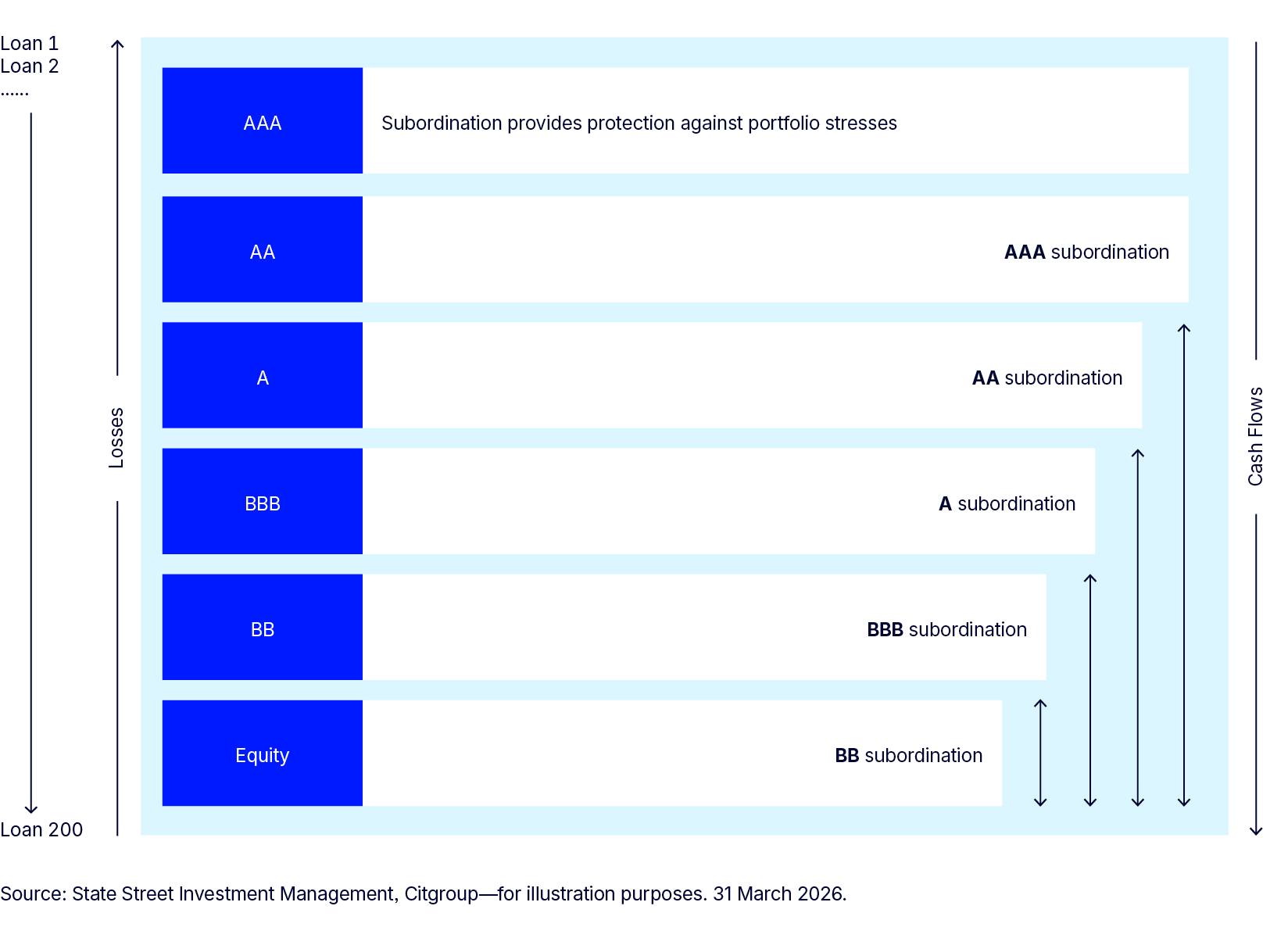
Collateralised Loan Obligations (CLO) Debt Securities carry certain structural risks including potential subordination to the other tranches of debt in the same capital structure, volatility of underlying collateral values, and potential for principal loss of the underlying assets in excess of the equity valuation. CLOs issue classes or "tranches" of securities that vary in risk and yield. Losses caused by defaults on underlying assets are borne first by the holders of subordinate tranches.
Bonds generally present less short-term risk and volatility than stocks, but contain interest rate risk (as interest rates rise, bond prices usually fall); issuer default risk; issuer credit risk; liquidity risk; and inflation risk. These effects are usually pronounced for longer-term securities. Any fixed income security sold or redeemed prior to maturity may be subject to a substantial gain or loss.
The values of debt securities may increase or decrease as a result of the following: market fluctuations, changes in interest rates, actual or perceived inability or unwillingness of issuers, guarantors or liquidity providers to make scheduled principal or interest payments or illiquidity in debt securities markets; the risk of low rates of return due to reinvestment of securities during periods of falling interest rates or repayment by issuers with higher coupon or interest rates; and/or the risk of low income due to falling interest rates.
The Fund's investments are subject to changes in general economic conditions, general market fluctuations and the risks inherent in investment in securities markets. Investment markets can be volatile and prices of investments can change substantially due to various factors including, but not limited to, economic growth or recession, changes in interest rates, changes in the actual or perceived creditworthiness of issuers, and general market liquidity. The Fund is subject to the risk that geopolitical events will disrupt securities markets and adversely affect global economies and markets. Local, regional or global events such as war, acts of terrorism, the spread of infectious illness or other public health issues, or other events could have a significant impact on the Fund and its investments.
State Street products are not sponsored, endorsed, sold or promoted by any of these entities and none of these entities bear any liability with respect to the ETFs or make any representation, warranty or condition regarding the advisability of buying, selling or holding units in the ETFs issued by SSGA, ASL.
There is no representation or warranty as to the currency or accuracy of, nor liability for, decisions based on such information.
The whole or any part of this work may not be reproduced, copied or transmitted or any of its contents disclosed to third parties without State Street IM’s express written consent.
© 2026 State Street Corporation - All Rights Reserved.
9031278.1.1.ANZ.RTL | Expiry Date: 31/08/2027