
Monthly Fund Commentary State Street Floating Rate Fund
In August, the State Street Floating Rate Fund returned 0.38% (net), outperforming the benchmark by 0.01%.1
Australian money markets were relatively stable throughout most of the month with the RBA leaving the cash rate unchanged at 4.35%, and softer employment data providing some support. The last week saw a different story as spreads inched wider on the back of the middle east conflict and anticipated off-shore central bank action. Domestically, CPI and household spending numbers came in higher than expected, prompting a renewed rise in rate expectations. Markets went from pricing in about half a hike to one and a half by early next year which saw the BBSW curve steepen slightly as one-month BBSW edged down from 4.32% to 4.30%, while three-month BBSW rose from 4.50% to 4.55% and six-month BBSW increased from 4.83% to 4.88%.
August saw the continued run of strong primary issuances across the FRN market, with approximately A$11.8 billion of new supply added across 10 issuers. This included CBA, ANZ, Macquarie and Google, who accounted for around $8.6 billion between them, issuing between $1.35 billion and $2.5 billion each as the demand for highly rated credit remains strong. The fund added to selected existing exposures via secondary market trading, taking advantage of pockets of market volatility to enhance the portfolio's yield, while maintaining its defensive risk profile and liquidity characteristics.The State Street Floating Rate Fund has outperformed its benchmark over all time periods net of fees, delivering +0.74% of alpha over the past 12-months, +1.05% p.a. over the past 3-years and +0.87% p.a. since inception.
Looking Ahead
Market Update and Outlook
Australian bonds continued to sell off in August, although losses were less than what we saw in July. The Bloomberg AusBond Treasury 0+ Yr Index returned -0.33%, while the Bloomberg AusBond Composite 0+ Yr Index returned -0.22%. Performance was weighed down by another rise in sovereign yields, with duration detracting across most of the curve. Carry helped cushion the impact at the front end, but longer-dated bonds remained more exposed to the increase in yields.
As expected and in a unanimous decision, the RBA left the cash rate unchanged at 4.35% at its August meeting. The Board judged monetary policy to be “somewhat restrictive”, noting that earlier rate increases were slowing consumer spending and housing activity, while labour market conditions had eased slightly more than expected. However, inflation remained too high and risks were still skewed to the upside, particularly from energy costs, domestic capacity pressures and weak productivity growth. The August Statement on Monetary Policy continued to forecast subdued economic growth, with underlying inflation remaining above 3% until mid-2027 and the unemployment rate rising gradually. Although the decision indicated that current policy settings may be sufficiently restrictive, the Board retained a tightening bias and remains prepared to raise the cash rate further “if upside risks materialise.”
The outlook became more finely balanced over August as Q2 GDP’s stronger than expected print added to the case for the Reserve Bank to raise rates again. With CPI remaining stubbornly high and the RBA’s new forecast seeing a return to the mid-point towards the end of 2027, many economist are now calling for a hike in September. We agree and believe the RBA will hike in September, and then again in November should the data continue on its current trend.
Bottom Line
"If you 'have optionality,' you don't have much need for what is commonly called intelligence, knowledge, insight, skills... For you don't have to be right that often." — Nassim Taleb
From his book Antifragile, Taleb's point is that the real edge in an uncertain world isn't forecasting it correctly, but structuring a position so that being wrong costs little and being right costs nothing to wait for. That distinction matters here. Inflation over the near term and possibly longer is hostage to a genuinely unpredictable scenario: Strait of Hormuz shipping volumes, oil pricing premiums, and decisions made in Washington and Tehran, none of which are forecastable with any real precision, by the RBA or anyone else. Positioning duration on a specific view of how that resolves is a bet on out-guessing an unpredictable process, whereas FRNs let an investor defer that bet indefinitely while still being paid to wait, adapting to whatever the present reveals rather than committing to a forecast of the future, because it’s better to be paid for admitting you don’t know than to risk being wrong about pretending you do.
Figure 1 highlights just how central oil is to the inflation outlook the RBA is working with. The Bank's own forecasts, released in the August Statement on Monetary Policy, assume Brent crude eases back to the low-to-mid US$70s per barrel in fairly short order, allowing the pass-through from the Middle East conflict to unwind and underlying inflation to ease back toward target. Given the conflict remains unresolved and oil has instead been pushing higher into September, this assumption looks optimistic, and any delay in that decline could keep inflation stickier for longer than the RBA's central case allows. Figure 2 shows the market has already drawn its own conclusion, pricing a cash rate path that currently sits above the RBA's own forecast from mid-2026 onward. In effect, the market is betting the Bank will need to do more than its own numbers currently suggest, with oil set to play a central role in how inflation, and the path for rates, evolves from here.
This backdrop reinforces the case for holding FRNs rather than taking a strong directional view on where the cash rate ultimately settles. If oil remains elevated for longer than the RBA assumes, the risk sits toward a higher and later terminal cash rate, which would keep upward pressure on yields and further pressure longer-dated bonds that are already pricing in an eventual easing cycle. FRNs sidestep this risk almost entirely: coupons reset quarterly in line with BBSW, so income moves with the cash rate path rather than against it, while minimal duration means the Fund carries little of the capital risk facing fixed-rate exposures if the market's higher-for-longer view proves correct. FRNs remain a sensible way to stay invested in fixed income while the inflation and rate outlook remains this unsettled.
Figure 1: Brent Crude Oil Price vs. RBA's Oil Price Forecast (SOMP)
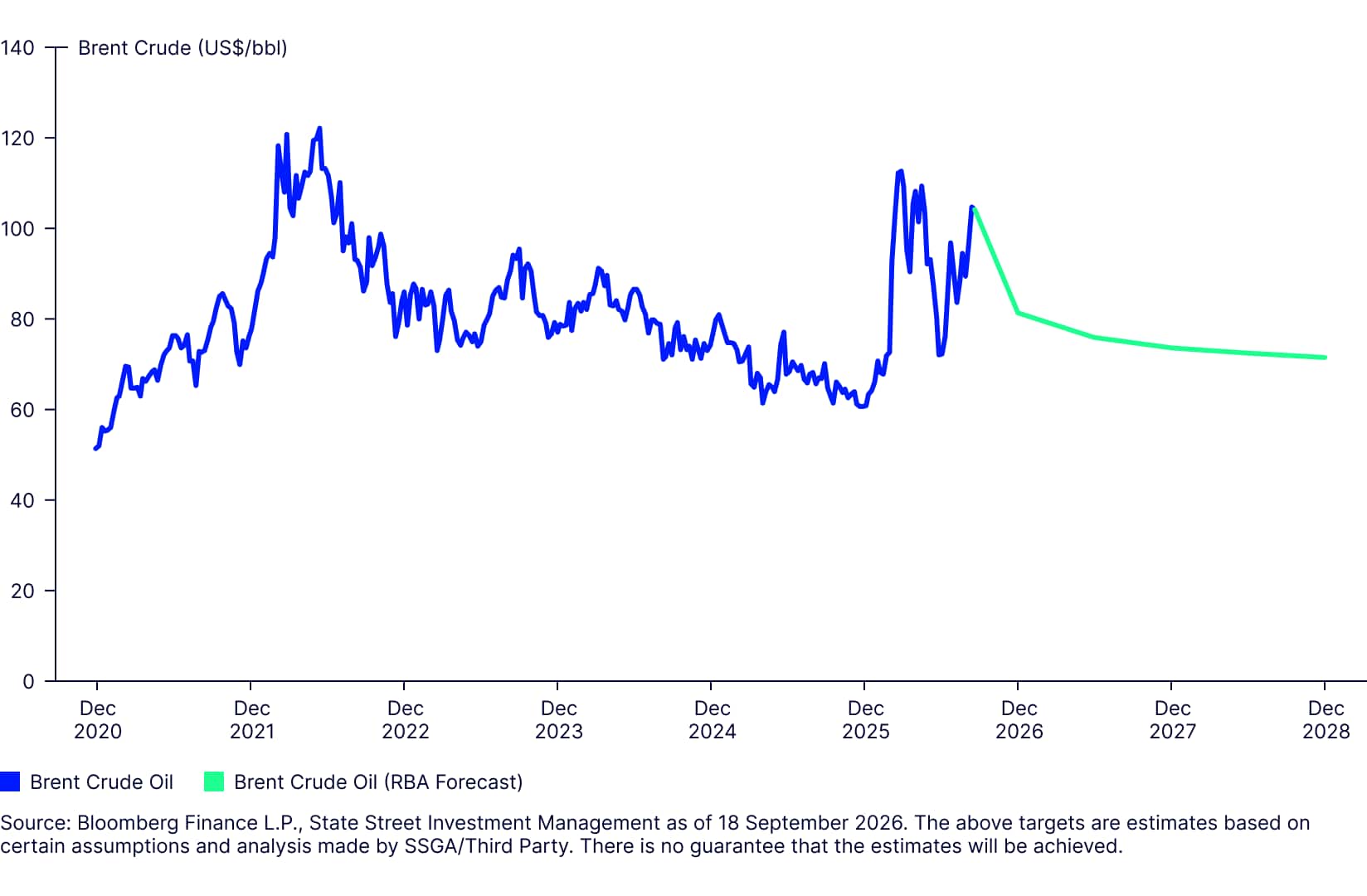
Figure 1 shows the Reserve Bank of Australia's own oil price assumption from the August 2026 Statement on Monetary Policy, plotted against actual Brent crude prices. The RBA's forecast factors Brent returns to the low-to-mid US$70s per barrel in fairly short order, underpinning its expectation that inflation eases back toward target as Middle East-related cost pressures unwind.
Figure 2: RBA Cash Rate Forecast vs. Market Expectations
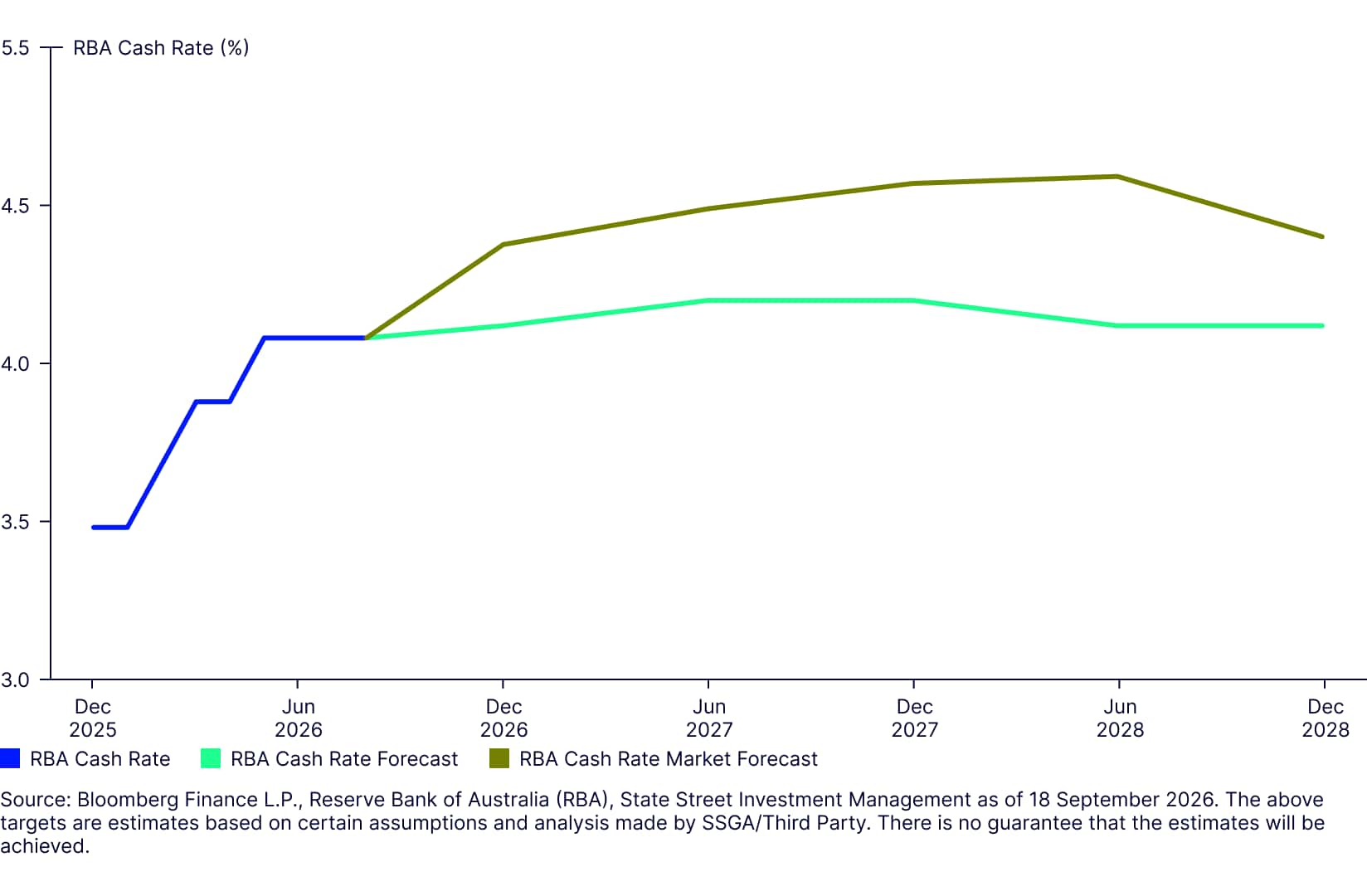
Figure 2 shows the RBA's own cash rate forecast from the August 2026 SOMP against the market-implied path. From mid-2026 the two diverge meaningfully, with the market pricing a higher, later-peaking cash rate than the RBA, a sign markets expect inflation and oil-driven cost pressures to prove stickier than the Bank's most recent forecast assumes.