
A smarter core: An Enhanced approach to optimizing equity portfolios
Is there a more thoughtful way to anchor your portfolio and deliver ballast—while improving the efficiency of returns beyond the traditional satellite approach?
Now more than ever, investors need to get the most out of their equity allocations. While equity markets remain relatively sanguine, long-term capital market assumptions for equities have become more muted, equity risk premia appears less compelling, and geopolitical uncertainty persists. In this environment, efficiency across equity allocations is critical.
Traditionally, that has meant pairing a passive core with higher conviction active satellites. But there’s an often-overlooked part of the active risk spectrum—one with strong potential to improve risk adjusted returns without giving up the ballast investors expect.
In this article, we explore how Enhanced equity strategies—operating in this segment of the active risk spectrum—provide a more effective tool for improving the overall risk and return profile of an equity allocation.
To understand where we are today, it’s helpful to start at the beginning. For a long time, portfolio construction was almost entirely active, driven by manager skill and discretion. As index investing gained traction, it was naturally paired with these active strategies.
Over time, as indexing grew into the dominant force it is today, portfolios began to evolve. Index strategies became the core—a reliable ballast to capture beta— complemented by higher-conviction satellite strategies designed to generate excess return. This core–satellite approach is simple, intuitive, and for many years, made sense.
More recently, however, results haven’t quite lived up to expectations, and as a result, more investors are starting to reevaluate whether there is a better way.
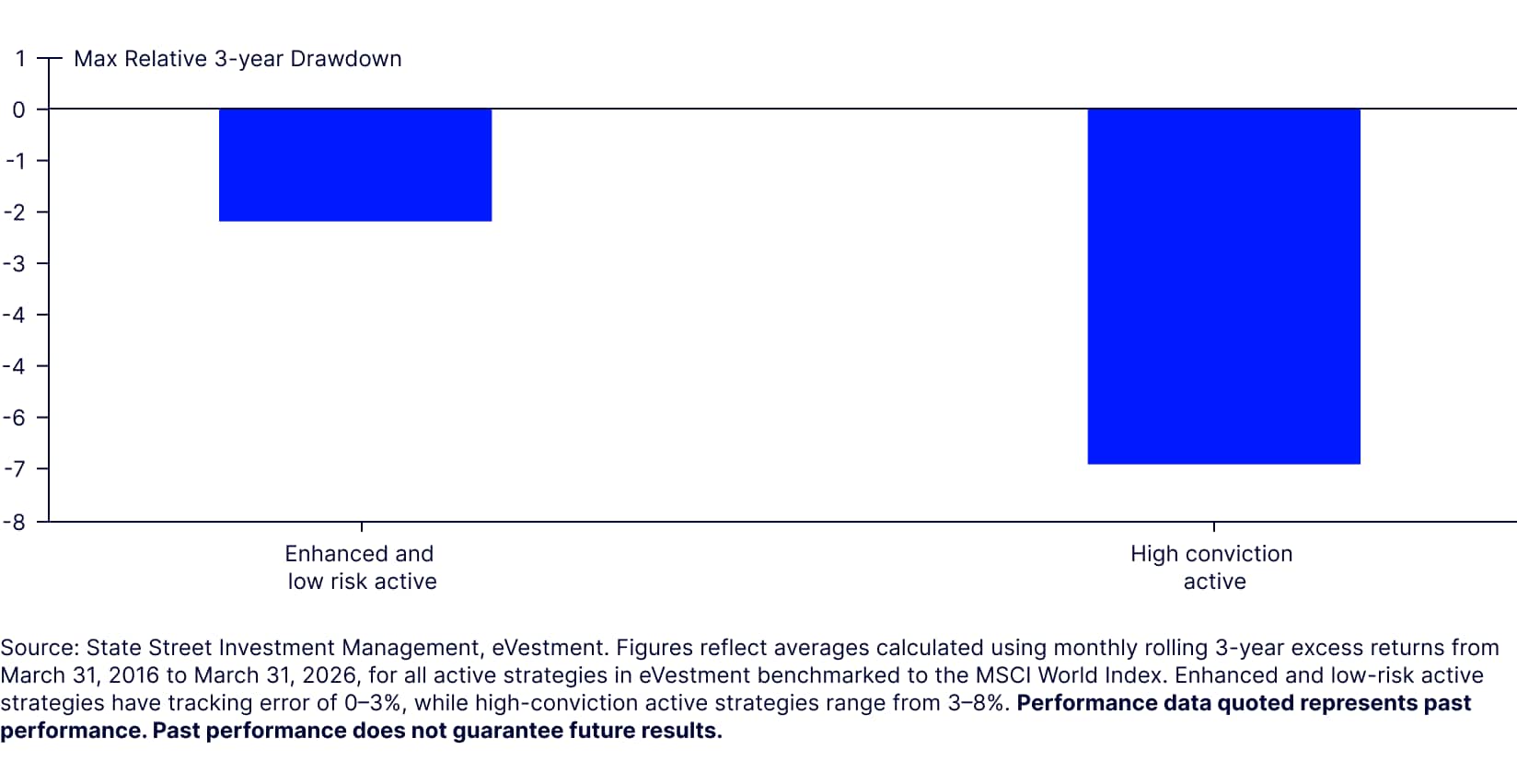
Figure 1: Enhanced strategies have delivered less extreme drawdowns in relative performance
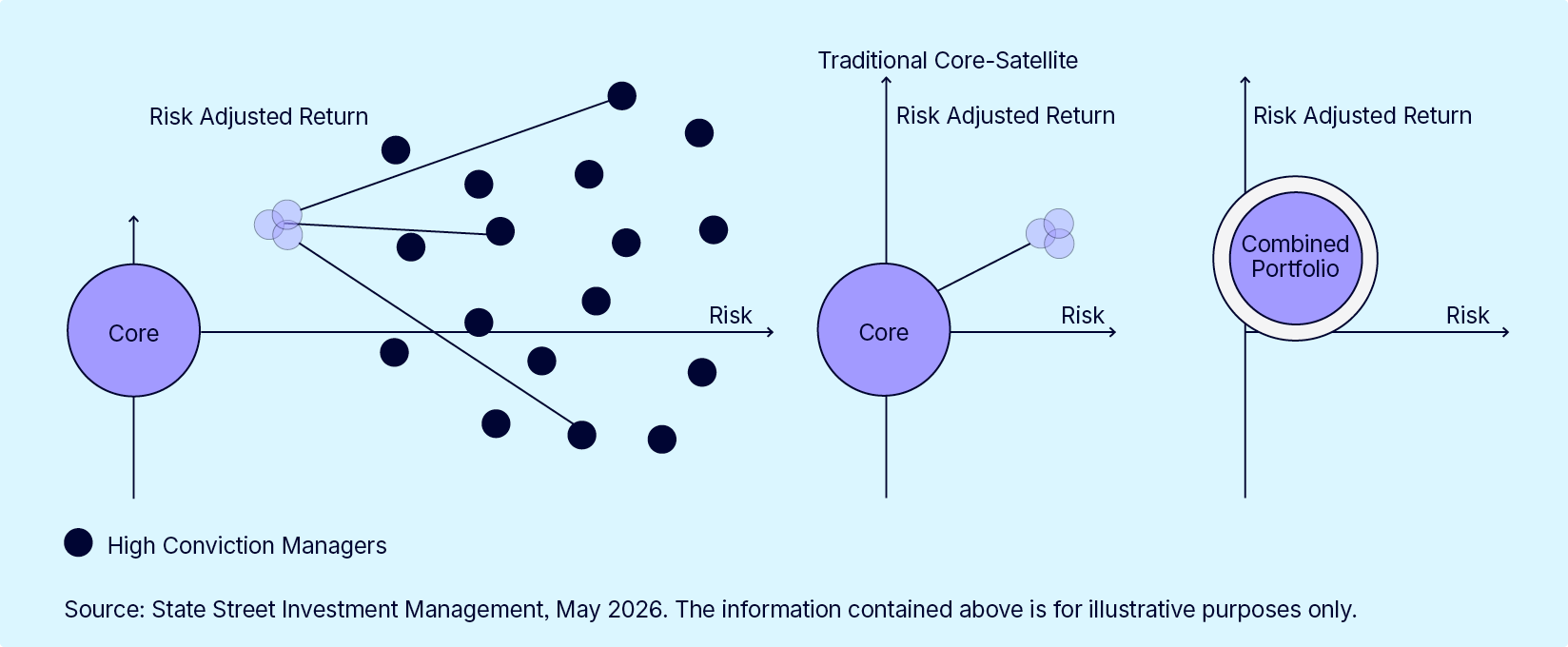
While core–satellite implementations vary, most fall along a spectrum. On one end, investors concentrate exposure in a small number of high active share managers—sometimes just one per region. On the other, they spread allocations across many managers, aiming to diversify sources of alpha.
Selecting a small number of concentrated portfolios can deliver stronger alpha, but this approach comes with higher volatility, sharper drawdowns, and a heavy reliance on manager selection—which is inherently difficult as we discussed in Consistency as a Compass.
Figure 2: Enhanced underperformed their benchmarks less often
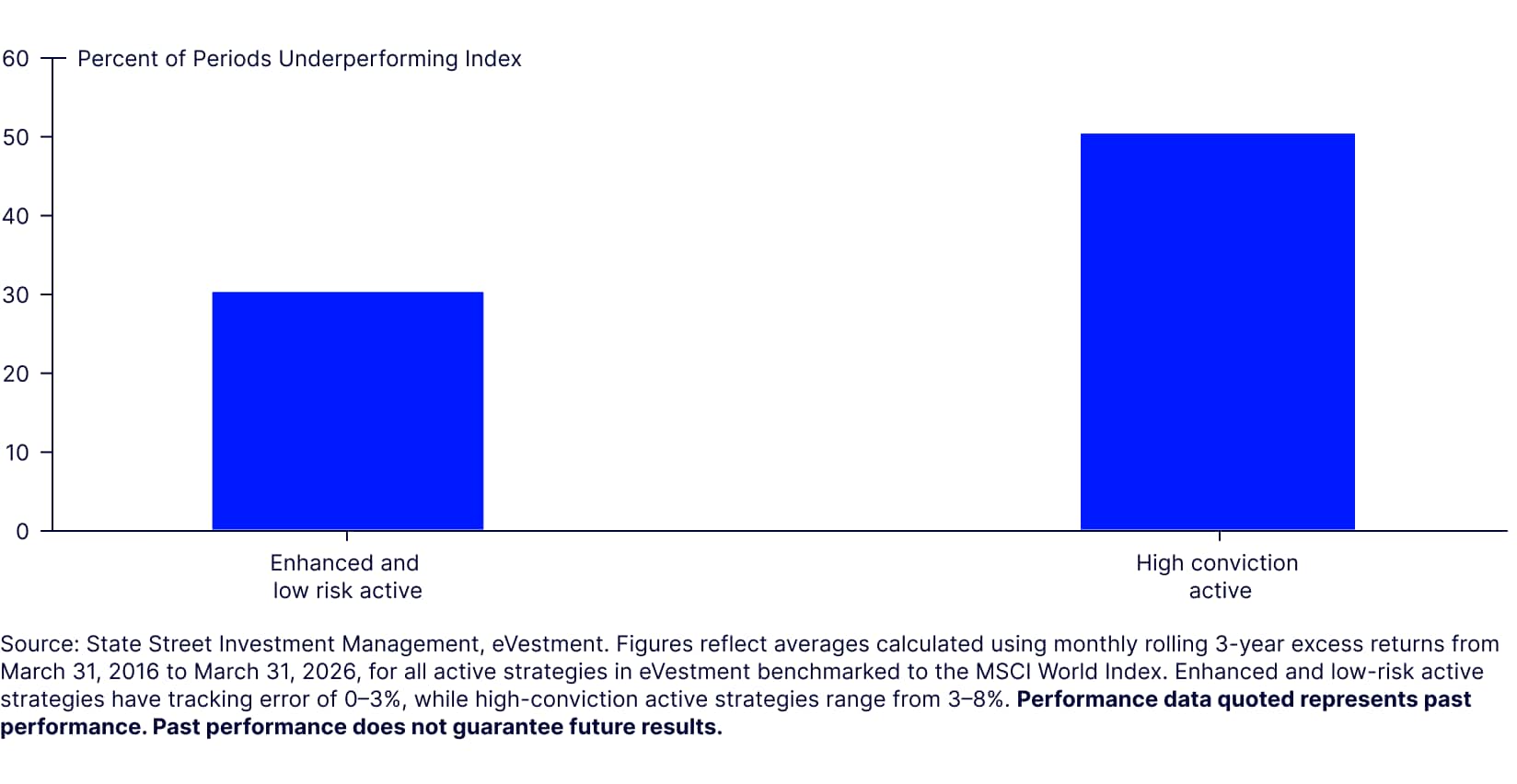
A more diversified approach helps smooth outcomes and reduce risk, but often creates its own issues. Combining multiple managers can lead to unbalanced and unintended exposures, and inefficiencies. In extreme cases, the end result is an over-diversified portfolio that looks increasingly like the index—but at a much higher cost.
Figure 3: Traditional core-satellite approaches
Enhanced strategies: Built with a clear purpose
What if there is a better way? Enter Enhanced.
At its core, Enhanced investing is built around a single objective: maximizing risk adjusted returns—or simply put, getting the most out of the risk you take.
It operates in a highly controlled segment of the active risk spectrum, where risk is deliberately managed and efficiently deployed. This allows for the construction of highly diversified, core oriented portfolios that reduce exposure to uncompensated risks—whether macro, geopolitical, style, country, sector, or currency—while delivering stronger risk adjusted outcomes.
These strategies aren’t just an extension of indexing or a scaled down version of high conviction active. They are purpose built. From the sophisticated bottom up alpha model that drives stock selection, to disciplined portfolio construction and efficient implementation, every component is designed to work together seamlessly.
In this part of the risk spectrum, success ultimately comes down to how efficiently insights are translated into outcomes. With lower turnover, tight risk controls, and a strong focus on cost discipline, every step—from alpha generation through execution—must be carefully calibrated to maximize risk adjusted returns.
This requires precision, not adaptation. These strategies aren’t retrofitted to meet demand—they are engineered from the outset to operate within a highly risk-aware, efficiency-driven framework.
The result is a balanced, diversified core portfolio with characteristics similar to the index, designed to limit exposure to uncompensated risks while delivering consistent, predictable, and risk aware alpha.
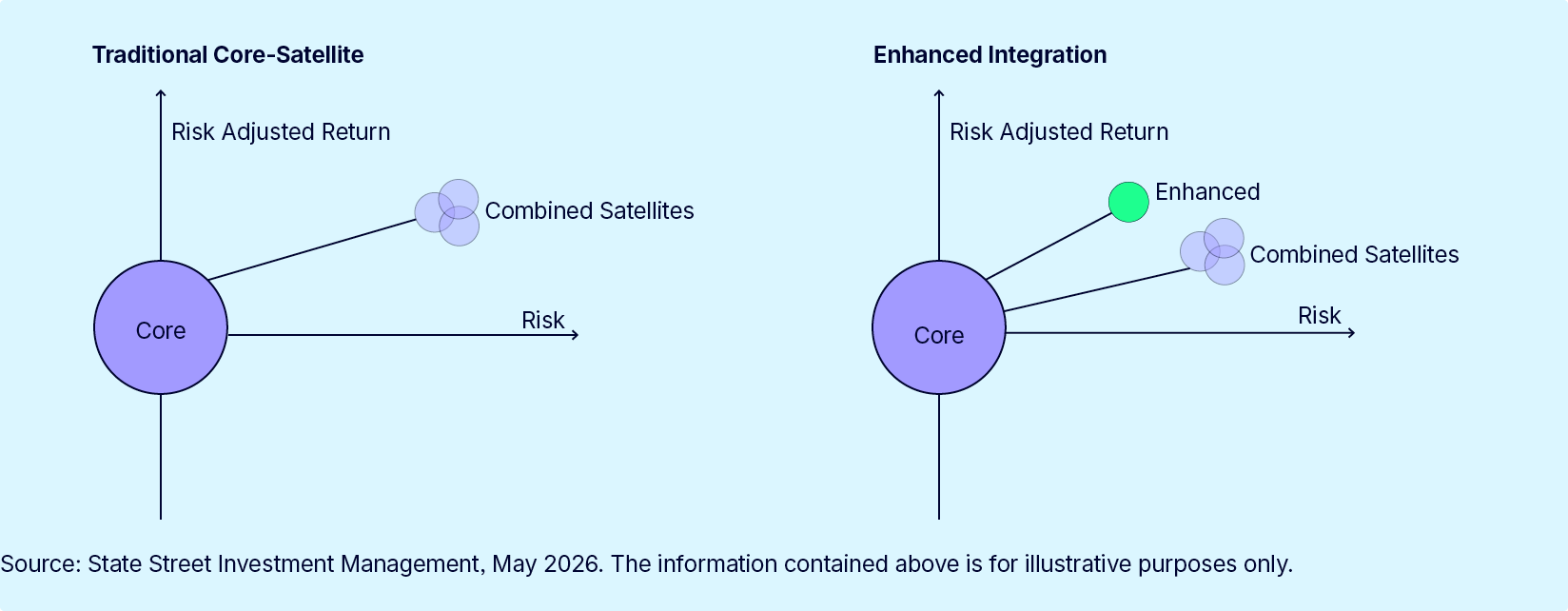
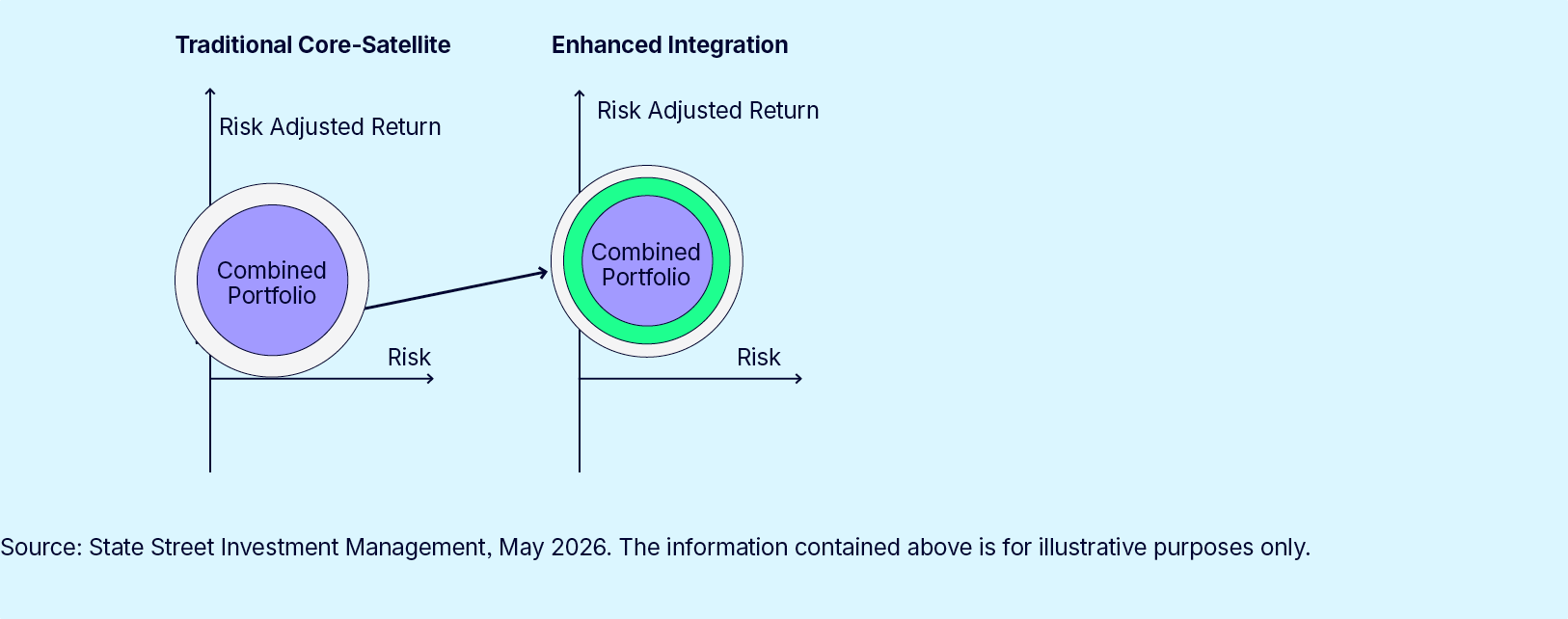
Figure 4: Enhanced integration
So where does this fit within the core–satellite framework?
Enhanced strategies offer a natural complement. With their index-like profile and more efficient use of active risk, they can serve as a stronger core—maintaining the ballast characteristics investors expect, while improving overall outcomes. They can be used either as a replacement for traditional index allocations or alongside higher-conviction satellite strategies.
For those looking to build a more efficient portfolio, Enhanced can play a key role—improving the overall risk-adjusted profile, helping to moderate the volatility of high-conviction managers, and delivering a smarter, more effective core.
At State Street Investment Management, our Systematic Equity Active team has been managing Enhanced strategies since the early 1990s. This long-standing experience, combined with the scale and capabilities of our broader systematic equity platform, provides a strong foundation for delivering consistent outcomes. Our approach brings together deep expertise in portfolio construction, data, technology, trading efficiency, and risk management within a broader $3.5T+ Systematic Equity platform,* enabling us to design portfolios that are both highly efficient and scalable.
Figure 5: A more effective core
As the opportunity set in systematic investing continues to expand—driven by new data, techniques, and computing power—our approach is to engage that complexity with discipline and intent. We actively explore a broad and evolving set of signals, including more advanced and sophisticated factors, while applying a rigorous research framework that demands clear economic rationale, empirical robustness, and consistent translation into better portfolio outcomes. Innovation is pursued deliberately.
Our edge lies in constructing portfolios where every unit of active risk is purposeful and productive—supported by the scale, infrastructure, and long-term commitment to delivering value for our clients.
For investors seeking incremental return without sacrificing the core characteristics of an index, Enhanced offers a compelling alternative. It provides a more efficient foundation—delivering consistent, resilient, and predictable outcomes—whether used to complement or replace traditional core allocations, or alongside higher-risk satellite strategies.
In a market that demands more from equity allocations, Enhanced stands out as a smarter approach to core equity investing.