
Bitcoin volatility and liquidity: Key trends for investors
Improve the diversification of your 60/40 portfolio with real assets like gold, commodities, and infrastructure—especially now that bonds are no longer the go-to for offsetting stock volatility.

Bitcoin (BTC) has long carried the reputation of being a stormy sea—waves of volatility crashing unpredictably, keeping many institutional investors anchored onshore. At first glance, the price movements may seem to be driven by headlines, regulatory shifts, and technological trends.
But look closer, and trends begin to emerge beneath the surface. As the digital asset market matures, investor interest in BTC and other digital assets has continued to accelerate. This evolution makes it more important than ever to understand BTC’s trading profile—its patterns, behaviors, and what they reveal about its role in modern portfolios.
BTC’s trading and volatility trends
Understanding these patterns can inform smarter trading strategies and guide allocation decisions as BTC continues to evolve.
BTC volatility has been trending down
BTC volatility has evolved since its inception and has been trending downward over time. Figure 1 shows that BTC two-year volatility started our sample period extremely elevated and then declined sharply before trending downwards over about the last five years. Ether showed a very similar volatility profile until the second half of 2022, when its volatility declined sharply as the Ethereum network transitioned its consensus mechanism from proof of work to proof of stake in September 2022, also known as “the merge.” However, Ether volatility has picked up from the start of 2025.
Despite recent trends, it’s clear that both BTC and Ether have had significantly higher volatility than broad market equities such as the S&P 500. But volatility has been trending down for both BTC and Ether.
BTC’s return distribution is super fat-tailed
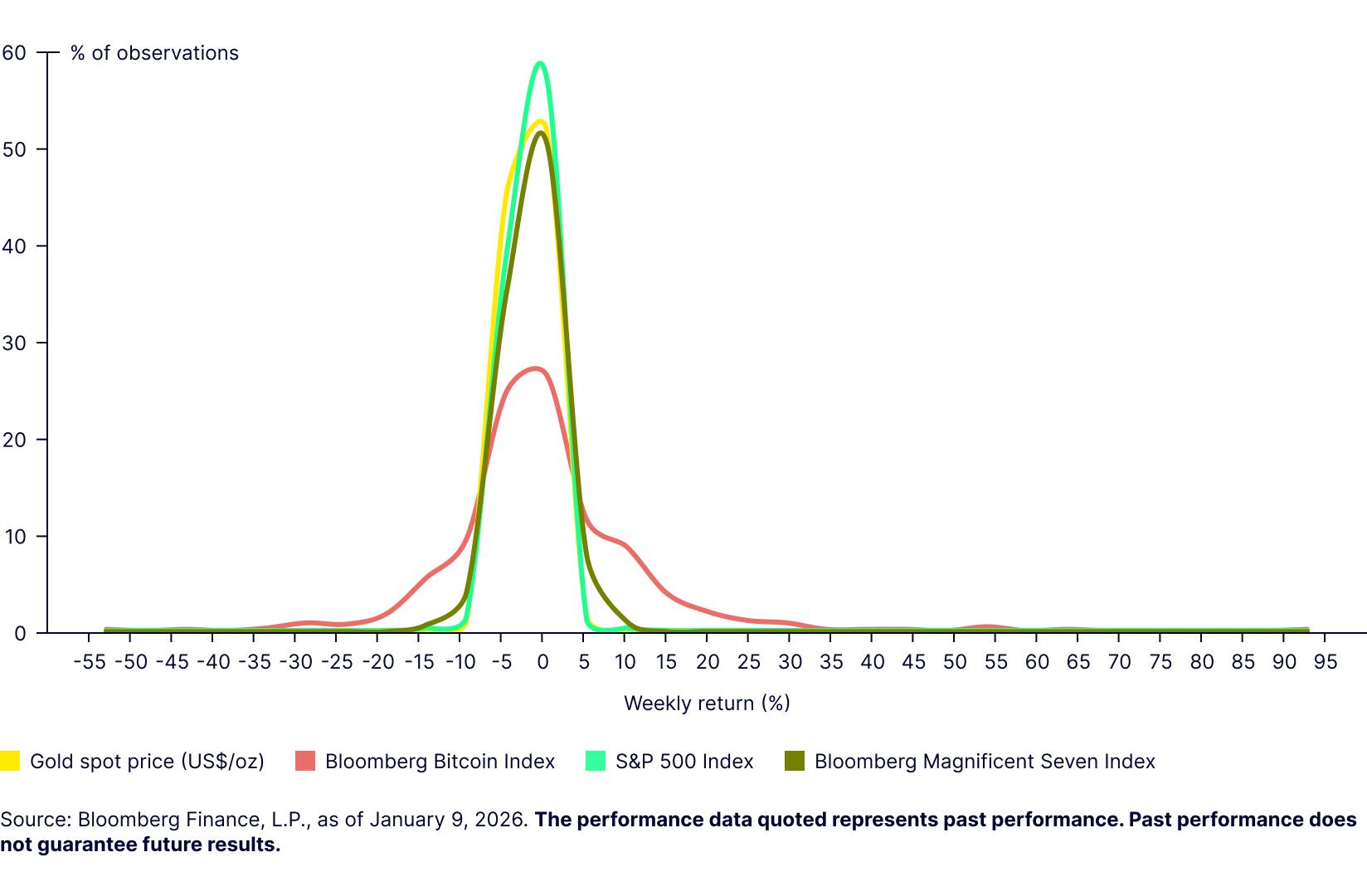
BTC has considerably fatter tails, both on the upside and downside, and a much lower central peak than seen with gold, broad market equities or even a narrow subset, represented by the “Magnificent 7.”
Figure 2: BTC is very fat-tailed on the upside and downside
Weekly return distribution
BTC’s drawdowns are way more “V-shaped”
Although BTC’s drawdowns are, on average, more significant and more frequent than traditional asset classes, it also tends to recover more quickly. BTC’s biggest price drop was about as bad as the tech crash in the early 2000s, but it bounced back in a little over two years. In comparison, it took US tech stocks 14 years to fully recover from the dot-com bubble.
Figure 3: BTC has had steep drawdowns but tends to recovers quickly
| Starting date | Maximum drawdown | Average of four largest drawdowns | ||||
|---|---|---|---|---|---|---|---|
| Drawdowns (%) | Drawdown period (Months) | Drawdown recovery period (Months) | Drawdowns (%) | Drawdown period (Months) | Drawdown recovery period (Months) | |
Bloomberg Bitcoin Index | December 31, 2012 | -79.80 | 14.00 | 25.00 | -67.42 | 11.00 | 16.50 |
S&P 500 | December 31, 1990 | -50.95 | 16.00 | 37.00 | -34.79 | 13.25 | 26.25 |
S&P 500 Info. Tech Sector | December 31, 1990 | -80.26 | 30.00 | 168.00 | -36.42 | 11.00 | 45.75 |
Bloomberg Commodity Index | December 31, 1990 | -72.02 | 142.00 | -- | -34.42 | 44.50 | 10.33 |
Gold spot price (US$/oz) | December 31, 1990 | -43.39 | 52.00 | 55.00 | -30.88 | 32.50 | 32.50 |
Source: FactSet, Bloomberg Finance, L.P., as of November 13, 2025. The performance data quoted represents past performance. Past performance does not guarantee future results.
BTC behaves most like equities, but less so than right after COVID
BTC’s correlation to traditional assets started low in our sample period, with most measures of two-year weekly return correlation below 0.1, although this jumped into the COVID pandemic with correlations to equity remaining elevated through 2022-2023. S&P 500 (SPX)-BTC correlation has also picked up from the start of 2025.
.png)
Why institutions are turning to bitcoin
Bitcoin institutional demand has continued to grow alongside the crypto market. Dive deeper into why BTC is the leading crypto asset for institutions.
Although absolute levels of correlations have dropped across the board, BTC remains most correlated with stocks. However, even during the sharp interest rate hikes in 2022–2023, BTC’s correlation with stocks stayed lower than the correlation between US stocks and US bonds (both nominal and inflation-linked). That’s because both stocks and bonds were hit hard by rising rates, while BTC moved more independently.
BTC has tended to track M2 money supply, and its link to equities may be about liquidity
The COVID-19 pandemic really focused the market’s mind on the link between BTC investment and liquidity as central banks injected unprecedented amounts of liquidity into the global economy. The rapid expansion of M2 during this time coincided with one of BTC’s most explosive bull markets.
The M2 measure of money supply appeared to track BTC closely until around the start of 2024. Investors flocked to BTC as a hedge against potential inflation and currency devaluation, both of which were driven by the massive increase in money supply.
Since the start of 2024, this correlation seems to have broken down, which might be due to the increased presence of institutional investors after the BTC ETF launch.
Why BTC’s market dynamics demand investor attention
BTC’s trading and volatility trends continue to evolve and can offer investors valuable insights into its behavior and its role in diversified portfolios. As BTC’s institutional adoption expands, the relevance of BTC’s market dynamics is becoming increasingly clear for investors. Staying ahead of these trends is vital for investors seeking to capitalize on new opportunities in the digital assets space—from BTC and beyond.

Expand your digital asset knowledge
Bitcoin is just the beginning. Explore our digital asset education hub to learn more about the broader market to navigate it with confidence.