
What’s driving the surge in global interest rates?
With rates rising around the world, we consider the scenarios that could drive rates higher or lower amid continued geopolitical uncertainty and strong inflation prints in the US.
Oil prices and the rise in rates
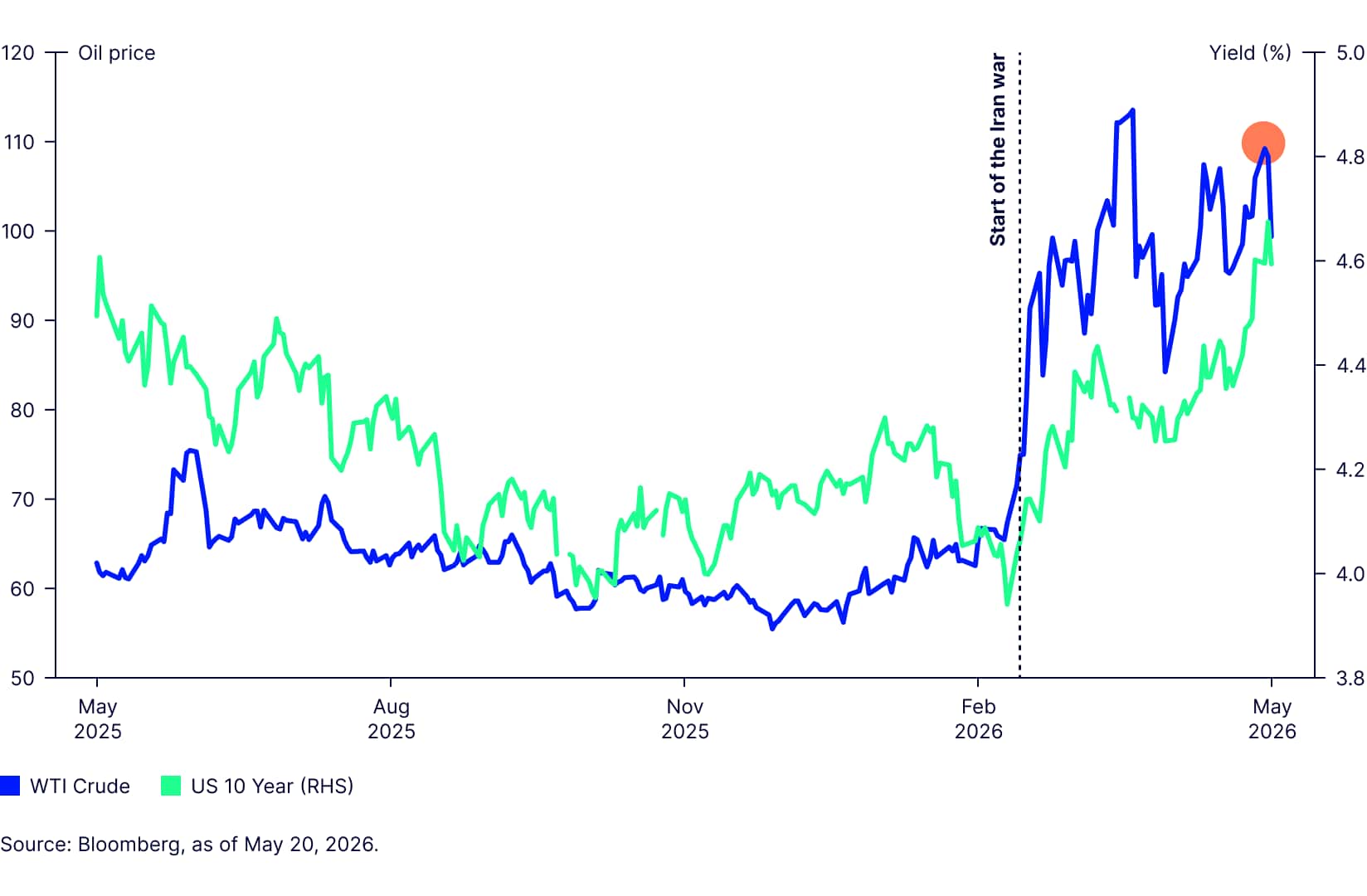
The recent spike in global rates came in two parts. The first, starting in early March, was catalyzed by higher oil prices following the inception of hostilities in Iran. The second came immediately following the April CPI release, which registered its highest level in three years. This, along with oil prices, reinforced concerns that the FOMC will be more inclined to increase, rather than reduce, policy rates.
Yields have retraced modestly from last week’s spike, helped by a moderation in oil prices along with softer UK inflation data and a well-received 20-year Japanese Government Bond auction. The conclusion is clear: in the near term, rates are primarily being driven by oil.
High oil prices put upward pressure on sovereign rates
April CPI, Y/Y, higher than 3.7% expected
Increase in US 10-year yield since start of Iran war
Percent change in oil price (WTI) from end of February
Sources: FactSet, Bloomberg, State Street Global Advisors, as of May 20, 2026.
Figure 2: Oil didn’t matter to rates—until it did
Scenario analysis
There are three likely paths forward for rates: one lower, one higher, and one possibly characterized by both directions. First, a peaceful resolution would push rates lower as oil prices rapidly decline and supply fears ease. By contrast, a “no war, no peace” scenario would likely push rates up alongside a grind higher in oil. An escalation would lead to volatility in rates with an initial spike followed by a decline.
Scenario one: A peaceful resolution to the Iran war
If there is a resolution to the Iran conflict, oil prices would fall dramatically, with a resulting decline in interest rates. However, inflation itself would not immediately trend lower; this, along with continued growth and other upward pressures on the long end such as high levels of fiscal debt, could prevent rates from returning to pre-war levels.
Scenario two: No resolution; no war, no peace
This situation is the least conducive to a rally in rates. In this case, oil likely remains elevated and trends higher as the supply shock impact grows. In this case, 10-year US Treasury rates could return to a 5% level, or higher.
Scenario three: A significant escalation of the Iran conflict
An escalation scenario could mean a significant increase in oil prices. This would prompt more inflation concerns, likely pushing long-end rates higher in the near term. However, if oil prices approach demand destruction levels, perhaps around $150 for WTI, consumption becomes unsustainable and the economy suffers. The resulting growth slowdown could imply a more dovish Fed posture and ultimately lower rates later in the year.
Investment implications for the scenarios are below:
| Scenario | Macro picture | Investment implications |
| One: Resolution |
Falling oil prices, moderating inflation and growth concerns.
|
Rates fall across the curve as lower oil prices reduce long-term inflationary fears. Both TIPS and nominal bonds benefit. |
Two: No war, no peace
|
Gradually increasing oil prices, higher inflation expectations become entrenched, the growth story is still uncertain.
| Sustained higher oil prices put upward pressure on rates. Challenging environment across fixed income, but TIPS provide some inflation protection relative to nominal bonds. |
| Three: Escalation |
Sustained higher oil prices, demand destruction, increased recession risk.
|
Oil and rates likely higher in the near term, but demand destruction and economic slowdown could ultimately push rates lower. Real yields (TIPS) provide some protection from sustained higher inflation and would benefit from an eventual decline in rates. |
The market appears more concerned about growth
Notably, most of the recent move in US yields has come through real yields. As the 10-year yield rose from below 4% before the war to 4.65%, breakeven inflation increased only marginally. That means real yields largely rose alongside nominals, suggesting investors are worried more about growth than inflation in the run-up in yields.
Higher US real yields make TIPS a more attractive expression of a long rate view, while offering some protection in a protracted inflationary environment.
Where the Federal Reserve fits in
Against this backdrop, the Federal Reserve’s bias toward easing has diminished, and markets have begun to price some probability of additional tightening. Even so, the bar for renewed rate hikes still appears high. The Fed would likely need to see a meaningful reacceleration in the labor market (such as a reduction in the unemployment rate to below 4%), or clearer second-order inflation effects, such as sustained wage pressure or a rise in longer-term inflation expectations. Our base case is that some of the recent labor market strength will prove temporary, rather than be the start of a new inflationary cycle.
Investment implications: Duration caution
At current levels, the 10-year Treasury has become more interesting, but the near-term outlook remains difficult. As long as resolution in the Middle East remains uncertain and the Fed is no longer clearly leaning toward cuts, and nominal rates are only modestly attractive.
Over the next six to 10 weeks, the risk of a prolonged “no war, no peace” outcome could limit the appeal of duration, as oil prices remain elevated and remain the primary driver of yields.
Within that environment, we continue to see relative value in the five- to 10-year part of the curve, primarily through TIPS, which offer a measure of inflation protection while still allowing investors to participate in any eventual decline in rates.
For more on event risk and market volatility, see our Geopolitics and the Financial Markets thought leadership page.
Learn more here.